NEET Biology Notes

NEET Biology Notes

NEET Biology Endocrine System Notes

NEET Biology Endocrine System

Hormone (Gk: Hormoein = to excite) is the secretion of the endocrine (Gk. yendon = inside, Krinein = to separate) gland.

Endocrine System Examples Of Signalling Molecules And Their Source

  • Endocrine Glands. (The Greek word Rendon means inside, and kinesin means to separate) These are endogenously located glands that lack the ducts (so also called ductless glands) and generally secrete their secretions into the blood (so-called glands of internal secretion) for their transportation to target organs (sites of action). Exocrine glands. Secretions of these glands are transported by duct or ductules or directly.
  • Heterocrine glands are composed of exocrine and endocrine tissues. The former sends its secretion or product through a duct and the latter discharges its secretion directly into the blood For example. pancreas, gonads.
  • The blood contains all the hormones but target organs pick up the required hormones only and ignore all others because target cells have a specific protein called a receptor which has a specific affinity for a particular hormone.
  • In man, there are the following endocrine glands: Thyroid, Parathyroid, Thymus, Pituitary, Adrenal, Pineal body, and (pancreas, stomach, intestine, skin, kidney, and gonads mixed glands).

Read and Learn More NEET Biology Notes

NEET Biology Notes on Endocrine System

NEET Biology Endocrine System Types Of Hormones With Their Function Intracellular Receptors

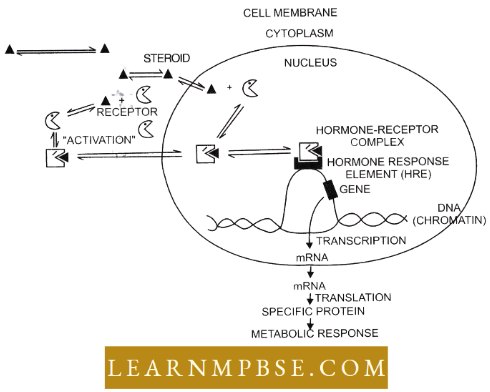
  • The steroid and thyroid hormones enter the cell directly and bind to the intracellular receptor proteins in the cytoplasm, this complex enters the nucleus and binds to the specific regulatory sites on the chromosome. This alters the pattern of gene expression initiating its transcription, formation of specific mRNA, and then protein (enzyme).
  • Synergic hormone. A pair of hormones work together for a particular function. For example. LH and FSH work together for the maturation of Graafian follicles.
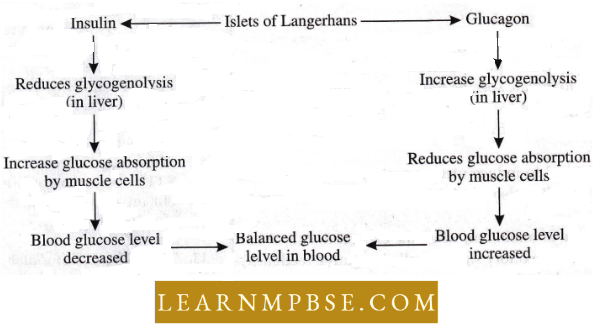
  • Antagonistic hormone. A pair of hormones each with opposite function. For example. Insulin and glucagon. Insulin acts as a hypoglycemic factor but glucagon acts as a hyperglycemic factor,
  • Tropic hormone. A hormone of one gland activates the secretion of the hormone of another gland. For example.TSH of the anterior lobe of the pituitary gland activates the thyroid gland to secrete thyroxine.
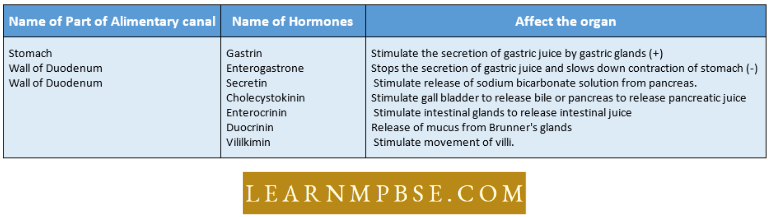
  • Chalones. These substances inhibit the secretion of other glands. For example, enterogasterone from duodenal mucosa inhibits the secretion of HCI in the gastric juice of the stomach.

Endocrine System Notes For Neet

Endocrine System Main Categories Of Hormones

NEET Biology Endocrine System Mechanism Of Hormone Action

Hormones are transported by the bloodstream to the entire body, but they influence only specific cells.

  • Cells that respond to a certain hormone possess receptor sites for that hormone. This resembles a lock and key mechanism.
  • Should the key be compatible with the lock, the door will unlock. If a hormone binds to the receptor location, an effect will ensue.
  • All cells possessing receptor sites for a specific hormone constitute the target tissue for that hormone. In certain instances, the target tissue is confined to a specific gland or organ.
  • In other instances, the target tissue is dispersed and disseminated throughout the body, resulting in many locations being impacted. Hormones exert their distinctive impacts on target cells by altering cellular functions.

Proteins, peptides, and modified amino acids

  1. These hydrophilic (and mostly large) hormone molecules bind to receptors on the sur¬face of ‘ ‘target’ ’ cells: that is, cells able to the presence of the hormone. The receptors are transmembrane proteins. Binding of the hormone to its receptor initiates a sequence of intracellular signals that may :
  2. alter the behavior of the cell (such as by opening or closing membrane channels) or stimulate (or repress) gene expression in the nucleus by turning on (or off) the promoters and enhancing the action of the genes.
  3. The hormone binds to a site on the extracellular portion of the receptor.
  4. The receptors are transmembrane proteins.
  5. Many (but not all) pass through the plasma membrane 7 times, with their N-terminal exposed at the exterior of the cell and their C-terminal projecting into the cytoplasm.
  6. Binding of the hormone to the receptor
  7. Activates a G protein associated with the cytoplasmic C-terminal
  8. This initiates the production of a “second messenger”. The most common of these are
  9. cyclic AMP, (cAMP) which is produced by adenyl cyclase from ATP and
  10. inositol 1,4, 5-triphosphate (IP3)
  11. The second messenger, in turn, initiates a series of intracellular events such as
  12. phosphorylation and activation of enzymes
  13. release of Ca2+ stores within the cytoplasm
  14. In the case of cAMP, these enzymatic changes activate the transcription factor CREB (cAMP response element binding protein)
  15. Bound to its response element 5′ TGACGTCA 3′ in the promoter of genes that can respond to the hormone, activated CREB turns on gene transcription.
  16. The cell begins to produce the appropriate gene products in response to the hormonal signal it has received at its surface.

NEET Biology Endocrine System Steroid Hormones

  1. Steroid hormones, being hydrophobic molecules, diffuse freely into all cells. However, their “target” cells contain cytoplasmic and/or nuclear proteins that serve as receptors of the hormone.
  2. The hormone binds to the receptor and the complex binds to hormone response elements – stretches of DNA within the promoters of genes responsive to the hormone. The hormone/receptor complex acts as a transcription factor turning the target gene “on” (or “off”). mRNA is formed and with translation, protein is synthesized. This protein formed is responsible for the biological action of that steroid.

Endocrine System Mode Of Action Of Steroid Hormone

NEET Biology Endocrine System Thyroid Gland

  1. Discovered by Wharton (1908) it is the largest endocrine gland (3 – 7 cm in diameter and 15-20 gm in weight).
  2. Situated below the thyroid cartilage of the larynx it is a bilobed structure, connected by an isthmus.
  3. The only endodermal gland homologous to the endostyle of protochordate develops as a venial outgrowth from the pharyngeal wall.
  4. Consists of many follicles formed by follicular cells as epithelial parts and interfollicular stroma of areolar connective tissue with parafollicular cells.

Endocrine System Thyroid Gland And Follicles Suspended In Stroma Of A Lobule

Hormones And Their Functions NEET Biology

NEET Biology Endocrine System Parathyroid Gland

Follicular cells are of two types.

  1. Chief cells. The main secretory cells and Oxyntic cells with eosinophilic granules.
  2. It secretes Parathormone (PTH or Collip’s hormone), a polypeptide with 84 amino acids which regulate the metabolism of calcium and phosphate;
  3. Increase plasma Ca++ level by increasing bone dissolution (osteoclastic activity) and enhancing reabsorption through renal tubules and by increasing Ca++ absorption in the gut.
  4. Thus, the maintenance of proper Ca++ levels in the body is the synergistic effect of calcitonin, PTH, and Vit. D.
  5. Increases phosphate elimination in urine and consequently lower phosphate concentration in plasma.

NEET Biology Endocrine System Adrenal Gland (OR Suprarenal body)

  1. A small, yellowish-brown, paired gland situated at the anterior end of each kidney like a cap, is a semicircular structure weighing 3.5 – 4.5 gm (in adults).
  2. Covered by a fibrous connective tissue capsule. The structure is internally differentiated as the outer mesodermal cortex and inner ectodermal medulla of nervous origin.
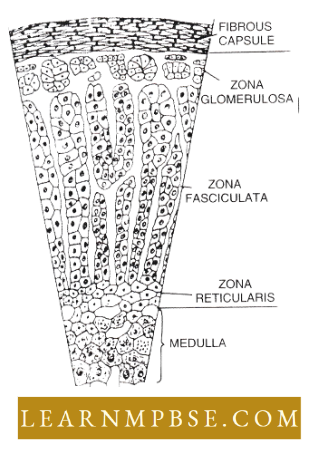
  3. Cortex. The thick layer constitutes 70 – 75% part of the gland distinct into the following three zones of cells :
  4. Zona glomerulosa. The outermost layer below the capsule, is made of five layers of small cuboidal basophilic cells densely set along an axis parallel to the surface.
  5. Zona fasciculata. The thickest and middle parts have large polyhedral cells arranged in radiating columns perpendicular to the surface.
  6. Zona reticularis. The innermost part has cells arranged in a layer to form a network.
  7. Medulla. Consists of groups of round granulated cells which are modified postganglionic cells of the sympathetic nervous system having an exclusively secretory function. These are chromaffin cells, distinct in two layers :
  8. Zona compactum. Densely packed rounded cells with thick plasma membrane, without any intercellular spaces, the average size of cells is 190 – 210 pm (diameter).
  9. Zona spongiosum. The innermost layer of irregular cells in 5 – 12 layers with large intermolecular spaces with matrix and blood vessels, the average size of cells is 260 pm- 360 pm.

NEET Biology Endocrine System Cortical hormones

About 50 types of steroids have been isolated from the adrenal cortex hence called corticosteroids. But, only a few are biologically active, of the following 3 types.

NEET Biology Endocrine System Mineralocorticoid (Aldosterone)

  • A 21-carbon steroid molecule is secreted by zona glomerulosa.
  • Increases the reabsorption of Na+ and Cl by uriniferous tubules, also controls the level of other salts, and thus plays a role in osmoregulation.
  • Increase the removal of K+ in urine.

NEET Biology Endocrine System Glucocorticoid (Cortisol or hydrocortisone and Corticosterone)

  1. A steroid of 20 carbons it is secreted from zona fasciculata and zona reticularis.
  2. It controls the metabolism of fat and amino acids into carbohydrates, protein, and fat, and stimulates gastric secretions.
  3. Stimulates the conversion of fat and amino acids into carbohydrates (gluconeogenesis).
  4. Reduces amino acid levels in tissues, and increases ketone formation in the blood.
  5. Anti-inflammatory in nature suppresses the WBC movement but increases RBC count.
  6. Immunosuppressive in nature, hence used for treatment of allergy and in transplantation surgery.
  7. Dexotes synthesis of collagen, hence cortisole is used for treatment of arthritis or rheumatism.

NEET Biology Endocrine System Sex Corticoid

  1. Secreted by zona fasciculata and zona reticularis is a 12 carbon steroid.
  2. Influences sex-related changes in muscles on bone, maintains the normal growth of external sex organs, hair growth, etc., in the pre-puberty stage, and also influences sexual behavior.
  3. Hypersecretion of this hormone causes gynecomastia in males with female-like characteristics like overgrowth of the mammary gland.
  4. Hirsutism (Adrenal Virilism) in females: growth of facial hairs, temporal baldness, enlargement of the clitoris, atrophy of breast, hoarse voice, etc.
  5. Control of Secretion. ACTH from the pituitary maintains its growth and secretion which in turn is controlled by corticotropin-releasing hormone (CRH) from the hypothalamus. Secretion of aldosterone is mainly controlled by the renin-angiotensin system.

Endocrine System A Magnified Portion Of Adrenal Gland Showing Cortex And Medulla

NEET Biology Endocrine System Hormones Of Adrenal Medulla

  1. Medullary hormones are formed from the amino acid tyrosine.
  2. Chromaffin cells take up tyrosine which is first hydroxylated and then decarboxylated to form dopamine which is further hydroxylated to form noradrenaline, this is then methylated to form adrenaline.
  3. All these, dopamine, noradrenaline, and adrenaline together are called catecholamines which means “catch-all” Adrenaline (or Epinephrine)
  4. Its secretion (from zona compactum) is stimulated by emergency conditions like fear, anger, accident, injury, stress, etc. hence is also called an emergency hormone. Its effect is like a sympathetic nervous system.
  5. Norepinephrine (or Noradrenaline).
  6. Secreted from zona spongiosus it is a polypeptide.
  7. It is a vasoconstrictor that increases blood pressure (both systolic and diastolic) and controls the normal circulation of blood.
  8. Control of Adrenal Medulla.
  9. Its secretion is controlled by the sympathetic (autonomic) nervous system and feedback system through the level of adrenaline and nor-adrenaline in the blood.

Pituitary Gland Hormones NEET Study Material

NEET Biology Endocrine System Thymus Gland

  1. It is a single, bilobed, flattened, pyramidal gland, situated in the mediastinal space just in front of the heart.
  2. Grows at an early age and becomes fully developed at 16 years but starts degenerating after 18 years and atrophies after the age of 25 years.
  3. It is partly endocrine and partly lymphoid, covered by a connective tissue capsule, and consists of two zones: (i) Outer cortex with lymphocyte-like cells; and
  4. Inner medulla comprising reticular cells. Thymosin is the only hormone secreted from this gland with the following functions :
  5. Stimulates T-lymphocytes to counter the attack of pathogens and antigens.
  6. Helps in the development of sex glands.
  7. Controls the heartbeat through the S.A. node.

NEET Biology Endocrine System Pineal Body

  1. Situated on the roof of 3rd ventricle (diencephalon), covered by a capsule from which many septa (or trabeculae extend inside dividing it into many lobules; contain 2 types of cells :
  2. Parenchymal pinealocytes with minute processes; neuroglia with the darkly stained nucleus.
  3. A few acervuli or brain sand are present within the capsule.

NEET Biology Endocrine System Hypothalamus

  1. It is the floor of the diencephalon (forebrain) with many neurosecretory cells that secrete a variety of hormones to control the secretion of the pituitary gland.
  2. It also contains several such nerve cells whose axons terminate into the posterior pituitary and secrete hormones.
  3. The ability of endocrine secretion in the hypothalamus is to monitor metabolite and hormone levels in the body as per the information gathered by the brain. Hypothalamic hormones released in the blood come to the pituitary through hypothalamo-hypophyseal portal circulation.
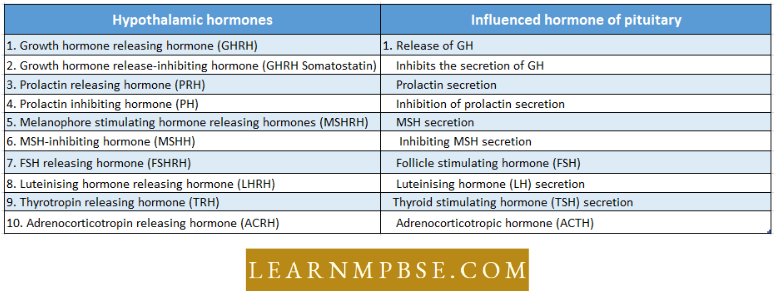
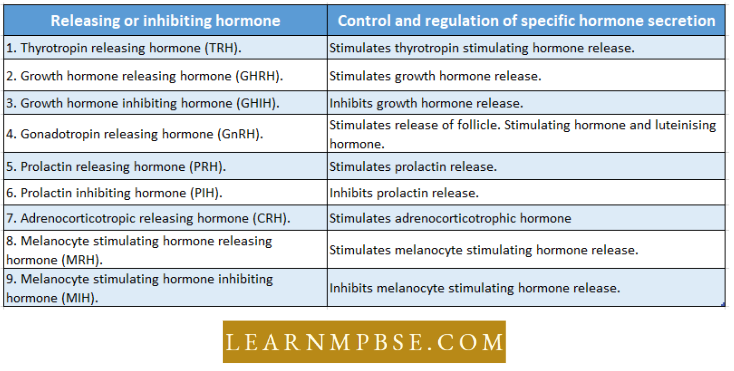
  4. These include various releasing and inhibiting hormones as follows :
  5. Hypothalamic hormones Influence hormones of the pituitary

Endocrine System Various Releasing And inhibiting Hormones

NEET Biology Endocrine System Pituitary Gland (Hypophysis)

  • Located on the ventral aspect of the hypothalamus, this single pea-sized gland was historically regarded as the master gland (Vesalius) because to its regulatory influence over all endocrine glands. However, Webster (1967) rejected this notion.
  • It is now referred to as the conductor of an endocrine orchestra.
  • Situated in a cavity known as the sella turcica, at the base of the sphenoid bone, it is linked via a stalk termed the infundibulum to the hypothalamus.
  • This stalk is lacking in mammals.

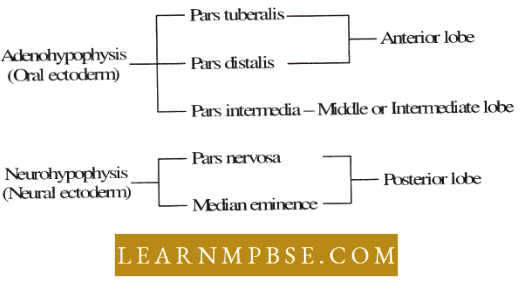
Endocrine System Divisi9on And Origin Of The Parts Of Pituitary Glands

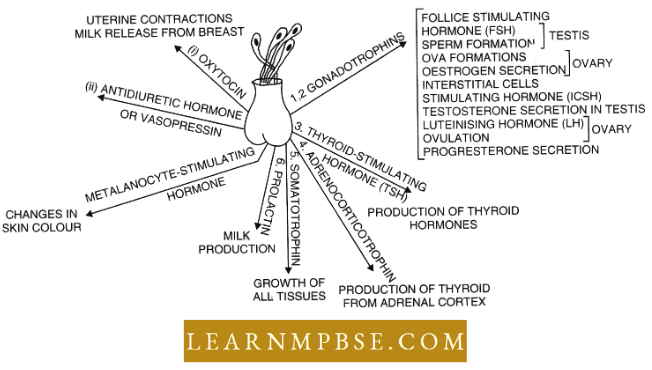
Endocrine System Hormones Of Anterior And Middle Lobe Of Pituitary Gland

Pituitary Gland Hormones NEET Study Material

NEET Biology Endocrine System Hormones Of the Posterior Lobe Of the Pituitary Gland

Antidiuretic hormone (ADH or Vasopressin or Pitressin)

  1. The osmoregulation hormone controls the volume of urine by increasing water reabsorption in nephric tubules.
  2. Brings back the normalcy in the autonomic nervous system during periods of stress, pain, anger, and excitement.
  3. Deficiency of its level causes ‘diabetes insipidus’ (drinking disease), an abnormal amount of water is lost in the urine and to compensate for it the patients keep taking equally high amounts of water.

Oxytocin (or Pitocin or labor hormone or birth hormone)

  1. Secreted from median eminence of pars nervosa hence is the direct secretion of hypothalamus stored in the pituitary.
  2. Facilitates childbirth by loosening pubic symphysis before the birth of the child causing contraction and relaxation of muscles of the uterus, relaxing vaginal muscles and vestibular sphincter of the vulva
  3. The release of milk from the mammary gland is made by relaxing the muscles of the nipple.

NEET Biology Endocrine System Islets Of Langerhans (Pancreas)

  1. The pancreas acts as both an exocrine and endocrine gland and hence is referred to as a heterochrony gland
  2. The endocrine component of the pancreas Islets of Langerhans was discovered by Langerhans (1950).

NEET Biology Endocrine System Hormones Of Islets Of Langerhans

NEET Biology Endocrine System Insulin

  • Isolated by Banting and Best and its primary structure was determined by Sanger(1950).
  • Hypersecretion causes hypoglycemia(extreme case insulin shock)

Endocrine System Hormones Of Islets Of Langerhans In Insulin

NEET Biology Endocrine System Glucagon

  1. Discovered by Kimbell and Murlin (1935) a polypeptide with a molecular weight of 2495; comprises 29 amino acids in a single chain.
  2. Hyperglycemic, by enhancing glycogenolysis in the liver.
  3. Promotes gluconeogenesis, uptake of amino acids, and its deamination in the liver.
  4. Lowers blood calcium level by increasing its renal elimination.
  5. It does not affect muscle glycogen.
  6. Its hypersecretion causes diabetes mellitus.

NEET Biology Endocrine System Somatostatin

  • Secreted from 8 cells, also called a GHH balances the level of glucagon and insulin as per requirement of the body.

NEET Biology Endocrine System GONADS

  • Gonads also secrete a variety of hormones.

NEET Biology Endocrine System Testes

  1. The interstitial cells (or cells of Leydig) in the stroma secrete androgen (steroid) from which the male sex hormone testosterone is synthesized.
  2. Induces the production of male gametes (sperms) and their morphogenesis.
  3. Promotes growth and virility of skeleton muscle, external genitalia (accessory sex organs) secondary sex characters in puberty.
  4. Its hyposecretion causes eunuchoidism, with the following symptoms.
  5. Less growth of secondary sex organs (prostate, seminal vesicle, penis)
  6. Improper spermatogenesis (infertility) and loss of secondary sexual characters.
  7. Extreme hyposecretion causes complete sterility.
  8. Sertoli cells secrete inhibin hormone that inhibits sperm formation.

Pituitary Gland Hormones NEET Study Material

NEET Biology Endocrine System Ovaries

  1. Follicular cells and theca of maturing follicles secrete estrogen (17 (J-estradiol), a steroid.
  2. Stimulates production, growth, and maturation of ovum and functions of secondary sex organs (uterus, fallopian tube, and ducts of mammary glands).
  3. Maintains external or secondary sexual characters.
  4. FSH from the anterior pituitary controls the level and functions of estrogen.
  5. The corpus luteum formed from a ruptured follicle after ovulation secretes another hormone progesterone (a steroid) the pregnancy hormone.
  6. Helps in the thickening of the uterus wall (endometrium) increasing blood supply to restore normalcy after menstruation.
  7. Implantation of zygote on uterus wall, and formation of placenta.
  8. Maintains the level of dissolved 02 in the embryonic fluid.
  9. It also secretes inhibin hormone that stops follicular maturation.

Endocrine System Hormones Secreted By Wall Of Alimentary Canal

NEET Biology Endocrine System Memory Points

  1. Thyroidectomy – removal of thyroid gland.
  2. Hypophysectomy- removal of the entire pituitary gland.
  3. Pheromones (Ectohormones). These are intraspecific chemical messengers released by an animal into the air to initiate specific responses in another animal of the same species. These may be signals of food, mate, etc. The term pheromone was coined by Karlson and Butenandt (1959). The first known pheromone is bombycol.
  4. Synthetic oxytocin is administered to induce uterine contraction in a woman who is exhausted during delivery. It is also administered in female cattle to induce lactation.
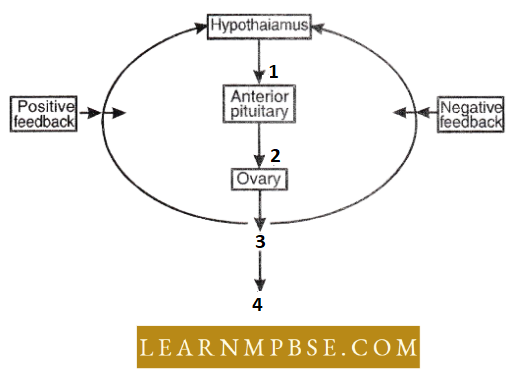
  5. Feedback inhibition. In this type of inhibition, when the end product is at the required level then it gives certain inhibitory signals (called negative feedback) which inhibit the formation of the end product.
  6. G-proteins are related to the hormonal action of those hormones requiring a second messenger, C-AMP. They link hormone receptors on the outer surface of the cell and the interior of the cell.
  7. Prostaglandins. These are lipid compounds secreted into the tissue fluid by cell membranes of the glandular cells. These control either contraction/relaxation of smooth muscles or dilation/ contraction of blood capillaries. These were first reported in the semen of men and are produced by the prostate gland.
  8. Enzyme adenyl cyclase is secreted by the plasma membrane and changes ATP into C-AMP which helps in hormonal action.
  9. Sutherland first described the role of C-AMP in hormone action and called it the “Second Messenger”
  10. Origin of endocrine glands. Most endocrine glands are endodermal in origin  For example. Thyroid, Parathyroid, Islets of Langerhans, and Gastric glands.
  11. Intestinal glands, Thymus, etc. while some are ectodermal in origin For example. Pituitary gland, Hypo-thalamus; Pineal body etc. Gonads are mesodermal in origin while the Adrenal gland is ecto-mesodermal in origin.
  12. The sub-neural gland of Herdmania is homologous to the pituitary of vertebrates. Herring bodies. Structures present in the pituitary and store neurosecretory substances of the hypothalamus.
  13. The H-shaped endocrine gland is the thyroid.
  14. The endostyle of lower chordates like Herdmania, Amphioxus, etc. is homologous to the thyroid gland.
  15. When under stress, adrenaline is secreted directly into the blood.
  16. Many other organs such as the digestive tract secrete hormones, and erythropoietin from the kidney stimulates RBC production. An atrial natriuretic hormone secreted by the heart helps to regulate salt and water balance and blood pressure.
  17. The iodine content of thyroxine is 65% and is called iodized hormone. Thyroxine contains 80% tetra do thyronine (T4) and 20% triiodo thyroxines (T3) is more active than T4
  18. Renin. A hormone secreted by the kidney. It helps in erythropoiesis in bone marrow and osmoregulation through the renin-angiotensinogen system. Adiposogenital syndrome of Hypothalamic eunuchoidism. Hypogonadism in males is caused by the genetic inability of the hypothalamus to secrete gonadotrophin-releasing hormones.
  19. Contraceptive pills. These contain estrogens and progesterone.
  20. Diseases Due To Deficiency/Excess Of Hormones
  21. Grave’s disease. (Exophthalmic Goitre)
  22. Cause: Hypersecretion of thyroxine due to enlargement of the thyroid gland.
  23. Cretinism. Cause: Hyposecretion of thyroxine in children.
  24. Myxoedema. Cause. Deficiency of thyroxine in adults
  • Symptoms: a. puffy appearance due to accumulation of fats.
  • Lack of alertness, and intelligence.
  • Slow heartbeat, low BP, decreased body temperature.
  1. Iodine Def. Goitre: Deficiency of iodine in diet.
  • Symptoms: Enlargement of thyroid gland.
  1. Parathyroid tetany : Cause: Deficiency of Parathormone.
  • Symptoms: Sustained contraction of muscles of face, pharynx, hands and feet.
  1. Addison’s Disease: Cause: Deficiency of mineralocorticoids and glucocorticoids.
  • Symptoms: a. low blood sugar, low Na+ ion, high K+ ion concentration in blood.
  • Bronze-like pigmentation of skin.
  • Nausea, vomiting, diarrhea.
  • Conn’s syndrome (Aldosteronism) Caused due to excessive secretion of aldosterone.

Cushing’s Syndrome. Cause. Excess of cortisol.

  • Symptoms, a. High blood sugar, b. Sugar in urine, c. Obesity, d. Wasting of limb muscles
  • Adrenal virilism. Excess of sex corticoids in (females) a tendency to develop male characteristics by the female due to imbalances in the secretion of adrenal hormones.
  • Dwarfism. Deficiency of GH from early age. It may be Lorrain type, Frohlich type, or Progeria.
  • Gigantism. Excess of GH from childhood.
  • Acromegaly. Excess of GH after adolescence. The stage is called Acromicria.
  • Diabetes Insipidus. Deficiency of ADH.
  • Diabetes Mellitus. Deficiency of insulin.
  • Eunuchoidism. Failure of testosterone.
  • Infantilism. Characteristics of childhood continue beyond the years of puberty. Generally caused due to imbalances in the hormone of the anterior pituitary.
    1. Diabetes is a disease caused by a deficiency of insulin secreted by the pancreas.
    2. Hyperglycemia is an increased blood glucose level than the optimum level.
    3. Hypoglycemia is a lower blood glucose level than the optimum level.
    4. Osteoporosis is a disease caused by hypersecretion of parathormone.
  1. Hashimoto’s Disease: Due to a fall in the secretion of thyroxine antibodies start forming against the gland, so the thyroid gets destroyed. It is also known as the suicide of the thyroid.
  2. Ridding Henson disorder: It is caused by to deficiency of collip’s hormone as a result of which phosphate level in the blood decreases and Ca2+ level increases.

Acidosis. Excessive loss of Na+ is known as acidosis. It may occur due to the hyposecretion of Aldosterone.

Endocrine System Notes For Neet

  1. Contributors related to Endocrinology
  2. The first hormone was discovered by William M. Bayliss and Earnest H. Starling (1903).
  3. The term hormone was introduced by Starling (1905).
  4. Selye (1948) defined hormone as a functional chemically complex organic compound.
  5. Berthold laid the foundation for the study of the functions of hormones.
  6. Scharrer and Scharrer (1936) stated that hormones generally control or regulate reproductive activities, growth, maturation, regeneration, metabolism, and homeostasis. , Huxley called hormones as chemical messengers.
  7. Thomas Addison is regarded as the father of endocrinology.
  8. Claude Bernard (1955) established that the nervous system controls the function of endocrine glands.
  9. The action of insulin hormone was demonstrated by Banting and later by Best. Shaefer (1912) gave the name insulin.
  10. F. Sanger (1954) worked out the molecular structure of insulin. He established that it is polypeptide and was awarded the Nobel Prize (1958). i
  11. Human insulin was synthesized by Tsan in 1965.
  12. Kimball and Murlin discovered glucagon.
  13. Karlson and Burtenandt coined the term pheromones.
  14. Kochar (1916) isolated thyroxine (pure form).
  15. Kendall (1919) obtained a crystallized form of thyroxine.
  16. Harrington and Barges (1927) worked out the molecular structures of thyroxine.
  17. Gudernatch (1912) discovered that metamorphosis in a frog’s tadpole begins only when an adequate amount of thyroxine is secreted by the thyroid of the tadpole.
  18. Aldrich (1901) worked out the molecular structures of adrenaline and noradrenaline.
  19. Stolz (1904) and Dakin (1905) synthesized adrenaline.
  20. Enterocrinin. This hormone was isolated by Nasset from both small and large intestinal mucosa

Hormones And Endocrine Glands Neet Notes

  • The nervous system and endocrine system together regulate the working of the body.
  • Hormones affect all the cells of a target organ whereas a neuron will affect only a single muscle or fraction of it.
  • A hormone is a chemical messenger secreted by the endocrine gland and carried to the target organ by blood.
  • The pituitary gland is pea-shaped, 1.3 cm in diameter, and weighs only 0.5 gm.
  • The pituitary is attached to the hypothalamus of the brain by a stalk-like structure called the infundibulum.
  • Region of pituitary
  • Anterior lobe (Adenohypophysis)
  • Posterior lobe (Neurohypophysis)
  • A third region is termed the intermediate lobe or pars intermedia.
  • Neurons of the autonomic system stimulate hormone release from some glands. For instance, adrenaline and noradrenaline are released from the adrenal medulla on the arrival of nerve impulses during anxiety, stress, and danger. Thus endocrine system is considered a chemical extension of the nervous system.
  • Corticotropes. about 20 % and secrete ACTH.
  • Gonadotropes. secrete FSH and LH in female ; and FSH and ICSF1 in male.
  • The gastrointestinal lining also secretes several hormones that regulate the secretion of digestive juices.
  • Thymosin secreted by the thymus stimulates the maturation of immune system cells. Melatonin controls skin shade in some animals and appears to control annual reproductive cycles. Some hormones, such as steroid hormones, act by binding to DNA and altering gene expression.
  • Other hormones bind to membrane receptors, where they either open ion channels (usually Ca2+) or trigger the production of other chemical messengers inside the cell. Typically the receptor activates an enzyme via a G protein intermediate, which generates c AMP, which in turn activates the first step in an enzyme cascade.
  • Cellular reactions are faster and more accurate when activity is determined by the ratio of two antagonistic hormones rather than the absolute level of a single hormone.

Endocrine System Regulation Of Secretion Of Pituitary Body

NEET Biology Endocrine System Quanta To Memory

  1. Hormonology. Study of hormones.
  2. Hormonotherapy. Treatment by hormones.
  3. Largest Endocrine Gland. The thyroid (25 to 40 gms) is the largest endocrine gland in the human body.
  4. Trophins (Tropins). The hormones which stimulate an endocrine gland to secrete its hormone (s,), For example.,  thyrotrophic hormone that stimulates the thyroid gland to secrete thyroxine.
  5. All the pituitary hormones are molecules made chiefly of monomers of amino acids
  6. The anterior pituitary has been called the master gland, because of the tropic hormones it releases. The real master “gland,” however, is the hypothalamus because its hormones regulate the secretory activity of the anterior pituitary.
  7. Anterior and intermediate lobes of pituitary form adenohypophysis derived from Rathke’s pouch are ectodermal in origin.
  8. The posterior lobe or neurohypophysis arises from the floor of the hypothalamus.
  9. Rathke’s pouch: an embryonic outgrowth of the pharynx which forms adenohypophysis of the pituitary gland. Median eminence is a part of the posterior pituitary
  10. Adenohypophysis gets its blood supply through the circle of Willis
  11. In comparison with the nervous system, hormones are distributed by blood but slowly.
  12. Hormonal action is generally less specific in comparison with nervous regulation.
  13. Kyphosis. Hunched back in the person suffering from acromegaly.
  14. Lag period. The period between secretion of hormone from the endocrine gland and biological response from the target organ.
  15. Baldness. It is related to the sex hormones. Male sex hormone promotes baldness, female sex hormones inhibit it.
  16. Melatonin is a hormone secreted by the pineal body and controls skin pigmentation.
  17. Sella turcica is the pituitary fossa (a depression in the skull in which the pituitary gland lies).
  18. Somatotropes are cells of the pituitary gland that secrete growth hormone (also called STH).
  19. Thymosin is a hormone secreted by the thymus gland and increases the activity of T-lymphocytes.
  20. Islets of Langerhans. These are approximately 1 to 2 million small clusters of endocrine cells which are named after the name of their discoverer (1869). Prostaglandins and leukotrienes are important eicosanoids.
  21. These are local hormones and are derived from a 20-carbon fatty acid called arachidonic acid. Contraceptive pills contain the hormones estrogen and progesterone.
  22. Melanocyte-stimulating hormone is secreted by the middle lobe of the pituitary. It darkens the skin of many animals including fishes and amphibians. It results from the stimulation of the synthesis of melanin in the skin.
  23. Gravidex test is for detecting the presence of HCG hormone in the urine in case of pregnancy
  24. Parathormone is a protein hormone consisting of 84 amino acids.
  25. The British biologist V.B. Wigglesworth discovered, in the 1930s, two hormones that regulate development in insects. One is ecdysone, which promotes growth, molting, and the development of adult traits.
  26. It is produced by the prothoracic glands in the head or thorax. The other hormone is juvenile hormone which promotes retention of larval characteristics. It is produced by the corpora allata glands in the head.
  27. Of the two insect hormones discovered by Wiggles Worth, ecdysone has no role in the adult insect, whereas juvenile hormone promotes the development of eggs and sperm.
  28. Prolactin and oxytocin are being used for increasing milk yield among dairy cattle. Recently genetically engineered Bovine growth hormone (BGH) was also used to boost milk yield in cows but was banned in March 1995.
  29. The melanocyte-stimulating hormone was previously known as intermedin.
  30. The adrenal gland is also known as the 3F gland (Fear, Flight, Fright)
  31. Oral insulin is given as IZS [Insulin zinc suspension] or PZS (Protamine zinc suspension)
  32. Hassels’ corpuscles are found in the thymus and are known as Thymic cells.
  33. a-and (3-chains of insulin are connected through disulfide bonds.
  34. The thymus is associated with our immune system. It acts as a lymphatic gland.
  35. Humulin is a human insulin, produced by DNA recombinant technology.
  36. Allaxonic diabetes is due to allaxon which destroys beta cells of the pancreas.
  37. The adrenal gland is also known as the 3-F gland and the 4-S gland.
  38. Oral contraceptive pills with a synthetic form of estrogen and progesterone hormones prevent ovulation in the female. Milk secreting hormone is prolactin and milk ejecting hormone is oxytocin.
  39. The pregnancy hormone is progesterone and the birth hormone is oxytocin.

NEET Biology Endocrine System Multiple-Choice Questions

Question 1. Hormones Chemically Are :

  1. Proteins
  2. Fatty Acid Derivatives
  3. Steroids
  4. All The Above.

Answer: 4. All The Above

Question 2. Hormonal Diseases May Be Called :

  1. Functional Diseases
  2. Deficiency Diseases
  3. Infectious Diseases
  4. All The Above.

Answer: 1. Functional Diseases

Question 3. Which Of The Following Is A Hormonal Disease?

  1. Measles
  2. Rabies
  3. Tuberculosis
  4. Osteitis Fibrosa Cystica.

Answer: 4. Osteitis Fibrosa Cystica.

Question 4. A Hormone Is A Molecule That:

  1. Moves Through The Blood Stream And Ducts
  2. Influences Development
  3. Has The Same Chemical Activity In A Variety Of Organisms
  4. Alters The Activity Of Certain Non-Adjacent Cells.

Answer: 4. Alters The Activity Of Certain Non-Adjacent Cells

Neet Previous Year Questions On Endocrine System

Question 5. Adrenaline Is Secreted By :

  1. Pituitary Gland
  2. Pineal Gland
  3. Adrenal Gland
  4. Thymus Gland.

Answer: 3. Adrenal Gland

Question 6. Corticoids Are Secreted By :

  1. Thymus
  2. Adrenals
  3. Pancreas
  4. Kidney.

Answer: 2. Adrenals

Question 7. Islets Of Langerhans Secrete :

  1. Adrenaline
  2. Acth
  3. Fsh
  4. Insulin.

Answer: 4. Insulin.

Question 8. Based on the Chemical Nature Of Hormones, They Are Divided Into :

  1. Two Categories
  2. Three Categories
  3. Five Categories
  4. Six Categories.

Answer: 4. Six Categories.

Question 9. α-Cells Of Adenohypophysis Secrete Which Hormone?

  1. ACTH And LH
  2. GH And LTH
  3. FSH And LH
  4. TSH And FSH.

Answer: 2. GH And LTH

Question 10. The Trophic Factors Are Made Up Of Proteins Containing :

  1. 1 To 4 Amino Acids
  2. 4 To 10 Amino Acids
  3. 3 To 15 Amino Acids
  4. 3 To 20 Amino Acids.

Answer: 4. 3 To 20 Amino Acids.

Question 11. Which One Of The Following Is Not Synthesized In the Pituitary?

  1. Lactotrophic
  2. TSH
  3. ICSH
  4. ADH

Answer: 1. Lactotrophic

Question 12. Acth Is Secreted By :

  1. Pineal Body
  2. Anterior Lobe Of Pituitary Gland
  3. Posterior Lobe Of Pituitary Gland
  4. Thymus.

Answer: 2. Anterior Lobe Of Pituitary Gland

Question 13. Adh Is Produced By :

  1. Pineal Body
  2. Anterior Lobe Of Pituitary Body
  3. Thymus
  4. Posterior Lobe Of Pituitary Body.

Answer: 4. Posterior Lobe Of Pituitary Body.

Question 14. Which Of The Following Substances Is Released In Excess Quantity During Excitement?

  1. Cortisone
  2. Serotonin
  3. Adrenaline
  4. Nor-Epinephrine.

Answer: 3. Adrenaline

Adrenal Gland Hormones NEET Biology

Question 15. Which Of The Following Structures Act As Temporary Ductless Gland?

  1. Pancreas
  2. Pineal
  3. Parathyroid
  4. Placenta.

Answer: 4. Placenta

Question 16. Which Of The Following Secretory Glands Acts Both As Endocrine And Exocrine?

  1. Adrenal
  2. Parathyroid
  3. Pancreas
  4. Pineal.

Answer: 3. Pancreas

Question 17. Like Muscles, Hormones Are Antagonistic In Their Functioning. Mark The Wrong One :

  1. Calcitonin And Parathormone
  2. Insulin And Glucagon
  3. Tsh And Thyroxine
  4. Somatostatin And Growth Hormone.

Answer: 3. Tsh And Thyroxine

Question 18. The Hormone Released From the Intermediate Lobe Of the Pituitary Is:

  1. FSH
  2. LH
  3. MSH
  4. ACTH.

Answer: 3. ACTH

Question 19. Secretion Of The Following Hormones Results In Cretinism :

  1. Thyroxine
  2. Testosterone
  3. Calcitonin
  4. ADH.

Answer: 1. Thyroxine

Question 20. Vasopressin Is Related With :

  1. Concentration Of Urine
  2. Dilution Of Urine
  3. Quick Digestion
  4. Slow Heart Beat.

Answer: 1. Concentration Of Urine

Question 21. Which Of The Following Statements Is False?

  1. Hormones Produced In Ovary Affects The Uterine Cycle
  2. Hormones Produced In Small Intestine Stimulate Heart
  3. Hormones Produced In Adrenal Medulla Stimulate HeartBeat
  4. Hormones Produced In Thyroid Stimulate Metabolism.

Answer: 2. Hormones Produced In the Small Intestine Stimulate the Heart

Hormonal Disorders And Imbalances Neet Notes

Question 22. The Target Cells Of A Hormone Always Have :

  1. Special Receptors To Which The Hormones Bind
  2. Special Channels Through Which The Hormones Move
  3. Large Amounts Of Hormones Stored Within Vesicles.
  4. Undifferentiated Cytoplasm.

Answer: 1. Special Receptors To Which The Hormones Bind

Question 23. The Cells That Produce Glucagon In Pancreas Are :

  1. α Cells
  2. β Cell
  3. ϒ Cells
  4. Acinar Cells.

Answer: 1. α Cells

Question 24. Calcium Ions Are Important In The Body Because They :

  1. Are Involved As Co-Factors
  2. Regulate Many Intercellular Metabolism
  3. Influence Membrane Permeability
  4. All The Above.

Answer: 4. All The Above.

Question 25. Fsh Is Produced By :

  1. Posterior Lobe Of Pituitary Body
  2. Middle Lobe Of Pituitary Body
  3. Anterior Lobe Of Pituitary Body
  4. Adrenal Cortex.

Answer: 3. Anterior Lobe Of Pituitary Body

Question 26. A Short Individual, Fairly Well Proportioned Body, Who Is Mentally And Physically Normal, Developed Due To The Undersecretion Of Growth Hormones, This Stage Is :

  1. Lorrain’S Type
  2. Frohlich’S Type
  3. Acromegaly
  4. Acromicria.

Answer: 1. Lorrain’s Type

Question 27. Adrenal Medullary Hormones Are Produced When :

  1. Neurohypophysis Is Stimulated
  2. Adenohypophysis Is Stimulated To Produce Oxytocin
  3. Under Stress
  4. Breeding Phase Starts.

Answer: 3. Under Stress

Question 28. Estrogen Is Necessary For :

  1. Development And Maintenance Of Uterus
  2. Proper Functioning Of Fallopian Tube
  3. Normal Functioning Of The Cervix And Vagina
  4. Development Of Secondary Sexual Characters In Females.

Answer: 4. Development Of Secondary Sexual Characters In Females.

Question 29. Vasopressin And Oxytocin Are Secreted By :

  1. Hypothalamic Neurosecretory Cells
  2. Neurohypophysis
  3. Medulla
  4. Pancreas.

Answer: 1. Hypothalamic Neurosecretory Cells

Question 30. Adrenal Cortical Cells Are Stimulated By :

  1. Corticotropins From The Hypothalamus
  2. Adreno Corticotropic Hormones
  3. Corticoids
  4. Changes In Blood Glucose Level.

Answer: 2. Adreno Corticotropic Hormones

Question 31. Many Hormones Are Initially Synthesised As Biologically Inactive Precursor Molecules Called :

  1. Ectohormones
  2. Pheromones
  3. Endorphins
  4. Prohormones.

Answer: 4. Prohormones.

Question 32. Rate Of Hormones Synthesis And Secretion Depend Upon :

  1. Functional Efficiency Of The Feedback
  2. Amount Of Excitation In Target Tissue
  3. Degree Of Inhibition Causes
  4. Functional State Of Tissue.

Answer: 1. Functional Efficiency Of The Feedback

Endocrine System Notes For Neet

Question 33. Thyrotrophic Releasing Hormone Is :

  1. A Neurosecretion From The Hypothalamus Which Stimulates Anterior Lobe Of Pituitary
  2. A Secretion Of Pars Distalis
  3. Elaboration Of Neurohypophysis
  4. From Thyroid Gland.

Answer: 1. A Neurosecretion From The Hypothalamus that stimulates the Anterior Lobe Of the Pituitary

Question 34. Involvement Of Any Hormone In The Control Of Cellular Function Depends On A Series Of Reactions Involving :

  1. Synthesis Of Hormone In The Endocrine Cells
  2. Feedback Control
  3. Beginning With Hormone Synthesis And Finishing With Feedback Control
  4. None Of The Above.

Answer: 3. Beginning With Hormone Synthesis And Finishing With Feedback Control

Question 35. Hormones Regulating The Morphogenetic Effects Are :

  1. Growth Hormone
  2. Testosterone
  3. Androgens
  4. All Of The Above.

Answer: 4. All Of Above.

Question 36. If the Ovaries Of A Lady Are Removed In The Fourth Month Of Pregnancy, The Result Will Be :

  1. Embryo Will Develop Normally Till Birth
  2. Abortion Will Occur After Some Time
  3. Development Of Embryo Become Improper
  4. None Of The Above.

Answer: 1. Embryo Will Develop Normally Till Birth

Question 37. A Substance Called ADH Is:

  1. A Hormone That Promotes Glycogenesis In Liver Cell
  2. An Enzyme Secreted By Cells Of Intestinal Wall; Hydrolyses Dipeptides Into Amino Acids
  3. A High Energy Compound Involved In Muscle Contraction
  4. A Pituitary Secretion Which Promotes Reabsorption Of Water From Glomerular Filtrate.

Answer: 4. A Pituitary Secretion that promotes Reabsorption Of Water From Glomerular Filtrate.

Question 38. The Pancreas Is A Mixed Gland In Which :

  1. All Cells Secrete Enzymes And Hormones
  2. Most Cells Secrete Hormones
  3. A Few Cells Secrete Enzymes
  4. Enzymes And Hormones Are Secreted By Separate Cells.

Answer: 4. Enzymes And Hormones Are Secreted By Separate Cells.

Question 39. Treatment With Alloxan Destroys :

  1. STH Cells
  2. β- cells of Islets Of Langerhans
  3. Cells Of Sertoli
  4. Cells Of Leydig.

Answer: 2. Islets Of Langerhans

Question 40. Select The Correct Answers To The Followings. Which Of The Following Techniques Should Be Least Likely To Help Elucidate The Function Of A Hormone Produced By An Endocrine Gland?

  1. Removal Of The Gland And Subsequent Analysis Of What Functions Are Lost
  2. Transplantation Of The Gland Into An Animal That Lacks The Gland
  3. Transfusion Of Blood From An Animal Lacking The Gland Into An Animal That Has The Gland And Observation Of Its Effects
  4. Observing Effects Of Gland Extract On Various Tissues Grown In Culture.

Answer: 3. Transfusion Of Blood From An Animal Lacking The Gland Into An Animal That Has The Gland And Observation Of Its Effects

Question 41. All The Following Commonly Serve As Signals Stimulating Hormone Secretion Except:

  1. Conditions Outside The Body
  2. Rising Levels Of Another Hormone
  3. Rising Levels Of The Hormone In Question
  4. Falling Levels Of The Hormone In Question.

Answer: 3. Rising Levels Of The Hormone In Question

Endocrine System Notes For Neet

Question 42. Hormones Are Known To Cause All The Following Changes In Target Cells Except:

  1. Changes In Genetic Make-Up
  2. Change In Permeability
  3. Change In Metabolic Rate
  4. Increase In Cyclic Amp Concentration.

Answer: 1. Changes In Genetic Make-Up

Question 43. An Advantage Of Having The Endocrine System As Well As The Nervous System Involved In The “Fight Or Flight” Response:

  1. The Endocrine System Responds Faster
  2. The Endocrine Response Usually Lasts Longer
  3. The Endocrine System Is Turned More Precisely To The Degree Of Need
  4. The Endocrine System Affects Only The Target Organ Whose Response Is Needed To Meet The Emergency.

Answer: 4. The Endocrine System Affects Only The Target Organ Whose Response Is Needed To Meet The Emergency.

Question 44. In Case Of Hypersecretion Of A Parathormone, Some Cells Of the Body Become Overactive. These Cells Are :

  1. Ependymal Cells
  2. Sarcoplasmic Reticulum
  3. Osteoclasts
  4. Osteocytes.

Answer: 3. Osteoclasts

Question 45. Hormones Controlling Expression Of Secondary Sexual Characters Are Secreted By Which Of These Cells In The Testis?

  1. Sertoli Cells
  2. Spermatogonia
  3. Leydig’S Cells
  4. Primary Spermatocytes.

Answer: 3. Leydig’s Cells

Question 46. Hormones Which Helps In The Implantation Of Embryo In Uterus Is :

  1. Estrogen
  2. Thyroxine
  3. Relaxin
  4. Progesterone.

Answer: 4. Progesterone

Question 47. In The Areas Of Destruction In The Bones, Fibrous Cysts Develop However The Parathyroid Becomes Overactive. This Is The :

  1. Osteitis Fibrosa Cystica
  2. Polydipsia
  3. Osteomalacia
  4. None.

Answer: 1. Osteitis Fibrosa Cystica

Question 48. Anti-Allergic Hormone Is :

  1. Epinephrine
  2. Non-Epinephrine
  3. Gluco-Corticoid
  4. Mineralo-Corticoid.

Answer: 3. Gluco-Corticoid

Question 49. Cretinism Is Due To :

  1. Hypothyroidism In Children
  2. Hypothyroidism In Adults
  3. Hyperthyroidism In Children
  4. Hyperthyroidism In Adults.

Answer: 1. Hypothyroidism In Children

Hormones And Endocrine Glands Neet Notes

Question 50. Which Of The Following Is Not Necessarily Property Of All Hormones?

  1. Carrying Information
  2. Secreted In Small Amounts
  3. Short Half-Life
  4. Proteinic Nature.

Answer: 4. Proteinic Nature.

Question 51. One Of The Following Hormones Is Not Produced By Alimentary Canal. Select?

  1. Insulin
  2. Cholecystokinin
  3. Secretin
  4. Gastrin.

Answer: 1. Insulin

Question 52. The True Proteinaceous Hormones Are Secreted By :

  1. Pancreas
  2. Anterior Lobe Of Pituitary
  3. Posterior Lobe Of Pituitary
  4. Thyroid.

Answer: 2. Anterior Lobe Of Pituitary

Question 53. What Does The Growth Hormone Do When the Growth Period Is Over:

  1. Regulates Metabolism
  2. Promotes Reproductive Activities
  3. Stimulates Growth Of Secondary Sexual Characters
  4. Stimulates Gametogenesis.

Answer: 1. Regulates Metabolism

Question 54. Strong Emotional Attachment To The Young Ones Is Due To:

  1. Emotional Hormones Like Epinephrine And Gluco-Corticoids
  2. Luteotropic Hormone (Lth)
  3. Lh
  4. All.

Answer: 2. Luteotropic Hormone (Lth)

Question 65. Secretion Of Vasopressin Is :

  1. Acyclic And Not Affected By Seasonal Changes
  2. Cyclic Phenomenon With Seasonal Changes
  3. Effect Of Exercise
  4. A Regular And Constant Feature.

Answer: 1. Acyclic And Not Affected By Seasonal Changes

Question 66. Precursor Chemical For Steroid Hormones Are:

  1. Cholesterol
  2. Nucleic Acid
  3. Amino Acid
  4. Mucoprotein.

Answer: 1. Cholesterol

Question 67. Function Of Progesterone Is :

  1. Preparation Of Uterus For Pregnancy
  2. To Maintain The Pregnancy
  3. To Complete The Formation Of Milk In The Mammary Glands
  4. Both  1 And 2.

Answer: 2. To Maintain The Pregnancy

Endocrine System NEET Notes

Question 68. A New Menstrual Cycle Starts When :

  1. Pituitary Resumes Lh Production In The Absence Of Fsh And Progesterone
  2. Ovary Resumes Progesterone Production In the Presence Of Lh
  3. Ovary Resumes Estrogen Production In The Presence Of Fsh
  4. Pituitary Resumes Lh Production In The Presence Of Fsh And Progesterone.

Answer: 3. Ovary Resumes Estrogen Production In The Presence Of Fsh

Question 69. Diabetes Mellitus Is Caused By Deficiency Of:

  1. Secretin
  2. Adrenaline
  3. Insulin
  4. Prolactin.

Answer: 3. Insulin

Question 70. The Growth Of Facial And Body Hair In Male Is Stimulated By :

  1. Pituitary Hormones
  2. Thyroxine
  3. Parathyroid
  4. Androgenic Hormones.

Answer: 4. Androgenic Hormones.

Question 71. The Phenomenon Of ‘Heat’ Or Oestrus In Females Is Due To The Hormones Secreted By :

  1. Pituitary
  2. Thyroid
  3. Interstitial Cells Of Testes
  4. Ovarian Follicles.

Answer: 4. Ovarian Follicles.

Question 72. Hyperadrenalism Is Called :

  1. Cushing’S Disease
  2. Addison’S Disease
  3. Simmond’S Disease
  4. None.

Answer: 1. Cushing’s Disease

Question 73. Which Of The Pituitary Hormones Is Responsible For The Secretion Of Milk By The Mammary Glands In Females?

  1. ACTH-RH
  2. LH And Prolactin
  3. LTH-RH
  4. TH.

Answer: 2. LH And Prolactin

Question 74. Which One Of The Endocrine Glands Shrinks After The Start Of Adolescence?

  1. Pituitary Body
  2. Pineal Glands
  3. Hypothalamus
  4. Thymus Glands.

Answer: 4. Thymus Glands.

Question 75. The Hormone That Regulates The Growth Of The Skeleton And The Body As A Whole Is :

  1. Thyroxine
  2. Parathormone
  3. Thyroid Stimulating Hormone
  4. Human Growth Hormone.

Answer: 4. Human Growth Hormone.

Question 76. Which One Of The Following Has an Anti-Insulin Effect?

  1. Calcitonin
  2. Cortisol
  3. Oxytocin
  4. Aldosterone.

Answer: 2. Cortisol

Question 77. Which Of The Following Hormones Is Proteinic In Nature But May Be Secreted By An Organ Which Normally Secretes Steroids Under Special Conditions Is :

  1. Relaxin
  2. LH
  3. Estrogen
  4. Oxytocin.

Answer: 1. Relaxin

Question 78. The Addison’s Disease Is Caused By The :

  1. Hyposecretion Of Cortical Hormones
  2. Hypersecretion Of Cortical Hormones
  3. Hypersecretion Of Pituitary Hormones
  4. Enlargement Of Thyroids.

Answer: 1. Hyposecretion Of Cortical Hormones

Question 79. The Determination And Masculinisation Of Female May Be Done By :

  1. Ovary
  2. Medulla Of Adrenals
  3. Cortex Of Adrenals
  4. Parathyroids.

Answer: 3. Cortex Of Adrenals

Question 80. Select The Odd One :

  1. Insulin
  2. Oxytocin
  3. Thyroxine
  4. Ecdysone.

Answer: 4. Ecdysone.

Question 81. Progesterone Is A / An :

  1. Enzyme
  2. Protein
  3. Hormone That Relaxes Uterus During Birth
  4. Hormone Responsible For Growth And Maintenance Of Foetus.

Answer: 4. Hormone Responsible For Growth And Maintenance Of Foetus.

Question 82. Which Hormone Of The Following Endocrine Glands Lacks Peptide, Amines And Sulphur?

  1. Hormones Of the Anterior Lobe Of the Pituitary
  2. Hormones Of the Posterior Lobe Of the Pituitary
  3. Hormones Of Thyroids And Adrenal Gland
  4. Hormones Of Gonads.

Answer: 4. Hormones Of Gonads.

Hormones And Endocrine Glands Neet Notes

Question 83. Which Endocrine Gland Stores Its Secretion In The Extracellular Space Before Discharging It Into The Blood?

  1. Adrenal
  2. Pancreas
  3. Testis
  4. Thyroid.

Answer: 4. Thyroid.

Question 84. According To The Accepted Concept Of Hormone Action, If Receptor Molecules Are Removed From Target Organs :

  1. The Target Organ Will Continue To Respond To The Hormone Without Any Difference
  2. The Target Organ Will Continue To Respond To The Hormone But Will Require Higher Concentration
  3. The Target Organ Will Not Respond To The Hormone
  4. The Target Organ Will Continue To Respond To The Hormone But In The Opposite Way.

Answer: 3. The Target Organ Will Not Respond To The Hormone

Question 85. Oxytocin Is A :

  1. Parathormone
  2. Small Peptide
  3. Fatty Acid Residue
  4. Sugar Molecule.

Answer: 2. Small Peptide

Question 86. The Hormone that elevates Blood Calcium And Phosphorus levels is:

  1. Parathormone
  2. Calcitonin
  3. Thyroxine
  4. Triiodothyronine.

Answer: 1. Parathormone

Question 87. The Hormone Which Stimulates Milk Production In Mammals Is Known As:

  1. Glucagon
  2. Prolactin
  3. Progesterone
  4. Oestrogen.

Answer: 2. Prolactin

Question 88. Which Of The Following Is Not a Steroid?

  1. Testosterone
  2. Oestradiol-17b
  3. Progesterone
  4. Prolactin.

Answer: 4. Prolactin.

Question 89. Which Of The Following Hormones Stimulate the Conversion Of Proteins Into Amino Acids Particular During Fasting Or Hibernation?

  1. Glucocorticoids
  2. Secretin
  3. Adrenaline
  4. Enterogastrone.

Answer: 1. Glucocorticoids

Question 90. Growth Hormone Is Secreted By :

  1. Hypothalamus
  2. Thyroid Glands
  3. Pituitary Gland
  4. Pineal Body.

Answer: 3. Pituitary Gland

Question 91. The Hormone In the Pineal Gland Is Called :

  1. Melatonin
  2. Melatonin
  3. Serotonin
  4. Pincolin.

Answer: 1. Melatonin

Question 92. The Pineal Gland :

  1. Is A Photoreceptor
  2. Responds To Smell
  3. Responds To Sound
  4. Is Sensitive To Light Stimulus.

Answer: 4. Is Sensitive To Light Stimulus.

Neet Biology Endocrine System Notes Pdf

Question 93. Endocrinology Term Was Proposed By :

  1. Pande
  2. Hardy
  3. Sutherland
  4. All Of These.

Answer: 1. Pande

Question 94. Hormones Are Needed In :

  1. Gms.
  2. Milligrams
  3. Nanograms
  4. Kilograms.

Answer: 3. Nanograms

Question 95. Pheromones Are :

  1. Hormones Of Insects
  2. Peripheral Hormones
  3. Both 1 And 2
  4. None.

Answer: 3. Both 1 And 2

Question 96. The Total No. Of Hormones Produced By Adrenal Cortex Is 20 But They Are Grouped Under :

  1. One
  2. Two
  3. Three
  4. Four.

Answer: 3. Three

Question 97. Calcitonin, Which Reduces The Excessive Amount Of Calcium Of The Blood, Is Secreted By The :

  1. Hypothalamus
  2. Parathyroid
  3. Thyroid
  4. Adrenal.

Answer: 3. Thyroid

Question 98. The Vesicles Of The Thyroid Gland Are Lined By :

  1. Epithelium Which Is Single Layered
  2. A Double Layer Of Epithelium
  3. A Single Layer Of Endothelium
  4. A Double Layer Of Endothelium.

Answer: 1. Epithelium Which Is Single Layered

Question 99. The Moulting In Insects Is Triggered Off By :

  1. Thyroxine
  2. Ecdysone
  3. Juvenile Hormone
  4. Pheromone.

Answer: 2. Ecdysone

Question 100. The Hormones Secreted By Hypothalamus Are Carried To The Pituitary Gland By :

  1. Hypophyseal Stalk
  2. Hypophyseal Portal System
  3. Neural Complex
  4. Neuro-Hypophyseal Portal System.

Answer: 2. Hypophyseal Portal System

Question 101. Cretinism In Children Is Caused By :

  1. Hypothyroidism
  2. Hypopituitarism
  3. Hypoparathyroidism
  4. Hypo-Insulin-Secretion.

Answer: 1. Hypothyroidism

Hormones And Endocrine Glands Neet Notes

Question 102. Mammalian Thymus Is Mainly Concerned With :

  1. Regulation Of Body Growth
  2. Regulation Of Body Temperature
  3. Immunological Functions
  4. Secretion Of Thyrotropins.

Answer: 3. Immunological Functions

Question 103. Insulin Was Extracted First By :

  1. Flemming
  2. Khorana
  3. Watson And Crick
  4. Banting And Best.

Answer: 4. Banting And Best.

Question 104. The Effect Of Different Hormones On The Body Can Be Best Said To Bring About:

  1. Stimulation Of Organs
  2. Release Of Inherent Capacities
  3. Proper Growth
  4. Coordination Of Functions.

Answer: 4. Coordination Of Functions.

Question 105. Which Hormone Has The Anti-Insulin Effect?

  1. Calcitonin
  2. Cortisol
  3. Oxytocin
  4. Glucagon.

Answer: 2. Cortisol

Question 106. Hypoparathyroidism Results Due To :

  1. Upset In Metabolism
  2. Improper Gonadial Function
  3. Convulsions And Tetany
  4. Nervousness And Wasting.

Answer: 3. Convulsions And Tetany

Question 107. The Secretion From Which Of The Following Controls Wall Balance In The Body?

  1. Cerebellum
  2. Cerebrum
  3. Pineal Body
  4. Pituitary.

Answer: 4. Pituitary.

Question 108. Hypothyroidism In Adult Causes :

  1. Cretinism
  2. Exophthalmic Goitre
  3. Myxoedema
  4. Graves’s Disease

Answer: 3. Myxoedema

Question 109. Insulin Promotes :

  1. Glycogenesis
  2. Glycolysis
  3. Glyconeogenesis
  4. Glycogenolysis.

Answer: 1. Glycogenesis

Question 110. Mark The Gland In Whose Presence Sex Glands Fail To Develop :

  1. Adrenal
  2. Pituitary
  3. Pineal
  4. Thyroid.

Answer: 3. Pineal

Question 111. The Anterior Lobe Of Pituitary Affects :

  1. Protein Metabolism
  2. Fat Metabolism
  3. Carbohydrate Metabolism
  4. All Of The Above.

Answer: 4. All Of The Above.

Question 112. Survival Time Can Be Minimized If We Remove:

  1. Adrenal
  2. Pituitary
  3. Thymus
  4. Thyroid.

Answer: 1. Adrenal

Question 113. Testis Secretes Androgen, It Is :

  1. Testosterone
  2. Androsterone
  3. Progesterone
  4. Aldosterone.

Answer: 1. Testosterone

Question 114. Which Of The Following Causes Ageing?

  1. Islets Of Langerhans
  2. Parathyroid
  3. Thyroid
  4. Thymus.

Answer: 4. Thymus.

Hormones And Endocrine Glands Neet Notes

Question 115. Breast Development During Pregnancy Is Induced By :

  1. Estradiol
  2. Progesterone
  3. Relaxin
  4. None Of These.

Answer: 2. Progesterone

Question 116. Which Of The Following Is Helpful For An Asthma Patient In Exhaling The Air?

  1. Adrenaline
  2. Insulin
  3. Oxytocin
  4. Thyroxine.

Answer: 1. Adrenaline

Question 117. Which Of The Following Controls Thirst?

  1. Adrenal
  2. Pituitary
  3. Parathyroid
  4. Thyroid.

Answer: 2. Pituitary

Question 118. Complete Failure Of Adenohypophysis Of Pituitary In Adult Women Causes :

  1. Addison’S Disease
  2. Cushing’S Disease
  3. Dwarfism
  4. Simmond’s Disease.

Answer: 3. Dwarfism

Question 119. Oxytocin Is Secreted By :

  1. Adenohypophysis
  2. Neurohypophysis
  3. Hypophyseal Stalk
  4. Only Pregnant Women.

Answer: 2. Neurohypophysis

Question 120. Fsh Is Produced By :

  1. Adrenal
  2. Thyroid
  3. Anterior Lobe Of Pituitary
  4. Posterior Lobe Of Pituitary.

Answer: 3. Anterior Lobe Of Pituitary

Question 121. Which Of The Following Hormones Is From the Parathyroid Gland?

  1. Epinephrine
  2. Gastrin
  3. Noradrenaline
  4. Parathormone.

Answer: 4. Parathormone.

Question 122. Thyroxine Is Produced Through :

  1. Chlorination Of Serine
  2. Iodination Of Isoleucine
  3. Iodination Of Tyrosine
  4. Phosphorylation Of Amino Acids.

Answer: 3. Iodination Of Tyrosine

Question 123. Which Of The Following Is Related To The Production Of Lymphocytes And Antibodies?

  1. Thymus
  2. Hypothalamus
  3. Thyroid
  4. Leydig Cells.

Answer: 1. Thymus

Question 124. Addison’s Disease Is Due To the Malfunctioning Of the:

  1. Adrenal Cortex
  2. Parathyroid
  3. Pineal Gland
  4. Pancreas.

Answer: 1. Adrenal Cortex

Question 125. The Recently Reported Hormone, Angiotensin Is Secreted By :

  1. Liver
  2. Kidney
  3. Pancreas
  4. Placenta.

Answer: 1. Liver

Question 126. Thyroxine Plays Significant Effect On :

  1. Carbohydrate Metabolism
  2. Protein Metabolism
  3. Vitamin Metabolism And Central Nervous System
  4. All Of The Above.

Answer: 3. Vitamin Metabolism And Central Nervous System

Question 127. Continued Secretion Of Milk Is Maintained By :

  1. Prolactin
  2. Progesterone
  3. Oestrogen
  4. Relaxin.

Answer: 1. Prolactin

Question 128. The Over-Secretion Of Which Of The Following Pituitary Hormones Causes Acromegaly (Irregularly Development Of Bones)?

  1. ACTH
  2. LH
  3. GTH
  4. STH Or GH.

Answer: 4. STH Or GH.

Question 129. Hormone Responsible For The Implantation Of Embryo In Uterus And Formation Of Placenta Is :

  1. Adrenaline
  2. Progesterone
  3. Estradiol
  4. FSH.

Answer: 2. Progesterone

Question 130. The Pituitary Gland’s Posterior Lobe Produces Two Hormones Called :

  1. Cortisone And Corticosterone
  2. Progesterone And Estradiol
  3. Testosterone And Androsterone
  4. Vasopressin And Oxytocin.

Answer: 4. Vasopressin And Oxytocin.

Question 131. According To Recent Knowledge, The Pineal Body Is Considered As :

  1. An Organ Of Intelligence
  2. An Endocrine Gland
  3. A Vestigial Organ
  4. An Organ Of Involuntary Action.

Answer: 2. An Endocrine Gland

Neet Previous Year Questions On Endocrine System

Question 132. Which Hormone Is Responsible For The Relaxation Of The Ligaments Of The Pelvic Girdles In Females At The Time Of Birth?

  1. Corpus Luteum
  2. Gastrin
  3. Estradiol
  4. Relaxin.

Answer: 4. Relaxin.

Question 133. Who Studied The Effect Of Thyroxine On Metamorphosis :

  1. Huxley
  2. Starling
  3. Kendall
  4. Gudernatsch.

Answer: 4. Gudernatsch.

Question 134. Correct Hormonal Sequence In The Increase Of Menstruation Is:

  1. Estrogen, Fsh And Progesterone
  2. Estrogen, Progesterone And Fsh
  3. Fsh, Progesterone And Estrogen
  4. Fsh, Estrogen And Progesterone.

Answer: 4. Fsh, Estrogen And Progesterone.

Question 135. Hormone Secreted By Posterior Lobe Of Pituitary Is Concerned With :

  1. Metabolism Of Carbohydrates
  2. Stimulation Of Thyroid
  3. Secondary Sexual Characters
  4. Contraction Of Uterus.

Answer: 4. Contraction Of Uterus.

Question 136. Hormone-secreting cells, Called Neurosecretory Cells, Are Abundant In The following:

  1. Hypothalamus
  2. Amygdala
  3. Cerebral Cortex
  4. Medulla Oblongata.

Answer: 1. Hypothalamus

Question 137. Oxytocin And Antidiuretic Hormone Reach The Posterior Pituitary By Way Of :

  1. The Anterior Pituitary Gland
  2. Lymphatic Vessels
  3. Blood Vessels
  4. Axons.

Answer: 4. Axons.

Question 138. Oxytocin And Antidiuretic Hormone Reach Their Target Cells By Way Of :

  1. The Anterior Pituitary Gland
  2. Lymphatic Vessels
  3. Blood Vessels
  4. Axons

Answer: 3. Blood Vessels

Question 139. The Luteinising Hormone Is Secreted By :

  1. Lactotrophs
  2. Gonadotrophs
  3. Thyrotrophs
  4. Neurohypophysis.

Answer: 2. Gonadotrophs

Question 140. Hypothalamic Releasing Hormones Reach The Anterior Pituitary Gland By Way Of:

  1. The Posterior Pituitary Gland
  2. Lymphatic Vessels
  3. Blood Vessels
  4. Axons.

Answer: 3. Blood Vessels

Question 141. Excessive Production Of Growth Hormone During Adulthood Can Lead To :

  1. A Pituitary Giant
  2. A Pituitary Dwarf
  3. Disproportionately Large Hands, Feet And Jaw
  4. Deterioration Of The Bones.

Answer: 3. Disproportionately Large Hands, Feet And Jaw

Question 142. In Mammals, Prolactin Stimulates The Production Of :

  1. Progesterone
  2. Mucus In The Digestive Tract
  3. Digestive Enzymes In The Small Intestine
  4. Milk.

Answer: 4. Milk.

Question 143. Cushing’s Syndrome Is Associated With the:

  1. Glucocorticosteroids
  2. Mineralo Corticosteroids
  3. Sex Corticosteroids
  4. Gene Mutation.

Answer: 1. Glucocorticosteroids

Question 144. If A Person Is Subjected To Stress (Like Heat, Cold, Loud Noise, etc.) Continuously, Which Organ Will Undergo Hypertrophy :

  1. Adrenal
  2. Liver
  3. Pancreas
  4. Salivary Glands.

Answer: 1. Adrenal

Question 145. Addison’s Disease Is Caused By the:

  1. Hyposecretion Of Corticosteroid
  2. Oversecretion Of Corticosteroid
  3. Hyposecretion Of Lh
  4. Oversecretion Of Lh.

Answer: 1. Hyposecretion Of Corticosteroid

Neet Previous Year Questions On Endocrine System

Question 146. The Adrenal Glands Are Located Adjacent To The :

  1. Larynx
  2. Urinary Bladder
  3. Kidneys
  4. Gonads.

Answer: 3. Kidneys

Question 147. The Fight-Or-Flight Response Is Developed By Hormones Of The :

  1. Hypothalamus
  2. Adrenal Medulla
  3. Adrenal Cortex
  4. Adreno-Pancreatic Complex.

Answer: 2. Adrenal Medulla

Question 148. The Main Function Of Norepinephrine Is To Increase :

  1. Blood Pressure
  2. Urine Production
  3. Cellular Respiration
  4. The Release Of Epinephrine.

Answer: 1. Blood Pressure

Question 149. Epinephrine And Norepinephrine Function As Both Hormones And :

  1. Fuel For Cellular Respiration
  2. Neurotransmitters
  3. Ions To Promote Action Potentials
  4. Solutes To Promote Osmotic Flow.

Answer: 2. Neurotransmitters

Question 150. All The Hormones Of The Adrenal Cortex Are Synthesized From:

  1. Tyrosine
  2. Glycoproteins
  3. Cholesterol
  4. Fats.

Answer: 3. Cholesterol

Question 151. Disease Osteitis Fibrosa Cystica Is Related With :

  1. Hyposecretion Of Parathyroid Hormone
  2. Hypersecretion Of Parathyroid Hormone
  3. Hypersecretion Of Mineralocorticosteroids
  4. Hyposecretion Of Glucocorticosteroids.

Answer: 2. Hypersecretion Of Parathyroid Hormone

Question 152. The Part Of The Brain With the Greatest Influence Over The Endocrine System Is The :

  1. Hypothalamus
  2. Amygdala
  3. Cerebral Cortex
  4. Medulla Oblongata.

Answer: 1. Hypothalamus

Question 153. Which Of The Following Groups Of Arthropoda Has a Well-Developed Endocrine System?

  1. Arachnida
  2. Crustacea
  3. Insecta
  4. All Classes Of Arthropoda.

Answer: 4. All Classes Of Arthropoda.

Question 154. If Adenohypophysectomy Is Done In Adults, Then Which Of The Following Is The Correct Statement:

  1. Acromegaly
  2. It Will Affect the Function Of the Testis And Ovary
  3. Gigantism
  4. B.M.R. Will Be Affected.

Answer: 2. It Will Affect the Function Of the Testis And Ovary

Question 155. The Moult Of An Insect Is Triggered By :

  1. Thyroxine
  2. Ecdysone
  3. Juvenile Hormone
  4. A Pheromone.

Answer: 2. Ecdysone

Question 156. The Development Of Adult Characteristics In A Moulting Insect Is Promoted By :

  1. Thyroxine
  2. Ecdysone
  3. Juvenile Hormone
  4. A Pheromone.

Answer: 2. Ecdysone

Question 157. The Retention Of Larval Characteristics In A Moulting Insect Is Promoted By :

  1. Thyroxine
  2. Ecdysone
  3. Juvenile Hormone
  4. A Pheromone.

Answer: 3. Juvenile Hormone

Question 158. A Male Moth Finds A Mate Using:

  1. Thyroxine
  2. Ecdysone
  3. Brain Hormone
  4. Pheromone.

Answer: 4. Pheromone.

Question 159. Diabetes Mellitus Develops Only When :

  1. α Cells Of the Pancreas Are In Excess
  2. α Cells Of the Pancreas Are Not Functioning
  3. β Cells Of Pancreas Are In Excess
  4. β Cells Of the Pancreas Are Not Functioning.

Answer: 4. 3 Cells Of Pancreas Are Not Functioning

Question 160. The Target Cells Of A Hormone Always Have :

  1. Special Receptors To Which The Hormone Binds
  2. Special Channels Through Which The Hormone Moves
  3. Large Amounts Of The Hormone Stored Within Vesicles
  4. Undifferentiated Cytoplasm.

Answer: 1. Special Receptors To Which The Hormone Binds

Question 161. The Hormone Which Is Related To The Urine Concentration In Mammals :

  1. Antidiuretic Hormone Only
  2. Antidiuretic Hormone And Oxytocin
  3. Antidiuretic Hormone And Aldosterone
  4. Testosterone Only.

Answer: 3. Antidiuretic Hormone And Aldosterone

Neet Previous Year Questions On Endocrine System

Question 162. Which Of The Following Hormones Is A Steroid?

  1. Prostaglandin
  2. Estrogen
  3. Epinephrine
  4. Thyroxine.

Answer: 2. Estrogen

Question 163. In A Male Heavy Voice And Growth Of Beard And Moustaches Is Due To Oversecretion Of :

  1. Androgen
  2. Estrogen
  3. Adrenaline
  4. Estrogen And Progesterone.

Answer: 1. Androgen

Question 164. A Steroid Hormone Typically Alters The Activity Of Its Target Cells By :

  1. Digesting Holes In The Cell’s Plasma Membrane
  2. Entering The Cell And Altering Gene Expression
  3. Passing Its Message To An Intracellular Messenger
  4. Digesting Holes In The Cell’s Lysosomes.

Answer: 2. Entering The Cell And Altering Gene Expression

Question 165. Which Of The Following Hormones Is A Modified Amino Acid?

  1. Prostaglandin
  2. Estrogen
  3. Epinephrine
  4. Progesterone.

Answer: 3. Epinephrine

Question 166. A Peptide Hormone Typically Alters The Activity Of Its Target Cells By :

  1. Digesting Holes In The Cell’s Plasma Membrane
  2. Entering The Cell And Altering Gene Expression
  3. Passing Its Message To An Intracellular Messenger
  4. Digesting Holes In The Cell’s Lysosomes.

Answer:  3. Passing Its Message To An Intracellular Messenger

Question 167. Animal Tissues That Synthesize Hormones Are Closely Associated With, And Sometimes Resemble, Cells Of The :

  1. Immune System
  2. Embryonic Mesoderm
  3. Circulatory System
  4. Nervous System.

Answer: 4. Nervous System.

Question 168. Which One Of The following is Not Under Direct Control Of Pituitary Gland?

  1. Adrenal Cortex
  2. Adrenal Medulla
  3. Thyroid
  4. Testis.

Answer: 2. Adrenal Medulla

Question 169. If Thyroidectomy Of Tadpole Is Performed, Moulting Will Take Place :

  1. Potassium Iodide Treatment
  2. Fed On Adult Sheep Thyroid
  3. Moulting Will Never Take Place
  4. Normal Moulting Will Take Place.

Answer: 2. Fed On Adult Sheep Thyroid

Question 170. Spermatogenesis In the Mammalian Testis Is Controlled By :

  1. FSH
  2. LH
  3. Progesterone
  4. ICSH.

Answer: 1. FSH

Question 171. Vasopressin Is Related With :

  1. Dilution Of Urine
  2. Increased Heart Beat
  3. Concentration Of Urine
  4. Decreased Heart Beat.

Answer: 3. Concentration Of Urine

Question 172. The Part Of The Brain With The Greatest Influence Over The Endocrine System Is The :

  1. Hypothalamus
  2. Cerebellum
  3. Cerebral Cortex
  4. Medulla Oblongata.

Answer: 1. Hypothalamus

Question 173. Metabolic Rate In Mammals Is Controlled By :

  1. Pancreas
  2. Liver
  3. Pituitary
  4. Thyroid.

Answer: 4. Thyroid.

Question 174. Hypothalamo-Hypophyseal System Is Derived From :

  1. Rathke’S Pouch
  2. Neuroectoderm
  3. Rathke’s Pouch And Neuroectoderm
  4. None Of The Above.

Answer: 3. Rathke’s Pouch And Neuroectoderm

Question 175. The Cells Of the Pancreas That Produce Glucagon Are :

  1. Alpha Cells
  2. Gamma Cells
  3. Acinar Cells
  4. Beta Cells.

Answer: 1. Alpha Cells

Question 176. The First Hormone To Be Isolated (In 1902) Was :

  1. Thyroxine
  2. Testosterone
  3. Epinephrine
  4. Secretin.

Answer: 4. Secretin

Question 177. The Mammalian Thyroid Gland Is Located Adjacent To The

  1. Adenoids
  2. Trachea
  3. Kidneys
  4. Pancreas.

Answer: 2. Trachea

Question 178. Thyroxine And Triiodothyronine, Produced By The Thyroid Are Synthesized From Iodine And :

  1. Phenylalanine
  2. Cholesterol
  3. Glycoproteins
  4. Tyrosine.

Answer: 4. Tyrosine.

Pituitary Gland Hormones NEET Study Material

Question 179. The Parathyroid Glands Are Located Adjacent To The :

  1. Adenoids
  2. Thyroid Gland
  3. Adrenal Glands
  4. Pancreas.

Answer: 2. Thyroid Gland

Question 180. Progesterone Is Secreted By :

  1. Corpora Allata
  2. Corpus Albicans
  3. Corpus Luteum
  4. None Of These.

Answer: 3. Corpus Luteum

Question 181. Which Of The Following Statements is correct?

A. Endocrine Control Is Integrated With Neural Control At The Level Of The Hypothalamus.

B. Thyroid Hormones Are Required For Normal Prenatal Brain Development.

C. Glucocorticoids Are Anabolic Steroids.

D. Adrenal Medulla Releases Adrenaline And Noradrenaline In A Ratio Of Approximately 10:1:

Choose The Correct Answer

  1. A And D
  2. A And C
  3. A And B
  4. B And C

Answer: 3. A And B

Question 182. Which Of The Following Statement Is Correct?

  1. Testosterone Is Not Water-Soluble And Acts Via Receptors On The Plasma Membrane Of The Target Cells.
  2. Hypoglycemia Occurs Most Commonly In Diabetic Patients.
  3. Oxytocin Is Released In Response To Mechanical Stimulation Of The Breast Nipple
  4. Cellular Reactions Are Slow And More Accurate When Activity Is Determined By Two Antagonistic Hormones.

Answer: 2. Hypoglycemia Occurs Most Commonly In Diabetic Patients.

Question 183. The Posterior Pituitary :

  1. Produces Oxytocin
  2. Is Under The Control Of the Hypothalamic Releasing Neurohormone
  3. Secretes Trophic Hormones
  4. Secretes Neurohormones.

Answer: 1. Produces Oxytocin

Question 184. Parathyroid Hormone :

  1. Is Produced By The Thyroid Gland
  2. Is Released When Blood Calcium Levels Fall
  3. Stimulates Osteoblasts To Lay Down New Bone
  4. Stimulates Calcitonin Release.

Answer: 2. Is Released When Blood Calcium Levels Fall

Question 185. Steroid Hormones :

  1. Have Only Cell Surface Receptors
  2. Are Lipophobic
  3. Act Through Altering The Activity Of Proteins In The Target Cell
  4. Are Produced By The Adrenal Cortex.

Answer: 3. Act Through Altering The Activity Of Proteins In The Target Cell

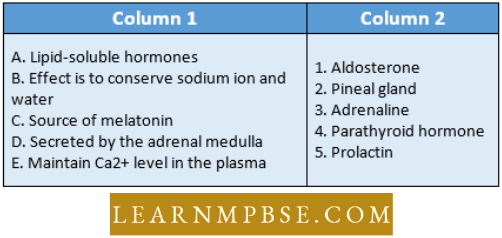
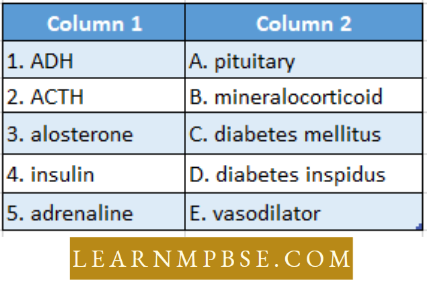
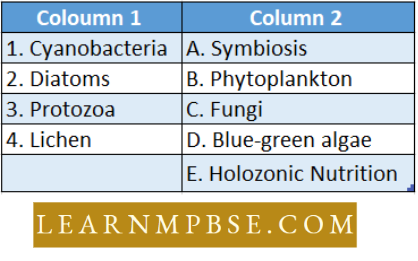
Question 186. Match The Definitions Of Column 1 With the Appropriate Term Of Column 2

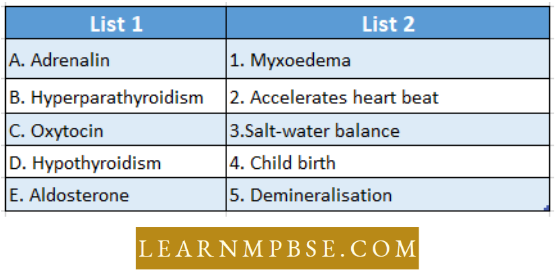
Endocrine System Match The Definition Question 186.

  • A B C D E
  1. 1 2 4 3 5
  2. 5 1 2 3 4
  3. 5 1 3 4 2
  4. 5 1 2 4 3.

Answer: 2.  5 1 2 3 4

Question 187. Both Adrenaline And Cortisol Are Secreted In Response To Stress; Which Of The Following Statement Is Also True For Both Of These Hormones?

  1. They Act To Increase Blood Glucose
  2. They Are Secreted By The Adrenal Cortex
  3. Their Secretion Is Stimulated By Adrenocorticotropin
  4. They Are Secreted Into The Blood Within Seconds Of The Onset Of Stress.

Answer: 1. They Act To Increase Blood Glucose

Question 188. Which Of The Following Is Not Inhibitory Hormone?

  1. PIH
  2. GHIH
  3. MIH
  4. GI.

Answer: 4. GI.

Question 189. Melanocyte Stimulating Hormone Is Secreted By Which Cell Type Of Pituitary Gland?

  1. Somatotroph
  2. Thyrotroph
  3. Corticotroph
  4. Gonadotroph.

Answer: 3. Corticotroph

Question 190. Which Of The Following Can Cause the Release Of Oxytocin Hormone In A Lactating Mother?

  1. Sight Of Baby
  2. Sound Of Baby
  3. Both 1 And 2
  4. None Of Above.

Answer: 3. Both 1 And 2

Question 191. Which Of The Following Hormone Is Not Present In Both Sexes?

  1. Oxytocin
  2. ADH
  3. FSH
  4. ICSH.

Answer: 4. ICSH.

Question 192. About A Million Islets Of Langerhans Each With Approximately 3000 Cells Comprise What Percentage Of Pancreas?

  1. 1
  2. 1-5
  3. 2
  4. 2-5.

Answer: 2. 1-5

Question 193. Which Of The Following Statement Is Incorrect?

  1. Somatostatin Inhibit The Secretion Of Insulin And Glucagon
  2. Cortisol Hormone Has No Role During And After Danger
  3. Hypoglycemic Results From Hypersecretion Of Insulin
  4. Human Placental Lactogen Stimulate Mammary Growth.

Answer: 2. Cortisol Hormone Has No Role During And After Danger

Thyroid Gland Disorders NEET Exam Preparation

Question 194. Which Of The Following Is A Function Of Calcitonin?

  1. Regulation Of Metabolic Rate
  2. Maintenance Of Body Temperature
  3. Regulate The Development Of Mental Faculties
  4. All Of The Above.

Answer: 4. All Of Above.

Question 195. Hypophysectomy Results In Diminution Of All Except One Of The Following Hormones.

  1. Acth (Adrenocorticotrophic Hormone)
  2. Growth Hormone
  3. Prolactin
  4. Tsh (Thyroid Stimulating Hormone).

Answer: 3. Tsh (Thyroid Stimulating Hormone).

Question 196. The Glucocorticoids Are Mainly Responsible For :

  1. Enhancement Of Glucose Formation
  2. Diminution Of Glucose Formation
  3. Excretion Of Sodium By Kidney
  4. Retention Of Sodium By Kidney.

Answer: 1. Enhancement Of Glucose Formation

Question 197. Insulin Deficiency Produces :

  1. Increased Entry Of Glucose Into Cells
  2. Reduced Entry Of Glucose Into Cells
  3. Decreased Release Of Glucose From Liver
  4. No Effect On Carbohydrate Metabolism.

Answer: 2. Reduced Entry Of Glucose Into Cells

Question 198. Hormones Based On Fatty Acids Are :

  1. Small In Size And Variable In Structure
  2. Small In Size And Constant In Structure
  3. Large In Size And Variable In Structure
  4. Large In Size And Constant In Structure.

Answer: 2. Small In Size And Constant In Structure

Question 199. A Disease Which Is Caused By The Under-Secretion Of Adrenal Cortex Is :

  1. Grave’s Disease
  2. Addison’s Disease
  3. Cushing’s Syndrome
  4. Acromegaly.

Answer: 2. Addison’s Disease

Question 200. A Hormone Which Helps In The Implantation Of Embryo In Uterus Is :

  1. Oestrogen
  2. Relaxin
  3. Progesterone
  4. Thymosin.

Answer: 3. Progesterone

NEET Biology Endocrine System Questions From Competitive Examination

Question 1. Myxoedema Is Due To :

  1. Decreased Production Of Thyroxine
  2. Increased Production Of Thyroxine
  3. Excess Gh
  4. Decreased Insulin.

Answer: 1. Decreased Production Of Thyroxine

Question 2. Injection Of Glucagon Will :

  1. Cause Hypoglycemia
  2. Cause Galactosemia
  3. Increase Blood Sugar
  4. Cause Goitre.

Answer: 3. Increase Blood Sugar

Question 3. Goitre Influences :

  1. Speech
  2. Excretion
  3. Metabolism
  4. Vision.

Answer: 3. Metabolism

Question 4. Pheromones Are :

  1. Produced By Endocrine Glands
  2. Mrnas
  3. Chemicals Used In Animal Communication
  4. Proteins.

Answer: 3. Chemicals Used In Animal Communication

Question 5. Which Is Not Involved In Endocrine Secretion?

  1. Ley Dig Cell
  2. Lutein Cell
  3. Para-Follicular Cells Of Thyroid
  4. Kupffer Cells.

Answer: 4. Kupffer Cells

Neet Previous Year Questions On Endocrine System

Question 6. Gh Affects Growth By Controlling Production Of:

  1. mRNA
  2. tRNA
  3. rRNA
  4. None Of The Above.

Answer: 1. mRNA

Question 7. If the Receptor Molecule Is Removed From the Target Organ For Hormone Action, The Target Organ Will:

  1. Continue To Respond But Requires Higher Concentration Of Hormone
  2. Continue To Respond But In Opposite Way
  3. Continue To Respond Without Any Difference
  4. Not Respond To Hormone.

Answer: 4. Not Respond To Hormone.

Question 8. Melatonin Is Produced By :

  1. Thymus
  2. Skin
  3. Pituitary
  4. Pineal Gland.

Answer: 2. Skin

Question 9. On Seeing A Tiger, The Heart Beat And Blood Pressure Increase Due To Release Of Hormone :

  1. Adrenaline
  2. Thyroxine
  3. Parathormone
  4. Corticoids.

Answer: 2. Thyroxine

Question 10. A Person Has Protruding Eyes, Tachycardia, And Higher Body Temperature. He Is Suffering From :

  1. Cretinism
  2. Hyperthyroidism
  3. Diabetes
  4. Acromegaly.

Answer: 2. Hyperthyroidism

Question 11. Match The Endocrine Gland, Given Under Column 1 With Their Respective Position In The Body, Given Under Column 2. Choose The Answer Which Gives The Correct Combination Of Alphabets Of Two Columns :

Endocrine System Match The Endocrine Glands Combination Question11

  1. A – S, B = T, C = P, D= Q
  2. A = Q, B = S, C = T, D= P
  3. A = T, B = R, C = P, D= Q
  4. A = P, B = Q, C = R, D= T.

Answer: 3. A = T, B = R, C = P, D= Q

Question 12. Match The Hormone Listed Under Column 1 With The Roles  Given Under Column 2. Choose The Choice In Which The Alphabets Of The Two Columns Are Correctly Matched :

Endocrine System Match The Hormone Question 12

  1. A = Q, B = S, C = P, D- R
  2. A – T, B = P, C = S, D= Q
  3. A = R, B = T, C = S, D= Q
  4. A = T, B – S, C = P, D= Q.

Answer: 4. A = T, B – S, C = P, D= Q.

Question 13. Autoimmune Hypothyroidism Is :

  1. Hashimoto Disease
  2. Cushing Syndrome
  3. Myxoedema
  4. Addison’s Disease.

Answer: 1. Hashimoto Disease

Question 14. Steroids Are Precursors Of:

  1. Progesterone
  2. Oestrogen
  3. Testosterone
  4. All Of the Above.

Answer: 4. All Of Above

Thyroid Gland Disorders NEET Exam Preparation

Question 15. Thyrotropin – Releasing Factor (Trf) Is Produced By :

  1. Cerebrum
  2. Optic Lobe
  3. Cerebellum
  4. Hypothalamus.

Answer: 4. Hypothalamus.

Question 16. Tetany Is Caused By :

  1. Hypothyroidism
  2. Hyperthyroidism
  3. Hypoparathyroidism
  4. Hyperparathyroidism.

Answer: 3. Hypoparathyroidism

Question 17. Mainly Which Type Of Hormones Control The Menstrual Cycle In Human Beings :

  1. FSH
  2. Progesterone
  3. FSH, LH, Estrogen
  4. LH.

Answer: 3. FSH, LH, Estrogen

Question 18. When Both Ovaries Are Removed From the Rat Then Which Hormone Is Decreased In Blood?

  1. Oxytocin
  2. Gonadotrophic Releasing Factor
  3. Estrogen
  4. Prolactin.

Answer: 3. Estrogen

Question 19. Which One Of The Following Pairs Correctly Matches A Hormone With A Disease Resulting From Its Deficiency?

  1. Insulin -Diabetes Insipidus
  2. Relaxin -Gigantism
  3. Prolactin -Cretinism
  4. Parathyroid Hormone -Tetany.

Answer: 4. Parathyroid Hormone -Tetany

Question 20. Synthesis Of Testosterone By Leydig Cells Is Stimulated By :

  1. FSH
  2. ICSH
  3. LTH
  4. TSH

Answer: 2. ICSH

Question 21. Which One Of The Following Hormones Is A Modified Amino Acid?

  1. Prostaglandin
  2. Estrogens
  3. Epinephrine
  4. Progesterone.

Answer: 3. Epinephrine

Question 22. Which One Of The Following Pairs Correctly Matches A Hormone With A Disease Resulting From Its Deficiency?

  1. Thyroxine-Tetany
  2. Parathyroid Hormone-Diabetes Mellitus
  3. Luteinizing Hormone-Failure Of Ovulation
  4. Insuhn-Diabetes Insipidus.

Answer: 3. Luteinizing Hormone-Failure Of Ovulation

Question 23. Chemically The Hormones Are :

  1. Proteins Only
  2. Steroids Only
  3. Biogenic Amines Only
  4. Proteins, Steroids And Biogenic Amines.

Answer: 3. Biogenic Amines Only

Question 24. Which Of The Following Hormones Is Not A Secretion Product Of the Human Placenta?

  1. Estrogens
  2. Progesterone
  3. Hcg
  4. Prolactin.

Answer: 4. Prolactin.

Question 25. Damage To the Thymus In A Child May Lead To :

  1. A Reduction In Haemoglobin Content Of Blood
  2. A Reduction In Stem Cell Production
  3. Loss Of Antibody-Mediated Immunity
  4. Loss Of Cell-Mediated Immunity.

Answer: 4. Loss Of Cell-Mediated Immunity.

Question 26. Parkinson’s Disease (Characterized By Tremors And Progressive Rigidity Of Limbs) Is Caused By Degeneration Of Brain Neurons That Are Involved In Movement Control And Make Use Of Neurotransmitters:

  1. Acetylcholine
  2. Norepinephrine
  3. Dopamine
  4. Gaba.

Answer: 3. Dopamine

Question 27. Fsh Is Secreted By :

  1. Anterior Lobe Of Pituitary
  2. Hypothalamus
  3. Gonads
  4. Posterior Lobe Of Pituitary

Answer: 1. Anterior Lobe Of Pituitary

Question 28. Which One Of The Following Four Glands Is Correctly Matched With The Accompanying Description?

  1. Thyroid – Hyperactivity In Young Children Causes Cretinism
  2. Thymus – Starts Undergoing Atrophy After Puberty
  3. Parathyroid – Secrete Parathormone Which Promotes the Movement Of Calcium Ions From Blood Into Bones During Calcification
  4. Pancreas – Delta Cells Of The Islets Of Langerhans Secrete A Hormone That Stimulates Glycolysis In the Liver.

Answer: 2. Thymus – Starts Undergoing Atrophy After Puberty

Thyroid Gland Disorders NEET Exam Preparation

Question 29. The Hormone That Controls The Level Of Calcium And Phosphorus In The Blood Is Secreted By :

  1. Thyroid
  2. Parathyroid
  3. Pituitary
  4. Thymus.

Answer: 2. Parathyroid

Question 30. Which Of The Following diseases is Not Related To Thyroid Gland?

  1. Myxoedema
  2. Cretinism
  3. Acromegaly
  4. Goitre.

Answer: 3. Acromegaly

Question 31. Grave’s Disease Is Due To :

  1. Hyperactivity Of the Thyroid Gland
  2. Hypoactivity Of Adrenal Cortex
  3. Hyperactivity Of the Adrenal Medulla
  4. Hypoactivity Of Islets Of Langerhans.

Answer: 1. Hyperactivity Of Thyroid Gland

Question 32. Hassal’s Bodies/Corpuscles Are Found In :

  1. Liver
  2. Thymus
  3. Thyroid
  4. Adrenal.

Answer: 2. Thymus

Question 33. Choose The Correct Combination Of Labelling In The Hormonal Control Of the Female Reproductive System

Endocrine System Choose The Correct Combination Question 33

  1. A-GnRH, B-Tsh, C- Lth, D-Uterus
  2. A-Gnrh, B-Fsh/Lh, C – Estrogen Of Progesterone, D- Utrerus
  3. A-Gnrh, B-Sth, C-Lh, D-Uterus
  4. A-Gnrh, B-Acth, C-Lh, D-Uterus.

Answer: 2. A-Gnrh, B-Fsh/Lh, C – Estrogen Of Progesterone, D- Utrerus

Question 34. Which Of The Following Is Not Paired Correctly?

  1. Myxoedema – Swollen Facial Tissues
  2. Cretinism – Mentally Retarded
  3. Grave’s Disease – Exophthalmos
  4. Insulin – Raise Blood Glucose.

Answer: 4. Insulin – Raise Blood Glucose.

Question 35. Match Item In Column 1 With Those Given In Column 2.

Endocrine System Match The Item Column 1 With Column 2 Question 35

  1. 1 – A, 2 – D, 3 – B,  4 – C, 5 – E
  2. 1 – D, 2 – B, 3 – A,  4 – C,  5 – E
  3. 1 – D, 2 – A, 3 – B,  4 – C,  5 – E
  4. 1 – D, 2 – A, 3 – C,  4 – B,  5 – E.

Answer: 3. 1 – D, 2 – A, 3 – B,  4 – C,  5 – E

Question 36. If the Receptor Molecule Is Removed From the Target Organ For Hormone Action, The Target Organ Will:

  1. Continue To Respond But Require Higher Concentration Of Hormone
  2. Continue To Respond But In Opposite Away
  3. Continue To Respond Without Any Difference
  4. Not Respond To Hormone.

Answer: 4. Not Respond To Hormone.

Question 37. Match The List 1 Wish List 2

Endocrine System Match The List 1 And List 2 Question 37

  1. A : 3, B:1, C: 4, D: 2
  2. A: 1, B: 2, C : 3, D: 4
  3. A: 2, B: 1, C: 4, D : 3
  4. A: 4, B : 3, C: 2, D: 1.

Answer: 3. A:2, B: 1, C: 4, D: 3

Question 38. A Patient Of Diabetes Mellitus excretes glucose In Urine Even When He Is Kept on a carbohydrate-free diet. It Is Because :

  1. Fats Are Catabolised To Form Glucose
  2. Amino Acids Are Catabolised In Liver
  3. Amino Acids Are Discharged In Blood Stream From Liver
  4. Glycogen From Muscles Are Released In The Blood  Stream.

Answer: 1. Fats Are Catabolised To Form Glucose

Question 39. Sertoli Cells Are Regulated By The Pituitary Known As:

  1. Prolactin
  2. LH
  3. FSH
  4. GH.

Answer: 3. FSH

Question 40. A Steroid Hormone Which Regulates Glucose Metabolism Is :

  1. 11-Deoxycorticosterone
  2. Cortisone
  3. Cortisol
  4. Corticosterone.

Answer: 3. Cortisol

Question 41. Which One Of The Following Is Not A Second Messenger In Hormone Action?

  1. Sodium
  2. Camp
  3. Cgmp
  4. Calcium.

Answer: 1. Sodium

Question 42. Which One Of The Following Statements Is Correct?

  1. Neurons Regulate Endocrine Activity, But Not Vice Versa
  2. Endocrine Glands Regulate Neural Activity, But Not Vice Versa
  3. Neither Hormones Control Neural Activity Nor The Neurons Control Endocrine Activity
  4. Endocrine Glands Regulate Neural Activity, And Nervous System Regulates Endocrine Glands.

Answer: 4. Endocrine Glands Regulate Neural Activity, And Nervous System Regulates Endocrine Glands.

Question 43. Which Hormone Causes Dilation Of Blood Vessels, Increased Oxygen Consumption And Glucogenesis?

  1. Adrenalin
  2. ACTH
  3. Glucagon
  4. Insulin.

Answer: 1. Adrenalin

Question 44. Withdrawal Of Which Of The Following Hormones Is The Immediate Cause Of Menstruation?

  1. FSH
  2. Progesterone
  3. Estrogen
  4. FSH-RH.

Answer: 2. Progesterone

Question 45. Which Is Not A Symptom Of Hypothyroidism?

  1. Lethargy
  2. Mental Retardation
  3. Oedema
  4. Rise In Blood Urea.

Answer: 4. Rise In Blood Urea

Question 46. Flyposecretion Of Which Of The Following Can Cause Diabetes Insipidus?

  1. Insulin
  2. Thyroxine
  3. Glucagon
  4. ADH.

Answer: 1. Insulin

Question 47. The Hormones That Initiate Ejection Of Milk, Stimulate Milk Production And Growth Of Ovarian Follicles Are Respectively Known As

  1. PRL, OT, And LH
  2. OT, PRL And FSH
  3. LH, PRL, And FSH
  4. PRH, OT, And LH
  5. PRH, OT, And FSH

Answer: 2. OT, PRL And FSH

Question 48. Hypothyroidism In Adults And Hyperparathyroidism Will Respectively Lead To :

  1. Myxoedema And Cretinism
  2. Grave’s Disease And Hashimoto’s Disease
  3. Myxoedema And Osteitis Fibrosa Cystica
  4. Addison’s Disease And Cretinism
  5. Cretinism And Osteitis Fibrosa Cystica.

Answer: 3. Myxoedema And Osteitis Fibrosa Cystica

Question 49. Which One Of The Following Endocrine glands functions As A Biological Clock And A Neurosecretory Transducer?

  1. Adrenal Gland
  2. Thyroid Gland
  3. Pineal Gland
  4. Thymus Gland
  5. Pituitary Gland.

Answer: 3. Pineal Gland

Question 50. Match The Hormone In Column 1 With Their Function In Column 2.


  1. A-5, B-4, C-L, D-2
  2. A-4, B-5, C-2, D-1
  3. A-4, B-3, C-2, D-5
  4. A-5, B-1, C-2, D-4
  5. A-4, B-2, C-3, D-5.

Answer: 1. A-5, B-4, C-1, D-2

Question 51. In The Homeostatic Control Of Blood Sugar Level, Which Organs Function Respectively As Modulator And Effector?

  1. Liver And Islets Of Langerhans
  2. Hypothalamus And Liver
  3. Hypothalamus And Islets Of Langerhans
  4. Islets Of Langerhans And Hypothalamus.

Answer: 3. Hypothalamus And Islets Of Langerhans

Question 52. Column 1 Lists The Endocrine Structure And Column 2 Lists The Corresponding Hormones. Match The Two Columns. Identify The Correct Option From Those Given.

Endocrine System Column 1 List The Endocrine Structure And Column 2 Lists The Corresponding Hormones Question 52

  1. P = t,  Q = r,  R = s,  S = q
  2. P = t,  Q = r,  R = q,  S = s
  3. P = p, Q = q, R = s,  S = r
  4. P = r,  Q,= t,  R = s,  S = q.

Answer: 1. P = t, Q = r, R = s, S = q

Question 53. Which Of The Following Hormones Are Produced In The Hypothalamus And Stored In The Posterior Pituitary?

  1. FSH And LH
  2. ADH And Oxytocin
  3. TSH And STH
  4. ACTH and MSH.

Answer: 2. ADH And Oxytocin

Question 54. Parathyroid :

  1. Increases Blood Ca Level
  2. Decreases Blood Ca Level
  3. Promotes Collagen Synthesis By Osteoblasts
  4. All Of The Above.

Answer: 1. Increases Blood Ca Level

Question 55. Which Part Of the Ovary In Mammals Acts As An Endocrine Gland After Ovulation?

  1. Stroma
  2. Germinal Epithelium
  3. Vitelline Membrane
  4. Graffian Follicle.

Answer: 4. Graffian Follicle.

Question 56. A Person Is Having Problems With Calcium And Phosphorus Metabolism In His Body. Which One Of The Following Glands May Not Be Functioning Properly?

  1. Parotid
  2. Pancreas
  3. Thyroid
  4. Parathyroid.

Answer: 4. Parathyroid.

Question 57. Feeling The Tremors Of An Earthquake A Scared Resident Of the Seventh Floor Of A Multistoryed Building Starts Climbing Down The Stairs Rapidly. Which Hormone Initiated This Action?

  1. Adrenaline
  2. Glucagon
  3. Gastrin
  4. Thyroxine.

Answer: 1. Adrenaline

Question 58. Match List With List Ii And Select The Correct Option.

Endocrine System Match The List 1 With List 2 Question 58

  1. A – 2, B – 5, C – 4, D – 1, E – 3
  2. A – 3, B – 4, C – 5, D -3,  E – 2 ‘
  3. A – 5, B – 3, C – 2, D – 4, E – 1
  4. A – 2, B -3,  C – 4, D – 5, E – 1
  5. A – 5, B – 3, C – 4, D – 2, E – 1.

Answer: 1. A – 2, B – 5, C – 4, D – 1, E – 3

Question 59. Which One Of The Following Pairs Of Organs Includes Only The Endocrine Glands?

  1. Thymus And Testes
  2. Adrenal And Ovary
  3. Parathyroid And Adrenal
  4. Pancreas And Parathyroid.

Answer: 3. Parathyroid And Adrenal

Question 60. Which One Of The Following Is An Amine Hormone?

  1. Insulin
  2. Oxypurin
  3. Thyroxine
  4. Progesterone.

Answer: 3. Thyroxine

Question 61. The Blood Calcium Level Is Lowered By The Deficiency Of :

  1. Thyroxine
  2. Calcitonin
  3. Parathormone
  4. Both Calcitonin And Parathormone.

Answer: 3. Parathormone

Question 62. In Human Adult Females Oxytocin :

  1. Is Secreted By the Anterior Pituitary
  2. Stimulates Growth Of Mammary Glands
  3. Stimulates Pituitary To Secrete Vasopressin
  4. Causes Strong Uterine Contractions During Parturition.

Answer: 4. Causes Strong Uterine Contractions During Parturition.

Question 63. Match The Source Gland With Its Respective Hormone As Well As The Function.

Endocrine System Match The Source Gland Question 63

Answer: 2. Posterior- Vasopressin- Stimulates resorption Of Water In the Distal tubules in the nephron

Question 64.  Given Below Is An Incomplete Table About Certain Hormones, Their Source Glands, And One Major Effect Of Each On The Body In Humans. Identify The Correct Option For The Three Blanks A, B, And C.

Endocrine System Given Is An Incomplete Table Question 64

Endocrine System Question 64 Options

Answer: 1. A- Ovary, B- Glucagon, C- Growth Hormone

Question 65. Which One Of The Following Statements Is Incorrect?

  1. Glucagon Is Secreted By Pancreas.
  2. Androgen Is Produced By Ovary.
  3. Thyroxine Is Secreted By Thyroid.
  4. Oxytocin Is Secreted By the Pituitary.

Answer: 2. Androgen Is Produced By Ovary.

Question 66. Which Of The Following Statements Is Correct To The Endocrine System?

  1. Organs In The Body Like the Gastrointestinal Tract, Heart, Kidney, And Liver Do Not Produce Any Hormones.
  2. Non-Nutrient Chemicals Produced By The Body In Trace Amount That Act As Intercellular Messenger Are Known As Hormones.
  3. Releasing And Inhibitory Hormones Are Produced By The Pituitary Gland.
  4. Adenohypophysis Is Under Direct Neural Regulation Of The Hypothalamus.

Answer: 2. Non-Nutrient Chemicals Produced By The Body In Trace amounts that Act As Intercellular Messengers Are Known As Hormones.

Question 67. A Pregnant Female Delivers A Baby Who Suffers From Stunted Growth, Mental Retardation/Low Intelligence Quotient And Abnormal Skin. This Is The Result Of :

  1. Low Secretion Of Growth Hormone
  2. Cancer Of The Thyroid Gland
  3. Oversecretion Of Pars Distalis
  4. Deficiency Of Iodine In Diet.

Answer: 4. Deficiency Of Iodine In Diet.

68. Select The Answer Which Correctly Matches The Endocrine Gland With The Hormone It Secrets And Its Function/Deficiency Symptom :

Endocrine System Select The Answer Question 68

Answer: 2.

NEET Biology Ecosystem Notes

NEET Biology Ecosystem

Ecosystem. The relationship between a living community (biotic) and its non-living environment (abiotic) is expressed by the term ecosystem. The term was introduced by Tansley (1937).

  • Ecosystems are also called biocoenosis, geobiocoenosis, phytocoenosis, biosystem, exosome, and Holocene.
  • Microecosystem. Very small-sized ecosystem.
  • The Ecosystem is maintained by the flow of energy through it. This flow is unidirectional.
  • Amount Of Energy Trapped. 2% of solar radiation by aquatic ecosystems.
  • 1% of solar radiations by terrestrial ecosystems

Read and Learn More NEET Biology Notes

Ecosystem Flowchart

Ecosystem Notes For Neet

Bioenergetics. The flow of energy into ecosystems and its transformations in living organisms.

  • Sun utilizes about 4 million tonnes of H2 per second.
  • Solar energy travels in space in the form of electromagnetic waves. Only 47% of solar radiation reaches the surface of the earth.
  • Biomass. The amount of living matter present in an organism is biomass.
  • The amount of biomass can be calculated in terms of energy.

NEET Biology Notes Covering Ecosystem Dynamics

NEET Biology Ecosystem

Components Of Ecosystem

Food Chains. A food chain consists of a connected group of producers, consumers, and decomposers. It starts with energy from the sun and nutrients from the soil. They pass through plants and one or several consumers to a final consumer that is not fed upon by any other.

Producers. They use the radiant energy of the sun during photosynthesis whereby CO2 is assimilated and the light energy is converted into chemical energy. Green plants are called producers transducers or converters.

Autotrophs. They are green plants that have the capacity to synthesize food in sunlight. They are also called primary producers because solar energy is locked up only in these plants.

Heterotrophs. These are those organisms that are non-green and hence can’t manufacture their own food. Hence they have to depend upon other plants and animals for their food requirement. Hence they are consumers.

Primary Consumers. These are herbivorous animals and depend upon green plants i.e. on producers for their food, for example, Cows and goats.

Secondary Consumers. These are carnivorous animals and eat the flesh of herbivorous animals, for example, dogs, and cats.

Tertiary Consumers are the carnivorous animals that eat other carnivores for example, snakes eat frogs, birds, eat fish.

Top Consumers are carnivores of an ecosystem that are not killed and eaten by other animals, for example, Lions, Vultures, bears, etc.

Microconsumer. Decomposers are termed microconsumers.

Grazing Food Chain: The grazing food chain is also known as the predator food chain.

Ecosystem Grazing Food Chain

  • In grazing food chains, the size of an individual gradually increases in successive trophic levels.
  • Ecosystems with grazing food chains are directly dependent on solar radiation.
  • Most of the ecosystems in nature follow the grazing food chain.

Detritus Food Chain: It starts from dead organic matter into microbes and then to detritus-feeding organisms (detritivores) and their predators. A good example of a detritus food chain is given by Heald and Odum.

Ecosystem Detritus Food Chain

The chain is based on mangrove (Rhizophore wangle) leaves, which fall into shallow estuarine waters of south Florida, leaf fragments acted on by saprotrophs and colonized by algae are eaten and re-eaten by a group of small detritus consumers which in turn, provide the main food for game fish and fish (small carnivore) eaten by birds (top carnivores).

  • Dead plant parts and animal remains are called detritus.
  • Dried plant parts such as leaves, bark, flowers, etc., and dead remains of animals including fecal matter dropped over the soil constitute the above-ground detritus or litter fall while dead roots (root detritus) constitute the below-ground detritus.
  • In the detritus food chain source of energy is detritus (dead organic matter) and not the Sun.
  • The detritus food chain is composed of a long chain of detritus-eating organisms (detritivores).
  • In some ecosystems such as tropical rain forests, more energy flows in the detritus food chain than the grazing food chain.

Decomposers. These include bacteria, fungi, and other organisms that break down the complex compounds present in dead producers and consumers into simpler compounds. These simple organic matters are again decomposed by bacteria into inorganic forms.

Neet Biology Ecosystem Notes Pdf

Processes Of Decomposition

  1. Fragmentation of detritus.
  2. Leaching
  3. Catabolism
  1. Fragmentation. Due to fragmentation, the surface area of detritus particles is greatly increased.
  2. Leaching. Water percolating through soil removes soluble substances (for example sugars, several nutrients) from the fragmented detritus due to leaching action.
  3. Catabolism. The extracellular enzymes released by bacteria and fungi carry out catabolism i.e. enzymatic conversion of the decomposing detritus to simpler compounds and inorganic substances. It is important to know that all three decomposition processes operate simultaneously on the detritus.

Humification And Mineralization occur during decomposition in the soil. Humification leads to the accumulation of a dark-colored amorphous substance called humus. Humus is highly resistant to microbial action and undergoes extremely slow decomposition. It serves as a reservoir of nutrients. Mineralization results in the release of inorganic substances (for example CO2, H2O) and available nutrients (NH+4, Ca++, Mg++, K+, etc.) in the soil.

Factors Affecting The Rate Of Decomposition

  1. The upper layer of soil is the main site of decomposition processes in the ecosystem.
  2. The rate of decomposition of detritus is affected by climatic factors and the chemical quality of detritus.
  3. Temperature and soil moisture affect the activities of root microbes.
  4. The chemical quality of detritus is determined by the relative proportion of water-soluble substances, polyphenols, lignin, and nitrogen.

The amounts of energy and materials transferred from one trophic level to the next higher level become less and less and can be represented graphically as pyramids of energy and pyramids of biomass.

Abiotic Components. Abiotic components are non-living factors. It includes water, minerals, salts, humidity, light, temperature, pH, wind, topography, and background.

NEET Biology Ecosystem Food Web

Many food chains operate in a community. They are not independent but are interconnected to such an extent that disturbance in any food chain disturbs the whole community. The interrelationship among the various food chains of a community is called the food web.

When food chains are interconnected with each other forming a network of food transfer of energy flow. This network is called a food web.

Ecosystem Food Web

The arrows in the figure indicate – the flow of energy which is always transferred but never exchanged.

Ecosystem Kinds Of Ecosystem

Kinds Of Ecosystem

E. P. Odum classified ecosystem on the basis of photosynthesis-respiration ratio as under (P/R Ratio):

  1. Stabilized Ecosystem: The P/R ratio is one.
  2. Autotrophic Ecosystem: P/R is more than one.
  3. Heterotrophic Ecosystem: The P/R ratio is less than one

NEET Biology Ecosystem General Pattern Of Energy Flow

Under favorable environmental conditions, only about 1-5% of the energy of incident radiation or 2-10% of PAR is actually captured by the photosynthetic process (gross primary productivity) and the remaining portion is dissipated.

Ecosystem General Pattern Of Energy Flow

Since the simultaneously occurring respiratory processes are energy-consuming and use up part of the photosynthetic gain, the net capture of energy (net primary productivity) is reduced to only 0-8—4% of the incident total radiation or 1-6-8% of PAR. Only the energy captured in the net productivity of producers can be used by other trophic levels.

NEET Biology Ecosystem Ecological Pyramids

Ecological Pyramids can be of three types:

  1. Pyramid Of Number. It can be upright, inverted, or spindle-shaped.
    • Upright Pyramid. Grassland, Pond ecosystem
    • Spindle Pyramid. Forest ecosystem.
    • Inverted Pyramid. Parasitic ecosystem
  2. Pyramid Of Biomass: It is upright for terrestrial habitats.
    • It is inverted or spindle-shaped for aquatic habitats where the biomass of a trophic level depends upon the reproductive potential and longevity of its members.
    • If the total biomass produced per unit of time is calculated, the pyramid of biomass shall always be upright.
    • Maximum biomass occurs in producers. About 10-20% of the biomass is transferred from one trophic level to another.
    • Upright-Pyramid. Grassland, Forest, and Parasitic ecosystems,
    • Inverted Pyramid. Pond ecosystem.
  3. Pyramid Of Energy. Always upright, more accurate than the pyramid of biomass or the pyramid of numbers.

The energy content is expressed in kcal/ m²/ yr or kJ/ m²/yr.

Components Of Ecosystem Neet Notes

Energy Conserving Efficiency

  • Grasslands: 1.15%
  • Savannah: 0.9%
  • Mixed Forests: 0.8%
  • Modem Crops: 5%
  • Sugarcane Field: 10-12%
  1. Community Productivity. Rate of net synthesis of organic matter by a community per unit time and area.
  2. Gross Primary Productivity. The total amount of food synthesized or biomass added by the organisms is called gross primary productivity.
  3. Net Primary Productivity. The organism loses a part of this biomass during its metabolic activities. The net or balanced dry matter accumulated in the organism, after it has consumed a part of it in metabolism or respiration, is called Net Primary Productivity. It is also called assimilative photosynthesis.
    • Net primary productivity = Gross primary productivity – Biomass consumed in respiration.
  4. Primary Productivity. The amount of energy accumulated through photosynthesis by producers is termed primary productivity.
  5. Secondary Productivity. The rate of synthesis of organic matter by consumers is termed secondary productivity.
    • In one year one hectare of forest shall consume 30 tonnes of CO2 and evolve 10 tonnes of O2
    • The amount of carbon dioxide fixed annually through photosynthesis is 7 x 10¹³  kg.

NEET Biology Ecosystem NEET Biology EcosystemEcological Efficiency

It is the effectiveness with which it maintains its dynamic nature. It is expressed as the energy ratio, expressing the efficiency with which organisms exploit their food resources and convert the food into biomass.

  • Such ratios are calculated by relating output to the input of energy, at various points along the pathway of energy flow.
  • These ratios are multiplied by 100 to express in percentage

Photosynthetic Efficiency = Gross primary productivity/Total incident solar radiation x 100

Net Production Efficiency (NPE). The efficiency with which assimilated energy is incorporated into reproduction, growth, and storage, is called the net production efficiency. It may be shown as:

∴ NEP = Production (reproduction and growth)/Assimilation x 100

In plants, NPE is defined as the ratio of net to gross production. This varies, between 3085% depending on the habitat and growth pattern.

Gross Production Efficiency. The GPE is the product of the assimilation efficiency and net production efficiency.

∴ GPR = Assimilation efficiency x NPE = Production}/Ingestion

This represents the overall efficiency of biomass production within a trophic level.

Assimilation Efficiency. The entire food energy that is consumed is not assimilated. The assimilation efficiency is defined as the percentage expressing the proportion of ingested or consumed energy that is assimilated. It may be shown as:

∴ Assimilation Efficiency = \(\frac{\text{Assimilation}{Ingestion}}\) x 100

Herbivores assimilate about 60 to 70% of the energy in young vegetation and 80% of that in seeds.

Exploitation Efficiency. It is defined as the efficiency with which the biological production of an entire tropic level is consumed.

Components Of Ecosystem NEET Biology

∴ Exploitation efficiency = Ingestion of food/Prey production x 100,

Ecological Efficiency. The % of energy converted into biomass by a higher trophic level over the energy of food resources available at the lower trophic level is called ecological efficiency.

Ecological Efficiency = Energy converted into biomass at tropic level/Energy present in biomass at lower trophic level x 100

Significance Of Ecological Efficiency:

The ratio is used to express the efficiency with which organisms exploit their food resources and convert the food into biomass. The ability of herbivores and carnivores to use the food energy ingested varies from one species to another.

NEET Biology Ecosystem Biomes

Biomes are large biogeographic areas characterized by the presence of distinct groups of climax vegetation, unique animals, and other forms of life.

Typical Climatic Conditions In Major Forest Types In India

Ecosystem Typical Climatic Conditions In Major Forest Types In India

  • Temperate Deciduous Forests. The areas have warm summers and moderately cool winters. Rainfall is 75-150 cm. Dominant trees are Oak, Elm, Birch, Maple Ash, Chestnut, and chickory. Beech, Poplar, and Magnolia. Conifers occur at places. Shrubs, herbs, ferns, mosses, lichens, grasses, vines, and epiphytes are abundant.
    • Most trees shed their leaves during autumn or fall making the soil brown. A mixed coniferous broad-leaved forest occurs in Indian hills between 1500-3500 m. Tree height can reach 30-40 m. Fauna consists of Deer, Fox, and Beaver. Wild Cat. Racoon, Opossum, Squirrel, Rabbit, Hare, Snakes, Lizards, Salamanders. Thrushes, Owls, Sparrows, and songbirds.
  • Taiga is the northern coniferous forest biome with long, severe winter and growing seasons limited largely to the few months of summer. Hardy conifers, Spruce in particular are the most representative of the flora and wolves and bears of the fauna.
  • Grasslands Distribution. The temperate grasslands are present in North America (Canada and the USA), South America, Eastern Europe, Central Asia, South Africa, and Australia. These are called prairies in North America, pampas in South America, steppes in Europe and Asia, veldts in Africa, and tussocks in Australia.
    • Economic Importance. The grasslands are of tremendous economic importance, for they are the prime farming (grain-growing and cattle-raising). Overfarming and loss of topsoil are serious ecological problems that threaten food production.
    • Physical Conditions. The land is plain or gently rolling. The annual rainfall ranges between 25 to 75 cm and it rains intermittently. Moisture is not enough to support forest or woodland. The climate is cold in winter and hot in summer. Dry periods are long. The sunlight is bright and evaporation high.
  • Life. Life is rich in the temperate grasslands.
    • Flora. The short and tall grasses, legumes, and composites form the dominant vegetation. Shrubs and trees may occur as scattered individuals.
    • Fauna. The animals of grasslands are grazing and burrowing mammals.
      • The grazing forms include bison, elk, prong-homed antelope, zebra, bighorn sheep, and deer. The burrowing forms are represented by rodents, such as jackrabbits, prairie dogs, gophers, and ground squirrels.
      • Carnivores, such as wolves, badger, coyotes, and many birds, such as lark, burrowing owl; and insects are also common. Some reptiles (lizards and snakes) also occur.

Characteristics Of Different Terrestrial Biome

Ecosystem Characterstics Of Different Terrestrial Biome

Desert: It is a dry sandy or rocky area with sparse vegetation due to the occurrence of little rain. Rainfall is low less than 120 mm or extreme deserts less than 70 mm per year because the area lies in rain shadow.

This is due to being present either far away from cloud-seeding areas, adjacent to cold ocean currents, beyond a mountain range, or without cloud intercepting mountains. Common deserts are Tibet, Gobi (Mongolia), Thar (India, Pakistan), Arabia, and Sahara, Deserts may be cold deserts or hot deserts.

Hot Deserts: Fewer plants grow in deserts. They are of different ecological categories, ephemeral annuals, rain perennials, succulents, and non-succulent perennials. Succulent include Cacti and Euphorbias. In cold deserts, Sedum, Draba, and Saxifraga occur.

Non-succulent hot desert plants are Aerua, Alhagi, Capparis, Calotropis, Cyperus, Calligonum, Eragrostis, Acacia, Tamarix, Prosopis, and Phoenix. Desert animals live in burrows during the hot periods. Common animals are ants, wasps, locusts, scorpions, spiders, lizards, snakes, desert rats, rabbits, hares, foxes, jackals, cats, etc.

Neet Previous Year Questions On Ecosystem

NEET Biology Ecosystem Aquatic Biomes

Oceanic, Lakes And Ponds, Marshes, Streams And Rivers.

Oceanic Biome– 2/3 of earth’s surface, 3.5%-concentration of salts, productivity is 1000 kcal/m² yr (less than the most terrestrial biomes). Temperature of ocean surface-28°C in equatorial regions and 0°C near the poles.

Divided Into (Depending Upon The Availability Of Light):

  1. Photic Or Euphotic Zone-upper 200 m layer of ocean.
  2. Apliotic Zone-200-2000 m.
  3. Abyssal Zone-dark zone, below 2000 m.
  4. Oceanic Basin Is Differentiated Into Three Parts:
    • Continental– Shelf. Gradually sloping area of the seashore. Slope- 0.1° from coastline to 160 km in the sea.
    • Continental Slope. A slanting area connects the continental shelf to the oceanic floor. Slope 3-6°.
    • Ocean Floor. Horizontal bottom area of open sea. Normal depth-6000m to 10,000m.

Three Main Types Of Environmental Zones Of Oceanic Basin:

  1. Littoral Zone-sea floor of continental shelf.
  2. Benthonic Zone– sea floor along continental slope, aphotic and abyssal zone, further differentiated into
  3. The Pelagic Zone, the water of the ocean, is further differentiated into Epipelagic, Mesopelagic, Bathypelagic, and Abyssopelagic.

Marine Organisms Are Classified According To The Region Of Their Activity.

  1. Plankton. Passively drifted organisms in surface layers of water bodies (some workers restrict the term plankton for micro-organisms, they refer to other large-size planktons as Neuston)
  2. Nekton, actively swim in surface and deep waters, phagotrophic.
  3. Benthos. Organisms of the bottom.

The Oceanic Biome Is Divided Into Three Major Ecosystems:

  1. Open Sea. the area beyond the continental shelf, divisible into photic, aphotic, and abyssal zones. Otherwise has 2 parts pelagic and benthoic.
  2. Coastal Region. The area of the continental shelf is divisible into 3 parts-intertidal, littoral, and neritic. The intertidal region is exposed, neritic zone comprises the main water body of the area. Beaches belong to the intertidal zone. A highly productive part of the coastal region is the Coral Reef, formed by foraminiferans, calcareous algae, and calcareous skeletons of coelenterates (especially corals).
  3. Estuary. The name of the coastal bay is formed by the tidal mouth of the river due to the mixing of fresh and seawater, there is a wide fluctuation of salinity 0.5-3.5%. Fluctuations of temperature also occur.

Lakes And Ponds. Stationary freshwater bodies that occur on land. Ponds are small, hollow size than one hectare, depth of less than 2 in. Lakes are larger and deeper. Actually, ponds arc natural or man-made depressions which get filled with rain or runoff water. Lakes develop due to:

  1. As a result of glaciation,
  2. Natural or man-made depressions get filled with H2O.
  3. Develop from main stream or river (oxbow lakes).
  • Oligotrophic Lakes– deep, rocky sides, little circulation of nutrients, little biota, for example, Sambhar Lake of Rajasthan.
  • Eutrophic Lakes are rich in biota, quick circulation of nutrients, and shallower, for example, Dal Lake of Kashmir.
  • Marshes -wetlands possessing turbid water bodies of a few cm in depth. Water received from rains and drains. Typical flora consists of amphibians and emerged hydrophytes named heliophytes. Snails, mosquitoes, larvae, insects, frogs etc occur.
  • Streams And Rivers – Lotic Ecosystems – flowing fresh water which differs in physical and climatic conditions, O2 content, temperature, speed, and volume of H2O.
  • Agroecology-Study of interrelationships between agricultural crops and their surrounding animate as well as inanimate environments.

Ecosystems do not occur in isolation, are in contact with adjacent ecosystems, and a part of their area overlaps (the overlapping area is called a Transition zone). Polar bear shows hibernation during winter in caves.

  • Microscopic Phytoplanktons-diatoms, Chlamydomonas, chlorella, spirogyra.
  • Freely Floating Plants – Lemna, Azolla, Pistia, Eichhomia.
  • Suspended Macrophytes – Utricularia, Hydrilla.
  • Anchored Submerged Plants – Vallisneria.
  • Floating Leaned Anchored Plants – Nelumbo, Nymphaea.
  • Emerged Plants – rooted at the bottom but part of them comes out of water. Sagittaria, Typha, Sciipus, Phragmites.

[All of the above varieties of plants are present in ponds and lakes]

Neet Previous Year Questions On Ecosystem

Aquatic Biomes Memory Points

  • The word “Biocoenosis” was introduced by Carl Mobius.
  • The Earth Summit in Rio de Janeiro focused on the conservation of genetic resources of flora and fauna.
  • The flora of Delhi is predominantly xerophytic.
  • Resurrection plants – examples of drought evasion Selaginella lepidophylla.
  • Fecundity refers to the potential ability of an organism to generate reproductive units, including eggs, sperm, or asexual structures.
  • Association. A collection of species within a trophic level use a shared resource base in a comparable manner, such as nectar-feeding birds or grazing and browsing mammals.
  • Herbivores are sometimes referred to as Key Industry Animals. (Elton, 1927) due to their ability to transform plant materials into animal matter.
  • Chaparral vegetation comprises resilient, dense, broad-leaved evergreen plants, such as sage and oak, that exhibit fire resistance.
  • Illumination is severely deficient in the tundra, with winter temperatures ranging from -30°C to -40°C. Summer lasts around 60 days at a temperature of 10°C.

NEET Biology Ecosystem Vegetation Of India

In India, there are two most common types of plant formations.

Forests. Indian forests are classified into four major types based on temperature such as tropical, mountain subtropical, temperate, and alpine.

  1. Tropical forests. They are of two types moist and dry. Moist tropical forests. On the basis of the degree of wetness, they may be
    • Tropical Wet Evergreen Forests. Annual rainfall is over 250 cm. as in the West Coast, Assam, Bengal, and Andaman islands. The dominant trees arc Dipterocarpus, Hopea, Artocarpus, Emblica, Man gif era, Iscora, and some climbers (Lianas) and epiphytes.
    • Tropical Moist Semi-Evergreen Forests. They are found in North Assam, Bengal, parts of Orissa receiving heavy rainfall. Trees shed their leaves for a brief period. They include trees such as Terminalia; and Shorca.
    • Tropical Moist Deciduous Forests. They are common in moist areas of Kerala, Karnataka, South Madhya Pradesh, Northern Uttar Pradesh, and Bihar. Bengal and North Orissa. They include teak and Sal trees.
    • Dry Tropical Deciduous Forests. Trees remain leafless for several weeks in the dry season. Trees are moderate in size with sparse canopy. Thorny shrubs, grasses, and some bamboos are also present in some regions. In the north, such forests are found in Punjab, U.P. Bihar, and Orissa in regions that are neither wet nor too dry.
  2. Temperate Forests. They occur above 5,300 ft altitude, chiefly in the mountains of the Himalayas and Nilgiri. In the Himalayas, Oaks and conifers are abundant.
  3. Alpine Vegetation. They are extensive throughout the Himalayas above 11,000 ft. The tree’s height becomes lesser with increasing altitude. Alpine vegetation is characterized by Rhododendrons. It includes small plants like Sedum, Primula, Saxifraga, and lichens.
  4. Grasslands. In India, natural grasslands are not found. Most Indian grasslands are being maintained in their present serai stage due to biotic interference.

NEET Biology Ecosystem Biosphere

Biosphere. The inhabited part of the earth and its atmosphere form the biosphere. It extends to about 22.5 km in thickness from the ocean bottom to the mountain tops.

  • Maximum Density Of Organisms is found in coral reefs and tropical rain forests.
  • Pedosphere. Consists of soil.
  • The lithosphere is the dry crust of the earth (rocks and soil) 20 km in thickness.
  • Hydrosphere. Oceans and sea (70% of the total earth’s surface).
  • The atmosphere consists of 78% N2, 20.9% 02, 0.94% Ar, and 0.03% CO2.

Ecosystem Fundamental regions Of The Environment

The atmosphere is differentiated into the troposphere, stratosphere, ozonosphere, and ionosphere.

NEET Biology Ecosystem Ecological Succession

Biotic Succession. A biologically controlled modification in the composition of a community of a particular area is called biotic succession or ecological succession. Biotic succession is also known as the successive development of different communities in a particular area till a climax community is formed.

It was first studied by King (1685). The term succession was coined by Hult(1885). Clements defined it as a natural process by which the same locality becomes successively colonized by different groups of plants. Odum further described it.

Energy Flow In Ecosystem NEET Study Material

Kinds Of Succession

  1. Primary Succession (Prisere). In any of the basic environments, primary succession starts from the primitive substratum, where there was no previously any sort of living matter. The first group of plants established there are known as pioneers, primary community, or primary colonizers and the last group is of climax community formed of tall trees.
    • The time taken for the development of forest climax or sand-dune or barren land is about 1000 yrs. Time taken is about 50-100 yrs in the case of grassland and more than 200 yrs for a forest
  2. Autotrophic Succession. This type of succession is dominated by autotrophs which represent the first serial stage. lt occurs on a substratum having excess mineral matter but little organic matter.
  3. Heterotrophic Succession. It occurs on a substratum having an excess of organic matter. This type of succession is always dominated by detrivores i.e., fungi and bacteria.
  4. Induced Succession. It occurs due to extensive external interference. Here the initial community has high productivity which gradually decreases. The agriculture can be deemed as an example of induced succession.
    • Here a steady state is maintained for an ultimate good harvest. Elimination of weeds can be deemed as a step towards retrogression as it inhibits the arrival of a stable state.
  5. Autogenic Succession. When the plants themselves gradually modify the environment to the extent that the habitat itself becomes unfavorable for the existing vegetation, a new type of succession starts. The old communities disappear and new ones come up for whom the environment is more suitable. This has been described as autogenic succession.
  6. Allogenic Succession. The habitat may change due to external thrust i.e. of the environment. The succession taking place on account of this is called as allogenic.
  7. Retrogressive Succession. Due to environmental thrust and human interference the climax vegetation may retrograde into shrubland or savannah. This is referred to as retrogressive succession.
  8. Deflated Succession. When the succession doesn’t proceed through its normal course and sidetracks the advancement line, it is called as deflated succession. If the normal stages are 1 → 2 → 3 → 4 and the succession occurs as 1 → 2 → 3A → 3B → 4 is deflated.
  9. Cyclic Succession. It occurs within the normal discourse of succession. If at a certain stage, the normal succession line is substituted by repetition of a previous stage due to external thrust, the succession is called cyclic for example 1 → 2 ⇔ 3 → 4.

Causes Of Succession

  1. Initiation.
    • Physiographic factors include erosion, deposition, submergence, and emergence.
    • Climatic Factors produce secondary, barren areas including wind, water, snow, hail, re, and draught.
    • Biotic Factors produce secondary barren areas including animals, mankind, and microorganisms.
  2. Continuation. Once started succession continues
  3. Stabilization

Process Of Succession: The various stages are

  1. Nudation
  2. Migration
  3. Ecesis
  4. Aggregation
  5. Competition
  6. Co-action
  7. Reaction and
  8. Stabilization.

Secondary Succession Subsere. It occurs when an early community has been damaged leaving a few organisms and considerable organic matter.

  • Ecological Succession in dry habitats, bare rock, sandy soil, and aquatic habitats are respectively called Xerosere, lithosere, psammosere, and hydrosere.
  • In hydrosere (or hydrarch), pioneers in an ecological succession are submerged hydrophytes.
  • In lithosere, the pioneers in an ecological succession are crustose (Saxicaulous lichens, Graphis, Rhijocaibon).
  • The dominant species are different for each succession stage in the series.
  • The last succession in a series is called the climatic climax or climax.

Energy Flow In Ecosystem NEET Study Material

NEET Biology Ecosystem Different Stages In Hydrosere With Component Plants

Phytoplankton Stage: (blue-green and green algae pioneer, Diatoms, bacteria.)

Rooted submerged Stage: Hydrilla, Vallisnaria Utricularia, Potamogeton Elodea, Najas, Ceratophyllum, certain got volume crunch as choro ano Nitalla

Floating Stage: Nelumbo, Nymphala, Zolle hemna, Trapa

Reed Swamp Stage: (Typha, Sagittaria Phragmites, Sagittaria, Siripus (Amphibious stage)

Sedge Meadow Stage: (Cyperus, Juncus, Eleocharis, Carix)

Wood Land Stage: (Salix, Populus, Alnus) (Climax community) Forest stage (Temperate mixed tropical rain and tropical deciduous)

NEET Biology Ecosystem Different Stages In Xerosere With Component Plants

Ecosystem Different Stages In Xerosere With Component Plants

NEET Biology Ecosystem Differences Between Terrestrial And Aquatic Succession

Ecosystem Differences Between Terrestrial And Aquatic Succession

NEET Biology Ecosystem Differences Between The Seral And Climax Community During Succession

Dominance of a species:

Any one or more species is present in a majority during succession in every stage, and that species is the dominant species in the community. For instance, a location may be classified according to the species that predominate the region, such as a teak forest or pine forest.

Ecosystem Difference Between The Serial Stage And Climax Community Being Succession

The dominant species significantly influences the community and the surrounding environment. At any stage, it is not requisite for a single species to dominate; multiple species may coexist in dominance. For example, in the rainforests of tropical regions, 10 to 12 species dominate.

NEET Biology Ecosystem Biogeochemical Cycle

The circular paths of the chemical elements between organisms and the environment are known as biochemical cycles.

Cycles of material are classified into gaseous and sedimentary cycles,

  1. For Gaseous cycles, the reservoir of materials is the atmosphere or water. The four major elements in living organisms: carbon, hydrogen, oxygen, and nitrogen, are predominantly gaseous;
  2. In the Sedimentary cycle involving minerals, like phosphorus, sulfur, and calcium, the reservoir is the lithosphere.

Energy Flow In Ecosystem NEET Study Material

Oxygen Cycle: The oxides can be reduced both chemically as well as biologically to produce oxygen. Microbial oxidation can also occur. O2 content of the atmosphere has remained constant for the last several million years.

Most of the O2 lost is replenished by photosynthesis.

Ecosystem Oxygen Cycle In Nature

Greenhouse gases tire (CO2 CH4, dust, HO2, NO2, SO2) are transparent to incoming solar radiations but are strong absorbers of long wave or infrared radiations emitted by the earth’s surface.

Carbon Cycle: The three main sources of carbon in the non-living world are:

  1. CO2 of air as well as dissolved in water
  2. Carbonates of rocks in the earth’s crust
  3. Coal and petroleum of fossil fuels.

Ecosystem Carbon Cycle

Most CO2 enters the living world through photosynthesis.

  • The amount of carbon fixed by photosynthesis is 7 x 10¹³ kg per year.
  • One hectare of healthy forest produces about 10 tonnes of O2 and absorbs 30 tonnes of CO2 every year.

Nitrogen Cycle: N2 forms 4/5 part of the atmosphere; picked up as inorganic compounds by plants and some prokaryotes (NO3 and NH4) and converted into organic N2.

N2 Fixation Is Of Three Types

1. Atmospheric-electrochemical and photochemical reactions (35 mg/ m²/ yr).

2. Biological by free-living bacteria (Azotobacter, Clostridium), symbiotic bacteria (Rhizobium), and cyanobacteria (Anabaena, Nostoc) [140-700 mg/m²/yr].

Proteins (Nitrogenous Compounds)

Ecosystem Nitrogenous Compounds

Ammonifying bacteria are Bacillus vulgaris and Bacillus remosa.

Ecosystem Nitrogen Cycle In Nature

Dead bodies of plants and animals also contain nitrogenous compounds, for example, Bacillus, actinomycetes, and fungi.

3. Industrial – Haber’s process

Ecosystem A Generalised Nitrogen Cycling Model Of A Terrestrial Ecosystem

Water Cycle: 60-90% of the body weight of an organism is made up of water.

  • The water or hydrological cycle is actually made up of two overlapping cycles: Larger ‘global’ and smaller ‘local’
  • Precipitation is of three main types. Rain, Snow, and Hail.
  • The total world precipitation amounts to 4.46 x 10²⁰ G per year. (1G = 1020 gm).
  • Biogeochemical Cycle. The cycling of materials between living and non-living components of the biosphere is called the biogeochemical cycle.

Phosphorus Cycle: The atmospheric or gaseous cycle for phosphorus is absent. Guano (excreta of marine birds) is a good source of phosphorus.

Sulfur Cycle: In the sulfur cycle, the gaseous phase is reduced. In nature, sulfur occurs in the elemental form (as metal sulfides and sulfates) and some amount as SO2 gas.

  • Sulfur is available to plants as sulfate
  • Sulfur is available to plants as sulfate. (SO42-) ions which are produced by the oxidation of exposed acid eroded rock surfaces. Most of this oxidation is biological and is carried out by specialized bacteria which derive energy from the process.
  • In plants, absorbed SO42- ions are incorporated into the thiol (-SH) groups of amino acids and proteins. In this form, the sulfur passes through the various trophic levels being released from living organisms only as a constituent of feces.
  • Decomposing bacteria break down the protein of dead organisms, reducing the -SH groups to H2S (hydrogen sulfide). It is the presence of this gas that sometimes gives the characteristic odor of rotten eggs to decomposing matter. The H2S produced may be oxidized to SO42- by certain bacteria but this is only possible under aerobic conditions.
  • Specialized photosynthetic bacteria living in sulfur springs use H2S instead of H2O as a raw material in the manufacture of carbohydrates and this sulfur returns to earth’s sediments.

Calcium, Magnesium, And Other Minerals: They are also cycled like other materials. These elements are slowly released from the rocks by the action of water and wind. These are either blown into the air as dust or are absorbed by plants through their roots.

Ecosystem Calcium Cycle

Some organisms, such as mollusks and corals, deposit a substantial quantity of calcium in their shells and skeletons that are not available for quick cycling.

Ecosystem Ecosystem Flowchart

  • The vertical distribution of different species occupying different levels is called stratification
  • Components of the ecosystem are seen to function as a unit with the following consideration

Ecosystem Notes For Neet

Productivity

  • Gross Primary Productivity (GPP)
  • Net Primary Productivity (GDP)
  • Secondary Productivity

Primary Productivity Depends Upon:

  • Plant species Environmental factors
  • Availability of nutrients
  • Photosynthetic capacity

Decomposition. Steps: Fragmentation, Leaching, Catabolism, Humification, Mineralization (Temperature, Soil moisture, Oxygen and detritus composition regulate decomposition,

Energy Flow: Producers → Primary → Secondary

  • Detritus Food Chain (DFC)
  • Grazing Food Chain (GFC)

Food Web. The natural interaction of food chains makes the food web.

  • The number of trophic levels is restricted as the transfer of energy follows 10 percent law Ecological pyramids
  • The pyramid of energy is always upright
  • The pyramid of number and biomass is generally upright
  • The pyramid of biomass in the sea is generally inverted
  • The pyramid of biomass of a small standing crop of phytoplankton supports a large standing crop of zooplankton thus it is inverted.

NEET Biology Ecosystem Ecosystem Synopsis

The deep sea constitutes an incomplete ecosystem due to the absence of producers. Koala bears are monophagous and will perish in the absence of eucalyptus leaves.

  • The pH of oceans exhibits minimal variation.
  • Snails and earthworms are absent in acidic soils.
  • Euglena and other flagellates are prevalent in acidic aquatic environments.
  • Organisms with calcareous shells inhabit environments with neutral or alkaline pH levels.
  • Snails inhabit soils abundant in calcium.
  • Animals counteract seawater salinity via salt-secreting glands.
  • Terrestrial animals are unaffected by alterations in pH levels. Nonetheless, it dictates the distribution of terrestrial flora and edaphic creatures.
  • Sloths are exclusively arboreal in their environment.
  • Some creatures function as both producers and consumers, such as insectivorous plants like Nepenthes (pitcher plant) and Drosera (Sundew plant).
  • Omnivores such as humans and bears occupy multiple trophic levels.

Ecological equivalents. Animals occupying similar ecological niches (similar food) in different geographical areas for example both owls and cats feed upon shrews and rats in woodland areas and near human habitations respectively.

  • There is the highest species diversity in the Tropical rainforest ecosystem.
  • Gujarat has the largest number of salt lakes in India.
  • Brine is water that has a high concentration of salt.
  • Herbs other than grass are called forb.
  • The number of biomes on a mountain range decreases with the increase in the latitude of the mountain.
  • Brackish lakes are always oligotrophic for example Sambhar Lake of Rajasthan.
  • Detritus trophic level – The last trophic level is constituted by decomposers.
  • Detritivores are decomposers as well as scavengers.

The detritus food chain is the shortest. Dystrophic lakes are rich in bogs (undecomposed organic matter), poor in CaCO2 and other inorganic matter, and poor in oxygen for example marshy lakes.

  • With increasing dependence on animal diets, the human population will need more farm produce.
  • Britain receives 2500 cal/cm²/yr of solar radiation while the amount at Varanasi in India is 75000 cal/ cm²/yr.
  • The fish ‘Hilsa’ is found in both fresh and marine waters.
  • Gauses hypothesis or Principle of competitive exclusion.
  • No two species can occupy the same ecological niche. In case it happens, only one survives while the other is excluded.
  • Tropical region occurs between 23°N and 23°S.
  • Secchi disc is used in measuring turbidity.

Plagiosere. It is a deflected sere where plant succession deviates from its natural course due to human activity and other forms of external intervention.

  • The climax of plagiosere is known as plagioclimax or disclimax.
  • The daily tidal cycle recurs after every 12.4 hours.
  • Characteristic vegetation beyond the timberline is Elfin scrub and Alpine meadows.
  • The water cycle is made up of two overlapping cycles — larger global and smaller local.
  • Matter occupies a space. It can be seen, smelled, tasted, and touched while energy does not occupy space and it can be felt through specific receptors for example heat, sound, light.
  • Earth is a closed system as far as materials are concerned.
  • Beijerinck (1888) isolated Bacillus radicicola and showed its ability to produce root nodules.
  • Winogradsky (1891) discovered nitrogen fixation.
  • Sea birds excrete uric acid, which is deposited to form guano in littoral islands. It is rich in uric acid and phosphorus and used as fertilizer.

Ozone-depleting gases are on NO2 (6%) chloroform carbons (25%) halocarbon/halons, and CO2 (57%)

Ecosystem Notes For Neet

Differences Between Grazing And Detritus Food Chains

Ecosystem Differences Between Grazing And Detritus Food Chains

Differences Between Wet Deposition And Dry Deposition

Ecosystem Differences Between Wet Deposition And Dry Deposition

The Ecosystem Receives Nutrients By

  1. Wet deposition
  2. Dry deposition

NEET Biology Ecosystem Multiple Choice Questions And Answers

Question 1. The term ecosystem was coined by:

  1. Sukachey
  2. Vernadsky
  3. Haeckel
  4. Tansley.

Answer: 4. Tansley.

Question 2. Biotic components of an ecosystem include:

  1. Producers
  2. Consumers
  3. Decomposers
  4. All the above.

Answer: 4. All the above.

Question 3. Which is the most stable ecosystem?

  1. Mountain
  2. Desert
  3. Forest
  4. Ocean.

Answer: 4. Ocean.

Question 4. In a biotic community, primary consumers are:

  1. Omnivores
  2. Carnivores
  3. Detritivores
  4. Herbivores.

Answer: 4. Herbivores.

Question 5. If we completely remove the decomposers from an ecosystem, the ecosystem functioning will be adversely affected because:

  1. Mineral movement will be blocked
  2. Herbivores will not receive solar energy
  3. Energy flow will be blocked
  4. The rate of decomposition of another component will be very high.

Answer: 1. Mineral movement will be blocked

Question 6. The food chain will end with:

  1. Carnivores
  2. Herbivores
  3. Decomposers
  4. Secondary carnivores.

Answer: 4. Secondary carnivores.

Question 7. Which of the following is a way flow rather than a two-way or cyclic flow?

  1. Carbon
  2. Nitrogen
  3. Potassium
  4. Free energy.

Answer: 4. Free energy.

Components Of Ecosystem Neet Notes

Question 8. The importance of the ecosystem lies in:

  1. Flow of energy
  2. Cycling of materials
  3. Both (1) and (2)
  4. None of the above.

Answer: 3. Both (1) and (2)

Question 9. The driving force for an ecosystem is:

  1. Biomass
  2. Producers
  3. Food
  4. Solar Energy.

Answer: 4. Solar Energy.

Question 10. About how much of solar energy that falls on the leaves of a plant is converted to chemical energy by photosynthesis?

  1. 1%
  2. 10%
  3. 30%
  4. 50%.

Answer: 1. 1%

Question 11. Energy and nutrients enter a community by way of:

  1. Producers
  2. Consumers
  3. Scavengers
  4. Detritivores.

Answer: 1. Producers

Question 12. A consumer whose carbon atoms have already passed through three species is a:

  1. Scavenger
  2. Tertiary Producers
  3. Tertiary Consumers
  4. Secondary Consumers.

Answer: 3. Tertiary Consumers

Question 13. The average annual precipitation in a desert biome is:

  1. 15-25 cm
  2. 25-30 cm
  3. 50-75 cm
  4. 75-100 cm.

Answer: 1. 15-25 cm

Question 14. A sequence of species through which the organic molecules in a community pass is called:

  1. Pyramid of energy
  2. Food chain
  3. Food web
  4. Nutrient cycle.

Answer: 2. Food chain

Question 15. Savannahs are:

  1. Tropical rain forest
  2. Desert scrubs
  3. Grassland with scattered trees
  4. Dense forests.

Answer: 3. Grassland with scattered trees

Components Of Ecosystem Neet Notes

Question 16. Most food chains are composed of:

  1. 1 or 2 species
  2. 3 or 4 species
  3. 9 or 10 species
  4. More than 16 species.

Answer: 2. 3 or 4 species

Question 17. A micro-climate is controlled mostly by factors associated with:

  1. The flatness of the terrain
  2. Vegetation
  3. Latitude
  4. Longitude.

Answer: 3. Latitude

Question 18. In which of the following habitats does the diurnal temperature of soil surface vary most?

  1. Desert
  2. Grassland
  3. Shrubland
  4. Forest.

Answer: 1. Desert

Question 19. A biome with high temperature, high rainfall no seasonal change, and soil rich in minerals and humus is:

  1. Shrub land
  2. Coral reef
  3. Tropical rain forest
  4. Temperate evergreen forest.

Answer: 3. Tropical rainforest

Question 20. A plant eaten by herbivorous animals which in turn is eaten by a carnivorous animal, it forms a:

  1. Food chain
  2. Food web
  3. Food pyramid
  4. Biotic potential.

Answer: 1. Food chain

Question 21. A pond is a:

  1. Biome
  2. Agro-ecosystem
  3. Natural ecosystem
  4. Community.

Answer: 3. Natural ecosystem

Question 22. Which of the following communities would have trees?

  1. Taiga
  2. Littoral zone
  3. Shrub land
  4. Tundra.

Answer: 1. Taiga

Question 23. Which of the following has a vegetation structure with only one level?

  1. Tropical rain forest
  2. Taiga
  3. Grassland
  4. Shrub land.

Answer: 3. Grassland

Question 24. What type of pyramids are commonly referred to in ecological studies?

  1. Lateral
  2. Compound
  3. Upright
  4. Inverted.

Answer: 3. Upright

Question 25. Which type of system does the earth along with its atmosphere constitute?

  1. Open
  2. Closed system
  3. Cut off system
  4. Biogeochemical system.

Answer: 2. Closed system

Question 26. Enrichment of habitat (say pond) with nutrients is called:

  1. BOD
  2. Biological magnification
  3. Eutrophication
  4. Autopurification.

Answer: 3. Eutrophication

Question 27. Wolves and lions may be said to occupy the same trophic level because:

  1. They both eat primary consumers
  2. They both utilize their food with about 10% efficiency
  3. They both live in a pond
  4. Both are large mammals.

Answer: 1. They both eat primary consumers

Question 28. About how much of the chemical energy within the producer’s tissue becomes chemical energy within herbivore tissue.

  1. 1%
  2. 10%
  3. 30%
  4. 50%.

Answer: 2. 10%

Question 29. The most diverse oceanic communities are in the:

  1. Abyssal zone
  2. Littoral zone
  3. Neritic zone
  4. Oceanic zone.

Answer: 2. Littoral zone

Components Of Ecosystem Neet Notes

Question 30. Which of the following aquatic ecosystems has very little primary productivity?

  1. River
  2. Estuary
  3. Lake
  4. Marsh.

Answer: 1. River

Question 31. Which of the following statements is true about ecological relationships?

  1. Competition with members of other species is more severe than that with one’s own species
  2. Competition with members of other species is less severe than with one’s own species
  3. Competition with members of other species is as severe as that with one’s own species
  4. Competition does not exist between members of different species.

Answer: 2. Competition with members of other species is less severe than with one’s own species

Question 32. The above represents:

Ecosystem Food Web Cahin

  1. Food chain
  2. Food web
  3. A population
  4. Ecosystem.

Answer: 2. Food web

Question 33. Light compensation zone refers to the zone:

  1. Where all light energy is used efficiently
  2. Where light is available
  3. Beyond which light does not penetrate
  4. Where light is maximum.

Answer: 3. Beyond which light does not penetrate

Question 34. Aquatic ecosystem covers how much of the earth’s surface?

  1. 87%
  2. 23%
  3. 72%
  4. 49%.

Answer: 3. 72%

Question 35. A biome with high temperature, and high rainfall is:

  1. Shrub land
  2. Coral reef
  3. Semi-desert scrub
  4. Tropical rain forest.

Answer: 4. Tropical rainforest.

Question 36. The importance of the ecosystem lies in:

  1. Cycling of materials
  2. Flow of materials
  3. Both of the above
  4. None of the above.

Answer: 3. Both of the above

Question 37. What are biotic components?

  1. The living components
  2. The non-living components
  3. Both living and non-living
  4. None of the above.

Answer: 1. The living components

Question 38. The flora and fauna in lakes and ponds are;

  1. Lentic biota
  2. Lotic biota
  3. Abiotic
  4. None of the above.

Answer: 1. Lentic biota

Question 39. The source of energy in an ecosystem is:

  1. The heat from the soil
  2. Heat reflected by leaves
  3. Burning of sugar
  4. Sunlight is received by leaves.

Answer: 4. Sunlight received by leaves.

Components Of Ecosystem Neet Notes

Question 40. The energy storage at the consumer level is called:

  1. Gross primary productivity
  2. Secondary productivity
  3. Net primary productivity
  4. Net productivity.

Answer: 2. Secondary productivity

Question 41. The hardest competition for food, light, and space is seen in:

  1. Closely related species growing in the same niche
  2. Closely related species growing in different habitats
  3. Distantly related species growing in the same niche
  4. Distantly related species growing in different habitats.

Answer: 1. Closely related species growing in the same niche

Question 42. Given below is an imaginary pyramid of numbers. What could be one of the possibilities about certain organisms at some of the different levels?

Ecosystem Imaginary Phyramid Of Numbers

  1. Level PC is “insects” and level SC is “small insectivorous birds”
  2. Level PP is “phytoplanktons” in sea and “Whale” on top-level TC
  3. Level one PP is “pipal trees” and the level SC is “sheep”
  4. Level PC is “rats” and level SC is “cats”.

Answer: 1. Level PC is “insects” and level SC is “small insectivorous birds”

Question 43. Which of the following relations is correct regarding the GPP and NPP of an ecosystem?

  1. NPP = GPP – Animal consumption
  2. NPP = GPP + Plant respiration
  3. NPP = GPP – Plant respiration
  4. NPP = GPP + Animal consumption.

Answer: 3. NPP = GPP – Plant respiration

Question 44. An ecosystem resists change because it is in a state of:

  1. Imbalance
  2. Shortage of components
  3. Homeostasis
  4. Deficiency of light

Answer: 3. Homeostasis

Question 45. The ecosystem has two components:

  1. Plants and animals
  2. Weeds and trees
  3. Biotic and abiotic
  4. Frogs and men.

Answer: 3. Biotic and abiotic

Question 46. The number of producers within a specified area would be maximum in:

  1. Pond ecosystem
  2. Grassland
  3. Desert
  4. Forest ecosystem.

Answer: 1. Pond ecosystem

Question 47. In an ecosystem, a big fish eats small fishes which eat water fleas supported by phytoplanktons. The water fleas in this ecosystem are:

  1. Producers
  2. Primary consumers
  3. Secondary consumer
  4. Top consumers.

Answer: 2. Primary consumers

Question 48. Which one of the following represents the largest population in an ecosystem?

  1. Consumers
  2. Top consumers
  3. Decomposers
  4. Producers.

Answer: 4. Producers.

Question 49. With regard to the ecological food chain, man is a:

  1. Consumer
  2. Producer
  3. Producer and consumer
  4. Producer and decomposer.

Answer: 1. Consumer

Neet Previous Year Questions On Ecosystem

Question 50. The first link in a food chain is always a green plant because:

  1. It has the capacity to synthesize organic food
  2. Plants are fixed to a place
  3. Plants are present everywhere
  4. There are more herbivorous animals than carnivorous animals.

Answer: 1. It has the capacity to synthesize organic food

Question 51. A food chain is represented by :

  1. Producers
  2. Decomposers in succession
  3. Primary consumers
  4. Producers—consumers—decomposers.

Answer: 4. Producers—consumers—decomposers.

Question 52. Organisms linked in a food chain represent:

  1. Food web
  2. Trophic levels
  3. Ecosystem
  4. Community.

Answer: 2. Trophic levels

Question 53. Free-floating organisms are termed:

  1. Planktons
  2. Benthos
  3. Nekton
  4. All algae.

Answer: 1. Planktons

Question 54. The bottom-dwelling organisms are:

  1. Nektons
  2. Phytoplankton
  3. Benthos
  4. Zooplanktons.

Answer: 3. Benthos

Question 55. The first trophic level is represented by :

  1. Herbivores
  2. Carnivores
  3. Insectivores
  4. Autotrophs.

Answer: 4. Autotrophs

Question 56. In a grassland, top consumers are:

  1. Herbivores
  2. Carnivores
  3. Bacteria
  4. Tall pine tree.

Answer: 2. Carnivores

Question 57. The food chain in which micro-organisms absorb and break the energy-rich compounds synthesized by the producers is

  1. Predator food chain
  2. Parasitic food chain
  3. Detritus food chain
  4. None of the above.

Answer: 3. Detritus food chain

Question 58. Lichens do not normally grow in cities :

  1. Because of the absence of the right type of algae and fungi
  2. Because of the lack of moisture
  3. Because of air pollution
  4. Because natural habitat is missing.

Answer: 3. Because of air pollution

Question 59. Primary productivity of the ecosystem refers to:

  1. Increase in primary consumers
  2. Net production of primary producers
  3. CO2 fixation of organic carbon
  4. Increase in mortality of primary producers.

Answer: 3. CO2 fixation of organic carbon

Question 60. The individuals in the uppermost ring of the pyramid represent the one with:

  1. Maximum number
  2. Maximum biomass
  3. The ultimate consumer in the chain
  4. Minimum biomass.

Answer: 3. The ultimate consumer in the chain

Neet Previous Year Questions On Ecosystem

Question 61. The pyramid of a number of individuals per unit area in a grassland ecosystem will be:

  1. Linear
  2. Upright
  3. Irregular
  4. Inverted.

Answer: 2. Upright

Question 62. The ecological niche is:

  1. Place of dwelling
  2. Place of origin
  3. Competitive ability
  4. Function with habitat.

Answer: 4. Function with habitat.

Question 63. Which of the following food chains is correct?

  1. Fallen leaves-bacteria-insect larvae
  2. Phytoplankton -zooplankton-fish
  3. Grasses-fox-rabbit
  4. Grasses-chameleon -insect-bird.

Answer: 2. Phytoplankton -zooplankton-fish

Question 64. ‘Greenhouse effect’ is:

  1. Growing maximum green plants in home gardens
  2. Reduction of the green part of sunlight reaching the earth
  3. Growing vegetables in green-coloured houses
  4. Retention of heat radiation from the earth by CO2

Answer: 4. Retention of heat radiation from the earth by CO2

Question 65. For recycling of materials which one is necessary?

  1. Producers
  2. Consumer
  3. Man
  4. Decomposers.

Answer: 4. Decomposers

Question 66. Energy flow in an ecosystem is:

  1. Multidirectional
  2. Bidirectional
  3. Unidirectional
  4. None of the above.

Answer: 3. Unidirectional

Question 67. The pyramid of energy in a terrestrial ecosystem may be:

  1. Inverted
  2. Upright
  3. Upright and inverted
  4. None of the above.

Answer: 2. Upright

Ecosystem NEET Notes

Question 68. Green plants are:

  1. Complete food chain
  2. First trophic level
  3. Second trophic level
  4. Third trophic level.

Answer: 2. First trophic level

Question 69. Solar energy can be trapped to the maximum capacity by:

  1. Planting trees
  2. Crops
  3. Grasses
  4. Xerophytic plants.

Answer: 3. Grasses

Question 70. The equilibrium of species is disturbed by

  1. Overgrazing
  2. Selective grazing
  3. Fanning
  4. None of the above.

Answer: 1. Overgrazing

Question 71. A food chain starts with:

  1. Decay
  2. Photosynthesis
  3. Respiration
  4. Nitrogen fixation.

Answer: 2. Photosynthesis

Question 72. Biological equilibrium is an equilibrium among the:

  1. Producers
  2. Producers and consumers
  3. Decomposers
  4. Producers, consumers, and decomposers.

Answer: 4. Producers, consumers, and decomposers.

Question 73. When the number of organisms at successive levels are plotted, they assume the shape of a pyramid. This is called:

  1. Pyramid of Numbers
  2. Pyramid of Energy
  3. Pyramid of Biomass
  4. None of these.

Answer: 1. Pyramid of Numbers

Question 74. The salt concentration in the open sea is about:

  1. 35 per cent
  2. 3.5 per cent
  3. 85 per cent
  4. 0.8 per cent.

Answer: 2. 3.5 per cent

Question 75. The upper vertical zone up to the depth of 200 meters is known as:

  1. Photic zone
  2. Aphotic zone
  3. Abyssal zone
  4. None of these.

Answer: 1. Photic zone

Question 76. In a food chain, the largest number is of:

  1. Decomposers
  2. Consumers
  3. Predators
  4. Producers.

Answer: 4. Producers.

Question 77. The ecosystem is a self-sustaining unit because it consists of:

  1. Plants and animals only
  2. Physical environment only
  3. Microbes only
  4. All the above.

Answer: 4. All the above.

Question 78. A component of the physical environment of an ecosystem is:

  1. Sunlight
  2. Decomposers
  3. Water
  4. Temperature.

Answer: 1. Sunlight

Question 79. In a food chain animals constitute the:

  1. First trophic level
  2. Second trophic level
  3. Intermediate trophic level
  4. Ultimate trophic level.

Answer: 3. Intermediate trophic level

Ecosystem NEET Notes

Question 80. Second-order consumers are:

  1. All heterotrophs
  2. Animals feeding on plants
  3. Animals preying on herbivorous animals
  4. Larger animals.

Answer: 3. Animals preying on herbivorous animals

Question 81. Active swimmers are:

  1. Phytoplankton
  2. Nektons
  3. Benthos
  4. Zooplankton.

Answer: 2. Nektons

Question 82. A food web is constituted by:

  1. Various interlinked food chains in a community
  2. Relationship between organisms and their environment
  3. Relationship between plants and animals
  4. Relationship between plants, animals and microbes.

Answer: 1. Various interlinked food chains in a community

Question 83. Vegetation found around the Mediterranean coast is called:

  1. Savannah
  2. Prairie
  3. Chaparral
  4. Melee.

Answer: 3. Chaparral

Question 84. An ecosystem is a complex interacting system of:

  1. Individuals
  2. Population
  3. Communities and their physical environment
  4. Communities and their soil condition.

Answer: 3. Communities and their physical environment

Question 85. Which of the following is truly a biome?

  1. Wheat crop field
  2. Pond ecosystem
  3. Greenfield
  4. Deciduous forest.

Answer: 4. Deciduous forest.

Question 86. The ecological niche of an organism is its:

  1. Way of life
  2. Habitat
  3. Habitat as well as climate
  4. Defended territory.

Answer: 1. Way of life

Question 87. Which of the following forests is more diverse?

  1. Coniferous evergreen
  2. Deciduous evergreen
  3. Tropical rain forest
  4. Sub-tropical rain forest.

Answer: 3. Tropical rainforest

Question 88. The solar energy is trapped to the maximum by:

  1. Wheat
  2. Rice
  3. Sugarcane
  4. Grams.

Answer: 1. Wheat

Question 89. Agroecosystem is a:

  1. Natural ecosystem
  2. Man-made ecosystem
  3. Balanced ecosystem
  4. Peripheral ecosystem.

Answer: 2. Man-made ecosystem

Question 90. Mangrove vegetation is found in:

  1. Dehradun valley
  2. Kulu valley
  3. Western ghats
  4. Sunderbans.

Answer: 4. Sunderbans.

Question 91. In a grassland ecosystem, the pyramid of energy is as:

  1. Inverted
  2. Upright
  3. Inverted or upright
  4. None of the above.

Answer: 2. Upright

Question 92. Which of the following is one-way flow rather than two directions or cyclic?

  1. Nitrogen
  2. Potassium
  3. Free energy
  4. Both (2) and (3).

Answer: 4. Both (2) and (3).

Question 93. The photic zone is spread up to a depth of:

  1. 10 m
  2. 10-100m
  3. 100-300 m
  4. 200 m.

Answer: 4. 200 m.

Question 94. Chaparral occurs in the Mediterranean area and rainfall occurs during:

  1. Throughout the year
  2. Summer
  3. Winter
  4. Spring.

Answer: 3. Winter

Neet Biology Ecosystem Notes Pdf

Question 95. The most diverse oceanic communities are in the:

  1. Abyssal zone
  2. Littoral zone
  3. Neritic zone
  4. Oceanic zone.

Answer: 2. Littoral zone

Question 96. Daily tidal cycle recurs after:

  1. 8 hrs
  2. 12.4 hrs
  3. 10.4 hrs
  4. 12 hrs

Answer: 2. 12.4 hrs

Question 97. The pyramid of numbers is based on

  1. Unit per area
  2. Food per individual
  3. Individuals with trophic levels
  4. None of the above.

Answer: 3. Individuals in trophic levels

Question 98. Bach couple should produce only two children which will help in

  1. Checking pollution
  2. Stabilizing the ecosystem
  3. Fertility of soil
  4. Improving food web.

Answer: 2. Stabilising the ecosystem

Question 99. The trophic level of Woji in a forest ecosystem is:

  1. T3
  2. T4
  3. T2
  4. T1

Answer: 2. T4

Question 100. About how much of the net primary productivity of a terrestrial ecosystem is eaten and digested by herbivores?

  1. 10%
  2. 1%
  3. 30%
  4. 50%.

Answer: 1. 10%

Question 101. About how much of the net primary productivity of an aquatic ecosystem is eaten and digested by herbivores?

  1. 1%
  2. 10%
  3. 40%
  4. 90%.

Answer: 4. 90%

Question 102. Life without air is:

  1. Free from oxidative damage
  2. Impossible
  3. Anaerobic
  4. Reduction in life spam

Answer: 3. Anaerobic

Question 103. Tropical dense forest is due to:

  1. High temp, and excess rain
  2. Low temp, and excess rain
  3. High temp, and less rain
  4. Wild animals like tigers, lions, bears.

Answer: 1. High temp, and excess rain

Question 104. The pyramid of energy is always:

  1. Inverted
  2. Upright
  3. Both upright and inverted
  4. Inverted in the forest ecosystem.

Answer: 2. Upright

Question 105. A kite eats mice, mice live on grains, Hence the kite is a:

  1. Primary producer
  2. Secondary consumer
  3. Primary consumer
  4. Secondary producer.

Answer: 2. Secondary consumer

Question 106. The composition of soil air is affected by:

  1. Pore size
  2. Soil organisms
  3. Type of roots
  4. All of these.

Answer: 4. All of these

Components Of Ecosystem NEET Biology

Question 107. Plants growing in alpine zone are short due to:

  1. Low temperature
  2. High wind velocity
  3. High light intensity
  4. None of these.

Answer: 2. High wind velocity

Question 108. Plants growing in the seashore are generally resistant to:

  1. Lodging
  2. Erosion
  3. Salt spray
  4. Injuries.

Answer: 3. Salt spray

Question 109. An anatomical feature that exclusively develops to counter the high velocity of wind:

  1. Reaction wood formation
  2. Absence of secondary growth
  3. Absence of leaves
  4. Absence of more branches.

Answer: 1. Reaction wood formation

Question 110. The classification of plant groups on the basis of temperature differentiating four zones such as mega therms was proposed by:

  1. Clements
  2. Raunkiaer
  3. Odum
  4. Warming.

Answer: 2. Raunkiaer

Question 111. Flowering is induced if germinating seeds are exposed

  1. Low temperature
  2. High temperature
  3. Temperature below freezing
  4. Temperature above 45°C.

Answer: 1. Low temperature

Question 112. The percentage of light from total solar input utilized by plants:

  1. About 1 %
  2. 3-5%
  3. 7-8%
  4. 14%.

Answer: 1. About 1 %

Question 113. Albido value refers to:

  1. Turbidity of solar radiations
  2. Percentage of solar absorption
  3. Percentage of reflected light by a surface
  4. Amount of light absorbed by forests.

Answer: 3. Percentage of reflected light by a surface

Question 114. According to Geiger, the percentage of light reflected by the clouds is

  1. 9%
  2. 10%
  3. 48%
  4. 33%.

Answer: 4. 33%.

Question 115. The albedo value of a forest is around:

  1. 1-2%
  2. 3-5%
  3. 5-10%
  4. 20-30%.

Answer: 3. 5-10%

Question 116. The aquatic thermal strata where no temperature gradients are observed is called as:

  1. Hypolimnion
  2. Metalimnion
  3. Epilimnion
  4. Thermocline.

Answer: 1. Hypolimnion

Neet Biology Ecosystem Notes Pdf

Question 117. The alpine forests are classed under the plant group called:

  1. Mesotherms
  2. Hekistotherms
  3. Microtherms
  4. Megatherms.

Answer: 2. Hekistotherms

Question 118. The optimum temperature for seedling growth in the upper Gangetic plains is around:

  1. 10°-15°C
  2. 5°-10°C
  3. 0°-25°C
  4. 30°—40°C.

Answer: 3. 0°-25°C

Question 119. When a plant of ho^ climate is transferred to colder regions, it gets an injury called:

  1. Chilling
  2. Thermal death
  3. Desiccation
  4. Freezing.

Answer: 1. Chilling

Question 120. In the western Himalayas, the Betula trees usually occur in:

  1. Tropical zone
  2. Sub-tropical zone
  3. Alpine zone
  4. Temperate zone.

Answer: 3. Alpine zone

Question 121. Annual carbon fixation by photosynthesis is:

  1. 7 x 10¹³
  2. 7×10¹⁰
  3. 7 x 10¹²
  4. 7 x 10²⁰

Answer: 1. 7 x 10¹³

Question 122. Annual world precipitation is:

  1. 7 x 10¹⁰ g
  2. 7 x 10¹⁰ g
  3. 4.46 x 10¹⁰ g
  4. 4.46 x 10²⁰ g.

Answer: 4. 4.46 x 10²⁰ g.

Question 123. Maximum oxygen comes from:

  1. Phytoplankton
  2. Grasslands
  3. Forests
  4. Herbs and shrubs.

Answer: 1. Phytoplankton

Question 124. The main nitrogen reservoir in the biosphere is:

  1. Atmosphere
  2. Ocean
  3. Organisms
  4. Rocks.

Answer: 1. Atmosphere

Ecosystem Notes For Neet

Question 125. Which one of the following pairs is a sedimentary type of biogeochemical cycle?

  1. Phosphorus and CO2
  2. Oxygen and Nitrogen
  3. Phosphorus and Nitrogen
  4. Phosphorus and Sulphur.

Answer: 4. Phosphorus and Sulphur

Question 126. The largest reservoir of phosphorus in the biosphere is the

  1. Atmosphere
  2. Ocean
  3. Organisms
  4. Rocks.

Answer: 4. Rocks

Question 127. Which one of the following pairs is a sedimentary type of biogeochemical cycle?

  1. Phosphorus and CO2
  2. Oxygen and Nitrogen
  3. Phosphorus and Nitrogen
  4. Phosphorus and Sulphur.

Answer: 4. Phosphorus and Sulphur

Question 128. Sedge is:

  1. Polygonum
  2. Potamogeton
  3. Carex
  4. Typha.

Answer: 3. Carex

Question 129. The perennial grass stage is represented by:

  1. Aristida
  2. Heteropogon
  3. Poa
  4. Tortula.

Answer: 2. Heteropogon

Question 130. The series of changes on the previously barren area is:

  1. Sere
  2. Climax community
  3. Primary succession
  4. Secondary succession.

Answer: 3. Primary succession

Question 131. Crustose lichen is:

  1. Rhizocarpon
  2. Pannelia
  3. Dermatocarpon
  4. Cladonia.

Answer: 3. Dermatocarpon

Ecosystem Notes For Neet

Question 132. Secondary succession will not be completed if the bare area is invaded by:

  1. Sphagnum
  2. Lantana
  3. Eichhomia
  4. All the above.

Answer: 4. All the above

Question 133. Plant succession occurring in a sandy area is:

  1. Psammosere
  2. Halosere
  3. Xerosere
  4. Hydrosere.

Answer: 1. Psammosere

Question 134. A plant growing on rock is:

  1. Psammophyte
  2. Eremophyte
  3. Lithophyte
  4. Chersophyte.

Answer: 3. Lithophyte

NEET Biology Ecosystem Questions From Competitive Examinations

Question 1. Green plants constitute:

  1. First trophic level
  2. Second trophic level
  3. Third trophic level
  4. Fourth trophic level.

Answer: 1. First trophic level

Question 2. Tip of an ecological pyramid is occupied by:

  1. Producers
  2. Herbivores
  3. Carnivores
  4. None of the above.

Answer: 3. Carnivores

Question 3. Zooplanktonic forms are:

  1. Primary producers
  2. Carnivores
  3. Primary consumers
  4. Secondary consumers.

Answer: 3. Primary consumers

Question 4. Which of the following occurs in the abiotic component of the ecosystem?

  1. Flow of energy
  2. Cycling of materials
  3. Consumers
  4. Flow of energy and cycling of materials.

Answer: 2. Cycling of materials

Question 5. A treeless biome is:

  1. Tundra
  2. Grassland
  3. Desert
  4. All the above.

Answer: 4. All the above

Question 6. A man-made micro-ecosystem is:

  1. Plants grown in a pond
  2. Crop field
  3. Tank formed naturally in your courtyard
  4. Lake in a forest.

Answer: 2. Crop field

Energy Flow In Ecosystem NEET Study Material

Question 7. Which one has always a steeper vertical gradient?

  1. Pyramid of mass
  2. Pyramid of energy
  3. Pyramid of numbers
  4. Pyramid of energy in aquatic ecosystem.

Answer: 2. Pyramid of energy

Question 8. Which one is exclusive of xerophytic adaptation?

  1. Absence of stomata
  2. Long tap root system
  3. Stipular leaves
  4. Spines.

Answer: 4. Spines.

Question 9. Which one has evergreen vegetation and drought-adapted animals?

  1. Chaparral
  2. Savannah
  3. Tundra
  4. Deciduous forest.

Answer: 1. Chaparral

Question 10. Which part of the world has a high density of organisms?

  1. Grasslands
  2. Savannahs
  3. Deciduous forests
  4. Tropical rain forests.

Answer: 4. Tropical rainforests

Question 11. Viviparity and pneumatophores are features of:

  1. Hydrophytes
  2. Halophytes
  3. Mesophytes
  4. Xerophytes.

Answer: 2. Halophytes

Question 12. The flora and fauna in lakes or ponds are:

  1. Lefitic biota
  2. Lotic biota
  3. Abiotic biota
  4. Field layer.

Answer: 1. Lefitic biota

Components Of Ecosystem NEET Biology

Question 13. Trophic levels are formed by:

  1. Only plants
  2. Only animals
  3. Only carnivores
  4. Organisms linked in food chains.

Answer: 4. Organisms linked in food chains.

Question 14. An ecosystem has which of the following two components?

  1. Frogs and men
  2. Weeds and trees
  3. Biotic and abiotic
  4. Plants and animals.

Answer: 3. Biotic and abiotic

Question 15. The atmospheric/humidity is measured by

  1. Potometer
  2. Photometer
  3. Hygrometer
  4. Auxanometer.

Answer: 3. Hygrometer

Question 16. The concept of ecological pyramids was developed by

  1. Elton
  2. Darwin
  3. Odum
  4. Reiter.

Answer: 1. Elton

Question 17. Feeding on herbivorous insects is:

  1. Primary consumer
  2. Secondary consumer
  3. Tertiary consumer
  4. Top carnivore.

Answer: 2. Secondary consumer

Question 18. Maximum biomass of autotrophs in oceans is made of:

  1. Benthic brown algae, coastal red algae, and daphnids
  2. Benthic diatoms and marine viruses
  3. Seagrasses and slime molds
  4. Free-floating microalgae, cyanobacteria, and nanoplankton.

Answer: 4. Free-floating microalgae, cyanobacteria, and nanoplankton.

Question 19. Terai forest is:

  1. Tropical
  2. Coniferous
  3. Deciduous
  4. Temperate deciduous.

Answer: 1. Tropical

Ecosystem Notes For Neet

Question 20. Savannah is found commonly in :

  1. U.S.A.
  2. U.S.S.R.
  3. Australia
  4. India.

Answer: 3. Australia

Question 21. A recently discovered ecosystem is:

  1. Crater
  2. Tundra
  3. Floating Iceberg
  4. Vent.

Answer: 1. Crater

Question 22. Controlling factors in the ecosystem is:

  1. Soil moisture
  2. Food
  3. Trepidation
  4. Temperature.

Answer: 3. Trepidation

Question 23. The transition zone between the two vegetational types is:

  1. Ecotone
  2. Ecotype
  3. Ecocline
  4. Ecosystem.

Answer: 1. Ecotone

Question 24. Plant decomposers are:

  1. Monera and fungi
  2. Fungi and plants
  3. Protista and Animalia
  4. Animalia and Monga.

Answer: 1. Monera and fungi

Question 25. The ecosystem consists of:

  1. Producers
  2. Consumers
  3. Decomposers
  4. All of these.

Answer: 4. All of these.

Question 26. Desert can be converted into green land by planting:

  1. Oxylophytes
  2. Psammophytes
  3. Halophytes
  4. Tropical trees.

Answer: 2. Psammophytes

Question 27. In the food chain, the lion is a:

  1. Primary consumer
  2. Secondary producer
  3. Tertiary consumer
  4. Secondary consumer.

Answer: 3. Tertiary consumer

Question 28. Which ecosystem shows maximum genetic diversity?

  1. Tropical rain forests
  2. Temperate forests
  3. Coniferous forests
  4. Subtropical forests.

Answer: 1. Tropical rainforests

Question 29. Which of the following is correctly matched?

  1. Butterfly camouflage
  2. Garden lizard mimicry
  3. House lizard autotomy
  4. None of these.

Answer: 3. House lizard autotomy

Nutrient Cycling In Ecosystems NEET

Question 30. Organisms found at the bottom of the sea are:

  1. Planktons
  2. Benthos
  3. Nektons
  4. Phytons.

Answer: 2. Benthos

Question 31. X is eating curd/yogurt. For this food intake in a food chain, he should be considered as occupying:

  1. First trophic level
  2. Second trophic level
  3. Third trophic level
  4. Fourth trophic level.

Answer: 3. Third trophic level

Question 32. These belong to the category of primary consumers:

  1. Eagle and snake
  2. Insects and cattle
  3. Snake and Frog
  4. Water insects.

Answer: 2. Insects and cattle

Question 33. If the high-altitude birds become rare or extinct, the plants that may disappear along with them are:

  1. Pine
  2. Oak
  3. Orchids
  4. Rhododendrons.

Answer: 2. Oak

Question 34. An ecosystem that can be easily damaged but can recover after some time if the damaging effect stops will have the following:

  1. Low stability and low resilience
  2. High stability and high resilience
  3. Low stability and high resilience
  4. High stability and low resilience.

Answer: 3. Low stability and high resilience

Question 35. Which of the following is expected to have the highest value (gm/m²/year) in a grassland ecosystem?

  1. Gross production (GP)
  2. Net production (NP)
  3. Secondary production
  4. Tertiary production.

Answer: 1. Gross production (GP)

Question 36. If by radiation all nitrogenase enzymes are inactivated, then there will be no:

  1. Conversion from nitrate to nitrite in the legumes
  2. Conversion from ammonium to nitrate in soil
  3. Fixation of nitrogen in the legumes
  4. Fixation of atmospheric nitrogen.

Answer: 4. Fixation of atmospheric nitrogen.

Question 37. The Great Barrier Reef along the east coast of Australia can be categorized as:

  1. Population
  2. Community
  3. Ecosystem
  4. Biome.

Answer: 4. Biome.

Question 38. Which one of the following pairs is mismatched?

  1. Savannah – acacia trees
  2. Prairie – epiphytes
  3. Tundra – permafrost
  4. Coniferous forest – evergreen trees.

Answer: 2. Prairie – epiphytes

Question 39. Which one of the following is the correct matching of the plant, its habitat, and the forest type where it normally occurs?

  1. Prosopis, tree, scrub
  2. Saccharum, grass, forest
  3. Shorea robusta, herb, tropical rainforest
  4. Acacia catechu, tree, coniferous forest.

Answer: 2. Saccharum, grass, forest

Question 40. Given below is one of the types of ecological pyramids. This type represents:

Ecosystem Ecological Phyramids

  1. Pyramid of numbers in a grassland
  2. Pyramid of biomass in a fallow land
  3. Pyramid of biomass in a lake
  4. Energy pyramid in a spring.

Answer: 3. Pyramid of biomass in a lake

Question 41. Energy transferred from one trophic level to another is:

  1. 5%
  2. 10%
  3. 15%
  4. 20%.

Answer: 2. 10%

Question 42. Maximum absorption of rainfall water is done by:

  1. Tropical deciduous forest
  2. Tropical evergreen forest
  3. Tropical savannah
  4. Scrub forest.

Answer: 2. Tropical evergreen forest

Question 43. The pyramid of energy is always upright for any ecosystem. This situation indicates the fact that

  1. Producers have the lowest energy conversion efficiency
  2. Carnivores have a better energy conversion efficiency
  3. Energy conversion efficiency is the same in all trophic levels
  4. Herbivores have a better energy conversion efficiency than carnivores.

Answer: 4. Herbivores have a better energy conversion efficiency than carnivores.

Question 44. Which of the following is called as a detritivore?

  1. An animal feeding on decaying organic matter
  2. An animal feeding on a plant
  3. A plant feeding on an animal
  4. An animal feeding on another animal.

Answer: 1. An animal feeding on decaying organic matter

Question 45. Which one of the following is not used for the construction of ecological pyramids?

  1. Dry weight
  2. Fresh weight
  3. Rate of energy flow
  4. Number of individuals.

Answer: 2. Fresh weight

Nutrient Cycling In Ecosystems NEET

Question 46. In the given formula, what does “a” represent?

Formula: Assimilatory efficiency = \(\frac{\text{Use of energy in food}{“a”}}\) x 100.

  1. Energy obtained through primary producer
  2. Biomass at own level
  3. Biomass at lower trophic level
  4. Energy is obtained through food.

Answer: 4. Energy obtained through food.

Question 47. Increased asthmatic attacks in certain seasons are related to:

  1. Eating fruits preserved in tin containers
  2. Inhalation of seasonal pollen
  3. Low temperature
  4. Hot and humid environment.

Answer: 2. Inhalation of seasonal pollen

Question 48. Which one of the following ecosystem types has the highest annual net primary productivity?

  1. Tropical deciduous forest
  2. Temperate evergreen forest
  3. Temperate deciduous forest
  4. Tropical rain forest.

Answer: 4. Tropical rainforest.

Question 49. Identify which one of the following is an example of an incomplete ecosystem.

  1. Cave
  2. Grassland
  3. River
  4. Wetland.

Answer: 1. Cave

Question 50. Consider the following statements concerning food chains.

  1. Removal of 80% of tigers from an area resulted in greatly increased growth of vegetation
  2. Removal of most of the carnivores resulted in an increased population of deer
  3. The length of food chains is generally limited to 3-4 trophic levels due to energy loss
  4. The length of food chains may vary from 2 to 8 trophic levels.

Answer: 3. The length of food chains is generally limited to 3-4 trophic levels due to energy loss

Question 51. Large Woody Vines are more commonly found in:

  1. Temperate forests
  2. Mangroves
  3. Tropical rainforests
  4. Alpine forests.

Answer: 3. Tropical rainforests

Question 52. Which one of the following statements for the pyramid of energy is incorrect, whereas the remaining three are correct?

  1. Its base is broad
  2. It shows the energy content of different trophic-level organisms
  3. It is inverted in shape
  4. It is upright in shape.

Answer: 3. It is inverted in shape

Question 53. The mass of living matter at a trophic level in an area at any time is called:

  1. Standing crop
  2. Detritus
  3. Humus
  4. Standing state.

Answer: 4. Standing state.

Question 54. Of the total incident solar radiation, the proportion of PAR is:

  1. About 70%
  2. About 60%
  3. Less than 50%
  4. More than 50%.

Answer: 4. More than 50%.

Question 55. Identify the possible link, “A” in the following food chain:

Plan—insect—frog—‘ ‘A” —Eagle

  1. Wolf
  2. Cobra
  3. Parrot
  4. Rabbit.

Answer: 2. Wolf

Question 56. The upright pyramid of numbers is absent in:

  1. Forest
  2. Lake
  3. Grassland
  4. Rabbit.

Answer: 2. Lake

Question 57. An inverted pyramid of numbers and an inverted pyram of biomass are respectively seen in

  1. Grassland and tree ecosystem
  2. Sea and tree ecosystem
  3. Tree and sea ecosystem
  4. Sea and grassland ecosystem.
  5. Tree and grassland ecosystem.

Answer: 3. Sea and grassland ecosystem

Question 58. Which of the following is a pioneer in xerarch success?

  1. Phytoplanktons
  2. Lichens
  3. Bryophytes
  4. Rooted hydrophytes
  5. Sedges

Answer: 2. Lichens

Question 59. The natural reservoir of phosphorus is

  1. Animal bones
  2. Rock
  3. Fossils
  4. Sea water.

Answer: 2. Rock

Question 60. Which one of the following processes during decomposition is correctly described?

  1. Humification leads to the accumulation of a dark coloured substance humus which undergoes microbial action at a very fast rate.
  2. Catabolism-Last step decomposition under fully anaerobic condition
  3. Leaching-Water soluble inorganic nutrients rise to the top layers of soil
  4. Fragmentation- carried out by organisms such as earthworms.

Answer: 4. Fragmentation- carried out by organisms such as earthworms.

Question 61. Secondary productivity is the rate of formation of new organic matter by:

  1. Parasite
  2. Consumer
  3. Decomposer
  4. Producer.

Answer: 2. Consumer


NEET Biology Multiple Choice Questions – Gymnosperms 

NEET Biology Gymnosperms Multiple Choice Questions

Question 1. Which one of the features is true for Pinus

  1. Pivsenee of antheridia
  2. Double fertilization
  3. Biciliated sperms
  4. Haploid endosperm.

Answer: 4. Haploid endosperm.

Question 2. Needles of finns possess meristem at:

  1. Apical portion
  2. Intercalary portion
  3. Basal portion
  4. Lateral portion.

Answer: 3. Basal portion

Question 3. Pinewood consists almost entirely of:

  1. Tracheids with bordered pits
  2. Vessels
  3. Tracheids and vessels both in equal amount
  4. More vessels than tracheids.

Answer: 1. Tracheids with bordered pits

Question 4. In the embryo of pinus, rosette cells lie :

  1. Above suspensor cells
  2. Between suspensor and embryonal cells
  3. Between primary and secondary suspensor cells
  4. Between embryonal cells and apical cells.

Answer: 1. Above suspensor cells

Read and Learn More NEET Biology Multiple Choice Question and Answers

Question 5. The resin duct of a gymnospermous stem is an example of:

  1. Intercellular space
  2. Schizogenous cavity
  3. Lysigenous cavity
  4. Big vacuole.

Answer: 2. Schizogenous cavity

Question 6. The time required between formation in pinus is :

  1. Three months
  2. Six months
  3. nine months
  4. Twelve months.

Answer: 4. Twelve months.

NEET Biology Gymnosperms Questions

Question 7. The gametophytes of pinus are protected from desiccation by living in

  1. Moist soil
  2. Moist tissue of sporophyte in the cone
  3. Bogs and marshes
  4. The rainy season only.

Answer: 2. Moist tissue of sporophyte in the cone

Question 8. Which statement out of the following is correct regarding pinus?

  1. Pinus forms deciduous trees in temperate regions
  2. Pinus grows in deserts and exhibits xerophytic characters
  3. Pinus is cosmopolitan in distribution
  4. Pinus is of great economic value.

Answer: 4. Pinus is of great economic value.

Question 9. Which is the smallest gymnosperm among the following?

  1. Cerberus
  2. Dalbergia
  3. Pinus
  4. Guest

Answer: 3. Pinus

Question 10. In gymnosperms, archegonia lack :

  1. Neck canal cells
  2. Venter cells
  3. Both
  4. None of these.

Answer: 4. None of these.

Question 11. The megasporangium is also known as:

  1. Fruit
  2. Endosperm
  3. Micropyle
  4. Ovule.

Answer: 3. Micropyle

Question 12. Which one is common between funaria and pinus?

  1. No fruits are produced
  2. No seeds are produced
  3. Anthcridia and archegonia are present
  4. A pollen tube is formed.

Answer: 1. No fruits are produced

NEET Biology Gymnosperms Questions

Question 13. In pinus, the terminal portion of the ovuliferous scale is called :

  1. Embryo sac
  2. Bract scale
  3. Ovule
  4. Apophysis.

Answer: 4. Apophysis.

Question 14. Which of the following sets of structures in pinus belong entirely to the gametophytic generation?

  1. Ovuliferous scale, embryo, bract scale
  2. Bract scale, urothelial cells in pollen, integument
  3. Embryo, endosperm, pollen
  4. Endosperm, sperm, megaspore.

Answer: 4. Endosperm, sperm, megaspore.

Question 15. The edible part of the seed of the pinus :

  1. Epispore
  2. Endosperm
  3. Perisperm
  4. Pericarp.

Answer: 4. Pericarp.

Question 16. The group of phanerogams which have naked seeds or which produce ovules and seeds exposed on open sporophytes are called:

  1. Phanerogams
  2. Angiosperms
  3. Gymnosperms
  4. Spermatophyta.

Answer: 2. Angiosperms

Question 17. The roots of gymnosperm are:

  1. Taproot
  2. Adventitious roots
  3. Rhizoid
  4. Rhizophores.

Answer: 3. Rhizoid

NEET Biology Gymnosperms Questions

Question 18. In which of the following manners do gymnosperms differ from angiosperms?

  1. Formation of endosperm before fertilization
  2. Formation of pollen tube
  3. Production of ovules
  4. None of the above.

Answer: 1. Formation of endosperm before fertilization

Question 19. Angiosperms and gymnosperms resemble in having:

  1. Vessels in wood
  2. Mode of fertilization
  3. Siphonogamy
  4. Nature of endosperm.

Answer: 1. Vessels in wood

Question 20. The nucellus in a gymnosperm has 24 chromosomes, the number of chromosomes in its endosperm cells will be:

  1. 48
  2. 36
  3. 24
  4. 12.

Answer: 3. 24

Question 21. Microsporophyll of pinus is equivalent to :

  1. Pollen grain of angiosperms
  2. Stamen
  3. Male gamelophyte
  4. Inflorescence.

Answer: 4. Inflorescence.

Question 22. Transfusion tissue replaces the veins in:

  1. Cycas
  2. Ferns
  3. Pinus and years
  4. Selaginella.

Answer: 2. Ferns

Question 24. The giant tree among the pines belongs to the genus:

  1. Cedrus
  2. Pinus
  3. Calbcrgia
  4. Sequoia.

Answer: 4. Sequoia.

Gymnosperms and Angiosperms MCQs NEET

Question 25. Canada balsam is an oleoresin obtained from:

  1. Abies balsamea
  2. Impatiens balsamic
  3. Finns
  4. Helianthus

Answer: 1. Abies balsamea

Question 26. Plant of pine is:

  1. Annual herb
  2. Biennial herb
  3. Evergreen tree
  4. Deciduous tree.

Answer: 3. Evergreen tree

Question 27. The megasporophyll of pinus consists of :

  1. Both bract and ovuliferous scales
  2. Only bract scales
  3. Only ovuliferous scales
  4. None of the above.

Answer: 1. Both bract and ovuliferous scales

Question 28. The neck of the archegonium in pinus:

  1. Five tiers of cells
  2. Six to eight tiers of 4 cells
  3. Two tiers of 4 cells
  4. None of the above.

Answer: 3. Two tiers of 4 cells

Question 29. The seed of pinus is:

  1. A monocotyledonous
  2. Dicotyledonous
  3. Polycotyledonous
  4. Tetracotyledonous.

Answer: 3. Polycotyledonous

Question 30. The wing of the seed of pinus develops from ;

  1. The outer layer of the integument and basal part of the ovuliferous scale
  2. The inner layer of the integument and basal part of the ovuliferous scale
  3. Only from the outer layer of the integument
  4. From ovuliferous scale.

Answer: 4. Frorn ovuliferous scale.

Question 31. In pinus, female gametophyte develops only from :

  1. Uppermost haploid megaspore
  2. The lowermost haploid megaspore
  3. Penultimate megaspore
  4. The megaspore.

Answer: 2. The lowermost haploid megaspore

Gymnosperms and Angiosperms MCQs NEET

Question 32. The foliage leaves or needles irc pinus are borne by:

  1. Branches of unlimited growth
  2. Branches of limited growth
  3. Branches of limited and unlimited growth
  4. Female cones.

Answer: 2. Branches of limited growth

Question 33. What nature does, the acicular nature of the pinus needle depict?

  1. Mesophytic
  2. Xerophytic
  3. Xerophytic
  4. Sporophytic.

Answer: 2. Xerophytic

Question 34. Female gametophyte (endosperm) in pinus is formed :

  1. Before fertilization
  2. After pollination
  3. After fertilization
  4. None of the above,

Answer: 1. Before fertilization

Question 36. Gymnosperms originated in:

  1. Cenozoic
  2. Palaeozoic
  3. Precambrian
  4. Mesozoic.

Answer: 2. Palaeozoic

Question 37. Gymnosperms differ from angiosperms in :

  1. Having seeds
  2. Having naked ovules
  3. Showing heterospory
  4. None of the above.

Answer: 2. Having naked ovules

Gymnosperms and Angiosperms MCQs NEET

Question 38. Turpentine is obtained from:

  1. Curcuma longa
  2. Bryophyte
  3. Pinus australis
  4. Ophioglossum.

Answer: 3. Pinus australis

Question 39. In pinus only the lower part of the oospore is concerned with the development of the embryo, such development is :

  1. Periblastic
  2. Holoblastic
  3. Meroblastic
  4. None of these.

Answer: 3. Meroblastic

Question 40. The mature embryo of the pinus consists of :

  1. Radicle and plumule
  2. 1 + 10 Cotyledons
  3. Radicle, plumule and many cotyledons
  4. 3 + Endosperm.

Answer: 3. Radicle, plumule and many cotyledons

Question 41. The wood obtained from the pinus plant is used for:

  1. Furniture
  2. Building purposes
  3. Matchboxes
  4. All the above.

Answer: 4. All the above.

Question 42. Winged seeds are found in :

  1. Cycas
  2. Pinus
  3. Papaver species
  4. None of the above.

Answer: 2. Pinus

Gymnosperms and Angiosperms MCQs NEET

Question 43. Integument in pinus ovule is :

  1. Haploid
  2. Diploid
  3. Triploid
  4. Tetraploid.

Answer: 2. Diploid

Question 44. Sclerenchyma of the hypodermis of the pinus needle helps in:

  1. Photosynthesis
  2. Increasing absorption
  3. Providing support
  4. Checking transpiration,

Answer: 3. Providing support

Question 45. Perisperm is :

  1. Haploid
  2. Diploid
  3. Polyploid
  4. Triploid.

Answer: 2. Diploid

Question 46. The number of archegonia in the pinus ovule is generally

  1. 1 To 4
  2. 2 To 5
  3. 2 To 6
  4. 1 To 8.

Answer: 2. 2 To 5

NEET Previous Year Questions on Gymnosperms

Question 47. Ovules in the pinus are generally:

  1. Anatropous with three integuments
  2. Anatropous with one integument
  3. Amphitropous with three integuments
  4. Orthotropous with one integument.

Answer: 2. Anatropous with one integument

NEET Biology Plant Kingdom Questions Question 48. In pinus, megaspores on germination forms :

  1. Pollen tube with two motile sperms
  2. Endosperm with archegonia
  3. Endosperm with sperms
  4. Endosperm with embryo core.

Answer: 2. Endosperm with archegonia

Question 49. Among the following which docs do not belong to sporophyte generation in pinus?

  1. Roots
  2. Endosperm
  3. Dwarf shoot
  4. Long shoot.

Answer: 2. Endosperm

Question 50. In pinus sylvestris spur is:

  1. Trifoliar
  2. Bifoliar
  3. Multifoliar
  4. Tetrafoliar.

Answer: 2. Bifoliar

Question 51. Chailgoza is obtained from:

  1. Pinus roxburghii
  2. Pinus gerardiana
  3. Pinus wallichiana
  4. Pinus longifolia

Answer: 2. Pinus gerardiana

NEET Previous Year Questions on Gymnosperms

Question 52. The girdle loaf traces in Cyrus go to leaves :

  1. After making a semi-circle
  2. After making a complete circle
  3. After making two concentric circles
  4. None of the above.

Answer: 1. After making a semi-circle

Question 53. The male cone of the pinus is a modification of

  1. Simple polyembryony
  2. Cleavage polyembryony
  3. Both simple and cleavage polyembryony
  4. None of the above.

Answer: 2. Cleavage polyembryony

NEET Biology Plant Kingdom Questions Question 54. The female cone of the pinus is a modification of

  1. Branches
  2. Dwarf shoot
  3. Long shoot
  4. Leaf

Answer: 3. Long shoot

Conifers And Cycads MCQs For NEET

Question 55. In cycas, megasporangia are located on its megasporophyll

  1. Dorsally
  2. Ventrally
  3. Laterally
  4. Apically

Answer: 3. Laterally

Question 57. Seed of finns shows three generations as :

  1. Parent sporophyte, gametophyte and future sporophyte
  2. Parent gametophyte, sporophyte and future gametophyte
  3. Parent sporophyte, sporophyte, future gametophyte
  4. All three sporophytes.

Answer: 1. Parent sporophyte, gametophyte, and future sporophyte

Question 58. Finns seed shows:

  1. Hypogeal germination
  2. Epigeal germination
  3. Dormancy
  4. None of the above

Answer: 2. Epigeal germination

Question 59. Monkey puzzle is common name of:

  1. Araucaria auracana
  2. Finns raxburghii
  3. Taxodium
  4. Cedrus deodora.

Answer: 1. Araucaria auracana

Question 60. The female cone of the pinus can be compared to which part of the plant:

  1. Flower
  2. Mcgasporophyll
  3. Inflorescence
  4. Microsporophyll.

Answer: 3. Inflorescence

Question 61. Female cone of finns forms seed in:

  1. One year
  2. Two years
  3. Three years
  4. Four years.

Answer: 3. Three years

Question 62. The male gametophyte of cycas differs from that of an angiosperm in:

  1. Producing two male gametes
  2. Producing a pollen tube with a tube nucleus and two ciliated motile male gametes
  3. Producing a pollen tube and a nucleus
  4. Starting its formation in situ.
  5. Answer: 2. Producing a pollen tube with a tube nucleus and two ciliated motile male gametes

Question 63. In which portion of Cyrus are found diplomatic vascular bundles?

  1. Root
  2. Stem
  3. Leaflet
  4. Racltis and leaflet.

Answer: 4. Racltis and leaflet.

NEET Botany Important Questions On Gymnosperms

Question 64. In which of the following regions of cyras the algal zone is found?

  1. Stem
  2. Normal roots
  3. Coralloid roots
  4. Leaflet.

Answer: 3. Coralloid roots

Question 65. Male cone of pinus replaces:

  1. Ncedlcs
  2. Scales
  3. Dwarf shoots
  4. Long shoots.

Answer: 3. Dwarf shoots

Question 66. Pollen grains in cycas arc shed at:

  1. 1-Celled stage
  2. 2-Celled stage
  3. 3-Celled stage
  4. 4-Cellcd stage.

Answer: 3. 3-Cellcd stage

Question 67. In cycas, the pollen lube is:

  1. Haustorial in nature
  2. Sperm carrier
  3. Carrier of ovule
  4. Carrier of archegonia.

Answer: 2. Sperm carrier

Question 68. Pinus is:

  1. Deciduous
  2. Dioecious
  3. Monoecious
  4. None of these.

Answer: 3. Monoecious

Question 69. Antherozoids of cycas are :

  1. Aflagellate
  2. Dinoflagellate
  3. Triflagellale
  4. Multiflagellate.

Answer: 4. Multiflagellate.

NEET Botany Important Questions On Gymnosperms

Question 70. In cycas ovules are :

  1. Orthotropous and unitegmic
  2. Anatropous and unitegmic
  3. Orthotropus and tritegniic
  4. Anatropous and tritegmic.

Answer: 1. Orthotropous and unitegmic

Question 71. The largest sperms are found in:

  1. Cycas
  2. Gnetum
  3. Pinus
  4. Welwitschia.

Answer: 1. Cycas

Question 72. Which of the following is a living fossil?

  1. Ginkgo
  2. Abies
  3. Pinus
  4. Cedrus.

Answer: 1. Ginkgo

Question 73. Gymnosperms do not form fruits because they lack:

  1. Pollination
  2. Fertilization
  3. Seeds
  4. Ovary.

Answer: 4. Ovary.

NEET Botany Important Questions On Gymnosperms

Question 74. In gymnosperms, pollination is carried through:

  1. Insects
  2. Birds
  3. Wind
  4. Bats.

Answer: 3. Wind

Question 75. Which of the following is the best explanation for excurrent (pyramidal shape of pinus tree.)?

  1. Effect of auxins on the growth of stem tip
  2. Competition between adjacent trees for sunlight
  3. Efficiency for water transport
  4. Adaptation for wind pollination.

Answer: 4. Adaptation for wind pollination.

Question 76. Turpentine is obtained from:

  1. Ferns
  2. Gymnospemious wood
  3. Angiospermous flowers
  4. Angiospermous wood.

Answer: 2. Gymnospemious wood

Question 77. The seeds of cycas are :

  1. Enclosed by fruit wall
  2. Enclosed within flower
  3. Naked and no fruit wall
  4. Absent.

Answer: 3. Naked and no fruit wall

Question 78. Dwarf shoot of pinus is :

  1. Shed every year
  2. Shed after 2—3 years
  3. Shed after five years
  4. Never shed.

Answer: 2. Shed after 2—3 years

Question 79. Cycas occurs commonly in :

  1. South america
  2. North america
  3. Southeast Asia
  4. Europe.

Answer: 3. Southeast Asia

NEET Botany Important Questions On Gymnosperms

Question 80. Secondary wood in cycas is devoid of or (wood in cycas does not have the following):

  1. Protoxylem
  2. Vessels
  3. Metaxylem
  4. Tracheids.

Answer: 2. Vessels

Question 81. In pinus, the male gametes are :

  1. Non-ciliate
  2. Multiciliate
  3. Biciliate
  4. Uniciliate.

Answer: 1. Non-ciliate

Question 82. Multiciliated antherozoids occur in:

  1. Riccia and funeral
  2. Pteris and cycas
  3. Riccia and pteris
  4. Marchantia and riccia.

Answer: 2. Pteris and cycas

Question 83. Sulphur shower refers to :

  1. Sulphur springs
  2. The yellow colour of pollen grains
  3. Pollen dust of pinus
  4. None of the above.

Answer: 3. Pollen dust of pinus

NEET Biology Gymnosperms Questions

Question 84. In cycas:

  1. Male strobilus (cone) and megasporophylls occur on separate individuals
  2. Male strobilus and megasporophylls occur on the same individual
  3. The same cone consists of both micro-and mega-sporophylls
  4. The same sporophyll bears micro-sporangia and ovules.

Answer: 1. Male strobilus (cone) and megasporophylls occur on separate individuals

Question 85. Tracheids of cycas are with :

  1. Uniseriate bordered pits
  2. Biseriate bordered pits
  3. Multiseriate bordered pits
  4. None of the above.

Answer: 3. Multiseriate bordered pits

NEET Biology Notes – Gymnosperms 

NEET Biology Gymnosperms

  1. Gymnosperms are the ancestral seed-producing plants. The term ‘Gymno’ signifies nude, whereas ‘Sperma’ denotes a seed. The term gymnosperms refers to plants that possess naked seeds.
  2. Approximately 900 species of extant gymnosperms exist, with conifers comprising around 500 species of this category.

Features of Gymnosperms

  1. J. Gymnosperms are mainly woody plants represented by trees, shrubs etc. They are perennials.
  2. They bear tap roots. They may exhibit association with algae to form coralloid roots (Cyras) or with fungus to form mycorrhizal roots (Pinus).
  3. Leaves may be of one or two kinds i.e. foliage leaves and scale leaves. Leaves may be reduced (Ephedra), needle-like (Pinus) or large and pinnately compound (Cycas).
  4. The ovules arc orthotropus and covered by a single integument which is usually made up of outer fleshy, middle stony and inner fleshy layers.
  5. The main plant body is sporophyte which is heterosporous. The gametophytes are reduced. The female gametophyte is never shed. (t. The female gametophyte is constituted by haploid endosperm on which 2-8 archegonia are present. Neck canal cells are absent.
  6. Sexual reproduction is of the oogamous type.
  7. Male cones bear microsporophylls on which microsporangia are borne.
  8. Microspores (pollen grains) are formed in the microsporangia and they lead to the development of male gametophytes.
  9. The pollen tube grows through the female gametophyte and reaches near the archegonium.
  10. Syngamy occurs and oospore (2n) is fonned.
  11. All gymnosperms arc wind-pollinated. They are anemophilous.
  12. After fertilization, the oospore forms the embryo. Since they are formed by many oospores, each oospore forms the embryo. So there is the phenomenon of polyembryony.
  13. Ovules arc transformed into seed.
  14. Seeds contain two to many cotyledons which on germination give rise to diploid plants hence they arc polycotylcdonous.

Read and Learn More NEET Biology Notes

Gymnosperms NEET Notes

Classification of Gymnosperms

Gymnosperms Graphical Representaton Of Life Cycle Of Pinus Showing Alternation Of Generation


Gymnosperms Classification Of Gymnosperms

NEET Biology Gymnosperms Life Cycle Of Pinus

It is an exposed seed-bearing phanerogam. It is found in hills at different altitudes. The main plant body is a sporophyte. It is a large large-sized tree, with roots, stems and leaves.

Stem has long and dwarf shoots, the former shows unlimited growth and the latter shows limited growth. Leaves are scale and foliage (needle-like and green).

Dwarfbranches fall at regular intervals so the tree is evergreen. The plant attains a conical shape due to the excurrent mode of branching.

The stem shows a normal type of secondary growth. The wood is pyroxylin (hard and compact woods and monocyclic has only one ring of xylem. The bordered pits are uniseriate.

The plants are monoecious. The male and female reproductive organs are in the form of well-organized cones. The short male cones or strobila are seen clustered on the tip of the young shoot.

Several microsporophylls arc spirally arranged on an axis or thalamus. The male cone therefore is is aflower and not an inflorescence. On the lower surface of each microsporophyll are two or more microsporangia containing numerous microspore mother cells which divide meiotically to produce microspores or pollen.

At maturity, each microsporangium splits open by a longitudinal slit. Then pollen grains are released and dispersed by wind.

The female cone is a complex structure. The axis beats some spirally arranged bract scales in the axil each of which produces an ovuliferous scale. Each ovuliferous scale bears on its surface two ovules or megaspomngin.

The ovule consists of u muss covered by an integument growing from its base. It is differentiated into three lasers. The integument is often at the top forming a micropylc or oblique pore.

The two oxuliferxnis scales with the ovules are considered to form a separate shoot. The strobilus (connect is a compound one homologous with an inflorescence.

The cone takes about 2b months to reach maturity. Within the nucellus is present a single megaspore mother cell which divides by meiosis to form a linear tetrad of megaspores. The lowermost of the 4 megaspores remains functional. Gamclophvtcs.

Gymnosperms vs Angiosperms NEET

The pollen grains and die megaspores are the first cells of the male and female gametophyte respectively. At the time of pollination, pollen grains are shed at the 4-celled stage (2 prothallial cells, a generating cell and tube cell).

During pollination the whole atmosphere becomes yellow. People call it as Showers of Sulphur. The female gametophyte bears 1-5 (usually 3) archegonia. The archegonium consists of a venter and a short neck of 4 cells in two tiers.

The neck canal cell is absent. In the venter, there is a venter canal cell and a large oosphere characterised by a prominent nucleus and dense cytoplasm.

Fertilization is siphonogamous with the help of a pollen tube. The zygote or oospore produces an embryo.

Development is meroblastic. Sometimes more than one embryos are formed from the same zygote. This is called Cleavage polyembryony. Seeds are winged. Germination is epigeal. The seeds are polycotyledonous.

The three generations in the seed are:

  1. Testa, tegmen and perisperm represent parental sporophyte
  2. Endosperm represents female gametophyte
  3. Plumule, radicle, cotyledon represent future sporophyte.

Gymnosperms Life Cycle OF Pinus

NEET Biology Gymnosperms Some Facts Regarding The Life Cycle Of Cycas

  • Cycas. Commonly called ‘sagopalm’ or ‘Cocopalm’ is a Gymnosperm of the order Cycadales and family Cycadaceae.
  • Out of a total of 20 spaces. 6 species of Cycas are found in India (C. circinalis, C pcctinala. C. rumpliii, C. beddomei, C. revoluta and C. siamensis).
  • Cycas appears like a palm and differentiates itself into roots, stems and leaves.
  • Roots are of two types, i.e. normal tools which grow deep into the soil and coralloid roots which are coral-like, dichotomously branched, negatively geotropic and green in colour because of the presence of some blue-green algae(For example Nostoc, Anabaena, etc.).
  • Stem is erect, stout and unbranched (rarely branched), and the leaves are of two types foliage leaves and scaly leaves.
  • Foliage leaves are large, pinnately compound and reach up to 3 to 5 feet or more in length. Young leaflets are circinately coiled. 80-100 pairs of leaflets may be present in each leaf.
  • Cycas is strictly dioecious = unisexual = Imperfect.
  • Normal roots are generally radial diarchs.
  • Coralloid roots are generally radial and exarch Triarch and always contain an algal zone in the cortex. The algal zone contains species of Anabaena, Nostoc, a few diatoms and some bacteria such as Azotobacter and Pseudomonas.
  • Old stems contain 2-22 xylem rings showing polycystic condition. Mucilage canals are also present.
  • In the rachis, the vascular bundles are arranged in an omega (Q)-shaped manner. The xylem is diploxylic i.e. consists of a centripetal xylem and a centrifugal xylem.
  • Leaflets contain transfusion tissue, sunken stomata, and diplomatic xylem mesophyll differentiated into palisade and spongy parenchyma. Margins of the wings of the leaflet are straight in C. circinalis while revoluted in C. revoluta.
  • Male cones and female megasporophylls or ovuliferous scales are present on different plants. The male cone reaches upto about 50 cm in height and contains several microsporophylls.
  • On the abaxial (lower) surface of each microsporophyll are present thousands of microsporangia in groups of 3 to 5. Each group of microsporangia is called a sorus. Several pollen grains or microspores are found in each microsporangium.
  • True female cones are absent. Female reproductive organs are present in the form of leaf-like megasporophylls.
  • Each megasporophyll contains an upper dissected or pinnate leafy portion and a stalk. Ovules remain arranged in two rows on the stalk of the megasporophyll.
  • Megasporophylls remain covered with many brown-coloured hairs.
  • Cycas circinalis contains the largest ovule amongst the living gymnosperms of the world. It measures about 6 cm in length.
  • Mature ovule is orthotropous and unitegmic. The single integument consists of 3 layers, i.e. outer fleshy layer, middle stony layer and inner fleshy layer.
  • A hollow pollen chamber is present in the nucellar beak. In the female gametophyte are present two archegonia near the archegonial chamber.
  • Pollination is directed by wind.
  • The time between pollination and fertilization is 12-15 months.
  • Dependence on water is overcome by siphonogamy.
  • After fertilization, the ovule as a whole develops into a seed.
  • Cycas show an alternation of generations.

Gymnosperms Examples For NEET

NEET Biology Gymnosperms Economic Importance Of Gymno Sperms

Gymnosperms are of great use in human welfare.

  1. Timber. Conifers provide a valuable limber Example Pinus roxburghii, Pinus longifolia (chir) Cedrus deodara {deodar), Pinus excelsa (kail)
  2. Protection from soil erosion. Gymnosperms commonly grow on slopes of hills where they hold the soil particles firmly against running water during the rains.
  3. Food. Seeds of Pinus ginardiana (chilgoza) are eaten after roasting. Roasted endosperm ofGinkgo, seed kernels of some Cycas species and Gnetum are edible. Sago grains can be obtained from the stem of Cycas. The latter is. therefore also called Sago Palm. Tender leaves of Cycas are cooked or added to curries.
  4. Abies balsamia yields a gum used as Canada balsam in microscopic studies.
  5. The resin obtained from the trunks of Finns roxburghii, P. wallichiana and P. insularis is used in the manufacture of turpentine oil and resin.
  6. Medicines. Drug ephedrine (obtained from stems of Eplicdra species) is given for asthma and bronchitis. Decoction of the stem is used to treat rheumatism. A gum from Cycast and C. circinalis is known to treat tumours. Taxol is an anticancer drug obtained from Tuuis.
  7. Sago. Cycas circinalis yields a starch Sago which is used as food.
  8. Sabudana is obtained from Cycas revoluta.
  9. Berries of juniper are used for flavouring alcoholic beverages like gin etc.
  10. Ornamental. Ginkgo (maidenhair tree), Tlnija, Pinus, Cycas, and Araucaria (monkey’s pu/./.lc) are grown for their ornamental value.
  11. Cedarwood oil is obtained from the heartwood of Juniperus Virginia.
  12. Young plants of P. merkusii (merkus pine) are used as raw material in the manufacture of craft paper.
  13. Wood of several gymnosperms is used in the preparation of pulp, e.g., Pinus, Abies, Picea, lurex, Tsuga, etc.
  14. Iannins. Bark of Tsuga canadensis (Hemlock) is used in tanning.
  15. linoleum. Saw dust formed during the preparation of timber is used in the formation of linoleum.
  16. Coverages and narcotics. Leaves of Tsuga canadensis are used in the preparation of tea. Wine is fermented from seeds and stems of Cvcas revoluta.

Gymnosperms Main Difference Between Gymnosperms And Angiosperms

Gymnosperms Comparsion Of Life Cycle Of Gymosperm And Angiosperm

  1. Unitcgmic ovules are where the integument is differentiated into outer sarrotesta, middle sclerotesta and inner sarcotcsta.
  2. Chilgoza is the fruit of the gymnosperm and cannot be called true because the true fruit scientifically is a ripened ovary which is absent in the gymnosperm.
  3. Gymnosperms are naked-seeded plants.
  4. In Pinus. pollen grains are winged.
  5. Dwarf shoots arise in the axil of bracts on long shoots.
  6. The remnant nucellar tissue present within the seed covering of the embryo is called perisperin.
  7. Transversely oriented conducting parenchyma tissue of pine leaf is called transfusion tissue.
  8. Medicinally most important gymnosperms are Taxus and Ephedra.
  9. The only gymnosperm which lacks haploid endosperm is Gnetum.
  10. Pinus also exhibits cleavage polyembryony.
  11. The largest gametes of the biological kingdom belong to Cycas circinalis.
  12. Screw pine is the common name for Pandanus. Gnetum is an advanced gymnosperm. Ginkgo and Cycas arc the living fossils. Pimts is a conifer.
  13. The mature ovule of Cycas circinalis may reach upto 6 cm long and 4 cm in diameter and the Sperms arc is visible with the naked eye.
  14. Xylcm lacks vessels in gymnosperms (non-porous). Vessels have been reported in Gnetum, Ephedra and Welwitschia.
  15. In gymnosperm, endosperm is haploid and develops before fertilization.
  16. About two hundred million years ago, the gymnosperms formed the dominant vegetation on the earth.
  17. Ginkgo biloba is called a living fossil.

Gymnosperms Classification NEET

NEET Biology Gymnosperms Quanta To Memory

  • Gnetum exhibits similarities with Angiosperms and is a sophisticated representative of the gymnosperms.
  • The red wood of China is Pinus longifera.
  • Conifers do not discard their foliage.
  • Gymnosperm wood Manoxylic timber. Cambial activity is ephemeral; the cortex and pith are expansive; parenchymatous rays are wide; the wood is fragile and commercially unviable. Illustration: Cycas.
  • Pycnoxylic timber. Cambial activity is prolonged; cortex and pith are diminished; parenchymatous rays are scarce; wood is dense and robust; wood is commercially significant and utilized as high-quality lumber. Illustration: Pinus.
  • Gymnosperms are perennial plants.
  • Gnetales possess vessels in the xylem, such as Ephedra and Gnetum.
  • The resin duct is a schizogenous hollow generated by the separation of cells.
  • In Gymnosperms, wood vessels are missing, consisting solely of tracheids.
  • In gymnosperms, ovules are exposed and lack an ovary.
  • Hydrostereone (Transfusion Tissue) Internal tissue in gymnosperm leaves comprises parenchymatous and tracheidial cells that function as lateral veins.
  • In Cycas, the plants are dioecious, with male and female cones produced on separate individuals.
  • In Bryophytes, Pteridophytes, and Gymnosperms, the female reproductive organs are termed archegonia, so referred to as archegoniate.
  • In gymnosperms, the archegonium venter is not encased by sterile vegetative cells of the jacket.
  • In gymnosperms, the nucellus secretes a pollen drop that facilitates the collection of pollen grains within the ovule’s pollen chamber.
  • Pollen grains are haploid, and the endosperm of gymnosperms is also haploid; hence, their chromosomal numbers are identical.
  • Ginkgo is a living fossil due to its flagellated male gametes. The Nucellus apex excretes sugar droplets to entice pollen, hence referred to as pollen drop.
  • Essential oils obtained from gymnosperms include Cedar leaf oil from Thuja occidentalis. ‘Oil of Cade’: Juniperus oxycedrus Oil of Hemlock-spruce: Tsuga canadensis
  • Cedarwood oil: Juniperus virginiana. Gymnosperms originated during the Upper Carboniferous epoch of the Paleozoic era, approximately 280 million years ago. Xylem exhibits diplomacy when it is centrifugal, as observed in the rachis of Cycas sp.

NEET Biology Gymnosperms Questions From Competitive Examinations

Question 1. Larges ovules, trees and gametes are found in:

  1. Monocots
  2. Dicots
  3. Both a and b
  4. Gymnosperms.

Answer: 4. Gymnosperms.

Question 2. The wood of Finns is:

  1. Manoxylic and homozygous
  2. Manoxylic and heterozygous
  3. Pycnoxylic and homozygous
  4. Pycnoxylic and heterozygous.

Answer: 3. Pycnoxylic and homozygous

Question 3. Male cone of pinus possesses

  1. Magasporophylls
  2. Microsporophylls
  3. Anthers
  4. Ligules.

Answer: 2. Microsporophylls

Question 4. Which one of the following has not changed for the last several thousand years?

  1. Dryopteris
  2. Gnetum
  3. Ginkgo
  4. Palms.

Answer: 3. Ginkgo

Question 5. The algal zone is characteristic of:

  1. Coralloid root of cycas
  2. The normal root of cycas
  3. The normal root of pinus
  4. Mycorrhizal root of pinus.

Answer: 1. Naked ovules

Gymnosperms NEET Mcqs

Question 6. Cycas have two cotyledons but not included in angiosperms because of:

  1. Naked ovules
  2. Seems like monocot
  3. Circinate praxis
  4. Compound leaves.

Answer: 1. Naked ovules

Question 7. Number of ovules present over megasporophyll of cycas is :

  1. 1—2
  2. 2—12
  3. 12—24
  4. 24—48.

Answer: 2. 2—12

Question 8. The endosperm of gymnosperms is:

  1. Haploid
  2. Diploid
  3. Triploid
  4. Tetraploid.

Answer: 1. Haploid

Question 9. A microsporophyll of pinus has :

  1. Two adaxial microsporangia
  2. Two abaxial microsporangia
  3. One abaxial microsporangium
  4. Four abaxial microsporangia.

Answer: 1. Two adaxial microsporangia

Question 10. Top-shaped multiciliale male gametes, and the mature seed which bears only one embryo with two cotyledons, are characteristic features of :

  1. Polypetalous angiosperms
  2. Gamopetalous angiosperms
  3. Conifers
  4. Cycads.

Answer: 2. Gamopetalous angiosperms

Question 11. The tallest tree is:

  1. Sequoia
  2. Eucalyptus
  3. Pinus
  4. Ranunculus.

Answer: 1. Sequoia

Question 12. Cycas is a gymnosperm because of :

  1. Naked sweet without fruit.
  2. Living fossils
  3. Vessels present in xylem
  4. None of the above.

Answer: 1. Naked seet without fruit.

Question 13. Select one of the following pairs of important features distinguishing gnetum from cycas and pinus and showing affinities with angiosperms:

  1. Perianth and two integuments
  2. Embryo development and apical meristem
  3. Absence of resin duct and leaf venation
  4. Presence of vessel elements and absence of archegonia.

Answer: 4. Presence of vessel elements and absence of archegonia.

Question 14. In which one of the following male and female gametophytes do not have free living independent existence?

  1. Polytrichum
  2. Cedrus
  3. Ptcris
  4. Funaria.

Answer: 2. Cedrus

Gymnosperms Lifecycle NEET

Question 15. The gametophyte is not an independent, free-living generation in:

  1. Polytrichum
  2. Adiantum
  3. Marchantia
  4. Pinus.

Answer: 4. Pinus.

Question 16. Cycas and adiantum resemble each other in having :

  1. Motile sperms
  2. Cambium
  3. Vessels
  4. Seeds.

Answer: 1. Motile sperms

NEET Biology Multiple Choice Questions Animal Kingdom Non Chordate Phyla

NEET Biology Phylum Porifera Multiple Choice Questions

Question 1. Approximately what percentage of existing animal species are invertebrates?

  1. 20%
  2. 50%
  3. 70%
  4. 95%

Answer: 4. 50%

Question 2. Which of the following is not a characteristic of organisation in the kingdom Animalia?

  1. Storage of carbohydrates as starch
  2. Multicellularity
  3. Obtaining nutrients by ingestion
  4. Having eukaryotic cells without wails.

Answer: 1. Multicellularity

Question 3. Most sponges are :

  1. Bilaterally symmetrical
  2. Radially symmetrical
  3. Vertically symmetrical
  4. Asymmetrical.

Answer: 4. Asymmetrical.

Question 4. Water exits from a sponge through the :

  1. Osculum
  2. Spicule
  3. Choanocyte
  4. Amoebocyte.

Answer: 1. Osculum

Read and Learn More NEET Biology Multiple Choice Question and Answers

Question 5. Which of the following is not a function of amoebocytes in a sponge?

  1. Secretion of skeletal materials
  2. Control of pores by contraction
  3. Transport of food to the epidermal cells
  4. Participation in reproduction.

Answer: 2. Control of pores by contraction

NEET Biology Non-Chordates Questions

Question 6. Which of the following is not true of reproduction in sponges?

  1. Asexual reproduction by gemmules
  2. Asexual reproduction by budding
  3. Internal sterilization
  4. Gamete production by epidermal cells.

Answer: 4. Gamete production by epidermal cells.

Question 7. Amoebocyte control of water entry
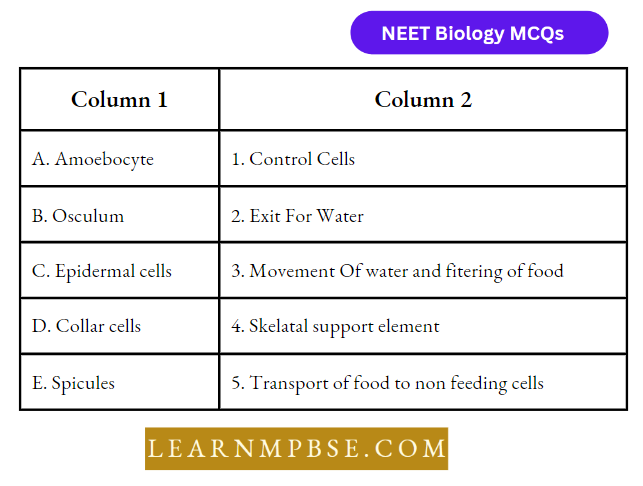
Animal Kingdom Non Chordate Phyla MCQS Question 7

Which of the following sets is correct

  1. (A-1), (B-2), (C-3), (D-4) (E-5)
  2. (A-1) (B-3) (C-2) (D-4) (E-5)
  3. (A-v) (B-2) (C-1) (D-3) (E-5)
  4. (A-4) (B-2) (C-1) (D-3) (E-5).

Answer: 3. (A-v) (B-2) (C-1) (D-3) (E-4)

Question 8. The mode of digestion in sponges is :

  1. Intracellular
  2. Intercellular
  3. Both 1 and 2
  4. None of the above.

Answer: Intercellular

Question 9. Spongocoel of leucosolenla is lined by :

  1. Pinacocytes
  2. Amoebocytes
  3. Choanocytes
  4. Scleroblasts.

Answer: 3. Choanocytes

Question 10. A common chamber for all the canals of a sponge is

  1. In current canal
  2. Paragastric
  3. Excurrent canal
  4. Radial canal.

Answer: 2. Paragastric

NEET Biology Non-Chordates Questions

Question 11. Leucosolenia is :

  1. Sessile, colonial and marine
  2. Sessile, solitary and marine
  3. Sessile, colonial and freshwater
  4. Sessile, solitary and marine.

Answer: 1. Sessile, colonial and marine

Question 12. Glass rope sponge is the common name of :

  1. Sycon
  2. Hyalonema
  3. Euspongia
  4. Leucosolenia.

Answer: 2. Hyalonema

Question 13. In current canal communicates with radial canals by:

  1. Apopyles
  2. Prosopyle
  3. Dermal Ostia
  4. Gastric Ostia.

Answer: 2. Prosopyle

Question 14. Gemmules are endogenous in origin and play a vital role in:

  1. Perennation
  2. Dispersal
  3. Reproduction
  4. All of the above.

Answer: 2. Dispersal

Question 15. Mesohyal is largely secreted by :

  1. Collencyte
  2. Trophocyte
  3. Choanocyte
  4. Chromocyte.

Answer: 1. Collencyte

Question 16. In sponges, food particles are ingested by :

  1. Thesocytes
  2. Pinacocytes
  3. Collencyte
  4. Choanocytes.

Answer: 4. Choanocytes.

Question 17. Which of these cells is not found in sponges?

  1. Calcoblasts
  2. Myocytes
  3. Porocyte
  4. Cnidoblasts.

Answer: 4. Cnidoblasts.

NEET Biology Non-Chordates Questions

Question 18. The power of regeneration in sponges is due to :

  1. Thesocytes
  2. Amoebocytes
  3. Scleroblasts
  4. Archaeocytes.

Answer: 4. Archaeocytes.

Question 19. Sponge differs from metazoan in :

  1. Cell division
  2. Division of labour
  3. Cell organization
  4. Sponge lacks

Answer: 3. Cell organization

Question 20. Best commercial sponges are found in :

  1. Cold shallow water
  2. Warm shallow water
  3. Deep seawater
  4. Warm shallow seawater.

Answer: 4. Warm shallow seawater.

Question 21. The skeleton of the bath sponge is made up of :

  1. Calcareous spicules
  2. Spongin fibres
  3. Collagen fibres
  4. Yellow fibres of elastic cartilage.

Answer: 2. Spongin fibres

Question 22. Sponges are not found in :

  1. Sea water
  2. Brackish water
  3. Cold water
  4. Sandy shore.

Answer: 3. Coldwater

Animal Classification MCQs For NEET

Question 23. The course of the water system in the second is :

  1. Ostia
  2. In current canal
  3. Prosopyle
  4. Radial canal
  5. Apopyle
  6. Spongocoel
  7. Osculum

Choose The Correct Option 

  1. 1→2→3→4→5→6→7
  2. 1→3→2→4→5→6→7
  3. 1→4→3→4→5→6→7
  4. 1→5→2→3→4→6→7

Answer: 1. 1→2→3→4→5→6→7

Question 24. Totipotent cells in sponges are :

  1. Porocyte
  2. Choanocyte
  3. Archaeocyte
  4. Pinacocyte;

Answer: 3. Archaeocyte

Question 25. Calcareous spicules are formed by :

  1. Calcoblasts
  2. Silicoblasts
  3. Spiroblasts
  4. Spongoblasts.

Answer: 1. Calcoblasts

Question 26. In a sponge body, the mesenchyme contains which type of cells:

  1. Pinacocytes
  2. Choanocytes
  3. Amoebocytes
  4. None of the above.

Answer: 3. Amoebocytes

Question 27. Monoaxon spicule with a knob at one end is called:

  1. Acanthostyle
  2. Tylostyle
  3. Diastyle
  4. Style.

Answer: 2. Tylostyle

Animal Classification MCQs For NEET

Question 28. One of the following cells takes part in the reproduction of sponges:

  1. Archaeocytes
  2. Thesocytes
  3. Myocytes
  4. Choanocytes.

Answer: 1. Archaeocytes

Question 29. Which one of the following is the most distinctive of the character of sponges?

  1. They are acellular
  2. They possess special cells called choanocytes
  3. They reproduce asexually
  4. They are all marine.

Answer: 2. They reproduce asexually

Question 30. Which one of the following cells maintains a current of water in a sponge?

  1. Trophocytes
  2. Porocytes
  3. Choanocytes
  4. Chromocytes.

Answer: 3. Choanocytes

Question 31. The boring sponge is :

  1. Spongilla
  2. Euplectella
  3. Cliona
  4. Euspongia.

Answer: 3. Cliona

Question 32. A chamber which is common in different types of canal systems is :

  1. Spongocoel
  2. Coelom
  3. Pseudocoelom
  4. Haernocoel

Answer: 1. Spongocoel

Animal Classification MCQs For NEET

Question 33. Osculum is generally surrounded by :

  1. Spongin fibre
  2. Spicules
  3. Myocytes
  4. Pinacocytes.

Answer: 3. Myocytes

Question 34. The cells in which the food is stored in the form of glycogen and glycoprotein are :

  1. Thesocyte
  2. Archaeocyte
  3. Choanocyte
  4. Amoebocyte

Answer: 1. Thesocyte

Question 35. The outer epithelial layer in sponges has:

  1. Choanocyte
  2. Amoebocyte
  3. Porocyte
  4. Porocyte and pinacocyte.

Answer: 4. Porocyte and pinacocyte.

Question 36. In sponges, nutrition, excretion, and respiration depend upon the system named:

  1. Water vascular system
  2. Canal system
  3. Circulatory system
  4. Haemocoelomic system.

Answer: 2. Canal system

Question 37. Which one of the sponges is harmful in the oyster industry?

  1. Cliona
  2. Ettspongia
  3. Hyalonema
  4. Euplectella.

Answer: 1. Cliona

Question 38. Olynthus is termed as the simplest type of sponge in structure as well as in form :

  1. It is an adult animal belonging to the germs as suggested by Haeckel
  2. A species of leucopenia
  3. A transitory stage in the life history of the second
  4. None of the above.

Answer: 2. A species of leucopenia

Animal Classification MCQs For NEET

Question 39. Which cells are found only in sponges?

  1. Amoeboid cells
  2. Choanocytes
  3. Pigment cells
  4. Gland cell.

Answer: 2. Choanocytes

Question 40. Trn most simple type of canal system of porifera, water flows through which one of the following ways?

  1. Ostia spongocoel – osculum + exterior
  2. Spongocoel – ostia + osculum + exterior
  3. Osculum – spongocoel + ostia -+ exterior
  4. Osculum – ostia – spongocoel + exterior.

Answer: 3. Osculum – spongocoel + ostia -+ exterior

Question 41. Gemmules are helpful in :

  1. Digestion
  2. Sexual reproduction
  3. Water current relation
  4. Asexual reproduction.

Answer: 4. Asexual reproduction.

Question 42. Which of the following is a freshwater sponge?

  1. Euplectella
  2. Spongilla
  3. Euspongia
  4. Sycon.

Answer: 2. Spongilla

Question 43. Larva of the sponge is known as :

  1. Glochidium larva
  2. Trochophore larva
  3. Zoea larva
  4. Amphiblastula larva.

Answer: 4. Amphiblastula larva.

NEET Previous Year Questions On Non-Chordates

Question 44. Which one of the following is not a class of phylum Porifera?

  1. Calcarea
  2. Hexactinellida
  3. Hydrozoa
  4. Demospoangiae.

Answer: 3. Hydrozoa

Question 45. Protospongia is a connecting link between :

  1. Protozoa and porifera
  2. Porifera and coelenterata
  3. Protozoa and annelida
  4. None of the above.

Answer: 1. Protozoa and Porifera

Question 46. The dried piece of bath sponge is made up of :

  1. Cellulose fibres
  2. Silk fibres
  3. Spongin fibres
  4. Yellow elastic fibres.

Answer: 3. Spongin fibres

Question 47. In sponges, prostyle is a :

  1. Cell at the opening of the incurrent canal
  2. Smaller canal and connect incurrent canal with radial canal
  3. A cell which forms the lining of spongocoel
  4. Contractile element at osculum.

Answer: 2. Smaller canal and connect incurrent canal with radial canal

Question 48. Which one of the following statements is correct?

  1. The body of sponges consists of epithelial tissues only
  2. All 4 types of tissues are seen in the body of the sponge
  3. Only epithelial and connective tissues are present
  4. Structurally organized tissues are absent in the body of the sponge.

Answer: 4. Structurally organized tissues are absent in the body of a sponge.

Question 49. In an experiment, the sponge is squeezed through silk bolting cloth and allowed to stand undisturbed in an appropriate medium. It is per{ormed to prove that :

  1. The sponges are multicellular
  2. The cells are loosely arranged
  3. The cells are so small that they can be squeezed through cloth
  4. The sponges are non-living.

Answer: 2. The cells are loosely arranged

NEET Previous Year Questions On Non-Chordates

Question 50. Phylogenetically sponges have evolved from :

  1. Protozoans
  2. Flagellates
  3. Choanoflagellates
  4. Ciliates.

Answer: 3. Choanoflagellates

Question 51. The inner lining of spongocoel is formed by :

  1. Porocytes
  2. Pinacocytes
  3. Choanocytes
  4. Archeocytes.

Answer: 3. Choanocytes

Question 52. Which of the following is not diploblastic?

  1. Coelenterata
  2. Porifera
  3. Acnidaria
  4. Platyhelminthes.

Answer: 4. Platyhelminthes.

Question 53. The body of sponges is mainly composed of :

  1. Spongin fibres
  2. Mesogloea
  3. Spicules
  4. Nematoblasts

Answer: 1. Spongin fibres

Phylum Coelenterata Cnidaria Multiple Choice Questions

Question 1. Which of the following is a radially symmetrical animal?

  1. Planarian
  2. Rotifer
  3. Fluke
  4. Sea anemone.

Answer: 4. Sea anemone.

Question 2. A distinguishing feature of cnidarians is the presence of specialized cells that contain nematocysts. They are located on the surface of the body wall and tentacles. They are used for capturing prey. These cells are called:

  1. Cnidocytes
  2. Flame cells
  3. Statocysts
  4. Nephridiopores.

Answer: 1. Cnidocytes

Question 3. Scyphozoan medusae are most commonly called :

  1. Sea anemones
  2. Jellyfishes
  3. Corals
  4. Hydra.

Answer: 4. Hydra.

Question 4. The ciliated free-swimming larval stage of cnidarian Aurelia (jellyfish) is called:

  1. Blastula
  2. Planula
  3. Polyp
  4. Medusa.

Answer: 1. Blastula

NEET Previous Year Questions On Non-Chordates

Question 5. A hydra is the simplest form of nervous system for integrating the functions of the body. It is called as :

  1. Ladder system
  2. Nerve net system
  3. Ganglionic system
  4. Ventral solid cord system.

Answer: 2. Nerve net system

Question 6. Polymorphism is an occurrence of:

  1. Several organ systems in an individual
  2. Several patterns of adaptation in a major animal group
  3. Several modes of feeding in an individual.
  4. Several modes of phenotypes in a population.

Answer: 4. Several modes of phenotypes in a population.

Question 7. Coelenterata includes sedimentary animals, they are:

  1. Bilaterally symmetrical, triploblastic
  2. Radially symmetrical, diploblastic
  3. Bilaterally symmetrical, diploblastic
  4. Radially symmetrical, triploblastic.

Answer: 2. Radially symmetrical, diploblastic

Question 8. The gastrovascular cavity is divided into compartments:

  1. Hydrozoa
  2. Scyphozoa
  3. Actinozoa
  4. None of the above.

Answer: 2. Scyphozoa

Question 9. Polymorphism is exhibited by :

  1. Hydra
  2. Obelia
  3. Aurelia
  4. Coral.

Answer: 2. Obelia

Question 10. The alternation of sexual and asexual generation is known as:

  1. Digenesis
  2. Metagenesis
  3. Metamorphosis
  4. Dimorphism.

Answer: 2. Metagenesis

Chapter-wise MCQs On Animal Kingdom NEET

Question 11. Which one of the following inhabitants of freshwater bodies?

  1. Hydra
  2. Obelia
  3. Tubularia
  4. Gorgonia.

Answer: 1. Hydra

Question 12. The animal without sexual medusae is :

  1. Velella
  2. Millipore
  3. Hydra
  4. None of the above.

Answer: 3. Hydra

Question 13. Testes in Hydra:

  1. Are less numerous than ovary
  2. Have a conical tip
  3. Are nearer the basal disc
  4. Develop one sperm in each.

Answer: 2. Have a conical tip

Question 14. In an association mutually beneficial to both partners, in the green hydra, some small green plants live in it giving it a green colour. They are :

  1. Zooxanthellae
  2. Zoochlorella
  3. Volvox
  4. Chlamydomonas.

Answer: 2. Zoochlorella

Question 15. Which one of the following layers contains zoochlorella?

  1. Gastrodermal cells
  2. Myoepithelial cells
  3. Mesogloea
  4. Interstitial cells.

Answer: 1. Gastrodermal cells

Question 16. Tentacles of hydra arise from :

  1. Aboral end
  2. Hypostome
  3. Stalk
  4. Body wall.

Answer: 2. Hypostome

Chapter-wise MCQs On Animal Kingdom NEET

Question 17. In hydra between the ectodermic and gastrodermis, the intermediate structureless layer is found. This is known

  1. Mesogloea
  2. Muscle endothelial
  3. Myoepithelial layer
  4. Endoderm.

Answer: 1. Mesogloea

Question 18. Spermatogonia in hydra develops from :

  1. Interstitial cells
  2. Gastrodermis
  3. Muscle endothelial cells
  4. Gland cells.

Answer: 1. Interstitial cells

Question 19. The proximal end of hydra bears an adhesive disc which secretes a sticky substance for:

  1. Protection
  2. Defence from enemies
  3. Sexual attraction
  4. Attachrnent to the substrate of hydra.

Answer: 4. Attachrnent to the substrate of hydra.

Question 20. Which of the following will happen to a hydra when it is cut transversely into 2 halves?

  1. Building up of lost parts
  2. Reunion of 2 halves
  3. Wound healing
  4. Death.

Answer: 1. Building up of lost parts

Question 21. Below the hypostome the number of tentacles is usually:

  1. 4-11
  2. 10-16
  3. 6-10
  4. 6-16.

Answer: 3. 6-10

Question 22. When an organism can be cut into two halves by one of the many longitudinal planes passing through the centre, the symmetry is said to be:

  1. Bilateral symmetry
  2. Radial symmetry
  3. Lateral symmetry
  4. Longitudinal symmetry.

Answer: 2. Radial symmetry

Question 23. The single sac-like cavity in the body of a hydra is called :

  1. Arachenteron
  2. Blastocoel
  3. Gastrovascular cavity
  4. Hypnotoxin.

Answer: 3. Gastrovascular cavity

Animal Phyla NEET Important Questions 

Question 24. The poisonous fluid present in the nematocyst of hydra is:

  1. Toxin
  2. Venom
  3. Haematin
  4. Hypnotoxin.

Answer: 3. Haematin

Question 25. In hydra, the gastrodermis is composed of :

  1. Myoepithelial cells
  2. Myonutritive cells
  3. Sensory cells
  4. Cnidoblasts.

Answer: 2. Myonutritive cells

Question 26. The mesogloea of hydra contains:

  1. Nerve cells
  2. Sensory cell
  3. Nematoblasts
  4. Nocells.

Answer: 4. Nocells.

Question 27. In hydra, the nematocysts are absent on the basal disc. They are abundant in:

  1. Tupper part
  2. Tmidclle part
  3. Tentacles
  4. None of the above.

Answer: 3. Tentacles

Question 28. Which animal depicts radial symmetry?

  1. Planaria
  2. Obelia
  3. Earthworks
  4. Pila.

Answer: 2. Obelia

Question 29. Stenotele nematocyst of hydra is important for :

  1. Catching prey
  2. Paralysing prey
  3. Tasting the food
  4. Tasting the water around;

Answer: 2. Paralysing prey

Question 30. Tentacles of hydra extend to the large length due to :

  1. Relaxation of myonemes of epitheliomuscular cells
  2. Relaxation of myonemes of gastrovascular cells
  3. The pressure generated by the body fluid
  4. None of the above.

Answer: 1. Relaxation of myonemes of epitheliomuscular cells

Question 31. The body wall of a hydra consists of :

  1. Ectoderm, mesoderm and endoderm
  2. Ectoderm, mesenchyme and endoderm
  3. Ectoderm and endoderm
  4. Epidermis, mesogloea and gastrodermis.

Answer: 4. Epidermis, mesogloea and gastrodermis

Question 32. Which one of the following is known as a persistent embryonic layer?

  1. Germ cells
  2. Cnidoblasts
  3. Interstitial cells
  4. Muscular cells.

Answer: 3. Interstitial cells

Question 33. The process of digestion of food in hydra is :

  1. Intercellular
  2. Extracellular
  3. Intracellular
  4. Both extracellular and intracellular.

Answer: 4. Both extracellular and intracellular.

Question 34. One of the following nematocysts is the most specialized for catching prey:

  1. Penetrant
  2. Large agglutinant
  3. Small conglutinant
  4. Desmoneme.

Answer: 4. Desmoneme.

Animal Phyla NEET Important Questions 

Question 35. Nerve cells of hydra differ from those of higher animals in that :

  1. They conduct impulses in a definite direction
  2. They conduct impulses in all directions
  3. Both 1 and 2
  4. None of the above.

Answer: 2. Both 1 and 2

Question 36. One of the following animals has a nervous system but no brainer:

  1. Cockroach
  2. Earthworm
  3. Hydra
  4. Sponges.

Answer: 3. Hydra

Question 37. In hydra, our contains :

  1. A few ova
  2. Single ovum
  3. No ova
  4. Lunlerous ova.

Answer: 2. Single ovum

Question 38. Mark the group, of animals that do not move :

  1. Bug and slug
  2. Coral and sponges
  3. Antedon and holothurian
  4. Coral and lepisma.

Answer: 2. Coral and sponges

Question 39. Fertilization in hydra is :

  1. Hxtemal
  2. In the body Glendale
  3. Both male and female individuals come close and fuse
  4. None of the above.

Answer: 2. In the body Lenrale

Question 40. Self-fertilization in Hydra never takes place because they are :

  1. Protandrous
  2. Protogynous
  3. Asexual
  4. Hermaphrodite.

Answer: 1. Protandrous

Question 41. Hydra reproduces by bidding during:

  1. Unfavourable conditions
  2. Favourable conditions
  3. Less water supply
  4. Summer.

Answer: 2. Favourable conditions

Question 42. Coral reefs have been a result of activity of mainly:

  1. Molluscs
  2. Echinoderms
  3. Coelenterates
  4. Hernichordates.

Answer: 3. Coelenterates

NEET Biology Non-Chordates Questions

Question 43. Polymorphism is best defined as the occurrence of:

  1. Several types of organ systems in an individual
  2. Different kinds of larval forms in the life history of an animal
  3. Different functions performed by a single kind of organism
  4. Several different types of individuals in the species.

Answer: 4. Several different types of individuals in the species.

Question 44. The cells of blastula in hydra divide repeatedly and tangentially forming many cells which migrate inward from all directions and fill in the blastocoel. This process is called:

  1. Invagination
  2. Immigration
  3. Involution
  4. Ingression.

Answer: 4. Ingression.

Question 45. Which animals are exceptions to the organ system level of organisation?

  1. Echinoderms
  2. Sponges
  3. Coelenterates
  4. Both 2 and 3.

Answer: 4. Both 2 and 3.

Question 46. Hydra is negatively chemotropic because it :

  1. Moves away from strong light
  2. Prefers weak illumination
  3. Moves to water of low temperature
  4. Avoids chlorinated water.

Answer: 3. Moves to water of low temperature

Question 47. If a hydra has to propagate successfully in a pond which is going to dry up soon, what method of reproduction will take place in the animal:

  1. Panhenogenesis
  2. Budding
  3. Sexual
  4. Sporogony.

Answer: 3. Sexual

Question 48. Tentaculocyst is :

  1. Receptor organ in Ascaris
  2. A part of Scolex
  3. Protective covering of amoeba
  4. A receptor organ of aurelia.

Answer: 4. A receptor organ of aurelia.

Question 49. Metagenesis is exhibited by :

  1. Hydra
  2. Fungia
  3. Metridium
  4. Obelia.

Answer: 4. Obelia.

Question 50. Penetrants and steno-teles are the names of hydra’s nematocysts. Of these;

  1. Penetrants are larger
  2. Penetrants are smaller
  3. Steoteles are not found in hydra
  4. Both are the same.

Answer: 4. Both are the same.

Question 51. A fringing reef is usually located at:

  1. Very near the shore
  2. In deep sea
  3. In cold sea
  4. Far away from the shore.

Answer: 1. Very near the shore

Question 52. True corals come from the order :

  1. Hydroidea
  2. Pennatulacea
  3. Madreporaria
  4. Alcyonacea.

Answer: 3. Madreporaria

Question 53. Sea pen is a popular name for:

  1. Gorgonia
  2. Pennatula
  3. Fungia
  4. Corallium.

Answer: 2. Pennatula

Question 54. The body cavity of cockroaches is

  1. Hydrozoan
  2. Scyphozoan
  3. Anthozoan
  4. Fish.

Answer: 3. Anthozoan

NEET Biology Non-Chordates Questions

Question 55. Rhopalium is a complex of :

  1. Two sense organs
  2. Three sense organs
  3. Four sense organs
  4. Five sense organs.

Answer: 3. Four sense organs

Question 56. In obelia, statocysts function as the organ for:

  1. Hearing
  2. Iight perception
  3. Smell
  4. Equilibrium.

Answer: 4. Equilibrium.

Question 57. In hydra tests are located at:

  1. Proximal half end of body
  2. The distal half end of the body
  3. Both the ends
  4. Tentacles only.

Answer: 2. Distal half end of body

Question 58. Hydra can digest all types of food except:

  1. Proteins
  2. Fats
  3. Sugars
  4. Starch.

Answer: 4. Starch.

Question 59. Aurelia belongs to:

  1. Hydrozoa
  2. Scyphozoa
  3. Actinozoa
  4. Cephalopoda.

Answer: 2. Scyphozoa

Question 60. Which of the following phyla include diploblastic animals?

  1. Coelenterata
  2. Platyhelminthes
  3. Aschelminthes
  4. Echrnodermata.

Answer: 1. Coelenterata

Phylum Platyhelminths

Question 1. Flatworms have three tissue layers and only one body cavity-the digestive cavity. They are called:

  1. Acoelomates
  2. Pseudo-acoelomates
  3. Pseudo-coelomates
  4. Coelomates.

Answer: 1. Acoelomates

Question 2. Which of the following is an ectoparasite?

  1. Fasciola
  2. Paragonimus
  3. Diplozoan
  4. Taenia

Answer: 3. Diplozoan

Question 3. A unisexual fluke is :

  1. Schistosoma
  2. Paragonimus
  3. Fasciola
  4. Opisthorchis.

Answer: 1. Schistosoma

Question 4. Locomotory and receptor organs are lacking in :

  1. Liver fluke
  2. Lung fluke
  3. Intestinal fluke
  4. Tapeworm.

Answer: 4. Tapeworm.

Animal Classification MCQs For NEET

Question 5. Flatwornrs have:

  1. Ectothelial eggs
  2. Endothelial eggs
  3. Both 1 and 2
  4. None of the above.

Answer: 2. Endothelial eggs

Question 6. The infective stage of taenia for man is:

  1. Hexacanth
  2. Onchosphere
  3. Cysticercus
  4. Adult worm.

Answer: 4. Adult worm.

Question 7. How many intermediate hosts does Paragonimus have?

  1. One
  2. Two
  3. Three
  4. None of the above.

Answer: 2. Two

Question 8. Paragonimus lives in :

  1. Intestine
  2. Blood
  3. Lung
  4. Brain.

Answer: 3. Lung

Question 9. For protection against the infection of diphyllobothrium, do not take raw or undercooked:

  1. Pork
  2. Mutton
  3. Vegetables
  4. Fish.

Answer: 4. Fish.

Question 10. Tapeworms do not have an alimentary canal because they get good from:

  1. Suckers
  2. Mouth
  3. Body surface
  4. All of the above.

Answer: 3. Body surface

Question 11. Which of the following statements about taenia saginata is true?

  1. It has a double circle of hooks on the rostellum
  2. Its life history involves pig as an intermediate host
  3. It has two large hooks on the scolex
  4. It has no rostellar hooks.

Answer: 1. It has a double circle of hooks on the rostellum

Question 12. The study of worms which cause a parasitic infestation in man is called :

  1. Helminthology
  2. Herpetology
  3. Ichthyology
  4. Malacology.

Answer: 1. Helminthology

Question 13. Liver fluke is :

  1. Coelomate
  2. Pseudo-coelomate
  3. Acoelomate
  4. Haemo-coelomate.

Answer: 3. Acoelomate

Animal Classification MCQs For NEET

Question 14. Taenia attaches to the intestinal wall by:

  1. Scolex
  2. Suckers
  3. Hooks
  4. Both 2 and 3.

Answer: 4. Both 2 and 3.

Question 15. Anaerobic respiration is likely to occur in :

  1. Ants
  2. Eafthworm
  3. Tapeworms
  4. Echinoderms.

Answer: 3. Tapeworms

Question 16. The correct sequence of various larvae in the liver fluke is :

  1. Miracidium→sporocysts →cercaria → redia→ metacercaria
  2. Miracidium → redia → Cercaria→metacercaria → sporocyst
  3. Metacercaria → cercaria → redia →sporocyst → miracidium
  4. Miracidium → sporocysts →redia→cercaria -→metacercaria.

Answer: 4. Miracidium →sporocysts→ redia→ cercaria→ metacercaria.

Question 17. Food is sucked into the fasciola hepatica with the help of:

  1. Oral sucker
  2. Muscular pharynx
  3. Ventral sucker
  4. Mouth.

Answer: 2. Muscular pharynx

Question 18. From the evolutionary point of view which group is considered to be the first triploblastic?

  1. Platyhelminthes
  2. Annelida
  3. Coelenterata
  4. Nemathelminthes.

Answer: 1. Platyhelminthes

Question 19. On examining the stool of a man, it was found to contain segments of tapeworms. Trace the possible source:

  1. Fish meat
  2. Beef
  3. Pork
  4. Mutton.

Answer: 3. Pork

Question 20. Which of the following is not a class of phylum Platyhelminthes?

  1. Turbellaria
  2. Hydrozoa
  3. Trematoda
  4. Cestoda.

Answer: 2. Hydrozoa

Question 21. Cysticercosis is caused by :

  1. Taenia
  2. Liver fluke
  3. Bladder worm
  4. Rhabditid.

Answer: 3. B1adder worm

Animal Classification MCQs For NEET

Question 22. Which of the following is not a parasitic adaptation of helminths?

  1. Secretion of mucus and anti-enzyme
  2. Production of a large number of eggs
  3. Presence of the nervous system
  4. Presence of flame cells.

Answer: 3. Presence of nervous system

Question 23. Fasciola hepatica differs from taenia solium in:

  1. Having a better-developed digestive system
  2. A protective cuticle
  3. Mesenchyme fills up the space between ectoderm and endoderm
  4. Presence of nervous system.

Answer: 1. Having a better-developed digestive system

Question 24. Special mesodermal tissue fills up the space between various organs in flatworms:

  1. Parenchyma
  2. Botryoidal
  3. Sclerenchyma
  4. Mesogloea.

Answer: 1. Parenchyma

Question 25. In platyhelminthes, vitellarium is generally found in association with:

  1. Ovaries
  2. Testes
  3. Both the ovary and testes
  4. Gut.

Answer: 1. Ovaries

Question 26. In Platyhelminthes flame cells are units of :

  1. Excretory system
  2. Reproductive system
  3. Vascular system
  4. Respiratory system.

Answer: 1. Excretory system

Question 27. One of the main characteristics of taenia solium is that it:

  1. Sucks the predigested food from the host’s intestine by employing oral suckers
  2. Has no mouth, alimentary canal and anus
  3. Has a head, a neck and a thorax but no abdomen
  4. Passes eggs which are unaffected even at the boiling temperature of water.

Answer: 2. Has no mouth, alimentary canal and anus

Question 28. Cestodes have:

  1. A scolex with sucker and hooks
  2. A ribbon-like body
  3. Numerous proglottids
  4. All the above.

Answer: 4. All the above.

Question 29. The primary host of taenia is.

  1. Pig
  2. Man
  3. Sheep
  4. Mollusc.

Answer: 2. Man

NEET Previous Year Questions On Non-Chordates

Question 30. The intermediate host of talent solium is :

  1. Pig
  2. Man
  3. Sheep
  4. Snail.

Answer: 1. Pig

Question 31. Which one of the following larvae does not belong to liver fluke?

  1. Cercaria
  2. Planula
  3. Media
  4. Miracidium.

Answer: 2. Planula

Question 32. Miracidium larva occurs in the life cycle of :

  1. Liver fluke
  2. Tapeworm
  3. Ascaris
  4. Malarial parasite.

Answer: 1. Liver fluke

Question 33. Taenia solium feeds with :

  1. Oral sucker
  2. Body surface
  3. Rostellum
  4. Ventral sucker.

Answer: 2. Body surface

Question 34. The tapeworm is :

  1. Unisexual
  2. Asexual
  3. Bisexual
  4. None of the above.

Answer: 3. Bisexual

Question 35. The head of taenia solium is called :

  1. Oral sucker
  2. Acetabulum
  3. Scolex
  4. Rostellum

Answer: 3. Scolex

Question 36. In taenia, scolex bears at the top in the middle a prominent:

  1. Cup-shaped sucker
  2. Head
  3. Rostellum
  4. Recurved hooks.

Answer: 3. Rostellum

Question 37. The adult taenia contains :

  1. 500 Proglottids
  2. 1000 Progloltids
  3. 800-900 Proglottids
  4. Only 3 proglottids.

Answer: 3. 800-900 Proglottids

Question 38. Proglottids of cestodes have :

  1. Monoecious reproductive system
  2. Dioecious genitalia
  3. Well-developed alimentary canal
  4. Ax the above.

Answer: 1. Monoecius reproductive system

Question 39. Segments of taenia proliferate from the :

  1. Head
  2. Neck
  3. The special region of proliferation in the neck
  4. Anywhere from the body.

Answer: 3. Special region of proliferation in neck

NEET Previous Year Questions On Non-Chordates

Question 44. A proglottid is called gravid proglottid when it has :

  1. Both male and female reproductive units
  2. Only the female reproductive unit
  3. Only the male reproductive unit well well-developed
  4. Branched uterus filled with fertilized eggs.

Answer: 4. Branched uterus filled with fertilized eggs.

Question 41. Liver fluke has :

  1. Self-fertilization
  2. Cross-fertilization
  3. None of above
  4. Both of the above.

Answer: 4. Both of the above.

Question 42. The body wall in tapeworm is covered by :

  1. Cuticle
  2. Tegument
  3. Integument
  4. Mucus.

Answer: 2. Tegument

Question 43. Rhabdits are present in the epidermal cells of

  1. Taenia
  2. Fasciola
  3. Dugesia
  4. Schistosoma

Answer: 3. Dugesia

Question 44. Nen ous system of flatworms is

  1. Of diffuse type
  2. In the form of anterior ganglia and nerve cords
  3. Consists of the central and sympathetic nervous system
  4. In the form of clustered ganglia.

Answer: 2. In the form of anterior ganglia and nerve cords

Question 45. The tcstes in taenia :

  1. Have a single structure
  2. Have bulbed structure
  3. Consist of several follicles
  4. Consists of a pair of branched structures.

Answer: 3. Consist of some follicles

Question 46. The ovary in taenia is :

  1. Single lobed
  2. Bilobed
  3. Follicular
  4. A pair of glandular structures.

Answer: 2. Bilobed

Question 47. In tapeworms, fertilization is affected by one of the following manners:

  1. Self-fertilization
  2. Fusion of gametes between two parasites
  3. Fertilization between gametes of adjacent segments
  4. A combination of 1 and 3.

Answer: 4. A combination of 1 and 3.

Question 48. The life cycle of taenia is :

  1. Monogenetic
  2. Digenetic
  3. Polygenetic
  4. None of the above.

Answer: 2. Digenetic

NEET Previous Year Questions On Non-Chordates

Question 49. The infective stage of taenia in pigs is :

  1. Onchosphere stage
  2. Hexacanth
  3. Adult stage
  4. None of the above.

Answer: 4. None of the above.

Question 50. Taenia saginata differs from taenia solium mainly in the absence of:

  1. Scolex
  2. Hooks upon scolex
  3. Suckers upon scolex
  4. None of the above.

Answer: 2. Hooks upon scolex

Question 51. Onchosphere is an embryo which occurs in taenia characterized by the presence of:

  1. Six hooks, primary shell only
  2. Six hooks, geosphere membrane and embryophore
  3. Onchosphere membrane only
  4. Six hooks, onchosphere membrane, embryophore and primary shell only.

Answer: 4. Six hooks, onchosphere membrane, embryophore and primary shell only.

Question 52. Cysticercus is a stage in the life history of:

  1. Fasciola
  2. Ascaris
  3. Taenia
  4. Pheretima.

Answer: 3. Taenia

Question 53. Larval forni of a trematode which penetrates a gastropod mollusc is:

  1. Hexacanth
  2. Media
  3. Cercaria
  4. Miracidium.

Answer: 4. Miracidium.

Question 54. Trematodes have :

  1. A branched alimentary canal
  2. A monoecious reproductive apparatus
  3. Direct or indirect alimentary canal
  4. All the above.

Answer: 4. All the above.

Question 55. Schistosoma is called

  1. Blood fluke
  2. Chinese liver t-luke
  3. Lung fluke
  4. Dog tapeworm.

Answer: 1. Blood fluke

Question 56. Dugesia is an exmple of

  1. Cestoda
  2. Turbellaria
  3. Digenetic Trematoda
  4. Mgogenetic trematoda.

Answer: 2. Turbellaria

Question 57. Taenia saginata is a parasite of

  1. Sheep
  2. Cow
  3. Man and cow
  4. Dog.

Answer: 3. Man and cow

Chapter-wise MCQs On Animal Kingdom NEET

Question 58. Fasciola hepatica is a parasite that lives in the:

  1. Intestine of sheep
  2. Liver of sheep
  3. Spleen of sheep
  4. Pancreas of sheep.

Answer: 2. Liver of sheep

Question 59. Strobilation is seen in :

  1. Taenia
  2. Fasciola
  3. Dugesia
  4. Digenia.

Answer: 1. Taenia

Question 60. The presence of spicules on the body wall is a characteristic of:

  1. Aurelia
  2. Planaria
  3. Taenia
  4. Fasciola.

Answer: 4. Fasciola.

Phylum Aschelminthes

Question 1. Which of the following are pseudocoelomates?

  1. Trematodes
  2. Nematodes
  3. Cestodes
  4. Archiannelida.

Answer: 2. Nematodes

Question 2. Round worms have three tissue layers, a digestive cavity and an additional cavity between the endoderm and mesoderm. They are called as:

  1. Acoelomates
  2. Pseudocoelomates
  3. Haemocoelomates
  4. Coelomates.

Answer: 2. Pseudocoelomates

Question 3. Dracunculus medinensis is a parasite of :

  1. Body fluids
  2. Body tissue
  3. Gut
  4. Lungs.

Answer: 2. Body tissue

Question 4. The common parasite of the human large intestine is:

  1. Asruris
  2. Trichinella
  3. Enterobius
  4. Ancylostoma.

Answer: 3. Enterobius

Chapter-wise MCQs On Animal Kingdom NEET

Question 5. The Epidermis of the nematode consists of :

  1. Cuticle
  2. Epidermis
  3. Muscle layer
  4. All of the above.

Answer: 4. All of the above.

Question 6. Trichinosis is caused by :

  1. Trichuris
  2. Trichinella
  3. Ancylostoma
  4. None of the above.

Answer: 2. Trichinella

Question 7. The number of cells in the various organs of the body is fixed in :

  1. Flatworms
  2. Segmental worms
  3. Walking worms
  4. Round worms.

Answer: 4. Roundworms.

Question 8. Excretory organs of hookworm are :

  1. Flame cells
  2. Green gland
  3. Renette glands
  4. Nephridia.

Answer: 3. Renette glands

Question 9. Juvenile of Ascaris undergoes moult :

  1. Twice
  2. Once
  3. Thrice
  4. Four times.

Answer: 4. Four times.

Question 10. Pinworms are found in humans:

  1. Alimentary canal
  2. Colon
  3. Intestine
  4. Lungs.

Answer: 2. Colon

Question 11. The technical name of pinworm is :

  1. Trichon cell
  2. Ancylostoma
  3. Oxyuris
  4. Microfilariae.

Answer: 3. Oxyuris

Chapter-wise MCQs On Animal Kingdom NEET

Question 12. The most dangerous parasitic roundworms of man are:

  1. Pinworm
  2. Hookworm
  3. Whipworm
  4. Guinea worm.

Answer: 2. Hook worm

Question 13. Filaria is transmitted by :

  1. Tsetse fly
  2. Sandfly
  3. Anopheles
  4. Culex.

Answer: 4. Culex.

Question 14. Which of the following groups have one or more animals which are not

  1. Ascaris, taenia
  2. Enterobius,wuchereria
  3. Ancylostoma, dracunculus
  4. Ascaris, ancyiostoma.

Answer: 1. Ascaris, taenia

Question 15. In Ascaris lumbricoides, (roundworms) the males and females can be identified externally by certain characters. This phenomenon is called

  1. Polymorphism
  2. Sexual dimorphism
  3. Anisogamy
  4. Regeneration.

Answer: 2. Sexual dimorphism

Question 16. Ascaris is a parasite found in the :

  1. Stomach
  2. Vermiform appendix
  3. Small intestine
  4. Large intestine.

Answer: 3. Small intestine

Question 17. Ln ascaris lumbricoides :

  1. The male is larger than the female
  2. The body cavity is a true coelom
  3. The life history involves two hosts
  4. None of the above.

Answer: 4. None of the above.

Question 18. In male ascaris the posterior end is :

  1. Straight
  2. Upturned
  3. Blunt and straight
  4. Curved with pineal setae protruding out.

Answer: 4. Curved with pineal setae protruding out.

Question 19. Lips of Oscars are :

  1. Horny
  2. Bony
  3. Cartilaginous
  4. None of the above.

Answer: 1. Horny

Question 20. Which of the following systems are not well-defined in nematodes?

  1. Respiratory and digestive
  2. Circulatory and respiratory
  3. Excretory and nervous
  4. Reproductive and excretory.

Answer: 2. Circulatory and respiratory

Chapter-wise MCQs On Animal Kingdom NEET

Question 21. Helminthes parasite without any intermediate host in its life cycle is:

  1. Liver fluke
  2. Tapeworm.
  3. Filarial worm
  4. Roundworm.

Answer: 4. Roundworm.

Question 22. The cuticle in Ascaris is secreted by :

  1. Muscular layer
  2. Epidermis
  3. Syncytial epidermis
  4. None of the above.

Answer: 3. Syncytial epidermis

Question 23. The lateral lines of the epidermis in Ascaris contain :

  1. Excretory canal
  2. Nerves
  3. Oviducts
  4. Spermatic ducts.

Answer: 1. Excretory canal

Question 24. The transmission of scans takes place through:

  1. Air
  2. Housefly
  3. Contaminated food and water
  4. Female anopheles.

Answer: 3. Contaminated food and water

Question 25. In Ascaris, the respiration is:

  1. Anaerobic
  2. Anaerobic
  3. Cutaneous
  4. All the above.

Answer: 2. Anaerobic

Question 26. Cuticle of ascaris is an adaptation for :

  1. Growth
  2. Parasitism
  3. Reproduction
  4. Locomotion.

Answer: 2. Parasitism

Question 27. The matrix layer of the cuticle of ascarls is :

  1. Spongy in consistency
  2. Formed of keratin
  3. Collagen fibres
  4. Formed of basement membrane.

Answer: 1. Spongy in consistency

Question 28. Musculature it ascaris is formed of :

  1. Circular muscles
  2. Circular and longitudinal muscles
  3. A single layer of spindle-shaped cells
  4. Oblique and tangential circular muscles.

Answer: 3. Single layer of spindle-shaped cells

Question 29. Locomotion in Ascaris is brought about by:

  1. Circular muscles
  2. Oblique muscles
  3. Alternate contraction of dorsolateral and ventrolateral muscles
  4. Circular and oblique muscles to counteract

Answer: 3. Alternate contraction of dorsolateral and ventrolateral muscles

Question 30. The toxins produced by Ascaris interfere in:

  1. Carbohydrate metabolism
  2. Protein metabolism
  3. Basal metabolic rate
  4. Fat metabolism.

Answer: 2. Protein metabolism

Animal Phyla NEET Important Questions 

Question 31. In Ascaris, excretory organs are:

  1. Excretory cell
  2. Kidney
  3. Nephridia
  4. Flame cells.

Answer: 1. Excretory cell

Question 32. Rectum of Ascaris :

  1. Consists of tall columnar cells
  2. Consists of internal cuticle
  3. In males opens into the cloaca
  4. All the above.

Answer: 2. Consists of internal cuticle

Question 33. The total number of apertures in male and female Ascaris are

  1. Two and three
  2. Three and four
  3. Two each
  4. Two and four.

Answer: 4. Two and four.

Question 34. Sperm in Ascaris is :

  1. Monoflagellate
  2. Biflagellate
  3. Amoeboid
  4. None of the above.

Answer: 3. Amoeboid

Question 35. Female ascsris lay eggs daily at the rate of about:

  1. 10
  2. 10,000
  3. 1,00,000
  4. 2,00,000.

Answer: 4. 2,00,000.

Question 36. In states, fertilization occurs in :

  1. Water
  2. Intestine of man
  3. Proximal part of the uterus
  4. Vagina.

Answer: 3. Proximal part of uterus

Question 37. A coiled embryo within the egg shell is formed in:

  1. 24 Hours
  2. 5 To 8 days
  3. 10 -14 Days
  4. 2 To 3 days.

Answer: 3. 10 -14 Days

Question 38. The innermost layer of shells of eggs is formed of :

  1. Esterified glycosides
  2. Proteins
  3. Carbolrydrates
  4. Phospholipids.

Answer: 1. Esterified glycosides

Question 39. First stage of the ascaris larva is :

  1. Juvenile
  2. Rhabdite larva
  3. Rhabditoid larva
  4. None of the above.

Answer: 3. Rhabditoid larva

Question 40. Final moulting gin ascaris takes place in :

  1. Outside the body of a man
  2. Intestine of man
  3. Lungs of man
  4. The trachea of man.

Answer: 2. Intestine of man

Question 41. Rhabditoid larva infects man by :

  1. Boring the sole of feet
  2. With water
  3. With air
  4. With contaminated food.

Answer: 4. With contaminated food.

Question 42. The infective stage of Ascaris is :

  1. 1st stage larva
  2. 2nd stage larva
  3. 3rd stage larva
  4. Egg itself.

Answer: 2. 2nd stage larva

Question 43. In the life cycle of Ascaris 3rd moulting occurs in:

  1. Intestine
  2. Lung
  3. Heart
  4. Liver.

Answer: 3. Heart

Question 44. Sites of first, second and third moulting of Ascaris larva are :

  1. Stomach, intestine and liver
  2. Soil, lungs and lungs
  3. Intestine, lungs and liver
  4. Lungs, intestine and liver.

Answer: 2. Soil, lungs and lungs

Question 45. Ascariasis is syntonised by :

  1. Abdominal discomforts
  2. Headache
  3. High fever
  4. All the above.

Answer: 1. Abdominal discomforts

Question 46. The larva of Ascaris circulates in the body of a man:

  1. Intestine-liver-trachea-lungs-intestine
  2. Intestine-heart-lungs-trachea-intestine
  3. Intestine-liver-heart-lungs-intestine
  4. Intestine-lungs-liver-trachea-intestine

Answer: 3. Intestine-liver-heart-lungs-intestine

Question 47. Infection of which parasite often gives rise to cough

  1. Tapeworm
  2. Pinworm
  3. Guinea worm
  4. Roundworm.

Answer: 4. Roundworm.

Question 48. In,a.sihelminthes the space between the body wall and visceral organs is called:

  1. Pseudocoel
  2. Schizocoel
  3. Hameocoal
  4. Roundworm

Answer: 1. Pseudocoel

Question 49. All roundworms differ from all flatworms in having :

  1. Longitudinal nerve cord
  2. Segrnerited body
  3. Metamorphosis in their life cycle
  4. Presence of pseudocoelom.

Answer: 4. Presence of pseudocoelom.

Question 50. Special modifications of ascaris in its parasitic mode of life is:

  1. Segmented body
  2. Resistant cuticle
  3. Tubular body
  4. Presence of toothed lips

Answer: 2. Resistant cuticle

Phylum Annelids

Question 1. Segmentation is found in :

  1. Annelida
  2. Arthropoda
  3. Vertebrata
  4. All of the above.

Answer: 4. All of the above.

Question 2. Trochophore larva occurs in :

  1. Anneiida
  2. Mollusca
  3. Brachiopoda
  4. All of the above.

Answer: 4. All of the above.

Question 3. The zoological name of the paddle worm is :

  1. Phererimr
  2. Arenicola
  3. Chaetopterus
  4. Polynoe

Answer: 3. Polynoe

Question 4. Branchiae are respiratory organs in

  1. Nereis
  2. Aphrodite
  3. Polynoe
  4. All of the above.

Answer: 4. All of the above.

Question 5. Parapodia are locomolory organs in :

  1. Oligochaeta
  2. Polychaeta
  3. Diplopoda
  4. Chiropoda.

Answer: 2. Polychaeta

Question 6. Segmentation in annelids is :

  1. Hornonornous
  2. Heteronomous
  3. Both 1 and 2
  4. None of the above.

Answer: 3. Both 1 and 2

Question 7. Aphrodite is popularly called as

  1. Scale worm
  2. Faloloworm
  3. Lugworm
  4. Sea mouse.

Answer: 4. Sea mouse

Question 8. Locomotion in leeches is brought about by :

  1. Parapodia
  2. (Ts) setae
  3. Suckers
  4. Body muscles and suckers.

Answer: 4. Body muscles and suckers.

Question 9. The excretory material of leech is mainly :

  1. Ammonia
  2. Urea
  3. Uric acid
  4. Amino acids.

Answer: 1. Ammonia

Question 10. Leech is :

  1. Unisexual
  2. Bisexual
  3. Dioecious
  4. None of the above.

Answer: 2. Bisexual

Question 11. In earthworm brain is located in :

  1. Prostorniurn
  2. Peristomium
  3. Third segment
  4. Second segment

Answer: 3. Third segment

Question 12. In earthworms, coelomic fluid oozes out through the :

  1. Nephridiopores
  2. Nephrostome
  3. Dorsai acres
  4. Spermathecal pores.

Answer: 3. Dorsai acres

Question 13. Which of the following does not apply to earthworms?

  1. In indirect development
  2. Protandry
  3. Extracellular digestion
  4. Closed circulatory system.

Answer: 1. In indirect development

Question 14. Blood of nereids contains haemoglobin in

  1. Plasma
  2. Amoeboid corpuscles
  3. Red blood corpuscles
  4. Both 1 and 2.

Answer: 1. Plasma

Question 15. A coelomic cavity in earthworms is

  1. Schizocoelic
  2. Enterocoelic
  3. Haemocoelic
  4. Pseudocoeiic.

Answer: 1. Schizocoelic

Question 16. The colour of the earthworm is given by :

  1. Porphyrin
  2. Chromatophores
  3. Vitamins
  4. Lacrnoglohin.

Answer: 1. Porphyrin

Question 17. The function of dorsal pores in earthworms is:

  1. Respiration
  2. Elimination of waste,
  3. Exudation of body fluids
  4. Excretion

Answer: 3. Exudation of body fluids

Question 18. In earthworm’s body is devoid of the:

  1. Cuticle
  2. Setae
  3. Appendages
  4. Epidermis.

Answer: 3. Appendages

Question 19. Septa without aperture lies between :

  1. 11/12; 12/13 And 13/14 segrnents
  2. 12/13; 13/14 And 14/15 segments
  3. 10/11; 14/12 and 12/13 segments
  4. 9/10; 10/11 And 11/12 segments.

Answer: 4. 9/10; 10/11 And 11/12 segments.

Question 20. In earthworms, chromophil cells are found in :

  1. Pharyngeal gland
  2. Respiratory cell
  3. Sensory cell
  4. Vascular system.

Answer: 1. Pharyngeal gland

Question 21. The major role of typhiosole in the intestine of earthworms is :

  1. To control the flow of blood
  2. To increase the absorptive surface
  3. To produce digestive enzyme
  4. To kill bacteria.

Answer: 2. To increase absorptive surface

Question 22. The presence of coelom and metamerism are important characters in :

  1. Helminthes
  2. Arthropods
  3. Annelids
  4. Coeienterates.

Answer: 3. Annelids

Question 23. The cuticle of annelids is ;

  1. Non-chitinous and albuminoid
  2. Chitinous
  3. Chitinous and albuminoid
  4. Non-chitinous.

Answer: 4. Non-chitinous.

Question 24. Earthworm is composed of 120 segments and prostomium refers to

  1. First segment
  2. 2nd segment
  3. Not a segment
  4. Fart of the reproductive system.

Answer: 3. Not a segment

Question 25. Setae are present in all segments except:

  1. First and last segment
  2. The first segment and the clitellum
  3. Cliteltum, first and anal segments
  4. Clitellum and last segrnent.

Answer: 3. Cliteltum, first and anal segments

Question 26. Clitellum in earthworms includes :

  1. First three segments
  2. 14,15 And 16 segments
  3. Last three segments
  4. 19, 20 And 21 segments.

Answer: 2. 14,15 And 16 segments

Question 27. In earthworms, the clitellar region helps in the process of:

  1. Copulation
  2. Conformation
  3. Digestion
  4. Locomotion.

Answer: 2. Conformation

Question 28. Where would you find calcareous glands in heretical?

  1. Oesophagus
  2. Stomach
  3. Rectum
  4. Typhlosole.

Answer: 2. Stomach

Question 29. During locomotion of earthworms:

  1. Longitudinal muscles contract first
  2. Circular muscles contract first
  3. Both muscles contract simultaneously
  4. Both muscles relax simultaneously.

Answer: 2. Circular muscles contract first

Question 30. The animals that drifted passively by water currents are known as :

  1. Pelagic
  2. Planktons
  3. Freshwater form
  4. Benthos.

Answer: 2. Planktons

Question 31. Which of these is secreted by pharyngeal mass?

  1. Albumen
  2. Mucin
  3. Mucin arid proteases
  4. None of the above.

Answer: 3. Mucin arid proteases

Question 32. The flow of blood in a dorsal blood vessel of heretical is :

  1. From in front backwards
  2. From behind forward
  3. In both directions
  4. None of the above.

Answer: 2. From behind forward

Question 33. l-lateral hearts in heretical are situated in the following segments :

  1. 12th and 13th
  2. 10th and 11th
  3. 7th and 9th
  4. Both 1st and 3rd.

Answer: 3. 7th and 9th

Question 34. Blood glands in earthworms are situated in 4, 5 and 6 segments. These are associated with:

  1. Excretion
  2. Digestion
  3. Secretion
  4. Formation of blood corpuscles.

Answer: 4. Formation of blood corpuscles.

Question 35. Lateral oesophageal hearts in heretical are situated in the following segments :

  1. 12 And 13
  2. 10 And 11
  3. 9 And 14
  4. 7 And 9th.

Answer: 1. 12 And 13

Question 36. The blood of earthworms is :

  1. Colourless
  2. Pinkish
  3. Bluish
  4. Red.

Answer: 4. Red.

Question 37. Which of these vessels distribute the blood in the first thirteen segments :

  1. Dorsal
  2. Oesophageal
  3. Subneural
  4. Lateral.

Answer: 1. Dorsal

Question 38. The blood from the seminal vesicle of earthworm is collected by :

  1. Lateral oesophageal
  2. Ventral blood vessel
  3. Ventro tegumentary vessel
  4. Subneural vessel

Answer: 1. Lateral oesophageal

Question 39. The excretory organs in earthworms are :

  1. Nephridia
  2. Malpighiantubules
  3. Flame cells
  4. Coelomc ducts.

Answer: 1. Nephridia

Question 40. Pharyngeal nephridia of earthworms are situated in segments :

  1. 4,5 And 6
  2. 5,6,7
  3. 3, 4 And 5
  4. 6, 7, 8.

Answer: 1. 4,5 And 6

Question 41. In earthworms, mesonephric excretion takes place by:

  1. Integumentary nephridia
  2. Septal nephridia
  3. Septal and pharyngeal nephridia
  4. None of the above.

Answer: 1. Integumentary nephridia

Question 42. The pharyngeal nephridia in earthworms do not open :

  1. Externally
  2. Terminally
  3. Internally
  4. None of the above

Answer: 1. Externally

Question 43. The origin of nephridium is :

  1. Germinal
  2. Ectodermal
  3. Mesodermal
  4. Endodermal.

Answer: 2. Ectodermal

Question 44. In heretical in which segments septal nephridia are found?

  1. In all the segments
  2. From the 15th to the last segment
  3. In the first 15 segments
  4. From last to last segment.

Answer: 2. From the 15th to the last segment

Question 45. Where nephrostome is present in heretical?

  1. Septal nephridia
  2. Integumentary nephridia
  3. Pharyngeal nephridia
  4. All the above.

Answer: 1. Septal nephridia

Question 46. In earthworms, chloragogen cells perform :

  1. Glycogen synthesis
  2. Synthesis of urea
  3. Removal of silicates
  4. Elimination of surplus ca+ ions.

Answer: 2. Synthesis of urea

Question 47. How many eyes are found in heretical :

  1. None
  2. One
  3. Two
  4. Many.

Answer: 1. None

Question 48. Enteronephric nephridia throws out the excretory material:

  1. Through alimentary canal
  2. Through cloacal aperture
  3. Directly outside
  4. Through circulatory system

Answer: 1. Through alimentary canal

Question 49. In earthworms the ovary is situated in the :

  1. 11th segment
  2. 10Th segment
  3. 13th segment
  4. 14th segment.

Answer: 4. 14th segment.

Question 50. In earthworms, the testes are enclosed in the following segments :

  1. 3th and 10th
  2. 8Th and 9th
  3. 11Th and 10th
  4. 12th and 10th.

Answer: 2. 8th and 9th

Question 51. In which segment female genital aperture is found heretical?

  1. 14th
  2. 19th
  3. 18th
  4. 17th.

Answer: 4. 17th.

Question 52. In earthworms, the spermathecae are used for

  1. Development of ovum
  2. Development of sperms
  3. Storing of spermatozoa
  4. Storing oval

Answer: 3. Development of Sperms

Question 53. In earthworm the

  1. Oviduct
  2. Spermatheca
  3. Clitellum
  4. Cocoon.

Answer: 4. Trochophore

Question 54. The annelids larva if present is :

  1. Tadpole
  2. Planula
  3. Trochophore
  4. Ephyra.

Answer: 3. Trochophore

Question 55. The Polychaeta have all but one of the following characteristics :

  1. Exclusively marine
  2. Segmentation infinite
  3. Distinct head
  4. Setae are numerous throughout the body.

Answer: 1. Exclusively marine

Question 56. The term deuterostomes excludes :

  1. Vertebrata
  2. Echinoderamta
  3. Cephalochordata
  4. Annelida.

Answer: 4. Vertebrata

Question 57. Which statement is not correct for septal nephridia of heretical?

  1. These occur in all segments except the first fourteen
  2. They are enteronephric
  3. They have a complicated nephrostome
  4. They are exonephric.

Answer: 4. They are exonephric.

Question 58. Which has not been correctly classified

  1. Oli go chaeta-heretical
  2. Archiannelida-glossophobia
  3. Hirudinea-pontobdella
  4. Polychaeta-series

Answer: 2. Archiannelida-glossophobia

Question 59. Copulation occurs between two earthworms :

  1. Generally at night during the rainy season
  2. Generally at day time during the rainy season
  3. At night during the winter season
  4. At night during the summer season.

Answer: 1. Generally at night during the rainy season

Question 60. The difference between septal and pharyngeal nephridia in earthworms relates to:

  1. Straight lobe
  2. Vesicle
  3. Funnel
  4. Mode of action.

Answer: 3. Funnel

Question 61. The neurons in earthworms are :

  1. Motor
  2. Sensory
  3. Adjustor
  4. Motor, sensory and adjustor.

Answer: 4. Motor, sensory and adjustor.

Question 62. Septal nephridia are :

  1. Largest in size
  2. Double the size of integumentary nephridia
  3. Both 1 and 2
  4. Smallest in size.

Answer: 3. Both 1 and 2

Question 63. The total number of pores in the body wall of heretical, which are concerned with reproduction is :

  1. 7
  2. 11
  3. 13
  4. 14.

Answer: 3. 13

Question 64. Which is correct about earthworms?

  1. It has a brain but no head
  2. It has locomotory organs
  3. It secretes cocoon around unfertilized egg
  4. It can crawl on a smooth surface easily.

Answer: 2. It has locomotory organs

Question 65. Earthworms are:

  1. Harmful to man
  2. Useful to man
  3. Both useful and harmful to man
  4. Found only near banks of river.

Answer: 1. Harmful to man

Question 66. Hirudin, an enzyme in the saliva of leech

  1. Coagulation of blood
  2. Excretion
  3. Sucking the blood
  4. Digestion of blood.

Answer: 3. Sucking the blood

Question 67. In which area there is a hydrostatic support system?

  1. Insects
  2. Earthworm
  3. Snail
  4. Jelly lish.

Answer: 2. Earthworm

Phylum-Arthropoda

Question 1. Which of the following is not an arthropod characteristic?

  1. Jointed appendages
  2. Unsegmented body
  3. Periodic moulting
  4. Artiithted exoskeleton.

Answer: 2. Unsegmented body

Question 2. Which of the following arthropods are not manipulated?

  1. Insects
  2. Crab
  3. Stumps
  4. Spider.

Answer: 4. Spider.

Question 3. Lobster, crayfish and cancer &re

  1. Myriapods
  2. Crustaceans
  3. Arachnids
  4. Insects.

Answer: 2. Crustaceans

Question 4. Which of the following is not a characteristic of insects?

  1. Three body divisions
  2. Three pairs of jointed legs
  3. Two pairs of antennae
  4. Excretion by malpighian tubule.

Answer: 3. Two pairs of antennae

Question 5. Which of the following arthropods is a chelicerate?

  1. Horseshoe crab
  2. Lobster
  3. Millipede
  4. Grasshopper.

Answer: 1. Horse-shoe crab

Question 6. Which of the following animals does not have a hydrostatic support system?

  1. Insects
  2. Earthworm
  3. Snail
  4. Jellyfish.

Answer: 1. Insects

Question 7. Mouthparts of butterflies are :

  1. Siphoninc
  2. Chewing
  3. Chewing lapping
  4. Sponging.

Answer: 1. Siphoninc

Question 8. Wriggler is the larva of :

  1. Housefly
  2. Butterfly
  3. Moth
  4. Mosquito.

Answer: 3. Moth

Question 9. Which of the following is a social insect?

  1. Butterfly
  2. Moth
  3. Wasp
  4. Locust.

Answer: 3. Wasp

Question 10. The body cavity of an arthropod is :

  1. Coelorn
  2. Haemocoel
  3. Spongocoel
  4. Pseudocoel.

Answer: 2. Haemocoel

Question 11. Drones in honeybee are :

  1. Fertile males
  2. Fertile females
  3. Sterile males
  4. Sterile females.

Answer: 1. Lertile males

Question 12. The arthropod with a sting at the hind end is :

  1. Scorpion
  2. Periplaneta
  3. Mantis
  4. Spider.

Answer: 1. Scorpion

Question 13. Millipede belongs to the class :

  1. Chilopoda
  2. Diplopoda
  3. Arachnida
  4. Gastropoda

Answer: 2. Diplopoda

Question 14. Which of the following has raptorial proleg?

  1. Locust
  2. Praying mantis
  3. Wasp
  4. Bed bug.

Answer: 2. Praying mantis

Animal Phyla NEET Important Questions 

Question 15. Excretory organs of crustaceans are :

  1. Nephridia
  2. Malpighian tubules
  3. Green glands
  4. Flame cells.

Answer: 3. Green glands

Question 16. Cockroach is :

  1. Ammonotelic
  2. Uricotelic
  3. Ureotelic
  4. Aminotelic.

Answer: 2. Uricotelic

Question 17. Which of the underlying causes plague :

  1. Salmonella Typhimurium
  2. Tric hine llaspiralis
  3. Yersinia pestis
  4. Leishmania donovani.

Answer: 3. Yersinia pestis

Question 18. In silkworm silk is a product of :

  1. Salivary glands of the larva
  2. Cuticle of adult
  3. Cuticle of larva
  4. Salivary glands of the adult.

Answer: 1. Salivary glands of the larva

Question 19. Earthworms and cockroaches have one thing in common:

  1. Ventral nerve bord
  2. Closed blood vascular system
  3. Nephridia
  4. Trachea.

Answer: 1. Ventral nerve bord

Question 20. In insects compound eyes are composed of :

  1. Ocelli
  2. Ommatidia
  3. Fye spots
  4. Haematochrome.

Answer: 2. Ommatidia

Questions Question 21. Scorpion respires with the help of :

  1. Gills
  2. Book lungs
  3. Trachea
  4. Malpighian tubules.

Answer: 2. Book lungs

Question 22. Drones in the colony of honey bees are produced by:

  1. Parthenogenesis
  2. Parthenocarpy
  3. Zygote
  4. None of the above.

Answer: 1. Parthenogenesis

Question 23. The male cricket produces a chirping sound with the help of its:

  1. Vocal cords
  2. Pharynx
  3. Legs
  4. Wings.

Answer: 3. Legs

Question 24. Locusts are closely related to :

  1. Moth
  2. Beetles
  3. Butterflies
  4. Grasshopper.

Answer: 4. Grasshopper.

Question 25. The larvae of sacculina are known as :

  1. Tornaria
  2. Nauplius
  3. Trochophore
  4. Veliger.

Answer: 2. Nauplius

Question 26. Which of these is an insect?

  1. Tick
  2. Mite
  3. Spider
  4. Lepisma.

Answer: 4. Lepisma.

Question 27. The number of segments in centipede is about :

  1. 300
  2. S0
  3. 10-30
  4. 10-25.

Answer: 4. 10-25.

Questions Question 28. One of the following traits which is not found in arthropods :

  1. Jointed feet
  2. Segmented body
  3. Movable jaws
  4. Closed circulation.

Answer: 4. Closed circulation.

Question 29. Theropods include animals with jointed legs, they have a body cavity called :

  1. Coelorn
  2. Haemocoel
  3. Gastrovascular cavity
  4. Pseudocoel.

Answer: 2. Haemocoel

Question 30. The crustacean biramous appendages have a basal part is known as :

  1. Exopodite
  2. Epipodite
  3. Protopodite
  4. Endopodite.

Answer: 3. Protopodite

Question 31. Mites are closely related to :

  1. Scorpions
  2. Cyclops
  3. Aphids
  4. Beetles.

Answer: 1. Scorpions

Question 32. The first antennal segment is known as :

  1. Frons
  2. Pedicel
  3. Scape
  4. None of the above.

Answer: 3. Scape

Question 33. Antennae are absent in :

  1. Dragon fly
  2. Spider
  3. Prawn
  4. Peripatus.

Answer: 2. Spider

Question 34. Which of the following two parts in a cockroach are fundamentally similar in structure :

  1. Mandible and antenna
  2. Wings and anal cerci
  3. Anal style and labrum
  4. Maxilla and labium.

Answer: 4. Maxilla and labium.

Question 35. In Periplaneta, the number of spiracles is :

  1. Six pairs
  2. Eight pairs
  3. Ten pairs
  4. Twelve pairs.

Answer: 3. Ten pairs

Animal Classification MCQs For NEET

Question 36. It feriplaneta the sclerites which surround the genital aperture are termed :

  1. Conophores
  2. Genitals
  3. Gonapophyses
  4. Sterna.

Answer: 3. Gonapophyses

Question 37. In cockroaches the exoskeleton is made of :

  1. Calcium carbonate
  2. Calcium phosphate
  3. Chitinous cuticle
  4. Calcium sulphate.

Answer: 3. Chitinous cuticle

Question 38. A dorsal plate of the cockroach is :

  1. Pleuron
  2. Plastron
  3. Tergum
  4. Stemum.

Answer: 3. Tergum

Question 39. Glossa and paraglossa are collectively termed as:

  1. Lingua
  2. Ligula
  3. Labium
  4. Labrum.

Answer: 2. Ligula

Phylum Porifera MCQ Questions With Answers  Question 40. Anal cerci are present :

  1. Only in male Ascaris
  2. Only in rare cockroaches
  3. Only in female cockroaches
  4. In both male and female cockroaches.

Answer: 4. In both male and female cockroaches.

Question 41. The flagellum of the antenna of a cockroach is :

  1. 11 jointed
  2. 13 Segmented
  3. Unjointed
  4. Many jointed.

Answer: 4. Many jointed.

Animal Classification MCQs For NEET

Question 42. In cockroach antennae function as :

  1. Thigmoreceptors, sensitive to touch
  2. To help in catching insects
  3. Locomotory structures
  4. Feeding structures.

Answer: 1. Thigmoreceptors, sensitive to touch

Question 43. The chitinous endoskeleton in the head of the cockroach is known as :

  1. Apodeme
  2. Tentorium
  3. Crematorium
  4. Notatum.

Answer: 2. Tentorium

Question 44. Wings of. cockroaches are attached to anterolateral corners of terga of :

  1. Mesothorax
  2. Metathorax
  3. Prothorax
  4. Mesothorax and metathorax.

Answer: 4. Mesothorax and metathorax.

Question 45. Which one of the following characters of the forewing of the cockroach is wrong :

  1. Leathery
  2. Without veins
  3. Opaque
  4. Protective.

Answer: 2. Without veins

Question 46. Clypeus is a part of :

  1. Head
  2. Wing
  3. Abdomen
  4. Leg.

Answer: 4. Leg.

Question 47. For an insect feeding on body fluids, blood of the prey, the mouth parts should be of :

  1. Sucking type
  2. Sponging type
  3. Piercing and sucking type
  4. Biting type.

Answer: 3. Piercing and sucking type

Question 48. From the feeding habits, cockroaches could be classified as:

  1. Herbivore
  2. Carnivore
  3. Frugivore
  4. Omnivore.

Answer: 4. Omnivore.

Question 49. The mouth parts of cockroach are :

  1. Piercing type
  2. Sponging type
  3. Siphoning type
  4. Cutting and biting type.

Answer: 4. Cutting and biting type.

Question 50. Hepatic caecal in cockroaches is derived from :

  1. Ileum
  2. Midgut
  3. Oesophagus
  4. Crop.

Answer: 2. Midgut

Question 51. Which part of the digestive system secretes the peritrophic membrane around the food in cockroaches?

  1. Crop
  2. Gizzard
  3. Hepatic caeca
  4. Stomodaeal valve.

Answer: 4. Stomodaeal valve.

Question 52. What will happen if a peritrophic membrane is not formed in cockroaches?

  1. Digestion of food will stop
  2. Absorption of food will stop
  3. Midgut will be injured
  4. None of the above.

Answer: 3. Midgut will be injured

NEET Previous Year Questions On Non-Chordates

Question 53. In cockroach, the term regurgitation is associated with :

  1. Swallowing
  2. Ingestion
  3. Egestion
  4. Absorption.

Answer: 4. Absorption.

Question 54. The body cavity of a cockroach is :

  1. Coelom
  2. Haemocoel
  3. Coelenteron
  4. Pseudocoel.

Answer: 2. Haemocoel

Question 55. The blood of cockroaches is white due to :

  1. Absence of haemoglobin
  2. The circulatory system is open
  3. There are no salts in the blood
  4. There is more water in the blood.

Answer: 1. Absence of haemoglobin

Question 56. The tubular heart of a cockroach is composed of :

  1. 7 Chambers
  2. 9 Chambers
  3. 13 Chambers
  4. 14 Chambers.

Answer: 3. 13 Chambers

Question 57. What is the name of the Blood cells in Periplaneta americana?

  1. Erythrocytes
  2. Leucocytes
  3. Haemocytes
  4. Amoebocytes.

Answer: 3. Haemocytes

Question 58. The respiratory passage in cockroaches during inspiration is:

  1. Spiracle and trachea
  2. Longitudinal respiratory tube
  3. Air chamber
  4. Stigmata.

Answer: 1. Spiracle and trachea

Question 59. Oxygen is transported in cockroaches by :

  1. Blood
  2. Lymph
  3. Trachea
  4. Spiracle.

Answer: 3. Trachea

Question 60. Tracheae are supported by chitinous rings :

  1. Inside the epithelium
  2. Outside the epithelium
  3. In between two epithelial layers
  4. Both inside and around the epithelial.

Answer: 1. Inside the epithelium

Question 61. The nervous system of an insect consists of :

  1. Sympathetic
  2. Autonomous
  3. Central, peripheral and sympathetic
  4. Simple nerve cells.

Answer: 3. Central, peripheral and sympathetic

NEET Previous Year Questions On Non-Chordates

Question 62. Statolith is a sense organ that helps in :

  1. Tactile stimulus
  2. Viscous
  3. Equilibrium
  4. Chemical stimulus.

Answer: 3. Equilibrium

Question 63. Green glands are :

  1. Respiratory organs of arachnids
  2. Respiratory organs of insects
  3. Excretory organs of many crustaceans
  4. Digestive glands of myriapods.

Answer: 3. Excretory organs of many crustaceans

Question 64. The total number of ganglia present in the ventral nerve cord of a cockroach is:

  1. 6
  2. 9
  3. 10
  4. 13.

Answer: 2.

Question 65. Ingluvial ganglion in cockroaches is present on the surface of.

  1. Crop
  2. Gizzard,
  3. Brain
  4. None of the above.

Answer: 1. Crop

Question 66. During the night, the isolation of ommatidia is incomplete and all act as a single body. What type of image would be formed:

  1. Single
  2. Blind
  3. Blurred
  4. Superimposed.

Answer: 4. Superimposed.

Question 67. Which one of these is formed by corneagen cells of an ommatidium?

  1. Cone cell
  2. Crystalline cone
  3. Corneal lens
  4. Rhabdome.

Answer: 3. Corneal lens

Question 68. The main excretory product of cockroaches is :

  1. Urea
  2. Ammonia
  3. Uric acid
  4. Urine.

Answer: 3. Uric acid

Question 69. The main excretory organs of insects are :

  1. Kidneys
  2. Nephridia
  3. Malpighian tubules
  4. Far bodies.

Answer: 3. Malpighian tubules

MCQs on Porifera Question 70. The malpighian tubules open at the junction of :

  1. Gizzard and gur
  2. Mid gut and ileum
  3. Ileum and colon
  4. Colon and rectum.

Answer: 2. Mid gut and ileum

Question 71. Malpighian tubules pour the nitrogenous waste into the gut for the reabsorption of :

  1. Useful salts
  2. Glucose
  3. Water
  4. None of the above.

Answer: 3. Water

Question 72. A pair of rod-like structures situated on the sides of the oesophagus just behind the brain. Secrete a growth hormone, which is the one?

  1. Corpora allata
  2. Corpora cardiaca
  3. Corpus srratum
  4. Corpus callosum.

Answer: 2. Corpora cardiaca

Question 73. Brain hormone secreted by the intercerebral gland cells is responsible for the activation of:

  1. Corpora cardiaca
  2. Cerebral ganglia
  3. Prothoracic gland
  4. Salivary gland.

Answer: 3. Prothoracic gland

Question 74. The function ofthe collateral gland in cockroaches is to

  1. Store spends
  2. Secrete the egg case
  3. Keep vagina moist
  4. Store eggs.

Answer: 2. Secrete the egg case

Question 75. The function of the spermatheca in Periplaneta is

  1. To help in copulation
  2. To store eggs
  3. To secrete musky fluid
  4. To store sperm.

Answer: 4. To store sperms.

Question 76. Testes of cockroach lie in which segment:

  1. 3Rd and 4rh
  2. 4Th and 5rh
  3. 6Th and 7th
  4. 7Th and 8th.

Answer: 2. 4Th and 5rh

Question 77. Mushroom-shaped gland name is given to :

  1. Phallic gland
  2. Conglobate gland
  3. Utricular gland
  4. Collateral glance.

Answer: 3. Utricular gland

Question 78. How many times between hatching and its complete development the young cockroach undergoes ecdysis:

  1. Not less than 7
  2. Not less than 8
  3. Not less than 9
  4. Not less than 10.

Answer: 1. Not less than 7

MCQs on Porifera Question 79. The spermatophore of the cockroach has 3 layered walls. The middle layer is secreted by:

  1. Seminal vesicles
  2. Long tubules
  3. Ejaculatory duct
  4. Phallic gland.

Answer: 3. Ejaculatory duct

Question 80. In female cockroaches the 7th, 8th and 9th sterna enclose a cavity known as :

  1. Egg chamber
  2. Brood pouch
  3. Oothecal chamber
  4. Salivary chamber.

Answer: 2. Brood pouch

Question 81. The thoracic region of insects is divided into :

  1. Anterior thorax and posterior thorax
  2. Tergum and sternum
  3. Prothorax, mesothorax and metathorax
  4. Prosoma, mesosoma and metasoma

Answer: 1. Anterior thorax and posterior thorax

Question 82. Egg case of cockroach is known as :

  1. Embryophore
  2. Ootheca
  3. Gonophore
  4. Female gamete

Answer: 2. Ootheca

Question 83. How many eggs do you find in the egg case of a cockroach?

  1. Eight
  2. Six
  3. Twelve
  4. Sixteen

Answer: 4. Sixteen

Question 84. Gradual metamorphosis occurs in :

  1. Crow
  2. Cat
  3. Amoeba
  4. Cockroach

Answer: 4. Cockroach

Question 85. The young of some insects resemble the adult in general structure but lack the wings and the mature reproductive organs, such a young one is called :

  1. Nymph
  2. Grub
  3. Caterpillar
  4. Maggot

Answer: 1. Nymph

Question 86. Which species lay eggs in the soil?

  1. Anopheles
  2. Aedes
  3. Culex
  4. Both culex and anopheles

Answer: 2. Aedes

Phylum Porifera Recommended MCQs NEET Questions Question 87. Which disease is transmitted through culex :

  1. Elephantiasis
  2. Yellow fever
  3. Diphtheria
  4. Malaria

Answer: 1. Elephantiasis

Question 88. Why male mosquitoes is unable to pierce the skin of man?

  1. Reduced mandibles
  2. Mandibles absent
  3. Antennae shott
  4. None of them.

Answer: 2. Mandibles absent

Question 89. Anopheles lays eggs on:

  1. Kitchen garbage
  2. Dead bodies of animals
  3. Still water
  4. Cow and horse dung

Answer: 3. Still water

Question 90. Mouth parts of mosquitoes are :

  1. Biting type
  2. Sucking type
  3. Piercing and sucking type
  4. Chewing type.

Answer: 3. Piercing and sucking type

Question 91. Yellow fever is transmitted through :

  1. Male anopheles mosquito
  2. Aedes mosquito
  3. Female anopheles
  4. Culex.

Answer: 2. Aedes mosquito

Question 92. What is the name of the full-grown larva of Musca domestica?

  1. Puparium
  2. Maggot
  3. Caterpillar
  4. Cocoon

Answer: 2. Maggot

Question 93. The mouth parts of houseflies are of :

  1. Cutting and chewing
  2. Piercing and sucking
  3. Sponging
  4. Siphoning

Answer: 3. Sponging

Question 94. Number of eggs a housefly lays is :

  1. 8-16
  2. 25-50
  3. 51-100
  4. 500-600.

Answer: 4. 500-600.

Question 95. 2nd instar larva of the housefly has :

  1. Two abdominal and one thoracic spiracle
  2. One abdominal and one thoracic spiracle
  3. Abdominal and two thoracic spiracles
  4. Two abdominal and two thoracic spiracles

Answer: 2. One abdominal and one thoracic spiracle

Question 96. The maggot breathes through :

  1. Trachea
  2. Integument
  3. External gill
  4. Rectum

Answer: 1. Trachea

Question 97. Which set of insects is useful to man?

  1. Silk moth, honey bee and dragonfly
  2. Lac insect, silk moth and honey bee
  3. Rice weevil, silk moth and honey bee
  4. Honey bees, lac insects and locust

Answer: 2. Lac insect, silk moth and hone3r bee

Question 98. Which of these insects helps in pollination in plants?

  1. Musca dotneslictt
  2. Apis torsade
  3. Bombyx more
  4. Drosphila welano gaster

Answer: 2. Apis torsade

Question 99. Which one of these insects is a voracious feeder and worst destroyer of standing crops and orchards?

  1. Schistosoma
  2. Mantis
  3. Dragonfly
  4. Tineapellionella

Answer: 1. Schistocera

Question 100. Write of these cause main damage to sugarcane crops?

  1. Locust
  2. Termites
  3. Perilla
  4. Aphids

Answer: 3. Pyrilla

Question 102. In part of the body, honey bee keeps the nectar for some time.

  1. Crop
  2. Mouth
  3. Gizzard
  4. Pollen basket

Answer: 1. Crop

Question 103. What is the function of vector insects?

  1. Spread disease acting as agents
  2. Destroy crops
  3. Act as scavengers
  4. Useful insects.

Answer: 1. Spread disease acting as agents

Question 104. Which one of these produces drones in honey bee colonies?

  1. Unfertilized eggs
  2. Fertilizecl eggs
  3. Larvae fed on royal jelly
  4. Fasting larvae.

Answer: 1. Unfertilized eggs

Question 105. Locomotory organs in the maggot of house fly are:

  1. Mandibular hooks
  2. Bristles
  3. Spiniferous pads
  4. Mandibular hooks and spiniferous pads

Answer: 4. Mandibular hooks and spiniferous pads

Question 106. The ants make their path in a definite direction in a perfect manner of cures it is due to :

  1. Vision
  2. Smell
  3. Sight
  4. Intelligence

Answer: 2. Smell

Question 107. Spider makes the web with the help of fluid which comes out from the:

  1. Mouth
  2. Leg
  3. Abdominal glands
  4. Salivary glands.

Answer: 3. Abdominal glands

Phylum Porifera MCQ Questions With Answers  Question 108. Which of the following terms includes all of the others?

  1. Larva
  2. Maggot
  3. Caterpillar
  4. Grub.

Answer: 1. Larva

Question 109. Which of the following is an insect?

  1. Spiny headed worm
  2. Shipworm
  3. Sandworm
  4. Screwworm.

Answer: 4. Screwworm.

Question 110. Systematic insecticides :

  1. Are absorbed by plants and then by insects
  2. Enter the insects through the cuticle
  3. Enter insect through the spiracle
  4. Are of short-duration effects.

Answer: 1. Are absorbed by plants and then by insects

Question 111. Which of these insects work as scavengers?

  1. Apis
  2. Ants
  3. Wasp
  4. Locust.

Answer: 2. Ants

Question 112. Nectar sucking apparatus is formed of :

  1. Galeae and glossae
  2. Galeae only
  3. Glossae only
  4. Galeae, glossae and labial palps.

Answer: 4. Galeae, glossae and labial palps.

Question 113. The most specialized leg for the collection of pollen is :

  1. Proleg
  2. Mesothoracic leg
  3. Metaleg
  4. None of these.

Answer: 1. Proleg

Question 114. Chemically queen substance is :

  1. 9 Oxodec-2 enoic acid
  2. 3 Oxodec-9 enoic acid
  3. 2 Oxodec-3 enoic acid
  4. None of the above.

Answer: 1. 9 Oxodec-2 enoic acid

Question 115. Embryonic development of honey bees is :

  1. Heterometabolous
  2. Hemimetabolous
  3. Holometabolous
  4. Holometabolous.

Answer: 4. Holometabolous.

Question 116. From which one of these formic acids is obtained?

  1. Honey bee
  2. Red and
  3. Gryllus
  4. Cimax.

Answer: 2. Red and

Question 117. From where does the spider prepare the web?

  1. Mouth
  2. Legs
  3. Spinnerets
  4. Salivary glands.

Answer: 3. Spinnerets

Question 118. Which stage of silkworm produces silk?

  1. Esg
  2. Caterpillar
  3. Cocoon
  4. Adult.

Answer: 3. Laccfer lacca

Question 119. Which of these insects secrete shellac?

  1. Bomby
  2. Laccfer lacca
  3. Apis
  4. Aepisma.

Answer: 2. Laccfer lacca

Question 120. The silk gland of the larva is the modification of :

  1. Labial gland
  2. Wall of the pharynx
  3. Mandibular gland
  4. All the above.

Answer: 1. Labial gland

Phylum Porifera MCQ Questions With Answers  Question 121. Where from you get Catherine :

  1. Apis
  2. Blister beetle
  3. Lepisma
  4. Culex.

Answer: 2. Blister beetle

Question 122. Which of these is a very useful scavenger?

  1. Dung beetle
  2. Bombyx
  3. Wasp
  4. Dragon fly.

Answer: 1. Dung beetle

Question 123. Which one of these spoils cotton before harvest :

  1. Apis
  2. Lepisma
  3. Boll weevil
  4. Dung beetle.

Answer: 3. Boll weevil

Question 124. Who decoded the language of honey bee :

  1. Charles Darwin
  2. William Harvey
  3. Karl von Frisch
  4. Carolus Linnaeus.

Answer: 3. Karl von frisch

Question 125. Which one of these surrounds the fine threads of silk emerging out from the exit tube :

  1. Sericin
  2. Collagen
  3. Mucin
  4. Myosin.

Answer: 1. Sericin

Question 126. Rostrum of lac insect is :

  1. Two jointed
  2. Three jointed
  3. Four jointed
  4. Unjointed.

Answer: 1. Two jointed

Question 127. Lac is :

  1. Resinous substance
  2. Alkaloid
  3. Mucoid substance
  4. Juice is acidic.

Answer: 1. Resinous substance

Question 128. Which of the following groups of animals can be included in the same group?

  1. Planaria, tubularia, plumularia and radiolarians
  2. Starfish, jellyfish, cuttlefish and dogfish
  3. Millipede, crab, scorpion, cockroach and tick
  4. Leech, locust, leucosolenia and lobster.

Answer: 3. Millipede, crab, scorpion, cockroach and tick

Question 129. In the life history of the culex mosquito :

  1. A larva floats passively on the surface of the water
  2. Each egg contains air spaces
  3. Respiratory trumpets in pupa are long and narrow
  4. Respiratory siphons in the area are very short.

Answer: 3. Respiratory trumpets in pupa are long and narrow

Phylum Porifera MCQ Questions With Answers  Question 130. The food canal in the proboscis of housefly is formed of :

  1. Labrum, epipharynx and hypopharynx
  2. Labial groove and hypopharynx
  3. Right and left mandibles
  4. Labella and pseudoffachea.

Answer: 2. Labial groove and hypopharynx

Question 131. The larva of anopheles differs from the larva of culex in the :

  1. Absence of spiracles
  2. Presence of piercing and sucking mouth parts
  3. Absence of pecten
  4. Absence of respiratory siphon.

Answer: 4. Absence of respiratory siphon.

Question 132. A housefly feeds upon sugar by :

  1. Lapping up sugar crystals
  2. Chewing sugar crystals and ingesting
  3. Dissolving sugar in saliva and sucking it
  4. Sucking sugar grain through pseudo trabeculae.

Answer: 3. Dissolving sugar in saliva and sucking it

Phylum Porifera Animal Kingdom NEET Practice Question 133. The period between two moults in insects is termed:

  1. Incubation
  2. Insrar
  3. Stadium
  4. Ecdysis.

Answer: 3. Stadium

Question 134. Which one is a colonial insect?

  1. Housefly
  2. Termite
  3. Bed bug
  4. Mosquito.

Answer: 2. Termite

Question 135. All of the following are blood-sucking except ;

  1. Leech
  2. Bed bug
  3. Musca
  4. Chigger.

Answer: 3. Musca

Question 136. Which one out of the following is a connecting link between annelids and arthropods?

  1. Planoblast
  2. Planaria
  3. Peripatus
  4. Pila.

Answer: 3. Peripatus

Question 137. An open type of circulatory system with no well-defined arteries and veins is characteristic of :

  1. Coelenteraa
  2. Sponges
  3. Arthropoda
  4. Mollusca

Answer: 3. Arthropoda

Question 138. Common house fly (Musca nebula) lays its eggs on:

  1. Open meats and sweets
  2. Hanging ropes
  3. Stagnant water
  4. Cow/horse dung

Answer: 4. Cow/horse dung

Phylum Mollusca

Question 1. In a mollusc nitrogenous wastes are removed from the body by tubular structures that connect the coelom with the mantle cavity. These structures are the:

  1. Radula
  2. Opercula
  3. Kidneys
  4. Ctenidia.

Answer: 3. Kidneys

Question 2. In all molluscs except bivalves, there is a tongue-like toothed structure, that is used to scrap off the food from the surface of rocks and convey it towards the digestive cavity. This structure is called :

  1. Meta-nePhridium
  2. Radulae
  3. Palp
  4. Ctenidium

Answer: 2. Radulae

Question 3. Which of the following characteristics is not found in gastroPods?

  1. Shell of two valves
  2. Asymmetrical due to torsion
  3. Presence of ctenidia
  4. Mostly marine.

Answer: 1. Shell of two valves

Question 4. A harmiul mollusc is :

  1. Chiton
  2. Teredo
  3. Pinctada
  4. Unio.

Answer: 2. Teredo

MCQs on Porifera Question 5. Shell is internal and reduced in :

  1. Pila
  2. Helix
  3. Teredo
  4. Limax.

Answer: 4. Limax.

Question 6. Superior quality pearls are formed by :

  1. Pinctada
  2. Unio
  3. Octopus
  4. Pecten.

Answer: 1. Pinctada

Question 7. Arms are webbed at the base in :

  1. Loligo
  2. SePia
  3. Octopus
  4. All the above

Answer: 3. Octopus

Question 8. CephaloPods are :

  1. Herbivorous
  2. Carnivorous
  3. Omnivorous
  4. Scavengers

Answer: 2. Carnivorous

Question 9. Most cephalopods when alarmed react by :

  1. Releasing a dark-coloured ink from an ink-producing gland
  2. Force water out of the ventral tubular funnel
  3. Both A+B
  4. Lie passively and do not react

Answer: 3. Both A+B

Question 10. The foot is missing in :

  1. Pelecypoda
  2. Aplacophora
  3. Monoplacophora
  4. Polyplacophora

Answer: 2. Aplacophora

Phylum Porifera Recommended MCQs NEET Questions Question 11. The blood vascular system of pila is :

  1. Open
  2. Closed
  3. Reduced
  4. Lacking

Answer: 1. Open

Question 12. The body cavity in the apple snail is :

  1. Coelom
  2. Pseudocoelom
  3. Haemocoel
  4. Absent

Answer: 3. Haemocoel

Question 13. Discriminate the Iayer that secretes pear lina molluscan shell:

  1. Brownish layer
  2. Prismatic layer
  3. Periostracum
  4. Nacre.

Answer: 4. Nacre.

Question 14. Commercial Pearl is formed by :

  1. Unio
  2. Lamellidens
  3. Ostrea
  4. Pecten.

Answer: 3. Ostrea

Question 15. Identify the larva which is characteristic of gastropods and scaphoPoda:

  1. Trochophore
  2. Tornaria
  3. Bipinnaria
  4. Muller’s Larva’

Answer: 1. TrochoPhore

Question 16. In molluscs the shell formation is affected by arms and not by the mantle:

  1. Sepia
  2. Dentalium
  3. Argonatae
  4. Nautilus.

Answer: 3. Argonatae

Question 17. The colour change in cephalopods is due to the presence of :

  1. External shell
  2. Internal secretions
  3. Ink sac
  4. ChromatoPhores

Answer: 4. ChromatoPhores

Question 18. Molluscan characters do not include one of the following :

  1. Soft body
  2. Mantle folds
  3. Coelom reduced
  4. Ventral ganglionated nerve cord

Answer: 4. Ventral ganglionated nerve cord

Question 19. Which one is not a class of Mollusca:

  1. Decapoda
  2. Scaphopoda
  3. Gastropoda
  4. PelecyPoda

Answer: 1. Decapoda

Phylum Porifera MCQ Questions With Answers Question 20. Select the class with the wrong example :

  1. Aplacophora Example Chaetoderma
  2. Polyplacophora Example Chiton
  3. CephaloPoda Example Dentalium
  4. Gastropoda Example Achatina.

Answer: 2. Polyplacophora Example Chiton

Question 21. Gastropods are characterised by one of the characters :

  1. Ventral muscular and massive foot
  2. Vertebrate like eYes
  3. Head degenerated
  4. Radula absent.

Answer: 3. Head degenerated

Question 22. Which one of the following is not a cephalopod?

  1. Octopus
  2. Sea Squirt
  3. Sea Squid
  4. Nautilus

Answer: 2. Sea Squirt

Question 23. Which one of the following is an amphibious mollusc?

  1. Pecten
  2. Teredo
  3. Nautilus
  4. Pila.

Answer: 4. Pila.

Question 24. Tusk shell is a :

  1. Tooth of an elephant
  2. Mollusc
  3. Apple Snail
  4. None of the above.

Answer: 2. Mollusc

Question 25. The respiratory pigment of most molluscs is :

  1. Vanadium
  2. Haemoenyrhrin
  3. Haemocyanin
  4. Haemoglobin.

Answer: 3. Haemocyanin

Question 26. Rasping organ of mollusc is :

  1. Radula
  2. Ctenidium
  3. Buccal mass
  4. Osphradium.

Answer: 1. Radula

Question 27. Slug belongs to class :

  1. Cephalopoda
  2. Gastropoda
  3. Pelecypoda
  4. Scaphopoda.

Answer: 2. Gastropoda

Phylum Porifera MCQ Questions With Answers Question 28. Gastropods are characterized by :

  1. Absence of shell
  2. Absence of head and tentacles
  3. Large foot and head with eyes and tentacles
  4. Absence of body mass.

Answer: 3. Large foot and head with eyes and tentacles

Question 29. Sepia belongs to the class :

  1. Gastropoda
  2. Bivalvia
  3. Cephalopoda
  4. Pelecypoda.

Answer: 3. Cephalopoda

Question 30. The foot is modified into an oral arm in the:

  1. Pelecypoda
  2. Gastropoda
  3. Cephalopoda
  4. Scaphopoda.

Answer: 3. Cephalopoda

Question 31. Pearls are formed of :

  1. Calcium carbonate
  2. Calcium sulphate
  3. Magnesium trisilicate
  4. None of the above.

Answer: 1. Calcium carbonate

Question 32. Which of the following is an invertebrate structure?

  1. Bowman’s capsule
  2. Cowper’s gland
  3. Volkman’s canal
  4. Aristotle lantern.

Answer: 4. Aristotle lantern.

Question 33. Which one of the following is the oldest living fossil?

  1. Limulus
  2. Nautilus
  3. Architeuthis
  4. Neopilina.

Answer: 2. Nautilus

Question 34. Cleavage in molluscs is usually :

  1. Radial
  2. Spiral
  3. Biradial
  4. Bilateral.

Answer: 2. Spiral

Question 35. Leaf-like chemoreceptors in apple snails is :

  1. Odontophore
  2. Ctenidium
  3. Radula
  4. Osphradium.

Answer: 4. Osphradium.

Question 36. Pearl is secreted by :

  1. Edge of mantle
  2. The inner lining of the mantle
  3. The outer lining of the mantle
  4. Organ of Bojanus.

Answer: 3. Outer lining of mantle

Phylum Porifera Animal Kingdom NEET Practice Question 37. One of the following genera has the wrong common name:

  1. Dentalium-Tusk shell
  2. Loligo-Sea squirrel
  3. Octopus-Devil fish
  4. Pila-Apple snail.

Answer: 2. Loligo-Sea squirrel

Question 38. To which class does oyster belong?

  1. Cephalopoda
  2. Gastropoda
  3. Pelecypoda
  4. None of these.

Answer: 3. Pelecypoda

Phylum-Echinodermata

Question 1. Which of the following is a deuterostome?

  1. Starfish
  2. Sea anemone
  3. Ant
  4. Octopus.

Answer: 1. Starfish

Question 2. Which of the following is not characteristic of echinoderms?

  1. Water vascular system
  2. Trochophore larva
  3. Tube feet
  4. Interior skeleton with projecting spines

Answer: 2. Trochophore larva

Question 3. Which of the following has a melon-shaped body:

  1. Sea star
  2. Sea cucumber
  3. Sea urchin
  4. Brittle star.

Answer: 1. Sea star

Question 4. Cloacal respiration occurs in :

  1. Clypester
  2. Antedon
  3. Sea cucumber
  4. Echinus.

Answer: 2. Antedon

Question 5. The skeletal ossicles of starfish arise from :

  1. Ectoderm
  2. Mesoderm
  3. Endoderm
  4. None of the above.

Answer: 4. None of the above.

Question 6. The ambulacral system contains :

  1. Blood
  2. Coelomic fluid
  3. Mucus
  4. Water.

Answer: 2. Coelomic fluid

Question 7. The echinoderms are related to chordates by their similarity in the development of :

  1. Gut
  2. Nervous system
  3. Heart
  4. Coelom.

Answer: 4. Coelom.

Question 8. The locomotory organs of echinoderms are called :

  1. Parapodia
  2. Pseudopodia
  3. Tube feet
  4. Setae.

Answer: 3. Tube feet

Question 9. Coelom of echinoderms is :

  1. Enterocoelous in origin
  2. Filled with coelomic fluid
  3. Provided with coelomocytes
  4. All the above.

Answer: 4. A1l the above.

MCQs on Porifera Question 10. Echinoderms :

  1. Lack of an alimentary canal
  2. Have a straight or coiled alimentary canal
  3. Have a poorly developed alimentary canal
  4. Have an alimentary canal.

Answer: 3. Have a poorly developed alimentary canal

Question 11. Adapted for hematophagous habit starfish belongs to the :

  1. Moilusca
  2. Hemichordata
  3. Cephalochordata
  4. Echinodermata.

Answer: 1. Moilusca

Question 12. All echinoderms are :

  1. Freshwater animals
  2. Terrestrial
  3. Arboreal
  4. Marine.

Answer: 4. Marine.

Question 13. Sea star is :

  1. Omnivorous
  2. Sanguivorous
  3. Herbivorous
  4. Carnivorous.

Answer: 4. Carnivorous.

Question 14. Respiration in stadish occurs by :

  1. Gills
  2. Lungs
  3. Water vacuoles
  4. Dermal branchiae.

Answer: 2. Lungs

Question 15. Echinoderm has calcareous and non-living :

  1. Exoskeleton
  2. Endoskeleton
  3. Both 1 and 2
  4. None of the above.

Answer: 2. Endoskeleton

MCQs on Porifera Question 16. A sieve plate in the vascular system is called :

  1. Ossicle
  2. Polian vesicle
  3. Podium
  4. Madreporite.

Answer: 4. Madreporite.

Question 17. Brown gland or axial gland is the other name heart in:

  1. Molluscs
  2. Echinoderms
  3. Insects
  4. Crustaceans.

Answer: 4. Crustaceans.

Question 18. The larva of starfish is called:

  1. Bipinnaria
  2. Trochophore
  3. Ephyra
  4. Tadpole.

Answer: 1. Bipinnaria

Question 19. The ability ofthe starfish to break off its arm is:

  1. Autonasty
  2. Autogamy
  3. Autotomy
  4. Autoplasty

Answer: 3. Autotomy

Question 20. Development in echinoderms is :

  1. Direct
  2. Indirect
  3. Completed in the intermediate host
  4. Retrogressive.

Answer: 2. Indirect

Question 21. Brittle Star is the name of :

  1. Asterias nebula
  2. Astropecten
  3. Ophiothrir
  4. Cucumaria-

Answer: 1. Asterias nebula

Question 22. Which one of the following is a sea cucumber?

  1. Thyone
  2. Synapta
  3. Cucumaria
  4. All the above.

Answer: 2. Synapta

Question 23. Sense organs in echinoderms are:

  1. Poorly developed
  2. We are developed
  3. Overdeveloped
  4. Absent.

Answer: 4. Absent.

Question 24. The group of echinoderms without spines, pedicellariae and suckers on tube feet are:

  1. Sea cucumber
  2. Sea star
  3. Sea lily
  4. Brittle star.

Answer: 2. Sea star

Question 25. Basket star belongs to the class :

  1. Ophiuroidea
  2. Echinoidea
  3. Asteria
  4. Crinoidea.

Answer: 1. Ophiuroidea

Phylum Porifera Recommended MCQs NEET Questions Question 26. Select the one with the wrong class :

  1. Sea star-Asteroidea
  2. Sea urchin-Echinoidea
  3. Holothuriodea-sea cake
  4. Ophiuroidea-brittle star.

Answer: 3. Holothuriodea-sea cake

Question 27. The water vascular system performs all but one function :

  1. Locomotion
  2. Sensation
  3. Excretion
  4. Food capturing and respiration.

Answer: 2. Sensation

Question 28. Which one of the following is not a part of the vascular system?

  1. Tube feet
  2. Polian vesicle
  3. Teidmanns body
  4. Axial sinus.

Answer: 4. Axial sinus.

Question 29. Antedon belongs to the class :

  1. Asteroidea
  2. Phiuroidea
  3. Crinoidea
  4. Echinoidea.

Answer: 3. Echinoidea.

Question 30. Aristotle’s lantern occurs in :

  1. Sea urchin
  2. Asterias
  3. Ophiothuria
  4. Sea anemone.

Answer: 1. Sea urchin

Phylum-Hemichordata

Question 1. Acorn worms belong to the phylum:

  1. Chordata
  2. Hemichordata
  3. Unrochordata
  4. Cephalochordata.

Answer: 2. Hemichordata

Question 2. Larva of hemichordate is:

  1. Tornaria
  2. Glochidium
  3. Bipinnaria
  4. Nauplius.

Answer: 1. Tornaria

Question 3. A non-contractile heart occurs in :

  1. Earthworm
  2. Sew star
  3. Acorn worms
  4. Apple snail

Answer: 3. Acorn worms

Question 4. The hollow nerve cord that occurs in the acorn worms is the:

  1. Proboscis
  2. Collar
  3. Trunk
  4. Entire body.

Answer: 2. Collar

Question 5. The circulatory system of palatoglossus is :

  1. Open
  2. Closed
  3. Absent
  4. Highly specialized.

Answer: 1. Open

Phylum Porifera Recommended MCQs NEET Questions Question 6. Respiration in palatoglossus is;

  1. Cutaneous
  2. Branchial
  3. Tracheal
  4. Pulmonary.

Answer: 2. Branchial

Question 7. Hemichordates are :

  1. Acoelomate
  2. Pseudocoelomate
  3. Coelomates
  4. None of the above.

Answer: 3. Coelomates

Question 8. Gill slits in hemichordates are :

  1. Lateral in position
  2. Dorsal in position
  3. Ventral in position
  4. None of the above.

Answer: 1. Lateral in position

Question 9. Tornaria larva of palatoglossus first discovered by j.muller resembles with:

  1. Tadpole larva
  2. Glochidium larva
  3. Axolotl larva
  4. Bipinnaria larva.

Answer: 4. Bipinnaria larva.

Question 10. The body of Balanoglossus is divisible into :

  1. Head, thorax and abdomen
  2. Head, trunk and tail
  3. Proboscis, collar and tail
  4. Proboscis, collar and trunk.

Answer: 4. Proboscis, collar and trunk.

Question 11. Epidermis of hemichordate is formed of :

  1. A single layer of cells
  2. Two layers of cells
  3. Many layers of cells
  4. Three lawyers of fat cells.

Answer: 1. Single layer of cells

Phylum Porifera MCQ Questions With Answers Question 12. The excretory organ of palatoglossus is :

  1. Body wall
  2. Glomeruli
  3. Kidneys
  4. Gills.

Answer: 2. Glomeruli

Question For competitive examinations

Question 1. The larva of bomby mori is

  1. Nymph
  2. Cocoon
  3. Trochophore
  4. Caterpillar.

Answer: 4. Caterpitlat.

Question 2. In hydra waste material of food digestion and nitrogenous waste material removed from :

  1. Mouth and mouth
  2. Body wetland body wall
  3. Mouth and body wall
  4. Mouth and tentacles.

Answer: 3. Mourh and body wall

Question 3. In which of the following haemocyanin pigment is found :

  1. Mollusca
  2. Echinodermata
  3. Insecta
  4. Lowerchordata.

Answer: 1. Mollusca

Question 4. Which of the following is present in molluscs but absent in echinoderms?

  1. Malpighian tubules
  2. Kidney
  3. Flarire cells
  4. None of above

Answer: 2. Kidney

Question 5. Which one of the following pair is a matching pair of an animal and a certain phenomenon it exhibits?

  1. Taenia – polymorphism
  2. Pheretima – sexual dimorphism
  3. Musca – complete metamorphosis
  4. Chametean – mimicry.

Answer: 3. Taenia – polymorphism

Question 6. A moulting hormone in insects is secreted by which gland?

  1. Corpora aliata
  2. Pineal gland
  3. Hypothalamus
  4. Prothoracic gland.

Answer: 4. Prothoracic gland.

Phylum Porifera MCQ Questions With Answers Question 7. The excretory system of prawn is called :

  1. Malpighian tubule
  2. Nephridia
  3. Solenocytei
  4. Green gland

Answer: 4. Green gland

Question 8. Hard shell, muscular body, ommatidiophores and foot are descripition abotrt :

  1. Prawn
  2. Limulus
  3. Pila
  4. Tortoise.

Answer: 3. Pila

Question 9. Sycon belongs to a group of animals, which are best described as :

  1. Multicellular having tissue organization, but no body cavity
  2. Multicellular with a gastrovascular system.
  3. Multicellular without any tissue organization
  4. Unicellular or acellular

Answer: 3. Multicellular without any tissue organization

Question 10. During the life cycle, fasciola hepatica infects its intermediate host and primary host at the following larval stages respectively:

  1. Miracidium and metacercaria
  2. Media and miracidium
  3. Cercaria and media
  4. Metacercaria and cercaria.

Answer: 1. Miracidium and metacercaria

Phylum Porifera Animal Kingdom NEET Practice Question 11. Ommatidia serve the purpose of photoreception in :

  1. Cockroach
  2. Frog
  3. Human
  4. Sunflower.

Answer: 1. Cockroach

Question 12. Which one of the phylum is devoid of coelom?

  1. Platyhelminthes
  2. Echinodermara.
  3. Arthropoda
  4. Annelida

Answer: 1. Platyhelminthes

Question 13. Body cavity not lined by mesoderm and directly connected to archenteron occurs in :

  1. Platyhelminthes
  2. Nematodes
  3. Earthworm
  4. Echinoderm.

Answer: 2. Nematodes

Question 14. Which one is correctly matched?

  1. Jellyfish and starfish-radial symmetry
  2. Hydra and shark-bilateral symmetry
  3. Tapeworm and octopus-radial symmetry
  4. Amoeba and sea urchin-asymmetry.

Answer: 1. Jellyfish and starfish-radial symmetry

Question 15. From the point of view of taxonomy, which of the following groups are correct :

  1. Dentalium, octopus
  2. Ascaris, cockroach, grasshopper.
  3. Spongilla, teredo, leucoselenia
  4. Starfish, petronryzon, solen

Answer: 1. Dentalium, octopus

Question 16. The young of cockroach is called :

  1. Fingerling
  2. Maggor
  3. Caterpillar
  4. Nymph.

Answer: 4. Nymph.

Question 17. Which one feature is common to leeches, cockroaches and scorpion ?

  1. Nephridia
  2. Ventral nerve cord
  3. Cephalization
  4. Antennae.

Answer: 2. Venrral nerve cord

Question 18. The contractile vacuole is absent in :

  1. Sporozoa
  2. Sarcodina
  3. Zooflagellata
  4. Slimemoulds.

Answer: 1. Sporozoa

Question 19. In nemathelminthes, the coelom not lined by the peritoneum is :

  1. Acoelom
  2. Pseudocoelom
  3. Enterocoelom
  4. Haemocoel.

Answer: 2. Pseudocoelom

Question 20. In arthropods, the head and thorax are often fused to form a cephalothorax, but in which one of the following classes, is the body divided into head, thorax and abdomen?

  1. Crustacea
  2. Arachnida and crustacea
  3. Insecta
  4. Myriapoda.

Answer: 3. Insecta

Question 21. The animals with bilateral symmetry in the young stage, and radial pentamerous symmetry in the adult stage belongs to phylum :

  1. Cnidaria
  2. Echinodermata
  3. Annelida
  4. Mollusca-

Answer: 2. Echinodermata

Phylum Porifera Animal Kingdom NEET Practice Question 22. The largest invertebrate animal is :

  1. Whale
  2. Giant squid
  3. Shrew
  4. Python.

Answer: 2. Giant squid

Question 23. Which one of the following genera of insects prefers to breed in clean water and their larvae lie parallel to the surface of the water?

  1. Culex
  2. Aedes
  3. Anopheles
  4. Phlebomotus

Answer: 3. Anopheles

Question 24. The spider web is formed by a fluid secreted by its :

  1. Abdominal gland
  2. Salivary gland
  3. Cephalothorax
  4. None of the above.

Answer: 1. Abdominal gland

Question 25. Which one is not correctly matched?

  1. Annelida-enterocoeomate
  2. Arthropoda-schizo-coelomate
  3. Platyhelminthes-acoelomate
  4. Nemathelminthes-pseudocoelomate

Answer: 1. Annelida-enteroscopyomate

Question 26. Coelomate animal where blastopore develops into the anus is:

  1. Blastostomate
  2. Protostomate
  3. Deuterostomes
  4. None of the above

Answer: 3. Deuterostomate

Question 27. Nektons are :

  1. Floating plants
  2. Swimming organisms
  3. Suspended plants
  4. Animals associated with plants.

Answer: 2. Swimming organisms

Question 28. From the following statements select the wrong one:

  1. Millipedes have two pairs of appendages in each segment of the body
  2. Prawn has two pairs of antennae
  3. Animals belonging to phylum Porifera are exclusively marine
  4. Nematocysts are characteristic of the phylum Cnidaria.

Answer: 3. Animals belonging to phylum Porifera are exclusively marine

Question 29. In contrast to annelids, the platyhelminths show:

  1. Radial symmetry
  2. Presence of pseudocoel
  3. Bilateral symmetry
  4. Absence of body cavity.

Answer: 4. Absence of body cavity.

Question 30. Hydra shows positive as well as negative responses in dim, and strong lights it shows :

  1. Negative response to strong and positive to dim lights
  2. Positive response to strong and negative to dim lights
  3. A negative response to both
  4. Positive response to both

Answer: 1. Negative response to strong and positive to dim lights

Question 31. The digestive system is not found in :

  1. Earthworm
  2. Cockroach
  3. Taenia
  4. Ascaris.

Answer: 3. Taenia

Question 32. Female Ascaris is identified based on:

  1. The presence of two spicules at the posterior end
  2. Presence of preanal and postanal papillae
  3. Straight posterior end
  4. A common cloacal aperture.

Answer: 3. Straight posterior end

Question 33. The stage of plasmodium when mosquitoes get infection:

  1. Exoerythrocytic stage
  2. Pre-erythrocytes cycle
  3. Sexual stage or gametogamy
  4. None of these.

Answer: 3. Sexual stage or gametogamy

Question 34. Classification of phylum proffer is primarily based on:

  1. Branching
  2. Symmetry
  3. Spicules
  4. Canal system.

Answer: 3. Spicules

Question 35. The phylum ‘Echinodermata’ was established by :

  1. Von Seibold
  2. Lamarck
  3. Jacob Klein
  4. Leuckart.

Answer: 3. Jacob Klein

Question 36. Which of the following has corect grouping ?

  1. Taenia solium, roundworm, flatworm-platyhel- minthes
  2. Cuttlefish, silverfish, sea urchin-coelenterate
  3. Centipede, millipede, silverfish sharthropoda
  4. None of these.

Answer: 4. None of these.

Question 37. Males are haploid in :

  1. Ascaris
  2. Honeybee
  3. Silkworm
  4. Hydra.

Answer: 2. Honeybee

Question 38. Molluscans possess :

  1. Enterocoel
  2. Pseudocoel
  3. Schizocoel
  4. No coelom.

Answer: 3. Schizocoel

Question 39. The coelenteron of hydra is :

  1. Gastrovascular cavity
  2. 181 Perivisceral cavity
  3. Pseudocoelomic cavity
  4. Coelomic cavity.

Answer: 1. Gastrovascular cavity

Question 40. Gynaecophoric canal is present in some animals of :

  1. Turbellaria
  2. Trematoda
  3. Cestoda
  4. Nematoda.

Answer: 2. Trematoda

Question 41. In Ascaris, eggs are fertilized in the :

  1. Seminal vesicle
  2. Lower parts of uteri
  3. Oviducts
  4. Vagina.

Answer: 2. Lower parts of uteri

Question 42. Flow of blood in dorsal vessel of earthworm is:

  1. Forwards
  2. Backwards
  3. Backwards in half of it and forwards in another half
  4. None of these.

Answer: 1. Forwards

Question 43. The male cockroach has :

  1. Longwing
  2. Anal style
  3. Anal cerci
  4. Both 2 and 3.

Answer: 4. Both 2 and 3.

Phylum Porifera Animal Kingdom NEET Practice Question 44. Honey is :

  1. Neutral
  2. Acidic
  3. Alkaline
  4. Basic after some days

Answer: 1. Neutral

Question 45. Which of the following is determinantal to pearl industry?

  1. Euspongia
  2. Oyster
  3. Chalina
  4. Cliona.

Answer: 4. Cliona.

Question 46. Antedon is a member of the class :

  1. Asteroidea
  2. Ophiuroidea
  3. Crinoidea
  4. Echinoidea.

Answer: 3. Crinoidea

Question 47. Which one of the following features is common in silverfish, scorpion, dragonfly and prawn?

  1. Three pairs of legs and a segmented body
  2. Chitinous cuticle and two pairs of antennae
  3. Jointed appendages and chitinous exoskeleton
  4. Cephalothorax and tracheae.

Answer: 3. Jointed appendages and chitinous exoskeleton

Question 47. Spiracles found in cockroaches are :

  1. 2 Pairs in the thorax and 10 pairs in the abdomen
  2. 2 Pairs in the thorax and 6 pairs in the abdomen
  3. 2 Pairs in the thorax and 8 pairs in the abdomen
  4. 2 Pairs in the thorax and 4 pairs in the abdomen.

Answer: 3. 2 Pairs in the thorax and 8 pairs in the abdomen

Question 48. The blood of earthworms is :

  1. Red in colour, due to dissolved haemoglobin in plasma
  2. Red in colour, due to dissolved haemoglobin in corpuscles
  3. Blue in colour, due to dissolved haemocyanin in plasma
  4. Blue in colour, due to dissolved haemocyanin in corpuscles.

Answer: 1. Red, due to dissolved haemoglobin in plasma

Question 49. Which of the following is a freshwater sponge?

  1. Euplectella
  2. Spongilla
  3. Euspongia
  4. Sycon.

Answer: 2. Spongilla

Question 50. Hepatic caeca in cockroaches are derived from:

  1. Crop
  2. Midgut
  3. Gzzad
  4. Ileum.

Answer: 2. Midgut

Question 51. Neoteny refers to

  1. Development of gonads
  2. Pre-adult animal
  3. Metamorphosis
  4. Retention of larval or embryonic trait in the adult body.

Answer: 4. Retention of a larval or embryonic trait in the adult body.

Question 52. In earthworm, the dorsal wall of the intestine from the 26th segment to the 95th segment forms a median internal fold called

  1. Trochophore
  2. Typhlosole
  3. Clitellum
  4. Trachea.

Answer: 2. Typhlosole

Question 53. The diagram represents the reproductive organ of a male cockroach. Choose the correct combination of labelling.

  1. A- 8th sternum, b-anal cercus, c – 10th tergun, d- anal style
  2. A – 10th tergum, b – anal cercus, c – anal style, d – 8th sternum
  3. A – anal style, b – anal cercus, c – 10th tergum, d – 8th sternum
  4. A- anal cercus, b – 8th sternum, c – 10th tergum. D . Analstyle.

Answer: 1.A- 8th sternum, b-anal cercus, c – 10th tergun, d- anal style

Question 54. Which one of the following groups of structures/organs have similar functions?

  1. Typhlosole in earthworms, intestinal villi in rats and contractile vacuole in amoeba
  2. Nephridia in earthworms, malpighian tubules in cockroaches and urinary tubules in rats.
  3. Antennae of cockroach, tympanum of frog and clitellum of earthworm
  4. Incisors of rats, gizzard(proventriculus) of cockroaches and tube feet of starfish.

Answer: 2. Nephridia in earthworms, malpighian tubules in cockroaches and urinary tubules in rats.

Question 55. The nasofrontal nerves in cockroaches originated from :

  1. Suboesophageal ganglia
  2. Supraoesophageal ganglia
  3. Antennary nerves
  4. Frontal ganglia

Answer: 2. Supraoesophageal ganglia

Question 56. Metameric segmentation is the characteristic of :

  1. Annelida and Arthropoda
  2. Mollusca and chordata
  3. Platyhelminthes and arthropoda
  4. Echinodermataandannelida.

Answer: 1. Annelida and Arthropoda

Question 57. Earthworms are :

  1. Uricotelic under conditions of water scarcity
  2. Ammonotelic when plenty of water is available
  3. Uricotelic when plenty of water is available
  4. Ureotelic when plenty of water is available.

Answer: 2. Ammonotelic when plenty of water is available

Question 58. Two common characteristics found in crabs are :

  1. Green gland and tracheae
  2. Book lungs and antennae
  3. Compound eyes and anal cerci
  4. Jointed legs and chitinous exoskeleton

Answer: 4. Jointed legs and chitinous exoskeleton

Question 59. Biradial symmetry and lack of cnidoblasts are the characteristics of:

  1. Aureiia and paramctiunt
  2. Hydra and starfish
  3. Stylish and sea anemone
  4. Ctenoplana and beroe

Answer: 2. Hydra and starfish

Question 60. Which one of the following is a matching set of a phylum and its three examples?

  1. Mollusca- loligo, teredo, octopus
  2. Porifera- spongilla, euplectella, pennatula
  3. Cnidaria-b onellio, physalia, aurelia
  4. Platyhelminthes-planaria, Schistosoma, Enterobius

Answer: 1. Mollusca- loligo, teredo, octopus

Phylum Porifera MCQ Questions With Answers  Question 61. Psetrdocoelom occur in

  1. Lascaris
  2. Taenia solium
  3. Fasciolu hepatica
  4. Planaria

Answer: 1. Lascaris

Question 62. What is true about nereis, scorpions, cockroaches and silver fish?

  1. They all possess a dorsal heart
  2. None of them is aquatic
  3. They all belong to the same phylum
  4. They all have joined paired appendages.

Answer: 1. They all possess a dorsal heart

Question 63. Which one of the following is a matching feature and the animal possessing it?

  1. Ventral solid – leech nervous system
  2. Pharyngeal gill slits – chamaeleon absent in embryo
  3. Ventral heart – scorpion
  4. Post-anal tail – octopus.

Answer: 1. Ventral solid – leech nervous system

Question 64. Which one of the following pairs is

  1. Apis inda – honey
  2. Kenia ACL – lac
  3. Bomhy mori – silk
  4. Pila – pearl

Answer: 4. Pila – pearl

Question 65. The radial symmetry is observed in :

  1. Plaryhelminrhes
  2. Coelerrterates
  3. Aschelminthes
  4. Annelids.

Answer: 2. Coelerrterates

Question 66. In understanding different types of symmetry, the term used as principal axis means :

  1. A flat area that runs through any axis
  2. An imaginary straight line joining two opposite points at the ends
  3. An imaginary straight line joining the midpoint at one end and the midpoint at the opposite end
  4. An animal has its body parts affected in such a manner to exhibit symmetry.

Answer: 2. An imaginary straight line joining two opposite points at the ends

Question 67. In hydra, nematocysts are found only in :

  1. Epidermis
  2. Gastrodermis
  3. Mesoderm is
  4. Endoderinis.

Answer: 1. Epidermis

Question 68. The jellyfish is classified under the phylum :

  1. Porifera
  2. Cnidaria
  3. Mollusca
  4. Echinodermara.

Answer: 2. Cnidaria

Question 69. Which of the following possesses a hard exoskeleton formed by calcium carbonate?

  1. Physalia
  2. Aurelicr
  3. Corallium
  4. Halisremma.

Answer: 3. Corallium

Phylum Porifera Animal Kingdom NEET Practice Question 70. Which of the following is not found in vertebrates?

  1. Body scales
  2. Cniodblasts
  3. Gill opening
  4. Bilateral symmetry

Answer: 2. Cniodblasts

Question 71. The infection of Enterobius in an

  1. Flying
  2. Piercing
  3. Inoculation
  4. Contamination.

Answer: 4. Contamination.

Question 72. Trophocytes, mycetocytes, oenocytes and urate cells are found in the body of cockroach. Which statement is true?

  1. Trophocyfes contain reserve blood
  2. Mycetocytes contain symbiotic bacteria
  3. Oenocytes secrete war and rate cells contain uric acid
  4. All of the above.

Answer: 4. All of the above.

Question 73. Cockroach have a stomodaeal valve between :

  1. Ileum and colon
  2. Crop and gizzard
  3. Mesenteron and ileurn
  4. Gizzad and mesenteron.

Answer: 4. Gizzad and mesenteron.

Question 74. Caterpillar and maggot are :

  1. Pupa
  2. Larvae
  3. Adults
  4. Nymphs.

Answer: 2. Pupa

Question 75. Which group of animals being to the same pirylurn

  1. Earthworms, pinworms, tapeworms
  2. Prawn, scorpion, locusta
  3. Sponge, sea anemone, starfish
  4. Malarial parasite, amoeba, mosquito

Answer: 4. Malarial parasite, amoeba, mosquito

Question 76. Mesogloea is seen between :

  1. Ectoderm and endoderm
  2. Ectoderm and mesoderm
  3. Mesoderm and endoderm
  4. Just below mesoderm.

Answer: 1. Ectoderm and endoderm

Question 78. Green giand is the excetory organ of:

  1. Prawn
  2. Butterlly
  3. Snail
  4. Earthworrn.

Answer: 1. Prawn

Question 79. The parasite completes its life cycle in a single host is :

  1. Fasciola hepatica
  2. Pktsmadiwn vivax
  3. Taenia solium
  4. Ascaris lum bricoides.

Answer: 4. Ascaris lum bricoides.

Question 80. In which triploblastic animal coelom is absent?

  1. Platyhelminthes
  2. Aschelminares
  3. Annelids
  4. Arthropoda.

Answer: 1. Platyhelminthes

Question 81. A waxy substance produced by honey bees to repair combs are called :

  1. Propolis
  2. Honeydew
  3. Nectar
  4. Sporopollenin

Answer: 1. Propolis

Question 82. Which one of the following groups of three animals each is correctly matched with their one characteristic morphological feature?

  1. Animal morphological feature
  2. Cockroach, locust, metameric segmentation taenia
  3. Liver fluke, bilateral symmetry sea anemone, sea cucumber
  4. Centipede, prawn, jointed appendages sea urchin
  5. Scorpion, spider, ventral solid central
  6. Cockroach nervous system.

Answer: 4. Cockroach nervous system.

Question 83. Which one of the following phyla is correctly matched with its two general characteristics?

  1. Chordat notochord at some stage and separate anal and urinary, openings to the outside
  2. Mollusca – normally oviparous and developement through a trochophore or veliger larva
  3. Arthropoda – body divided into head, thorax and abdomen and respiration by trachea
  4. Echinodermata – pentamerous radial symmetry and mostly internal fertilisation.

Answer: 2. Mollusca – normally oviparous and developement through a trochophore or veliger larva

Question 84. Ascaris is characterized by :

  1. Presence of true coelom and metamerism (metamerisation)
  2. The presence of neither true coelom nor metamerism
  3. The absence of true coelom but the presence of metamerism
  4. Absence of true coelom but the absence of metamerism

Answer: 2. Presence of neither true coelom nor metamerism

Question 85. Which of the following is not a characteristic of the phylum annelida?

  1. Segmentation
  2. Pseudocoelom
  3. Ventral nerve cord
  4. Closed circulatory system.

Answer: 2. Pseudocoelom

Question 86. Which of the following are correctly matched concerning their taxonomic classification?

  1. Centipede, millipede, spider, scorpion-Insecta
  2. Housefly, butterfly, silverfish-Insecta
  3. Spiny anteater, sea urchin, sea cucumber- Echinodermata
  4. Flying fish, cuttlefish, silverfish – pisces

Answer: 2. Housefly, butterfly, tsetse fly, silverfish-Insecta

Question 87. Which of the following is the true description of an animal concerned?

  1. Cockroach – 10 pairs of spiracles (2 pairs on thorax and 8 pairs on abdomen)
  2. Earthworm – the alimentary canal consists of a sequence of pharynx, oesophagus, and stomach. Gizzard and intestine
  3. Frog – body divisible into three regions, head, neck and trunk
  4. Rat – left kidney is slightly higher in position than the right one

Answer: 1. Cockroach – l0 pairs of spiracles (2 pairs of on thorax and 8 pairs on the abdomen)

Question 88. The number of abdominal segments in male and female cockroaches is :

  1. 10, 10
  2. 10, 10
  3. 10, 11
  4. 8, 10.

Answer: 1. 10, 10

Question 89. In earthworms, the characteristics internal median fold of the dorsal wall of the intestine called typhlosole are present in:

  1. 5 To 9 segments
  2. 9 To 14 segments
  3. 26 To 95 segments
  4. 15 To the last segment

Answer: 3. 26 To 95 segments

Question 90. In which of these following phyla, while the adults show radial symmetry, the larva shows bilateral symmetry?

  1. Annelids
  2. Arthropods
  3. Molluscs
  4. Echinoderms
  5. Porifera.

Answer: 4. Porifera.

Question 91. Muga silk worm feeds on :

  1. Shorea
  2. Terminalia
  3. Machilus
  4. Morus

Answer: 3. Machilus

Question 92. Which of the following phylum possesses spicules

  1. Annelids
  2. Mollusca
  3. Porifera
  4. Platyhelminthes

Answer: 3. Porifera

Question 93. One of the representatives of phylum Arthropoda is :

  1. Silverfish
  2. Pufferfish
  3. Flying fish
  4. Cuttlefish

Answer: 1. Silverfish
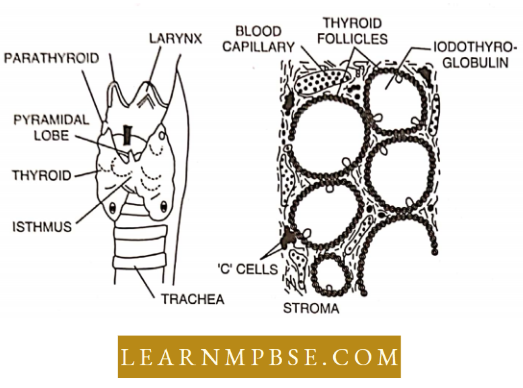
NEET Biology Multiple Choice Questions – Phylum Chordata

NEET Biology Phylum Chordata Multiple Choice Questions

Question 1. Chordates are distinguished from non-chordates by the presence of:

  1. Dorsal nerve cord
  2. Ventral nerve cord
  3. Visceral nervous system
  4. Heart.

Answer: 1. Dorsal nerve cord

Question 2. The pharynx in chordates is :

  1. Solid and segmented
  2. Perforated
  3. Not perforated
  4. An endocrine gland.

Answer: 2. Perforated

Question 3. Which one of the following characters is not a characteristic of phylum chordata?

  1. Perforated pharynx
  2. Dorsal notochord
  3. Hollow tubular ventral nerve cord
  4. Presence of ventral heart.

Answer: 3. Hollow tubular ventral nerve cord

Question 4. Hemichordates have one chordate feature in their typical form which is that?

  1. Buccal diverticulum
  2. Perforated pharynx
  3. 3 Types of coelom
  4. Integument with cilia.

Answer: 2. Perforated pharynx

Read and Learn More NEET Biology Multiple Choice Question and Answers

Question 5. Which one is the most prominent difference between urochordates and cephalochordates?

  1. Position of endostyle
  2. Length of notochord
  3. Dorsal lamina
  4. Perforated pharynx.

Answer: 2. Length of notochord

NEET Biology Phylum Chordata Questions

Question 6. Petromyzon is not true fish because of:

  1. Absence of median fins
  2. Absence of paired fins and true jaws
  3. Presence of acicular mouth
  4. Absence of operculum.

Answer: 2. Absence of paired fins and true jaws

Question 7. Herdmania belongs to the group:

  1. Hemichcrdata
  2. Urochordata
  3. Cephalochordata
  4. Gnathostomata.

Answer: 2. Urochordata

Question 8. Which of the following is a chordate but not a vertebrate?

  1. Rabbit
  2. Lamprey
  3. Snake
  4. Sea squirt

Answer: 4. Sea squirt

Question 9. Larva of hemichordate is called :

  1. Trilobite
  2. Trochophore
  3. Tomaria
  4. Dipinnaria

Answer: 3. Tomaria

Question 10. Ciliary muscles are found in :

  1. Ciliated epithelium
  2. Mammalian diaphragm
  3. Vertebrate eye
  4. Mammalian heart.

Answer: 3. Vertebrate eye

Question 11. The major constituent of vertebrate bones is:

  1. Calcium phosphate
  2. Calcium and magnesium phosphate
  3. Calcium carbonate
  4. Sodium chloride.

Answer: 1. Calcium phosphate

NEET Biology Phylum Chordata Questions

Question 12. The ovary of vertebrates is also an organ for :

  1. Balancing
  2. Visual
  3. Excretory
  4. Endocrine function.

Answer: 4. Endocrine function.

Question 13. The greatest evolutionary change enabling the land vertebrates to be completely free from water habitat is the development of:

  1. Four legs
  2. Lungs
  3. Four chambered heart
  4. Shelled eggs.

Answer: 4. Shelled eggs.

Question 14. Which special type of circulatory system is seen in all types of vertebrates?

  1. Renal portal
  2. Hepatic portal
  3. Open circulatory
  4. Double circulatory.

Answer: 2. Hepatic portal

Question 15. The Mullerian duct is the name given to :

  1. Ureter
  2. Urinogenital duct
  3. Oviduct
  4. Spermiduct

Answer: 3. Oviduct

NEET Biology Phylum Chordata Questions

Question 16. Branchiostoma belongs to:

  1. Cephalochordata
  2. Urochodrata
  3. Hemichordata
  4. Vertebrata.

Answer: 1. Cephalochordata

Question 17. Petromyzon belongs to the class:

  1. Chondrichthyes
  2. Osteichthyes
  3. Cyclostomata
  4. Tunicata.

Answer: 3. Cyclostomata

Question 18. Chordates and echinoderms are phylogenetically similar because of their:

  1. Axes of symmetry
  2. Embryo forms
  3. Biochemical pathways
  4. Fossil form.

Answer: 2. Embryo forms

Question 19. Which gland has immunological functions?

  1. Thymus
  2. Pituitary
  3. Adrenal
  4. Thyroid.

Answer: 1. Adrenal

Question 20. Crocodiles, fish, and frog on the one hand, and squirrels and
crow on the other hand differ in:

  1. The former has two appendages while the latter has two only.
  2. The body temperature of the former changes with environmental temperature while the latter remains more or less constant
  3. The former undergo metamorphosis while the latter do not
  4. The former are oviparous while the latter are not.

Answer: 2. The former undergo metamorphosis while the latter do not

Question 21. Some characters that are shown by vertebrates are mentioned below:

  1. Two-chambered heart and single-circulation
  2. Ten pairs of cranial nerves
  3. Pronephric kidney
  4. Renal and hepatic portal systems are present.

Choose the right combination for true fishes

  1. 1,2, 3
  2. 2, 3, 4
  3. 1,2, 4
  4. 1, 3, 4.

Answer: 3. 1,2, 4

Question 22. Which one of the phylum is not a commonly accepted subphylum of chordata?

  1. Urochordata
  2. Hemichordata
  3. Cephalochordata
  4. Vertebrata.

Answer: 2. Hemichordata

Vertebrates And Invertebrates MCQs NEET

Question 23. Vertebrates differ from other chordates in the possession of:

  1. Cartilaginous or bony vertebrae
  2. Usually two pairs of appendages
  3. Rbc
  4. Ventrally situated heart
  5. Internal and jointed skeleton
  6. Coelom
  7. Gill slits
  8. Bilateral symmetry

Choose the correct option

  1. All the above are correct
  2. 1, 2, 3, 4, and 5 are correct
  3. 1, 2, 3, 6, and 7 are correct
  4. 1, 2 4, 5, 6, and 7 are correct

Answer: 2. Rbc

Question 24. organized pancreas and spleen are absent in :

  1. Lamprey
  2. Shark
  3. Carp
  4. Hagfish

Answer: 1. Lamprey

Question 25. Larva of lamprey is :

  1. Tomaria
  2. Ammocoetes
  3. Appendicularia
  4. Bipinnaria.

Answer: 2. Ammocoetes

Question 26. Water is drawn into gill pouches through gill slits in

  1. Petromyzon
  2. Scoliodon
  3. Labeo
  4. Protopterus

Answer: 1. Petromyzon

Question 27. The spinal nerves of vertebrates are :

  1. Snsory
  2. Motor
  3. Mixed
  4. None of these.

Answer: 3. Mixed

Question 28. Which one of the following is found in chordates but not in non-chordates?

  1. Chitinous exoskeleton
  2. Gills
  3. Post anal tail
  4. Spiracles

Answer: 3. Post-anal tail

Class Pisces (Fishes)

Question 1. Scales in Chondrichthyes are:

  1. Placoid
  2. Ganoid
  3. Cycloid
  4. None of the above.

Answer: 1. Placoid

Question 2. Air bladder in Chondrichthyes is:

  1. Single
  2. Double
  3. Reduced
  4. Absent.

Answer: 4. Double

Question 3. Electric organs are present in :

  1. Scoliodon
  2. Torpedo
  3. Pristis
  4. Labeo.

Answer: 2. Torpedo

Question 4. Which of the following cartilaginous fish is with operculum over the gills?

  1. Pristis
  2. Trygon
  3. Chimaera
  4. Raja.

Answer: 3. Chimaera

Question 5. The suckers of sucker fish is a modification of:

  1. Dorsal fin
  2. Anal fin
  3. Caudal fin
  4. None of these.

Answer: 1. Dorsal fin

Question 6. Sharks feed on :

  1. Human beings only
  2. Squids, fishes, and other aquatic animals
  3. Aquatic plants
  4. Human beings and other aquatic animals.

Answer: 4. Human beings and other aquatic animals.

Question 7. Rays differ from sharks in having a:

  1. Dorsoventrally compressed body
  2. Broad body and narrow tail
  3. Ventrally positioned gill slits
  4. All of the above.

Answer: 4. Ventrally positioned gill slits

Question 8. The teeth of sharks are :

  1. Bony projections of the upper jaw
  2. Hardened cartilaginous projections from the upper and lower jaw
  3. Modified placoid scales
  4. Horny out grown of jaws

Answer: 3. Modified placoid scales

Question 9. Electric organs of electric rays and skates are modified:

  1. Muscles
  2. Neurons
  3. Connective tissue4
  4. Receptors

Answer: 1. Muscles

Question 10. The scientific name of African lungfish is:

  1. Polypterus
  2. Lepidosiren
  3. Protopterus
  4. Neoceratodus

Answer: 3. Protopterus

Question 11. Scales in bony fishes are not:

  1. Cosmoid
  2. Cycloid
  3. Placoid
  4. Ctenoid

Answer: 2. Cycloid

Question 12. A homocercal tail is found in:

  1. Bony fishes
  2. Shark
  3. Rays
  4. Lung fishes

Answer: 1. Bony fishes

Question 13. Air bladder in fish does not help in:

  1. Respiration
  2. Sound production
  3. Movement
  4. Excretion.

Answer: 4. Excretion.

Question 14. Viviparity is seen in :

  1. Labeo
  2. All freshwater bony fishes
  3. All marine bony fishes.
  4. Answer: 2. All freshwater bony fishes

Question 15. A flying fish is:

  1. Exocoetus
  2. Amia
  3. Acipenser
  4. None of these.

Answer: 1. Exocoetus

Question 16. The tympanum is absent in :

  1. Sharks
  2. Cartilaginous fishes
  3. Bony fishes
  4. All of these.

Answer: 4. All of these.

Question 17. Internal nares are absent in :

  1. Scoliodon
  2. Protopterus
  3. Labeo
  4. Anabas.

Answer: 2. Protopterus

Question 18. Which one of the following combinations is not correct?

  1. Elasmobranchii—scoliodon
  2. Dipnoi— Petromyzon
  3. Mammalia—whale
  4. Urochordata— herdmania.

Answer: 2. Dipnoi— Petromyzon

Question 19. The holocephali lacks only one of the following elasmobranch characters, it is :

  1. Claspers in male
  2. Number of gills slits(5-7)
  3. Cartilaginous endoskeleton
  4. Marine habitat.

Answer: 2. Number of gills slits(5-7)

Question 20. Which one of the following ileostomies has no food value?

  1. Mystus seenghala
  2. Anabas
  3. Labeo rohita
  4. Cyprinus carpio.

Answer: 2. Anabas

Question 21. Fishes with ventral mouths and five pairs of gill slitsiare kept under the group :

  1. Pleurotremata
  2. Hypotremata
  3. Holocephali
  4. Actinopterygii.

Answer: 2. Hypotremata

Question 22. The tail of the bony fish is :

  1. Protocercal
  2. Heterocercal
  3. Diphycercal
  4. Homocercal.

Answer: 4. Homocercal.

Question 23. But of one, others are called carps, which one is?

  1. Labeo
  2. Catla catla
  3. Mystus
  4. Cyprinus.

Answer: 3. Mystus

Question 24. Which is the fish that gives birth to young ones?

  1. Scoliodon
  2. Anabas
  3. Heteropneustes
  4. Catla catla.

Answer: 1. Scoliodon

Question 25. Oxygenated blood never goes to the heart in :

  1. Mammals
  2. Fishes
  3. Birds
  4. Reptiles.

Answer: 2. Fishes

Question 26. The lateral line sensory system is markedly developed in

  1. Scoliodon
  2. Labeo
  3. Larval stages of fishes
  4. All members of class elasmobranchii.

Answer: 4. All members of class elasmobranchii.

Question 27. The kidney of fish is of the type :

  1. Pronephros
  2. Mesonephros
  3. Metanephros
  4. Nephridial.

Answer: 2. Mesonephros

Question 28. Vision in elasmobranch is :

  1. Of importance for close-range
  2. Is adapted for perception in low light intensities
  3. Due to rods-rich retina
  4. All of the above.

Answer: 1. Of importance for close-range

Question 29. Bony fishes are :

  1. Ammonotelic
  2. Ureotelic
  3. Uricotelic
  4. Aminotelic.

Answer: 1. Ammonotelic

Question 30. Fishes possess exoskeleton of:

  1. Bones
  2. Cartilages
  3. Scales
  4. Scutes.

Answer: 3. Scales

Question 31. Out of the following, which two are the most important identification features of fishes :

  1. Epidermal scales and tail
  2. Epidermal scales and gills
  3. Tail and venous heart
  4. Venous heart and gills.

Answer: 2. Epidermal scales and gills

Question 32. By noting the presence or absence of one of the following, the fish can be identified either as an elasmobranch fish or as a teleostean fish

  1. Lateral line
  2. Operculum
  3. Mucus
  4. Middle ear.

Answer: 2. Operculum

Question 33. Shagreen is :

  1. Dried shark skin
  2. Green colored gland of a shark
  3. A fish meal
  4. A gland found in amphibians.

Answer: 1. Dried shark skin

Question 34. An example of a migratory fish is :

  1. Shark
  2. Salmon
  3. Carp
  4. Ribbon fish.

Answer: 2. Salmon

Question 35. Electric ray is a:

  1. Cartilagittpus fish
  2. Bony fistt
  3. Freshwater fish.

Answer: 1. Cartilagittpus fish

Question 36. Ichthyology is, the study of:

  1. Birds
  2. Reptiles
  3. Insects
  4. None of these

Answer: 4. None of these

Question 37. Which one is the true fish :

  1. Dogfish
  2. Silverfish
  3. Starfish
  4. Cuttlefish.

Answer: 1. Dogfish

Question 38. Carp fish common in India is:

  1. Hilsa
  2. Labeo
  3. Barbus
  4. Wallago.

Answer: 2. Labeo

Question 39. Which one of the following is an exotic Indian fish?

  1. Labeo rohita
  2. Catla,catla
  3. Heteropneustes fossilis
  4. Cyprinus carpio.

Answer: 4. Cyprinus carpio.

Question 40. In the fish, to see in the water medium :

  1. The lens is flat and the cornea spherical
  2. The cornea is flat and the lens spherical
  3. Both the lens and cornea are flat
  4. Both the lens and cornea are spherical.

Answer: 2. The cornea is flat and the lens spherical

Question 41. Lungfish burrow into the mud of rivers during hot day periods, which enables them to reduce their metabolic rate and survive. This phenomenon is called:

  1. Hibernation
  2. Aestivation
  3. Reproduction
  4. None of these.

Answer: 2. Aestivation

Question 42. Which of the following has a closed type of circulatory system?

  1. Cockroach
  2. Scorpion
  3. Fish
  4. Mollusc

Answer: 3. Fish

Question 43. Which among the following i.4 a living fossil?

  1. Varanus
  2. Dodo
  3. Coelocanth
  4. Dogfish.

Answer: 3. Coelocanth

Question 44. The lateral line system is present in :

  1. Fish
  2. Frog
  3. Reptile
  4. Man.

Answer: 1. Fish

Question 45. Pristis belongs to the class:

  1. Dipnoi
  2. Teleostomii
  3. Elasmobranchii
  4. Holocephali.

Answer: 2. Teleostomii

Question 46. Anadromous fishes move :

  1. From the river to the sea
  2. To fresh water from the sea
  3. From estuary to sea
  4. From sea to estuary.

Answer: 2. To fresh water from the sea

Question 47. The common name of a marine fish, Anguilla, is :

  1. Rohu
  2. Hilsa
  3. Eel
  4. Bombay duck.

Answer: 3. Eel

Question 48. One can identify a fish by the presence of one of the given characteristic features:

  1. Tails
  2. Fin with fin rays
  3. Scales
  4. Gills.

Answer: 3. Scales

Question 49. Which one of the following is a real fish?

  1. Silver fish
  2. Star fish
  3. Dog fish
  4. Shellfish.

Answer: 3. Dogfish

Class Amphibia

Question 1. A frog differs from a toad in:

  1. Absence of warts
  2. Absence of pinna
  3. Presence of pigmented skin
  4. Absence of neck.

Answer: 1. Absence of warts

Question 2. In frogs the mucous glands are derivatives of :

  1. Stratum compactum
  2. Stratum spongiosum
  3. Epidermis
  4. Dermis.

Answer: 4. Dermis.

Question 3. In frogs, teeth are present on:

  1. Lower jaw
  2. Upper jaw
  3. Both jaws
  4. None of these.

Answer: 2. Upperjaw

Question 4. In amphibia, the Jacobson organ is also known as:

  1. Alimentary canal
  2. Ear
  3. Nasal chamber.
  4. Eye.

Answer: 3. Nasal chamber.

Question 5. Among vertebrates, amphibians are the first to invade land but they always have to return to water for:

  1. Excretion
  2. Respiration
  3. Breeding
  4. Preying.

Answer: 1. Excretion

Question 6. In frogs false copulation occurs since the penis is absent in the male and fertilization of the eggs occurs:

  1. Inside the bidder canal of the kidney
  2. Externally in the water
  3. When the egg is in the cloaca
  4. When the egg is passing through the uterus.

Answer: 4. When the egg is passing through the uterus.

Question 7. During hibernation in frogs, the mode of respiration is:

  1. Gill respiration
  2. Cutaneous respiration
  3. Pulmonary respiration
  4. Pharyngeal respiration.

Answer: 4. Pharyngeal respiration.

Question 8. Pulmonary breathing increases when the frog is :

  1. Hibernating
  2. Underwater
  3. Overwater
  4. Excited.

Answer: 3. Overwater

Question 9. The biggest part of the brain of a frog is known as:

  1. Forebrain
  2. Hindbrain
  3. Midbrain
  4. None of these.

Answer: 1. Fore brain

Question 10. During the hibernation period, the left auricle of the frog heart contains:

  1. Oxygenated blood
  2. Deoxygenated blood
  3. Mixed blood blood.

Answer: 3. Mixed blood blood.

Question 11. How many cranial nerves are present in the body of a frog?

  1. 12 Pairs
  2. 8 Pairs
  3. 10 Pairs
  4. 14 Pairs.

Answer: 2. 8 Pairs

Question 12. In frogs several spinal nerves are:

  1. 9 Pairs and 10th unpaired
  2. 12 Pairs
  3. 31 Pairs
  4. 37 Pairs.

Answer: 1. 9 Pairs and 10th unpaired

Question 13. Which of the following statements apply to the teeth of a frog?

  1. Homodonty
  2. Heterodonty
  3. Pleurodonty
  4. Acrodonty and homodonty.

Answer: 4. Acrodonty and homodonty.

Question 14. Cells in the skin of a frog for change the color according to the environment are known as:

  1. Chromatophores
  2. Melanocytes
  3. Phagocytes
  4. Thrombocytes.

Answer: 2. Melanocytes

Question 15. In frog:

  1. Adult kidney develops from nephridia
  2. The heart has a single ventricular chamber
  3. There is a single portal system
  4. There are seven cervical vertebrae.

Answer: 1. Adult kidney develops from nephridia

Question 16. Frogs are ectothermic or poikilothermal animals because:

  1. Its body temperature is constant irrespective of the fluctuation in the temperature of the environment
  2. Its body temperature is higher than that of the surrounding environment
  3. Its body temperature is low and fluctuates with the temperature of the environment
  4. None of the above.

Answer: 4. None of the above.

Question 17. The dorsal median line present in the skin of a frog is :

  1. Warming line
  2. Cold adaptation line
  3. Sensory line
  4. Ornamental line.

Answer: 2. Cold adaptation line

Question 18. The opening in the frog cranium in which the spinal cord comes out is called:

  1. Foramen magnum
  2. Occipital condyle
  3. Pterygoid
  4. Obturator foramen.

Answer: 2. Occipital condyle

Question 19. The number of vertebrae in the vertebral column of a frog is:

  1. 9
  2. 9 Vertebrae and urostyle
  3. 8 Vertebrae and urostyle
  4. None of the above.

Answer: 2. 9 Vertebrae and urostyle

Question 20. The glenoid cavity or fossa in frogs is found in:

  1. Pelvic girdle
  2. Pectoral girdle
  3. Sacrum
  4. Skull.

Answer: 2. Pectoral girdle

Question 21. Acetabulum in frogs is associated with:

  1. Pelvic girdle
  2. Pectoral girdle
  3. Sacrum
  4. Cranium.

Answer: 2. Pectoral girdle

Question 22. The Iliac crest is a feature of frogs:

  1. Hyoid apparatus
  2. Sacrum
  3. Pelvic girdle
  4. Pectoral girdle.

Answer: 4. Pectoral girdle.

Question 23. The body of the frog is slimy with a mucus covering and the skin is maintained moist because the animal:

  1. Cannot hold food with dry skin
  2. Is unable to move with dry skin
  3. Is unable to swim with dry skin
  4. Has to perform cutaneous respiration.

Answer: 3. Is unable to swim with dry skin

Question 24. A well-fed frog’s skin is fully covered with a wax coating. After a day. The animal is found to be lazy and slow. This is because:

  1. Animal gets poisoned by nitrogenous wastes which the skin cannot excrete
  2. The animal is hungry
  3. The animal is oxygen-starved and cutaneous respiration is blocked
  4. None of the above.

Answer: 1. Animal gets poisoned by nitrogenous wastes which the skin cannot excrete

Question 25. The excretory product of an adult frog and tadpole in an internal gill stage respectively are :

  1. Urea in both
  2. Urea and uric acid
  3. Urea and ammonia
  4. Ammonia and uric acid.

Answer: 2. Urea and uric acid

Question 26. The largest living amphibian is the:

  1. Giant salamander of Japan
  2. The tiger salamander
  3. The crimson-spotted newt
  4. Necturus.

Answer: 4. Necturus.

Question 27. Which of the following is strictly aquatic amphibian?

  1. Ambystoma
  2. Cryptobranchus
  3. Necturus
  4. Diemictylus.

Answer: 2. Cryptobranchus

Question 28. A frog has no neck, suppose it has one, it would:

  1. Swallow its prey
  2. Unable to leap on land easily
  3. Breathe easily by floating on water’s surface
  4. Swim easily in water.

Answer: 1. Swallow its prey

Question 29. Nuptial pads occur on frogs:

  1. Inner toes
  2. Outer toes
  3. Inner fingers
  4. Outer fingers.

Answer: 1. Inner toes

Question 30. Which of the following is a limbless amphibian?

  1. Ichthyophis
  2. Rhacophorus
  3. Eryops
  4. Necturus.

Answer: 3. Eryops

Question 31. Neoteny is exhibited by :

  1. Axolotl larva
  2. Necturus
  3. Proteus
  4. All of these.

Answer: 2. Necturus

Question 32. The most striking case of parental care seen in:

  1. Alytes
  2. Echinoderm
  3. Surinam toad
  4. Necturus.

Answer: 2. Rhinoderm

Question 33. In toads poison glands are present in:

  1. Parotid duct
  2. Carotid labyrinth
  3. Parotid glands
  4. Sudoriferous glands.

Answer: 1. Parotid duct

Question 34. Coelom of rana is:

  1. Enterocoel
  2. Pseudocoel
  3. Schizocoel
  4. Eucoel.

Answer: 2. Pseudocoel

Question 35. The following vertebrate respires by skin :

  1. Fish
  2. Frog
  3. Crocodile
  4. Whale

Answer: 1. Fish

Question 36. Blindworm is :

  1. Typhlops
  2. Uraeotyphlus
  3. Ophiosaurs
  4. Necturus.

Answer: 4. Necturus.

Question 37. Ichthyophis is :

  1. Limbless amphibian
  2. Reptile
  3. Lizard
  4. Fish.

Answer: 1. Limbless amphibian

Question 38. Characteristic features of amphibians are:

  1. Presence of scales
  2. Amphibious mode of life
  3. Poison glands
  4. Absence of scales, glandular and moist skin.

Answer: 2. Amphibious mode of life

Question 39. Which of the following is a limbless amphibian?

  1. Hyla
  2. Necturus
  3. Amphiuma
  4. Uraeotyphlus.

Answer: 4. Uraeotyphlus.

Question 40. Which of the following similarity is between fish and tadpole?

  1. Fins
  2. Scales
  3. Gills
  4. All of these.

Answer: 2. Scales

Question 41. In frogs, there are:

  1. No outer ear
  2. No outer ear but eardrum and cochlea
  3. Cochlea and outer ear
  4. Eardrum and internal ear.

Answer: 2. No outer ear but eardrum and cochlea

Question 42.  The character that proves that frogs have evolved from fish is:

  1. Similarity in the shape of the head
  2. The ability to swim in water
  3. The tadpole larva in frogs which resembles the fishes in many characters
  4. None of the above.

Answer: 3. The tadpole larva in frogs which resembles the fishes in many characters

Question 43. The suspended state of life of animals is called:

  1. Hibernation
  2. Origin of life
  3. Aestivation
  4. Migration.

Answer: 3. Aestivation

Question 44. Axolotl is the name given to the larva of:

  1. Roundworm
  2. Amphioxus
  3. Ambystoma
  4. Silkworm.

Answer: 1. Roundworm

Question 45. The glands of Swammerdam are rich in the following:

  1. Calcium
  2. Acetylcholine
  3. Dopamine
  4. Gonadotrophin.

Answer: 1. Calcium

Question 46. The renal portal system is made of :

  1. Sciatic, renal portal veins
  2. Femoral, sciatic, renal portal veins
  3. Femoral, renal portal veins
  4. Renal portal veins.

Answer: 2. Femoral, sciatic, renal portal veins

Class Reptilia

Question 1. Hands and feet are grasping in:

  1. Chameleon
  2. Calotes
  3. Phrynosoma
  4. Draco.

Answer: 1. Chameleon

Question 2. The only poisonous lizard is:

  1. Varanus
  2. Phrynosoma
  3. Heloderma
  4. Calotes.

Answer: 3. Heloderma

Question 3. Heart in a crocodile is :

  1. Two chambered
  2. Three chambered
  3. Incomplete four chambered
  4. Complete four-chambered.

Answer: 4. Complete four-chambered.

Question 4. The functional udult kidney of reptiles arc :

  1. Pronephric
  2. Metanephric
  3. Mesonephric
  4. 50% Each of mesonephric and metanephric

Answer: 2. Metanephric

Question 5. The reason for the death of a patient of cobra bite is :

  1. Destruction of rbc
  2. Permanent contraction of muscles
  3. Inactivation of nerves
  4. None of the above.

Answer: 3. Inactivation of nerves

Question 6. A reptile which can live in water as well as on land:

  1. Turtle
  2. Python
  3. Sphenodon
  4. Hemidactylus.

Answer: 4. Hemidactylus.

Question 7. The cleidoic eggs first developed in:

  1. Fishes
  2. Amphibians
  3. Reptiles
  4. Birds.

Answer: 4. Birds.

Question 8. Gavialis gangeticus the Indian gharial does not have the powerful jaws of their crocodile cousins. They eat:

  1. Small aquatic birds
  2. Crabs and prawn
  3. Mollusc
  4. Fishes.

Answer: 3. Mollusc

Question 9. The largest living lizard is:

  1. Komodo dragon
  2. The homed toad
  3. Draco
  4. Heloderma

Answer: 1. Komodo dragon

Question 10. The only lizard with a prehensile tail is :

  1. Chameleon
  2. Calotes
  3. The Komodo dragon
  4. Flying lizard.

Answer: 3. The Komodo dragon

Question 11. Snakes lack tympanic membranes. The auxiliary olfactory organs are :

  1. Skin
  2. Scales
  3. Tongue
  4. Precomea.

Answer: 2. Scales

Question 12. The number of occipital condyles in the skull of reptiles is:

  1. Zero
  2. One
  3. Two
  4. Four.

Answer: 1. Zero

Question 13. Typhlops is a :

  1. Blind snake
  2. Glass snake
  3. Tree snake
  4. Sea snake.

Answer: 4. Sea snake.

Question 14. The sea snake is different from the rest because it has:

  1. Uniform scales on the head and body
  2. Pectoral and pelvic fins for swimming
  3. Big head
  4. A laterally compressed tail.

Answer: 2. Pectoral and pelvic fins for swimming

Question 15. Which of the following snakes is not poisonous?

  1. Naja naja
  2. Python
  3. Bungarus
  4. Hydrophis.

Answer: 1. Naja naja

Question 16. Most of the poisonous snakes have:

  1. Narrow transverse belly plates
  2. Wide transverse plates stretching completely across the belly
  3. Small uniform belly plates
  4. None of the above.

Answer: 4. None of the above.

Question 17. Skull of the reptile is :

  1. Dicondylar
  2. Monocondylar
  3. Tetracondylar
  4. None of these.

Answer: 2. Monocondylar

Question 18. Largest fossil reptiles are :

  1. Dinosaurs
  2. Archaeopteryx
  3. Sphenodon
  4. Pterosaurs.

Answer: 2. Archaeopteryx

Question 19. Reptiles that can glide in the air are:

  1. Heloderma
  2. Draco
  3. Phrynosoma
  4. Anguis.

Answer: 2. Draco

Question 20. Aquatic reptiles belong to the order :

  1. Crocodilia
  2. Lacertilia
  3. Ophidia
  4. Rhynchocephalia.

Answer: 2. Lacertilia

Question 21. Embryonic membranes of reptiles are:

  1. Yolk sac
  2. Amnion
  3. Allantois
  4. All of these.

Answer: 2. Amnion

Question 22. The poison glands of a poisonous snake are modified :

  1. Buccal glands
  2. Salivary glands
  3. Palatine glands
  4. Lacrimal glands.

Answer: 4. Lacrimal glands.

Question 23. Fangs develop on:

  1. Quadrate
  2. Squamosal
  3. Maxilla
  4. Mandibles.

Answer: 3. Maxilla

Question 24. Phrynosoma is :

  1. Horned lizard
  2. Flying lizard
  3. Monitor lizard
  4. Garden lizard.

Answer: 1. Horned lizard

Question 25. Which of the following is not a snake?

  1. Rattlesnake
  2. Rat snake
  3. Glass snake
  4. Blind snake.

Answer: 2. Rat snake

Question 26. Gymnophiona are :

  1. Wormiform without limbs
  2. Tail-less with long legs
  3. Scaleless with a well-developed tail
  4. Extinct with a massive endoskeleton.

Answer: 4. Extinct with a massive endoskeleton.

Question 27. The true coelom is lined with :

  1. Ectoderm
  2. Endoderm
  3. Mesoderm
  4. Ectoderm and endoderm.

Answer: 2. Endoderm

Question 28. Most adapted for desert habitat:

  1. Lizard
  2. Rana tigrina
  3. Cockroach
  4. Osteichthyes.

Answer: 1. Lizard

Question 29. The carapace is the outer hard covering of:

  1. Trilobites
  2. Lizards
  3. Tortoises
  4. Gharial.

Answer: 1. Trilobites

Question 30. Four chambered hearts are found in reptiles:

  1. Python
  2. Krait
  3. Crocodile
  4. Bungarus.

Answer: 3. Crocodile

Question 31. The study of lizards is called :

  1. Herpetology
  2. Saurology
  3. Ophiology
  4. Serology.

Answer: 2. Saurology

Question 32. A lizard found in New Zealand and was considered extinct:

  1. Rhynchoderma
  2. Sphenodon
  3. Varanus
  4. Gecko.

Answer: 2. Sphenodon

Question 33. A snake has :

  1. No eyelids
  2. Moveable eyelids
  3. Immoveable eyelids.
  4. Eyelids placed in pouches.

Answer: 3. Immoveable eyelids

Question 34. Kidney of adult reptiles are:

  1. Mesonephric
  2. Metanephric
  3. Pronephric
  4. Both 1 and 2.

Answer: 2. Metanephric

Question 35. To which of the following is carapace related?

  1. Crocodile
  2. Bird
  3. Tortoise
  4. None.

Answer: 3. Tortoise

Question 36. The non-poisonous snake is :

  1. Viper
  2. Python
  3. Naja
  4. None.

Answer: 2. Python

Question 37. The identifying character of cobra is :

  1. Presence of hood
  2. Small scales on the head
  3. Round tail
  4. The third supra labial touches the eye and nostril.

Answer: 1. Presence of hood

Question 38. Laterally compressed tail is found in :

  1. Marine, non-poisonous snakes
  2. Marine, poisonous snakes
  3. Freshwater snakes
  4. Terrestrial snakes.

Answer: 2. Marine, poisonous snakes

Question 39. Herpetology is the study of :

  1. Insects
  2. Birds
  3. Fishes
  4. Reptiles.

Answer: 4. Reptiles.

Question 40. Which of the following is true?

  1. All lizards are poisonous
  2. Only 2 species of Mexican lizards are poisonous
  3. The tail of the common lizard is poisonous
  4. No lizard is poisonous.

Answer: 2. Only 2 species of Mexican lizards are poisonous

Question 41. The venom of cobra affects the following:

  1. Digestive system
  2. Circulatory system
  3. Nervous system
  4. Respiratory system.

Answer: 2. Circulatory system

Question 42. When the tail is cylindrical and ventral scales do not extend the entire width of the belly, the snake is:

  1. Non-poisonous
  2. Either poisonous or non-poisonous
  3. Poisonous
  4. Deadly poisonous.

Answer: 2. Either poisonous or non-poisonous

Question 43. ‘Homed toad’ is a/an :

  1. Fish
  2. Amphibian
  3. Reptile
  4. Mammal.

Answer: 3. Reptile

Class Aves

Question 1. Birds are:

  1. Cold Blooded
  2. Homeothermal
  3. Poikilothermal
  4. Homeopoiesis.

Answer: 2. Homeothermal

Question 2. The wing and tail feathers of birds are termed as:

  1. Quill feathers
  2. Filoplumes
  3. Down feathers
  4. Shaft feathers.

Answer: 1. Quill feathers

Question 3. Birds sing:

  1. To ward off danger
  2. To bring together birds
  3. To attract mate
  4. For communication between parents and young- ones.

Answer: 3. To attract a mate

Question 4. A bird that does not incubate its eggs is:

  1. Cuckoo
  2. Common hummingbird
  3. Seagulls
  4. Penguins.

Answer: 1. Cuckoo

Question 5. The largest living bird weighing about 136 kg is:

  1. Emu
  2. Cassowary
  3. Ostrich
  4. Kiwi.

Answer: 3. Ostrich

Question 6. The largest order of birds is :

  1. Passiformes (songbirds)
  2. Columbiformes (pigeons)
  3. Falconiformes (birds of prey)
  4. Galliformes (pheasants and fowls).

Answer: 1. Passiformes (songbirds)

Question 7. Which of the following is our national bird?

  1. Pavo cristatus
  2. Gallus gallus
  3. Milvus migrans
  4. Diomedea exulans.

Answer: 1. Pavo cristatus

Question 8. Which bird has claws on its digits in the wings?

  1. Ostrich
  2. Rheas
  3. Hoatzin
  4. All of these.

Answer: 3. Hoatzin

Question 9. Birds shed their old feathers in:

  1. Late winter
  2. Autumn
  3. Late summer
  4. After breeding season.

Answer: 4. After breeding season.

Question 10. A typical feather has three parts viz: Vane or vexillum, after shaft and

  1. Calamus
  2. Furcula
  3. Rami
  4. Shaft.

Answer: 1. Calamus

Question 11. Birds groom their feathers with oil from preen glands. These are located:

  1. Under their beaks
  2. In the neck regions
  3. Below the eyes
  4. Near the cloaca.

Answer: 4. Near the cloaca.

Question 12. Which of the following is a bird of prey?

  1. Pavo
  2. Eudynamis
  3. Bubo
  4. Picus.

Answer: 2. Eudynamis

Question 13. Wings are modified into swimming paddles in :

  1. Ducks
  2. Geese
  3. Water fowls
  4. Penguins.

Answer: 4. Penguins.

Question 14. Rectrices are feathers of:

  1. Wings
  2. Body
  3. Tail
  4. Legs.

Answer: 3. Tail

Question 15. Birds are:

  1. Ureotelic
  2. Uricotelic
  3. Ammonotelic
  4. Aminotelic.

Answer: 2. Uricotelic

Question 16. The urinary bladder is absent in :

  1. Fishes
  2. Amphibians
  3. Mammals
  4. Birds.

Answer: 4. Birds.

Question 17. Which of the following can fly backward?

  1. Albatross
  2. Crane
  3. Hummingbird
  4. Penguin.

Answer: 3. Hummingbird

Question 18. Penguins are:

  1. Amphibious
  2. Terrestrial
  3. Strictly aquatic
  4. Strictly aerial.

Answer: 1. Amphibious

Question 19. The skull of birds is :

  1. Monocondylar
  2. Condylar
  3. Amphicondylar
  4. None Of These.

Answer: 1. Monocondylar

Question 20. Birds fly from place to place, this movement is termed:

  1. Cursorial
  2. Volant
  3. Scansorial
  4. Digitigrade.

Answer: 2. Volant

Question 21. Which one of the following birds sucks nectar?

  1. Parrot
  2. Red-vented bulbul
  3. Sunbird
  4. Mynah.

Answer: 3. Sunbird

Question 22. Feathers of birds are modifications of:

  1. Epidermal scales
  2. Plates
  3. Dermal scales
  4. None of the above.

Answer: 1. Epidermal scales

Question 23. Flight adaptations in the forelimbs of birds are:

  1. Presence of flight muscles
  2. Feathers arranged to form wings
  3. Pneumatic bones and clawless digits
  4. All the above.

Answer: 4. All the above.

Question 24. Avian skin contains :

  1. Oil glands in the region of the tail only
  2. Oil glands distributed all over the body
  3. Sweat glands
  4. Special sudoriferous glands.

Answer: 1. Oil glands in the region of the tail only

Question 25. Furcula of birds are formed of:

  1. Clavicles and interclavicles
  2. Coracoids
  3. Sternum and scapula
  4. Coracoids and clavicles.

Answer: 1. Clavicles and interclavicles

Question 26. Sound in birds is produced by:

  1. Syrinx
  2. 1 Aryngo-tracheal chamber
  3. Vocal cord
  4. Larynx.

Answer: 1. Syrinx

Question 27. Air sacs are present in :

  1. Terrestrial birds
  2. Aquatic birds
  3. All birds
  4. None of the above.

Answer: 4. None of the above.

Question 28. Number of aortic arches in birds is:

  1. One pair
  2. Two pairs
  3. Single left
  4. Single right.

Answer: 2. Two pairs

Question 29. The female genitalia of birds consists of:

  1. Paired ovaries which function alternatively
  2. Left functional ovary
  3. Right functional ovary
  4. Equipotent left and right ovaries.

Answer: 2. Left functional ovary

Question 30. Flightless birds comprise a group called :

  1. Ostrich
  2. Kiwi
  3. Emu
  4. Ratitae.

Answer: 4. Ratitae.

Question 31. Birds of prey lay their eggs :

  1. On lofty trees on high rocks
  2. In sand pits
  3. In nests built by them
  4. In water.

Answer: 1. On lofty trees on high rocks

Question 32. Which of the following traits is not characteristic of birds?

  1. Air sacs attached to lungs
  2. Hollow bones
  3. Ectothermic
  4. Amniote egg.

Answer: 3. Ectothermic

Question 33. The types of vertebrae seen in birds are :

  1. Opisthocoelous
  2. Amphicoelous
  3. Acoelous
  4. Heterocoelous.

Answer: 4. Heterocoelous.

Question 34. How many air sacs do pigeons have?

  1. 9
  2. 8
  3. 5
  4. 6.

Answer: 1. 9

Question 35. The wish-bone of a bird, which supports the flight muscle is formed from:

  1. The fusion of collarbones
  2. Anterior ribs
  3. Ventral extensions of vertebrae
  4. Posterior extensions of the larynx.

Answer: 1. The fusion of collarbones

Question 36. Which of these characters is not true for birds?

  1. Only one functional ovary present
  2. Urinary bladder absent
  3. Body temperature is constant within a narrow range
  4. The diaphragm separating the thorax from the abdomen is present.

Answer: 4. The Diaphragm separating the thorax from the abdomen is present.

Question 37. Which of the following is not the flight adaptation of the bird?

  1. Single ovary
  2. Hollow bones with air space.
  3. Light water waterproof feathers
  4. Presence of penis in some birds.

Answer: 4. Presence of penis in some birds.

Question 38. Which of these are the longest feathers?

  1. Contours
  2. Filoplumes
  3. Quill on wing
  4. Tail quill.

Answer: 4. Tail quill.

Question 39. The hollow long bones connected by air passages are characteristics of:

  1. All land vertebrates
  2. Mammals
  3. Reptiles
  4. Aves.

Answer: 4. Aves.

Question 40. Sinus venosus is absent in :

  1. Mammal
  2. Birds
  3. Reptiles
  4. Amphibia.

Answer: 3. Reptiles

Question 41. Penguin is related to:

  1. South pole
  2. North pole
  3. South America
  4. New Zealand.

Answer: 1. South pole

Question 42. In which of the following bird teeth are/were present:

  1. Pigeon
  2. Peacock
  3. Dodo
  4. Archaeopteryx.

Answer: 4. Archaeopteryx.

Question 43. Which sound-producing organ is found in birds?

  1. Pharynx
  2. Larynx
  3. Syrinx
  4. Trachea.

Answer: 3. Syrinx

Question 44. Both birds and bats fly. Bats are different from birds due to the presence of:

  1. Wings
  2. Four chambered heart
  3. Diaphragm
  4. Homiotherm.

Answer: 2. Four chambered heart

Question 45. Dodo disappeared from :

  1. Mauritius
  2. Indonesia
  3. Australia
  4. India.

Answer: 4. India.

Question 46. Long snout and backwardly directed claws are present in:

  1. Cursorial animals
  2. Fossorial animals
  3. Arboreal animals
  4. Aquatic animals.

Answer: 3. Arboreal animals

Question 47. Four chambered hearts are present in:

  1. Chelonia
  2. Crocodilia
  3. Amphibia
  4. Birds and Crocodilia.

Answer: 3. Amphibia

Question 48. Which bird sucks nectar :

  1. Humming Bird
  2. Parrot
  3. Sarus crane
  4. Albatross.

Answer: 1. Humming Bird

Question 49. Pneumatic bones are expected to be found in :

  1. Flying fish
  2. Frog’s tadpole
  3. Pigeon
  4. House lizard.

Answer: 4. House lizard.

Question 50. All birds are:

  1. Omnivorous
  2. Have feathers and fly
  3. Have calcareous shelled egg
  4. Form nests and care for their young ones.

Answer: 3. Have calcareous shelled egg

Question 51. Flightless bird cassowary is found in :

  1. Mauritius
  2. Indonesia
  3. New Zealand
  4. Australia.

Answer: 2. Indonesia

Question 52. In birds, some of the vertebrae are fused to form:

  1. Syncytium
  2. Synsacrum
  3. Keel
  4. Furcula.

Answer: 1. Syncytium

Vertebrates And Invertebrates MCQs NEET

Question 53. The vertebrae in birds are mostly :

  1. Procoelous
  2. Amphicoelous
  3. Opisthocoelous
  4. Heterocoelous.

Answer: 2. Amphicoelous

Question 54. The “wishbone” or “Merrythought bone” of birds is :

  1. Sternum
  2. Scapula
  3. Coracoid
  4. Clavicles.

Answer: 2. Scapula

Question 55. Flightless, aquatic birds are included in this group :

  1. Ratittae
  2. Carinatae
  3. Odontognathae
  4. Impennae.

Answer: 4. Impennae.

Questions for NEET Biology Animal Kingdom PhylumQuestion 56. The study of bird migration is known as :

  1. Phenology
  2. Oology
  3. Nidology
  4. Ornithology.

Answer: 2. Oology

Question 57. The state which has named most of its holiday resorts after names of birds is :

  1. Himachal Pradesh
  2. Haryana
  3. Assam
  4. Karnataka.

Answer: 2. Haryana

Question 58. Dr. Salim Ali is a famous birdman of India. He observed and described a maximum number of birds. His last desire was to rediscover:

  1. Himalayan mountain quail
  2. Jerdon’s courser
  3. Indian courser
  4. White-breasted King Fisher.

Answer: 1. Himalayan mountain quail

Question 59. The scientist who described the birds as glorified reptiles

  1. Romer
  2. Huxley
  3. Mendel
  4. Robert Hooke.

Answer: 2. Huxley

Question 60. The special sound-producing organ in birds is:

  1. Syrinx
  2. Glottis
  3. Larynx
  4. None.

Answer: 1. Syrinx

Question 61. Which one of the following is a flightless bird:

  1. Pavo cristatus
  2. Corvus
  3. Aptenodytes
  4. Passer.

Answer: 1. Pavo cristatus

Vertebrates And Invertebrates MCQs NEET

Question 62. The larynx is also called :

  1. Glottis
  2. Epiglottis
  3. Voice box
  4. Vocal chord.

Answer: 3. Voicebox

Question 63. The bones of a bird are :

  1. Hollow and heavy
  2. Solid but light
  3. Hollow and light
  4. Like iron rods.

Answer: 3. Hollow and light

Question 64. Which of the following birds is a famous migratory bird in India?

  1. Arctic tern
  2. Wagtail
  3. Maina
  4. Goose.

Answer: 1. Arctic tern

Question 65. Kingfisher is a bird in which the feet are :

  1. Scratching type
  2. Raptorial
  3. Wading type
  4. Perching type.

Answer: 3. Wading type

Question 66. The young chickens raised specifically for meat are called :

  1. Hen
  2. Broilers
  3. Cockerels
  4. Pullets.

Answer: 2. Broilers

Question 67. What is common between ostrich, penguin, and kiwi?

  1. These are running birds
  2. These have four toes on their feet
  3. These are migratory birds
  4. These are flightless birds.

Answer: 1. These are running birds

Vertebrates And Invertebrates MCQs NEET

Question 68. Bone marrow is absent in :

  1. Reptilia
  2. Amphibia
  3. Fishes
  4. Birds.

Answer: 4. Birds.

Question 69. The national bird of India is :

  1. The Peacock
  2. The house sparrow
  3. The hornbill
  4. Black swan.

Answer: 1. The peacock

Class Mammalia

Question 1. Tachyglossus is a representative of:

  1. Prototheria
  2. Eutheria
  3. Metatherian
  4. Proboscidia.

Answer: 1. Prototheria

Question 2. The body is covered by large, thick, homy, overlapping scales in:

  1. Hedgehog
  2. Pangolin
  3. Porcupine
  4. Hare.

Answer: 2. Pangolin

NEET Previous Year Questions on Chordates

Question 3. Loris belongs to the order :

  1. Primata
  2. Insectivora
  3. Rodentia
  4. Chiroptera.

Answer: 1. Primata

Question 4. Tusks occur in :

  1. Elephant
  2. Dugong
  3. Walrus
  4. All of these.

Answer: 4. All of these.

Question 5. Hind limbs are lacking in :

  1. Balaenoptera
  2. Dugong
  3. Both of them
  4. None of these.

Answer: 3. Both of them

Question 6. Which of the following is not a primate?

  1. Rhesus monkey
  2. Man
  3. Lemur
  4. Cat.

Answer: 4. Cat.

Question 7. Which of the following is a toothless whale?

  1. Dolphin
  2. Killer whale
  3. Narwhale
  4. Whalebone whale.

Answer: 4. Killer whale

Question 8. Bats can find their way in the dark by being highly sensitive:

  1. Electromagnetic mechanism
  2. Sonar mechanism
  3. Heat mechanism
  4. None of the above.

Answer: 2. Sonar mechanism

NEET Previous Year Questions on Chordates

Question 9. Unguligrade is the posture referred to as:

  1. Man
  2. Horse.
  3. Cat
  4. Mouse.

Answer: 2. Horse.

Question 10. The smallest mammal is :

  1. Shrew
  2. Mouse
  3. Mole
  4. Platypus.

Answer: 1. Shrew

Question 11. The whale is a warm-blooded mammal. It survives in cold seas. Its main device is:

  1. Blubber
  2. Pelage
  3. Muscles
  4. Blood vessel.

Answer: 1. Blubber

Phylum Chordata NEET Questions Question 12. Seal belongs to order ;

  1. Sirenia
  2. Carnivora
  3. Lagomorpha
  4. Proboscidia.

Answer: 2. Carnivora

Question 13. Which one of the following glands is responsible for aging?

  1. Islets of Langerhans
  2. Thyroid
  3. Thymus
  4. Parathyroid.

Answer: 3. Thymus

Question 14. Common cloacal aperture is found in :

  1. Metatherian
  2. Prototherians
  3. Prototherians and metatherians
  4. Metatherian and eutherians.

Answer: 3. Prototherians and metatherians

NEET Previous Year Questions on Chordates

Question 15. The patella, and the kneecap an examples of:

  1. Cartilage bone
  2. Replacing bone
  3. Sesamoid bone
  4. None of these.

Answer: 2. Replacing bone

Question 16. Which one of the following is without a cloaca?

  1. Dogfish
  2. Hen
  3. Frog
  4. Rabbit.

Answer: 4. Rabbit.

Question 17. Prototherians evolved from :

  1. Eutherians
  2. Reptiles
  3. Amphibians
  4. Birds.

Answer: 2. Reptiles

Phylum Chordata NEET Questions Question 18. The common indian hare is:

  1. Rattus rattus
  2. Camelus dromodarius
  3. Tachyglossus
  4. Lepus ruficaudatus.

Answer: 4. Lepus ruficaudatus.

Question 19. The exoskeleton of a rabbit consists of:

  1. Hairs, horns, and claws
  2. Hairs and claws
  3. Hairs, horns, and hoofs
  4. Hairs.

Answer: 2. Hairs and claws

Characteristics Of Chordates MCQs NEET

Question 20. The elephant is an inhabitant of the hot climate. This is suggested by:

  1. Fleshy feet
  2. Huge size
  3. Small eggs
  4. Almost hairless skin.

Answer: 2. Huge size

Question 21. The whale is a warm-blooded creature that can survive in very cold seas. The main device for keeping the body warm is:

  1. Thick hair coal
  2. Thick layer of fat
  3. Thick muscle
  4. Thick blood vessels.

Answer: 3. Thick muscle

Question 22. Mammals lack mucous glands in their skin because:

  1. Skin is not respiratory
  2. The skin is tough
  3. Skin is slippery
  4. The epidermis has many layers of cells.

Answer: 1. Skin is not respiratory

Question 23. The dermis in the skin of mammals is produced by:

  1. The malpighian layer
  2. The regenerating cells of the skin
  3. The dermal cells
  4. None of the above.

Answer: 4. None of the above.

Question 24. Which mammal lays eggs:

  1. Spiny anteater
  2. Bat
  3. Hedgehog
  4. Scaly anteater.

Answer: 1. Spiny anteater

Question 25. The bear has very thick hair while the elephant has very scanty, this suggests that the bear :

  1. Has not been domesticated
  2. Lives in a cold climate
  3. Has more natural enemies than elephant
  4. Has more sexual dimorphism than elephants.

Answer: 2. Lives in cold climate

Question 26. The hairy and milk-producing duckbill platypus lays eggs and has a common aperture for rectal, reproductive, and excretory products. It suggests that:

  1. This is a stage between birds and mammals
  2. This is a degenerated mammal
  3. This is a primitive mammal retaining some of the reptilian features
  4. This is a reptile that gives rise to mammals.

Answer: 3. This is a primitive mammal retaining some of the reptilian features

Question 27. The name of structure in mammals which divides the body into two parts is called as:

  1. Ileum
  2. Ischium
  3. Diaphragm
  4. Liver.

Answer: 3. Diaphragm

Characteristics Of Chordates MCQs NEET

Question 28. Intercostal muscles extend between :

  1. The femur and tibia
  2. Thoracic ribs
  3. Digits of fingers
  4. Radius and ulna.

Answer: 4. Radius and ulna.

Question 29. The whale is a mammal because it:

  1. Bears a pair of lungs
  2. Bears 4 chambered heart
  3. Bears a diaphragm between the thorax and abdomen
  4. All of the above.

Answer: 2. Bears 4 chambered heart

Question 30. The injection of serum of a horse that has been repeatedly injected with cobra venom into a person, bitten by cobra results in:

  1. Active immunity
  2. Natural immunity
  3. Passive immunity
  4. No immunity.

Answer: 4. No immunity.

Question 31. In mammals, the sperms are stored in :

  1. Prostate gland
  2. Seminiferous tubules
  3. Epididymis
  4. Cowper’s gland.

Answer: 1. Prostate gland

Question 32. Bats belong to the order:

  1. Rodentia
  2. Proboscidea
  3. Carnivora
  4. Chiroptera.

Answer: 4. Chiroptera.

Characteristics Of Chordates MCQs NEET

Question 33. What is the approximate volume of blood per kilogram of our body weight?

  1. 55 Ml
  2. 45 Ml
  3. 70 Ml
  4. 120 Ml.

Answer: 3. 70 Ml

Question 34. Which part of the ear is common to both frogs and mammalian ears?

  1. Organ of Corti
  2. Columella auris
  3. Eustachian tube
  4. Cochlea.

Answer: 3. Eustachian tube

Question 35. Sebaceous glands are seen in :

  1. Dermis of human skin
  2. Epidermis of pigeon’s skin
  3. Dermis of the skin of the frog
  4. Epidermis of human skin.

Answer: 2. Epidermis of pigeon’s skin

Question 36. Which of the following can be seen only in the female mammals?

  1. Corpus callosum
  2. Corpus luteum
  3. Corpora adipose
  4. Corpora cavernosa.

Answer: 2. Corpus luteum

Question 37. Flying fox is a :

  1. Bat
  2. Bird
  3. Owl
  4. Reptile.

Answer: 1. Bat

Question 38. Which of the glands in mammals produces tears?

  1. Sebaceous
  2. Lacrimal
  3. Ceruminous
  4. Sudoriferous.

Answer: 2. Lacrimal

Question 39. During the serological test, antihuman serum is mixed with the blood of another animal. Blood of which animal gives the thickest precipitate

  1. Gibbon
  2. Dog
  3. Mule
  4. Chimpanzee.

Answer: 3. Mule

Question 40. Order primates contain:

  1. Bats and vampire
  2. Horses and zebra
  3. Monkeys and man
  4. Shrew and hedgehog.

Answer: 3. Monkeys and man

Characteristics Of Chordates MCQs NEET

Question 41. Which of the following animals is an example of class Mammalia?

  1. Manis
  2. Planorbis
  3. Hydrophis
  4. Psittacula.

Answer: 1. Manis

Question 42. In which of the following mammary glands are found?

  1. In all mammals
  2. In placental mammals
  3. Only in metatherian
  4. In all chordates.

Answer: 1. In all mammals

Question 43. Which of the following is a metatherian?

  1. Ant eater
  2. Kangaroo
  3. Sea cow
  4. Sea lion.

Answer: 2. Kangaroo

Question 44. The renal portal system is absent in :

  1. Frog
  2. Rabbit
  3. Lizard
  4. Reptile.

Answer: 2. Rabbit

Animal Kingdom chordates NEET QuestionsQuestion 45. Which of the following groups belongs to amniota?

  1. Pisces and amphibia
  2. Amphibia and reptilia
  3. Reptilia and Aves
  4. Reptilia, aves and mammals.

Answer: 4. Reptilia, Aves, and Mammalia.

Question 46. Which of the following mammals originated from?

  1. Pisces
  2. Amphibia
  3. Reptilia
  4. Aves

Answer: 3. Reptilia

Question 47. Right systemic arch is absent in :

  1. Reptiles
  2. Birds
  3. Mammals
  4. None of these

Answer: 4. None of these

Question 48. Ruminants are:

  1. Artiodactylus
  2. Peri ssodactylus
  3. Edentate
  4. Pholidota.

Answer: 1. Artiodactylus

Question 49. Among the following sets of salient features which set does not exclusively characterize mammals?

  1. Presence of mammary glands, hairs on skin, and diaphragm
  2. Presence of sweat glands, hairs on the skin, and dipsydonts
  3. The presence of mammary glands, sweat glands, and diaphragm
  4. Warm-blooded 4-chambered heart and fetal membranes.

Answer: 3. Presence of mammary glands, sweat glands and diaphragm

Animal Kingdom chordates NEET Questions Question 50. Which of the following depends upon echolocation for survival?

  1. Bats and insects
  2. Some mammals
  3. Only bats
  4. Bats and birds.

Answer: 3. Only bats

Question 51. Which of the following statements is true :

  1. Bats can fly easily with eyes open and ears plugged
  2. Bats can fly easily with eyes closed and ears open
  3. Bats can fly easily muzzle tied and eyes open
  4. Bats can fly easily with ears plugged and muzzle tied.

Answer: 4. Bats can fly easily with ears plugged and muzzle tied.

Question 52. Mammary glands are without teats or nipples in :

  1. Prototheria
  2. Eutheria
  3. Metatheria
  4. Pantotheria.

Answer: 2. Eutheria

Question 53. Marine mammals such as cetaceans, living at the bottom of water can live for a very long time in the water because :

  1. They have large fat deposits
  2. They have very large lungs
  3. They have small lungs
  4. They have light body weight

Answer: 4. They have light body weight

Animal Kingdom Chordata MCQs For NEET

Question 54. Camel is good in the desert because:

  1. It can store large amounts of water
  2. Metabolic activities need less water
  3. It can smell water from long distances
  4. It does not require water.

Answer: 4. It does not require water.

Question 55. Which of the following is the largest mammal?

  1. Elephant
  2. Rhinoceros
  3. Whale
  4. Dinosaur.

Answer: 4. Dinosaur.

Question 56. In mammalian societies, a social group called a troop consisting of about 30-150 members can be seen in the:

  1. Wolves
  2. Bonnet and rhesus monkey
  3. Indian elephants
  4. Lions.

Answer: 2. Bonnet and rhesus monkey

Question 57. All true mammals are characterized without exception by :

  1. Diaphragm
  2. Mammary glands
  3. Viviparity
  4. Hair

Answer: 1. Diaphragm

Question 58. The vestigial pelvic girdle and bones of hind limbs are characteristics of :

  1. Rodents
  2. Otters
  3. Whales
  4. Sharks.

Answer: 3. Whales

Question 59. The only mammal in which poison glands are found

  1. Porcupine
  2. Sloth
  3. Ornithorhynchus
  4. Polar bear.

Answer: 3. Ornithorhynchus

Animal Kingdom Chordata MCQs For NEET

Question 60. An example of an oviparous mammal is:

  1. Talpa
  2. Erinaceous
  3. Macropus
  4. Echidna.

Answer: 4. Macropus

Question 61. Which of the following is a plankton feeder:

  1. Aquatic mammals
  2. Dolphins
  3. Sponges
  4. Crab.

Answer: 2. Dolphins

Question 62. Mammalia is a:

  1. Category
  2. Taxon
  3. Both the above
  4. None of the above.

Answer: 2. Taxon

Question 63. External ears are characteristics of:

  1. Birds
  2. Mammals
  3. Birds and mammals
  4. Mammals and reptiles.

Answer: 2. Mammals

Question 64. Diaphragm is found in :

  1. Crocodile
  2. Kangaroo
  3. Ostrich
  4. None.

Answer: 2. Kangaroo

Animal Kingdom Chordata MCQs For NEET

Question 65. Pinna is absent in the following order :

  1. Primata
  2. Sirenia
  3. Rodentia
  4. Edentata.

Answer: 2. Sirenia

Question 66. Which one of the following is prototherian?

  1. Platypus
  2. Kangaroo
  3. Opposum
  4. None.

Answer: 1. Platypus

Question 67. The animals in the deep sea water will be severely affected by:

  1. Sewage
  2. Nuclear wastes
  3. Oil spills
  4. Heavy metals.

Answer: 2. Nuclear wastes

Question 68. Only poisnous mammal is :

  1. Echidna
  2. Guinea pig
  3. Ornithorhynchus
  4. Ophidia.

Answer: 3. Ornithorhynchus

Question 69. Pouched mammals are known as :

  1. Prototherians
  2. Metatherians
  3. Eutherians
  4. Therians.

Answer: 2. Metatherians

Question 70. Egg-laying mammals are called :

  1. Marsupials
  2. Monotremes
  3. Eutherians
  4. Therians.

Answer: 2. Monotremes

Animal Kingdom Chordata MCQs For NEET

Question 71. Bats can fly only when :

  1. Their eyes are open
  2. Their ears and eyes are open
  3. Their muzzle and ear are plugged with cotton
  4. Both muzzle and ear are open.

Answer: 4. Both the muzzle and ear are open.

Phylum Chordata NEET Questions Question 72. The long neck of the camel is due to the:

  1. Increase in length of cervical vertebrae
  2. Due to a bony plate between two vertebrae
  3. Due to muscle in between two vertebrae
  4. None of the above.

Answer: 2. Due to a bony plate between two vertebrae

Question 73. Which animal has the largest heart:

  1. Lion
  2. Giraffe
  3. Elephant
  4. Rhinoceros.

Answer: 2. Giraffe

Question 74. Nails, hoofs, and horns are derived from tissue:

  1. Epithelium
  2. Cartilage
  3. Supporting tissue
  4. Bone.

Answer: 1. Epithelium

Question 75. Tusks of elephant are :

  1. Incisor
  2. Canine
  3. Premolar
  4. Molar.

Answer: 1. Incisor

Question 76. The biological name of domestic cat is :

  1. Panthera domestica
  2. Felis domestica
  3. Felis leo
  4. Panthera indica.

Answer: 2. Felis domestica

Phylum Chordata NEET Questions Question 77. Which of the following is a pouched mammal?

  1. Bat
  2. Dolphin
  3. Kangaroo
  4. Hedgehog.

Answer: 3. Kangaroo

Question 78. Oryctolagus cuniculus belongs to :

  1. Mammalia
  2. Eutheria
  3. Lagomorpha
  4. Artiodactyla.

Answer: 3. Lagomorpha

Question 79. Rats, mice, squirrels, and porcupines are characterized by :

  1. Pinna, chisel teeth, hairs
  2. Chisel teeth, missing canines, and prcmolars
  3. Chisel teeth, long canines, and sharp prcmolars
  4. Long incisors, long canines, and missing prcmolars.

Answer: 2. Chisel teeth, missing canines and prcmolars

Question 80. Which one of the following is an exclusive character of class Mammalia?

  1. Homoiothermy
  2. Presence of a completely 4-chambered heart
  3. Internal fertilization
  4. Presence of a muscular diaphragm.

Answer: 4. Presence of a muscular diaphragm.

Question 81. Order cetacea of class Mammalia is famous for:

  1. Flying mammals
  2. Aquatic mammals
  3. Trunked mammals
  4. Gnawing mammals.

Answer: 2. Aquatic mammals

Animal Kingdom Chordata MCQs For NEET

Question 82. In mammals, carbon dioxide is transported from tissues to the respiratory surface by:

  1. Plasma only
  2. Red blood corpuscles only
  3. Red blood corpuscles as well as white blood corpuscles
  4. Plasma and only red blood corpuscles.

Answer: 4. Plasma and only red blood corpuscles.

Question 83. Which animal has the least number of bones in the lower jaw :

  1. Snake
  2. Rabbit
  3. Frog
  4. Fish.

Answer: 2. Rabbit

Question 84. The following mammal lays eggs :

  1. Porcupine
  2. Platypus
  3. Kangaroo
  4. Koala.

Answer: 2. Platypus

Question 85. What is common in a whale, a bat, and a rat?

  1. Presence of external ears
  2. Absence of neck
  3. A muscular diaphragm between the thorax and abdomen
  4. Extra-abdominal testes to avoid higher temperature of the inside of the body.

Answer: 3. A muscular diaphragm between the thorax and abdomen

Question 86. The term “blubber” refers to :

  1. None
  2. The irregular heart-beat sounds
  3. A substitute for natural rubber
  4. A subcutaneous deposition of fat in whales.

Answer: 4. A subcutaneous deposition of fat in whales.

Question 87. Which one of the following animals is an egg-laying animal?

  1. Kangaroo
  2. Whale
  3. Dolphin
  4. Spiny ant-eater.

Answer: 4. Spiny ant-eater.

Question 88. In which of the following animal’s milk is squirted down the throat of the baby by muscular contraction of the mother:

  1. Camel
  2. Bear
  3. Rhinoceros
  4. Whale.

Answer: 4. Whale.

Question 89. Asiatic lion is :

  1. Panthera pardues
  2. Panthera tigris
  3. Panther uncia
  4. Panthera leopersica.

Answer: 4. Panthera leopersica.

Animal Kingdom Chordata MCQs For NEET

Question 90. The scientific name of Indian ape is :

  1. Presbytis
  2. Macaco
  3. Hyalobates
  4. Gorilla.

Answer: 3. Hyalobates

Question 91. What is referred to as gestation?

  1. Fertilization
  2. Ovulation
  3. Period of pregnancy
  4. None of these.

Answer: 3. Period of pregnancy

Question 92. The shape of a fish and whale indicates :

  1. Convergence
  2. Divergence
  3. Adaptive radiation
  4. Evolutionary replacement.

Answer: 1. Convergence

Questions For Competitive Examinations

Question 1. The order Insectivora comes under:

  1. Class Insecta
  2. Class mammalia
  3. Phylum—Arthropoda
  4. Phylum—echinodermata.

Answer: 2. Class mammalia

Question 2. Which fish selectively feed on larvae of mosquitoes:

  1. Gambusia
  2. Rohu
  3. Clarias
  4. Exocoetus.

Answer: 1. Gambusia

Question 3. In which of the following animal post-anal tail is found:

  1. Earthworm
  2. Lower invertebrate
  3. Scorpion
  4. Snake.

Answer: 4. Snake.

Question 4. Venom of cobra attacks on :

  1. Nervous system
  2. Respiratory system
  3. Digestive system
  4. Circulatory system.

Answer: 1. Nervous system

Question 5. Which of the following animals is not ammonotelic ?

  1. Whale
  2. Fishes
  3. Amoeba
  4. Tadpole.

Answer: 1. Whale

Question 6. Which of the following is not classified as amphibian?

  1. Frog
  2. Salamander
  3. Ichthyophis
  4. Tortoise

Answer: 4. Tortoise

NEET Biology Phylum Chordata Questions

Question 7. Frog’s testis does not possess:

  1. Interstitial cells
  2. Seminiferous tubules
  3. Sertoli cells
  4. Seminal vesicles.

Answer: 3. Sertoli cells

Question 8. Which group of vertebrates comprises the highest number of endangered species?

  1. Birds
  2. Mammals
  3. Fishes
  4. Reptiles.

Answer: 2. Mammals

Question 9. Given below are four matchings of an animal and its kind of respiratory organ:

  1. Silverfish trachea
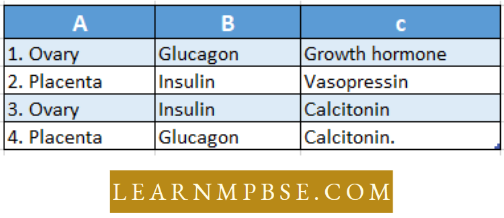
  2. Scorpion book lung
  3. Sea squirt pharyngeal
  4. Dolphin skin

Answer: 3. Sea squirt pharyngeal

Question 10. Two-toed hoofed feet occur in which animals:

  1. Horse
  2. Elephant
  3. Zebra
  4. Sheep.

Answer: 4. Sheep.

Question 11. Ancestors of mammals belong to:

  1. Therapsida
  2. Omithischia
  3. Silusoidea
  4. Chelonia.

Answer: 1. Therapsida

MCQ Animal Kingdom Question 12. Besides bats, echolocation also occurs in

  1. Primates
  2. Wild cat
  3. Whales and dolphins
  4. Beavers.

Answer: 3. Whales and dolphins

Question 13. Bat is a member of the order:

  1. Chiroptera
  2. Urodela
  3. Hymenoptera
  4. Lagomorpha.

Answer: 1. Chiroptera

NEET Biology Phylum Chordata Questions

Question 14. Choose the catfish from the following :

  1. Labeo rohita
  2. Catla cat la
  3. Wallago attu
  4. Cirrhina mrigala

Answer: 4. Cirrhina mrigala

Question 15. The scientific name of Zebu is :

  1. Lobulus bubbles
  2. Gallus gallus
  3. Bos indicus
  4. Bombyx mori.

Answer: 3. Bos indicus

Question 16. Mule is a product of:

  1. Breeding
  2. Mutation
  3. Hybridization
  4. Interspecific hybridisation.

Answer: 4. Interspecific hybridisation.

Question 17. Viper venom affects :

  1. Circulatory system
  2. Nervous system
  3. Respiratory system
  4. None of the above.

Answer: 1. Circulatory system

Question 18. Use of the following is a unique feature of the mammalian body :

  1. Four chambered heart
  2. Rib cage
  3. Homeothermy
  4. Diaphragm.

Answer: 4. Diaphragm.

Question 19. The chambered heart is not found in :

  1. Snakes
  2. Birds
  3. Crocodiles
  4. Whale.

Answer: 1. Snakes

Question 20. Which one of the following is correctly matched:

  1. House lizards — four-chambered heart
  2. Heloderma — poison gland
  3. Chameleon — binocular vision
  4. Varanus— prehensile tail.

Answer: 2. Heloderma — poison gland

Question 21. Catadromous fish migrates from :

  1. River to estuary
  2. River to sea
  3. Sea to river
  4. Deep sea to surface water.

Answer: 2. River to sea

NEET Biology Phylum Chordata Questions

Question 22. Which one of the following is an exclusive character of class Mammalia?

  1. Internal fertilization
  2. Homoiothermy
  3. Presence of a muscular diaphragm
  4. Presence of a completely 4-chambered heart.

Answer: 3. Presence of a muscular diaphragm

Question 23. Annual migration does not occur in the case of:

  1. Siberian crane
  2. Salamander
  3. Arctic tern
  4. Salmon.

Answer: 3. Arctic tern

Question 24. Which one of the following characters is not typical of the class mammalia?

  1. Seven cervical vertebrae
  2. Thecodont dentition
  3. Ten pairs of cranial nerves.
  4. Alveolar lungs.

Answer: 3. Ten pairs of cranial nerves.

NEET Biology Phylum Chordata Questions

Question 25. In which one of the following sets of animals do all four give birth to young ones?

  1. Shrew, bat, cat, kiwi
  2. Kangaroo, hedgehog, dolphin, loris
  3. Lion, bat, whale, ostrich
  4. Platypus, penguin, bat, hippopotamus.

Answer: 4. Platypus, penguin, bat, hippopotamus

Question 27. All mammals without any exception are characterized by

  1. Viviparity and biconcave red blood cells
  2. Extra-abdominal testes and a four-chambered heart
  3. Heterodont teeth and 12 pairs of cranial nerves
  4. A muscular diaphragm and milk-producing glands.

Answer: 4. A muscular diaphragm and milk-producing glands.

Question 28. Lizard-like member of the reptila is sitting on a tree with its tail coiled around a twig. This animal could be

  1. Hemidactylus showing sexual dimorphism
  2. Varanus showing mimicry
  3. Garden lizard (calories) showing camouflage
  4. Chameleon showing protective coloration.

Answer: 4. Chameleon showing protective coloration.

Question 29. Which of the following statements are true/false?

  1. In torpedo, the electric organs are capable of generating strong electric shock to paralyze the prey
  2. Bony fishes use pectoral, pelvic, dorsal, anal, and caudal fins in swimming
  3. Amphibian skin is moist and has thick scales
  4. Birds are poikilothermous animals
  5. The most unique mammalian characteristic is the presence of milk-producing mammary glands by which the young ones are nourished.

Choose the correct option

  1. 1, 2 And 3 are true; 4, 5 are false
  2. 1, 2 And 5 are true ; 3 and 4 are false
  3. 1,4 And 5 are true; 2 and 3 are false
  4. 1, 2 And 4 are false ; 3 and 5 are true
  5. Only 4 is true; 1, 2, 3 and 5 are false.

Answer: 2. 1, 2 And 5 are true ; 3 and 4 are false

Question 30. Which of the following statements is true?

  1. All living members of class Cyclostomata are parasites on some fishes
  2. There are about 2,000 species in the class Osteichthyes
  3. Ciona belongs to the subphylum Cephalochordata
  4. Arthropods are triploblastic animals
  5. Ascaris lumbricoides is a flat worm.

Answer: 1. All living members of class Cyclostomata are parasites on some fishes

Question 31. Which of the following characters is exclusive to mammals?

  1. The presence of a four-chambered heart
  2. Homeothermic condition
  3. Respiration by lungs
  4. Presence of a diaphragm.

Answer: 4. Presence of a diaphragm.

Phylum Chordata NEET Questions Question 32. Which of the following statements is/are not true ?

  1. In Urochordata, the notochord is present only in the larval tails.
  2. In cephalochordata, the notochord extends from the head to the tail region.
  3. Branchiostoma belongs to hemichordata.
  4. Only one class of living members, class Cyclostomata represents the superclass agnatha.

choose the correct opition 

  1. 1, 2 And 4 only
  2. 3, 4 And 1 only
  3. 3 Only
  4. 1 And 4 only
  5. 3 And 4 only

Answer: 3. 3 Only

Question 33. A poisonous lizard is :

  1. Varanus
  2. Chamaeleon
  3. Ancistrodon
  4. Heloderma

Answer: 4. Heloderma

Question 34. What is common between parrot, platypus, and kangaroo?

  1. Toothless jaws
  2. Functional post-anal tail
  3. Ovoparity
  4. Homeothermy.

Answer: 4. Homeothermy.

Question 35. What is common to whales, seals, and sharks?

  1. Thick subcutaneous fat
  2. Convergent evolution
  3. Homoiothermy
  4. Seasonal migration.

Answer: 2. Convergent evolution

Question 36. Which of the following pairs are correctly matched?

  1. Animals -morphological features
  2. Crocodile -4-chambered heart
  3. Sea urchin-parapodia
  4. Obelia -metagenesis
  5. Lemour -thecodont
  6. 2, 3 And 4
  7. Only 1 and 4
  8. Only 1 and 2
  9. 1,3 And 4.

Answer: 4. 1,3 And 4.

Question 37. Which one of the following is not a characteristic feature of the subphylum Vertebrata?

  1. Presence of kidneys
  2. Ventral muscular heart
  3. Dorsal tubular nerve cord
  4. The presence of notochord in the adult
  5. Two pairs of lateral appendages, fins, or limbs.

Answer: 4. Two pairs of lateral appendages, fins, or limbs.

NEET Biology Phylum Chordata Questions

Question 38. In mammals, the teeth are :

  1. Of different types
  2. Embedded in the cup-like-socket of the jaw bones

Only two sets, present throughout life these conditions are referred to as:

  1. Heterodont, thecodont, and diphyodont
  2. Thecodont, heterodont, and diphyodont
  3. Diphyodont, thecodont, and heterodont
  4. Heterodont, diphyodont, and thecodont
  5. Thecodont, diphyodont, and heterodont.

Answer: 1. Heterodont, thecodont and diphyodont

Question 39. Statement: all metatherians are placental mammals. Statement: all placental mammals have a menstrual cycle.

  1. Statement (1) is true and statement (2) is false
  2. Statement (2) is true and statement (1) is false
  3. Both the statements (1) and (2) are true
  4. Both the statements (1) and (2) are false.

Answer: 4. Both the statements (1) and (2) are false.

Question 40. The reason of the death of a patient of cobra bite is:

  1. Permanent contraction of muscles
  2. Inactivation of nerves
  3. Destruction of RBCs
  4. None of the above.

Answer: 1. Permanent contraction of muscles

Question 41. Types of quill (flight) feathers are :

  1. Down feathers
  2. Covert
  3. Filoplume
  4. Remiges.

Answer codes:

  1. 1 And 2 are correct
  2. 2 And 4 are correct
  3. 1 And 3 are correct
  4. 1, 2 And 3 are correct

Answer: 2. 2 And 4 are correct

Phylum Chordata NEET Questions Question 42. Which of the following has a copulatory organ?

  1. Parrot
  2. Toad
  3. Snake
  4. Squirrel.

Answer: 4. Squirrel.

Question 43. Identify the correct sequence of classification of the following:

  1. Eutheria
  2. Mammalia
  3. Leporidae
  4. Higomorpha
  5. Oryctcolagus.

Answer: 2. Mammalia

Question 44. Instead of the tooth, baleen (hanging homy plates in mouth) are found in:

  1. Blue whale
  2. Shark
  3. Dolphin
  4. Archaeopteryx.

Answer: 1. Blue whale

Question 45. Which one of the following is not a major carp?

  1. Cirrhius mrigala
  2. Puntius tieto
  3. Ctenopharyngodon idella
  4. Labeo rohita.

Answer: 2. Puntius tieto

NEET Biology Phylum Chordata Questions

Question 46. Select the correct order of classification of Rana tigrina upto genus :

  1. Chordata, Craniata, amphibia, Gnathostomata, Rana
  2. Chordata, craniata, gnathostomata, amphia, rana
  3. Chordata, amphibia, gmathostomata, cranial, tigrina
  4. Chordata, craniata, amphibia, gnathostomata, tigrina
  5. Gnathostomata, craniata, chordata, rana, tigrina.

Answer: 2. Chordata, Craniata, Gnathostomata, amphibia, Rana

Question 47. The cloaca in frogs is a common chamber for the urinary tract, reproductive tract, and:

  1. Alimentary canal
  2. Portal system
  3. Hepatic portal vessels
  4. Notochord
  5. Lymphatic system.

Answer: 1. Alimentary canal

Question 48. Which one of the following in birds, indicates their reptilian ancestry?

  1. Two special chambers crop and gizzard in their digestive tract
  2. Eggs with a calcareous shell
  3. Scales on their hind limbs
  4. Four chambered hearts.

Answer: 3. Scales on their hind limbs

Question 49. Which one of the following groups of animals is correctly matched with its one characteristic feature without even a single exception?

  1. Reptilia: possess a 3-chambered heart with one incompletely divided ventricle.
  2. Chordata: possess a mouth provided with an upper and a lower jaw
  3. Chondrichthyes: possess a cartilaginous endoskeleton
  4. Mammalia: give birth to young ones.

Answer: 3. Chondrichthyes: possess cartilaginous endoskeleton

Question 50. What will you look for to identify the sex of the following?

  1. Female Ascaris – sharply curved posterior end
  2. Male frog – a copulatory pad on the first digit of the hind limb.
  3. Female cockroach – anal cerci
  4. Male shark – claspers borne on pelvic fins.

Answer: 3. Female cockroach – anal cerci

Question 51. Fin rot of fish is caused by :

  1. Aeromonas
  2. Pseudomonas
  3. Brachiomyces
  4. Xenopsylla
  5. Both 1 and 2

Answer: 5. Both 1 and 2

Neet Self Assessment Test Unit—Diversity Of Life

Question 1. As we go from species to kingdom in a taxonomic hierarchy, the number of common characteristics :

  1. Will decrease
  2. I will increase
  3. Remun same
  4. May increase or decrease.

Answer: 1. Will decrease

Question 2. Which of the following ‘suffixes’ used for units of classification in plants indicates a taxonomic category of ‘family’?

  1. – Ales
  2. – Onae
  3. – Aceae
  4. – Ae.

Answer: 3. – Aceae

Question 3. The term ‘systematics’ refers to :

  1. Identification and classification of plants and animals
  2. Nomenclature and identification of plants and animals
  3. Diversity of kinds of organisms and their relationship
  4. Different kinds of organisms and their classification.

Answer: 3. Diversity of kinds of organisms and their relationship

Question 4. Census represents :

  1. An individual plant or animal
  2. A collection of plants or animals
  3. Group of closely related species of plants or animals
  4. None of these.

Answer: 3. Group of closely related species of plants or animals

Question 5. The taxonomic unit ‘Phylum’ in the classification of animals is equivalent to which hierarchical level in the classification of plants?

  1. Class
  2. Order
  3. Division tDt Family.

Answer: 3. Division tDt Family.

Question 6. Botanical gardens and zoological parks have :

  1. Collection of endemic living species only
  2. Collection of exotic living species only
  3. Collection of endemic and exotic living species
  4. Collection of only local plants and animals.

Answer: 3. Collection of endemic and exotic living species

Question 7. Taxonomic key is one of the taxonomic tools in the identification and classification of plants and animals. It is used in the preparation of :

  1. Monographs
  2. Flora
  3. Both 1 & 2
  4. None of these.

Answer: 3. Both 1 & 2

Question 8. All living organisms are linked to one another because :

  1. They have common genetic materials of the same type
  2. They share common genetic material but to varying degrees
  3. All have a common cellular organization
  4. All of the above.

Answer: 4. All of the above.

Question 9. Which of the following is a defining characteristic of living organisms?

  1. Growth
  2. Ability to make sound
  3. Reproduction
  4. Response to external stimuli

Answer: 4. Response to external stimuli

Question 10. All eukaryotic unicellular organisms belong to:

  1. Monera  Prorista
  2. Fungi
  3. Bacteria.

Answer: 2. Fungi

Question 11. The five-kingdom classification was proposed by :

  1. R.H. Whittaker
  2. C.Linnaeus
  3. A.Roxberg
  4. Virchow.

Answer: 1. R.H. Whittaker

Question 12. Organisms living in salty areas are called as :

  1. Methanogens
  2. Halophiles
  3. Heliophytes
  4. Thermoacidophiles.

Answer: 2. Halophiles

Question 13. Naked cytoplasm, multinucleated, and saprophytic are the characteristics of:

  1. Monera
  2. Protista
  3. Fungi
  4. Slime molds.

Answer: 4. Slime molds.

Question 14. An association between roots of higher plants and fungi is called:

  1. Lichen
  2. Fern
  3. Myconhiza
  4. BGA.

Answer: 3. Myconhiza

Question 15. A dikaryon is formed when :

  1. Meiosis is arrested
  2. The two haploid cells do not fuse immediately
  3. Cytoplasm does not fuse
  4. None of the above

Answer: 2. The two haploid cells do not fuse immediately

Question 16. Contagium vivum Gaudium was proposed by :

  1. D.J. Ivanowsky
  2. M.W. Beiierinek
  3. Stanley
  4. Robert Hook.

Answer: 2. M.W. Beiierinek

Question 17. Mycobiont and Phycobiont are found in :

  1. Mycorrhiza
  2. Root
  3. Lichens
  4. BGA.

Answer: 3. Lichens

Question 18. The difference between Virus and Viroid is :

  1. Absence of protein coat in viroid but present in virus
  2. Presence of low molecular weight RNA in virus but absent in viroid
  3. Both 1 and 2
  4. None of the above.

Answer: 1. Absence of protein coat in viroid but present in the virus

Question 18. Concerning the fungal sexual cycle, choose the correct sequence of events:

  1. Karyogamy, Plasmogamy and Meiosis
  2. Meiosis, Plasmogamy, and Karyogamy
  3. Plasmogamy, Karyogamy and Meiosis
  4. Meiosis, Karyogamy, and Plasmogamy.

Answer: 3. Plasmogamy, Karyogamy and Meiosis

Question 19. Viruses are non-cellular organisms but replicate themselves once they infect the host cell. To which of the following kingdoms do viruses belong?

  1. Monera
  2. Protista
  3. Fungi
  4. None of the above.

Answer: 4. None of the above.

Question 20. Members of Phycomycetes are found in :

  1. Aquatic habitats
  2. On decaying wood
  3. Moist and damp places
  4. As obligate parasites on plants

Choose from the following options :

  1. None of the above
  2. 1 and 2
  3. 1 and 3
  4. All of the above.

Answer: 4. All of the above.

Question 21. Cyanobacteria are classified under :

  1. Protista
  2. Plantae
  3. Monera
  4. Algao.

Answer: 1. Protista

Question 22. The fusion of two gametes that are dissimilar in size is termed as:

  1. Oogamy
  2. Isogamy
  3. Anisogamy
  4. Zoogamy.

Answer: 3. Anisogamy

Question 23. Holdfast, stipe, and frond constitute the plant body in the case of:

  1. Rhdoph year
  2. Chlorophyceae
  3. Phaeophyceae
  4. All of the above.

Answer: 3. Phaeophyceae

Question 24. A plant shows a thallus level of organization. It shows rhizoids and is haploid. It needs water to complete its life cycle because the male gametes are motile. Identify the group to which it belongs to :

  1. Pteridophytes
  2. Gymnosperms
  3. Monocots
  4. Bryophytes.

Answer: 4. Bryophytes.

Question 25. A Prothallus is :

  1. A structure in pteridophytes formed before the thallus develops
  2. A sporophytic free living structure formed in pteridophytes
  3. A gametophyte-free living structure formed in pteridophytes
  4. A primitive structure formed after fertilization in pteridophytes.

Answer: 3. A gametophyte-free living structure formed in pteridophytes

Question 26. Plants of this group are diploid and well-adapted to extreme conditions. They grow bearing sporophylls in compact structures called cones. The group in reference is:

  1. Monocots
  2. Dicots
  3. Pteridophytes
  4. Gymnosperms.

Answer: 4. Gymnosperms.

Question 27. The embryo sac of an Angiosperm is made up of :

  1. 8 cells
  2. 7 cells and 8 nuclei
  3. 8 nuclei
  4. 7 cells and 7 nuclei.

Answer: 2. 7 cells and 8 nuclei

Question 28. If the diploid number of a flowering plant is 36. What would be the chromosome number in its endosperm:

  1. 36
  2. 18
  3. 54
  4. 72.

Answer: 3. 54

Question 29. Protonema is :

  1. Haploid and is found in mosses
  2. Diploid and is found in liverworts
  3. Diploid and is found in pteridophytes
  4. Haploid and is found in pteri-dophytes.

Answer: 1. Haploid and is found in mosses

Question 30. The giant Redwood tree (sequoia sempervirens) is all an:

  1. Angiosperm
  2. Tree fern
  3. Pteritlophyte
  4. Gymnosperrn.

Answer: 4. Gymnosperrn.

Question 31. In some animal groups, the body is divided into compartments with at least some organs/organs repeated.

This characteristic feature is named :

  1. Segmentation
  2. Metamdrism
  3. Metagenesis
  4. Metamorphosis.

Answer: 2. Metamdrism

Question 32. Given below are the types of cells present in some animals.

Each one is specialized to perform a single specific function except :

  1. Choanocytes
  2. Interstitial cells
  3. Gastrodermdl cells
  4. Nematocytes.

Answer: 2. Interstitial cells

Question 33. Which one of the following sets of animals shares a four-chambered heart?

  1. Amphibians, Reptiles, Birds
  2. Crocodiles, Birds, Mammals
  3. Crocodiles, Lizards, Turtles
  4. Lizards, Mammals, Birds.

Answer: 2. Crocodiles, Birds, Mammals

Question 34. Which of the following pairs of animals has non-glandular skin?

  1. Snake and Frog
  2. Chameleon and Turde
  3. Frog and Pigeon
  4. Crocodile and Tiger.

Answer: 3. Frog and Pigeon

Question 35. Birds and mammals share one of the following characteristics as a common feature.

  1. Pigmented skin
  2. Alimentary canal with some modification
  3. Viviparity
  4. Warm-blooded nature.

Answer: 2. Alimentary canal with some modification

Question 36. Which one of the following sets of animals belongs to a single taxonomic group?

  1. Cuttlefish, Jellyfish, Silverfish, Dogfish, Starfish
  2. Raq Pigeon, Butterfly
  3. Monkey, Chimpanzee, Man
  4. Silkworm, Tapeworm, Earthworm.

Answer: 3. Monkey, Chimpanzee, Man

Question 37. Which one of the following statements is incorrect?

  1. Mesoglea is present in between ectoderm and endoderm in Obelia.
  2. Radial symmetry is found in, Asterias
  3. Fasciola is a pseudocoelomate animal
  4. Taenia is a triploblastic animal.

Answer:  1. Mesoglea is present in between ectoderm and endoderm in Obelia.

Question 38. Which one of the following statements is incorrect?

  1. In cockroaches and prawns excretion of waste material occurs through Malpighian tubules.
  2. In ctenophores. locomotion is mediated by comb plates.
  3. In Fasciolg flame cells take part in excretion
  4. Earthworms are hermaphrodites and yet cross-fertilization takes place among them.

Answer: 1. In cockroaches and prawns excretion of waste material occurs through Malpighian tubules.

Question 39. Which one of the following is oviparous?

  1. Platypus
  2. Flying fox (Bat)
  3. Elephant
  4. Whale.

Answer: 1. Platypus

Question 40. Which one of the following is not a poisonous snake?

  1. Cobra
  2. Viper
  3. Python
  4. kait.

Answer: 3. Python

Question 41. The body cavity is the cavity present between the body wall and the gut wall. In some animals the body cavity is not lined by mesoderm. Such animals are called :

  1. Acoelomate
  2. Pseudocoelomate
  3. Coelomate
  4. Haemocoelomate.

Answer: 2. Pseudocoelomate

Question 42. Which one of the following animals possesses high regeneration capacity?

  1. Planaria
  2. Taenia
  3. Salpa
  4. Periplaneta
  5. Ascidian.

Answer: 1. Planaria

Question 43. “Oryan of Jacobson” helps in :

  1. Touch
  2. Vision
  3. Smell
  4. Hearing.

Answer: 3. Smell

Question 44. Cysticercus larva is formed in the life history of:

  1. Taenia
  2. Plasmodium
  3. Leishmania
  4. Wuchereria.

Answer: 1. Taenia

Question 45. The water vascular system is found in :

  1. Sea anemone
  2. Sea pen
  3. Sea cucumber
  4. Sea horse.

Answer: 3. Sea cucumber

Question 46. Radula is found in

  1. Plla sp.
  2. Lamellidens sp.
  3. Chiton sp.
  4. Pinctada sp.

Answer: 1. Plla sp.

Question 47. The phenomenon of torsion occurs in :

  1. Gastropoda
  2. Pelecypoda
  3. Cephalopoda
  4. Amphineura.

Answer: 1. Gastropoda

Question 48. In which of the following, pyrenoids are present :

  1. Charu, Fucus, Polysiphonia
  2. Volvox, Spiro gyra, Chlamyomonas
  3. Porphyra, Ectocarpus, Ulothrix
  4. Sargassum, Laminaria, G racilLaria.

Answer: 2. Volvox, Spirogyra, Chlamydomonas

Question 49. Both chlorophyll a and d are present in :

  1. Rhodophyceae
  2. Phaeophyceae
  3. Chlorophyceae
  4. None of these.

Answer: 1. Rhodophyceae

Question 50. An alga that is rich in protein is :

  1. Ulothrix
  2. Spirogyra
  3. Nostoc
  4. Chlorella.

Answer: 4. Nostoc

Question 51. Yellow-green pigment is found in :

  1. Xanthophyta
  2. Chlorophyta
  3. Phaeophyta
  4. Rhodophyta.

Answer: 1. Xanthophyta

Question 52. Mannitol is the stored food in :

  1. Chara
  2. Porphyra
  3. Focus
  4. Gracillaria.

Answer: 3. Fucus

Question 53. Which one of the following has a haplontic life cycle?

  1. Fwnaria
  2. Polytrichum
  3. Ustilago
  4. Wheat.

Answer: 2. Polytrichum

Question 54. Which one of the following plants is monoecious ?

  1. Marchantia
  2. Pinus
  3. Cycas
  4. Papaya

Answer: 1. Marchantia

Question 55. Which one of the following is a vascular cryptogam?

  1. Equisetum
  2. Ginkgo
  3. Marchantia
  4. Cedrus.

Answer: 1. Equisetum

Question 56. Which one of the following is considered important in the development of seed habit?

  1. Dependent sporophyte
  2. Heterospory
  3. Faplontic life cycle
  4. Freelivinggametophyte.

Answer: 2. Heterospory

NEET Biology Notes – Phylum Chordata

NEET Biology Phylum Chordata Diagnostic Characters

1. Dorsal hollow nerve cord.

  • The chordates possess a centrally located neural system situated dorsally within the body. The structure consists of a longitudinal, hollow, or tubular nerve cord positioned superior to the notochord and running along the body’s length.
  • The nerve cord, or neural tube, originates from the dorsal ectodermal neural plate of the embryo and encases a cavity known as the neuronal canal. No discernible ganglionic enlargements are present. The nerve cord facilitates the integration and coordination of the body’s functions.
  • In vertebrates, the anterior segment of the nerve cord is adapted to develop a cerebral vesicle or brain, which is encased by a protective bony or cartilaginous skull. The posterior segment of the nerve cord develops into the spinal cord, which is safeguarded within the vertebral column

Read and Learn More NEET Biology Notes

Phylum Chordata Diagrammatic Side View Of A Chordate Showing The Three Fundamental Chordate Characters.

2. Notochord or chorda dorsalis.

  • The notochord is a flexible, elongated rod-like structure that spans the length of the body. It is located directly beneath the nerve cord and immediately above the stomach canal. It originates from the mesoderm. It originates from the endodermal roof of the embryonic archenteron.
  • The structure consists of sizable vacuolated notochordal cells that contain a gelatinous matrix, encased by an outer fibrous sheath and an inner elastic sheath.
  • The notochord is the principal distinguishing characteristic of the phylum Chordata, from which it receives its name. It functions as a support or internal framework and should not be conflated with the nerve cord.
  • Protochordates possess a characteristic notochord. In adult vertebrates, it is encased or supplanted by the vertebral column.

3. Pharyngeal gill slits. In all the chordates, at some stage of their life history, a series of paired lateral gill clefts or gill slits perforate through the pharyngeal wall of the gut behind the mouth. These are variously termed as pharyngeal, branchial and visceral clefts or pouches.

Phylum Chordata NEET Notes

They serve primarily for the passage of water from the pharynx to the outside, thus bathing the gills for respiration. The water current secondarily aids in filter-feeding by retaining food particles in the pharynx.

In protochordate (For example Branchiostoma) and lower aquatic vertebrates, the gill slits are functional throughout life. But, in higher vertebrates, they disappear or become modified in the adult with the acquisition of pulmonary respiration.

Phylum Chordata T.S. Notochord Of Young Dogfish
Phylum Chordata Classification Of Phylum Chordata

NEET Biology Phylum Chordata Sub-Phylum Urochordata

Important Features

  1. They are exclusively marine, solitary’ colonial, fixed, or free swimming.
  2. The body is enclosed in a loose investment called a tunic or test formed of tunicate.
  3. Epidermis single layered.
  4. Notochord is absent in adults but present in minute tadpole larvae.
  5. The dorsal, hollow nerve cord is present in the larval stage but gets reduced to a solid ganglion in adults.
  6. The body cavity is represented by an atrial cavity. Coelom is altogether absent.
  7. Pharynx perforated by numerous gill slits.
  8. The heart is ventral, simple, and tubular.
  9. Sexes united ie. hermaphrodite.
  10. There is usually retrogressive metamorphosis.

Characteristics Of Chordata NEET

Classification of Urochordata

3. Classes

  1. Class Larvacea (Appendicularia) eg. Appendicularia
  2. Class Ascidiacea Example Ciona, Molgula, Botryllus, Herdmania (Sea squirt)
  3. Class Thaliacca Example Dolioliwi, Salpa.

Phylum Chordata Characters Of Classes Of Vertebrata

Phylum Chordata Characters Of Classes Of Vertebrata 2

NEET Biology Phylum Chordata Sub Phylum Cephalochordata

Important features

  1. They are exclusively marine and solitary forms. The body is long and laterally compressed and is provided with median fins. Paired fins are absent.
  2. Notochord persistent and extends upload the tip of the snout hence cephalochordate.
  3. Along the median dorsal line, above the notochord is present a dorsal, hollow nerve cord or spinal tube, the anterior end of which is dilated into cerebral vesicles.
  4. The epidermis consists of a single layer of columnar epithelium.
  5. Definite coelom in addition to the atrial cavity is present.
  6. The pharyngeal gill slits are numerous that open into the atrial cavity.
  7. The body is metamerically segmented and the excretory organs arc protonephridia with solenocytes.
  8. The animals are dioecious or unisexual, but there is no sexual dimorphism.
  9. Gonads are metamerically arranged jn die bodies. Gonoducts are absent. Example: Amphioxus, Asymmetron

NEET Biology Phylum Chordata Sub Phylum Vertebrata

Distinguishing features

  1. The Notochord of the vertebrates is partly or fully replaced by a segmented vertebral column in adults.
  2. The neural tube is differentiated into the anterior brain and posterior spinal cord.
  3. Pharyngeal gill slits may be persistent or present at least during developmental stages.

Phylum Chordata Classification NEET

NEET Biology Phylum Chordata Section Agnatha

Distinguishing features

  1. Jaws are lacking in these vertebrates, hence, agnatha.
  2. The exoskeleton is usually absent.
  3. Paired appendages are absent.
  4. A single medial nostril is present in the case of these animals.
  5. The pharyngeal gill slits numbering 6-14 pairs are always present in the lateral wall of the pharynx.
  6. The notochord is persistent.
  7. They have numerous hook-like teeth in a round, funnel-shaped mouth.
  8. Section Agnatha has a single living class.

Class Cyclostomata

  1. The body of these animals is long and cylindrical.
  2. The skin is soft glandular without an exoskeleton.
  3. Paired fins are absent but the median fins are present.
  4. The mouth is circular, suctorial, and devoid of functional jaws.
  5. A single median nostril is present.
  6. The endoskeleton is cartilaginous.
  7. The notochord is persistent.
  8. The heart is two-chambered, and the aortic arches are many.
  9. External and middle ears are absent. The internal ear contains one or two semicircular
  10. A single gonad without gonoducts is present.
  11. Examples— Petromyzoii (Lamprey), and Myxine (Hagfish).

NEET Biology Phylum Chordata Class Chonprichthyes

Advancement of Cartilaginous Fishes Over Cyclostomcs

  1. Presence of exoskeleton of scales.
  2. Presence of paired fins and olfactory organ.
  3. Jaws are movable and bear teeth.
  4. Complete vertebrae present.
  5. Presence of visceral arches.
  6. Presence of three semicircular ducts in each car.
  7. Gonads arc paired provided with ducts and fertilization internal.

Classification 2-Sub Classes

  1. Sub Class: Sclachii (Elasmobranchii) Examples: Scoliodon (Dogfish,) Sphyma (Hammer-headed sharkj. Pristis (Saw fish), Rhinobatur (Guitar fish). Torpedo (Electric ray) and Trygon (Ming ray)
  2. Sub Class: Holocephali: Skin .scaleless in adult Example Chimaera (Rabbitfish)
  3. Class Osteichthyes (Bony Fishes)
  4. Advancement Over Cartilaginous Fishes
  5. Presence of homocercal tail
  6. Autostylic jaw suspension
  7. Better developed brain.
  8. Classification 2. Sub Classes
  9. Sub Class: Actinopterygii: Examples
  10. Aipenscr, Amia (Bow fin), Muraena (The Spotted Ed), Anguilla (The Ed). Rita rita (Catfish), Mystus (Catfish) Labeo rohita (Rohu), Catla catla (Carp), Hippocampus (Sea horse), Syngnathus (pipe fish).
  11. Exocoetus (Flying fish,) Anabas (Climbing perch), Diodon (Porcupine fish), Telradon (Globefish), Lopliius(The angler or fishing frog), Solea (Flatfish)
  • 2. Sub Class: Sarcropterygii
  • Examples Latimaria (The Coelacanth).
  • Lcpidosiren (Lung fish). Protopterus (African mud fish-lung fish).

Phylum Chordata NEET Mcqs

NEET Biology Phylum Chordata Interesting Points Of Fishes

  • The most powerful electric ray (Torpedo) produces an electric shock of 600 volts.
  • Sound-producing fish: Tetragon
  • Living fossil: Latimaria
  • Ichthyology is the study of fishes.
  • The climbing perch has gill chambers in its mouth to gulp in and store air, besides gills, where gas exchange takes place.
  • The climbing perch can move short distances on land using its lateral fins.
  • Fossil evidence shows that tetrapods arose from a group of fishes called the lobe-finned fishes. These fishes had functional lungs.
  • The pectoral and pelvic fins of lobe-finned fishes had a fleshy lobe with a bony skeleton within. The tetrapod limb arose from such lobe-fins.
  • A lobed-finned fish Latimaria is called a living fossil’. It is a deep sea fish occasionally found in the Indian Ocean.
  • Anabas (climbing perch) occur in rivers of India and Southeast Asia. It has accessor}’ respiratory organs gill chambers for breathing atmospheric air which enable the fish to take long overland excursions in search of earthworms. Contrary to belief fish never climb up the trees.
  • Catadromous fishes live in fresh water and go down to sea for breeding Example Anguilla (European eel). When fishes migrate from the rivers to the sea, it is called catadromous migration.
  • Anadromous fishes live in seawater and migrate to the rivers for breeding Example Hilsa, Salmo (Salmon) migration is called anadromous migration.
  • Gambusia fish was introduced into several tropical regions to control malaria.
  • The copulatory organs of sharks are known as daspers.
  • As cartilaginous fishes do not have a swim bladder as a hydrostatic organ so they have to swim continuously to neutralize the gravitational pull.
  • Ampullae of Lorenzini are peculiar sense organs on their snout to note the thermal changes in water.
  • The lateral line is with neuromast organs which have rheoreceptors and note changes in water currents.
  • The electric organs of the Torpedo are modified muscles. These produce an electric current of 50-60 volts.
  • Trygon (Sting ray or whip-tailed ray): The dorsal fin is modified into a spine for defense.
  • Chimaera (Rabbitfish or ratfish or king of Herrings). Most advanced cartilage fish and acts as connecting link between cartilage fishes (Cartilages only, clampers) and bony fishes (4 pairs of gill slits covered by opercula, anus, and fleshy lips)
  • Lung fishes use lungs for breathing. The lungs arise near the front end of the alimentary canal.
  • Lung fishes
  • Protopterns = African lungfish.
  • Neoceratodus = Australian lungfish.
  • Lepidosiren = South American lungfish.
  • Latimeria (Coelacanth). A lobe-finned bony fish and is about 70 million years old. First reported by Miss Latimer called a living fossil.
  • Fin rot of fise is caused by Psaulomoiuis.

Kinds Of Scales 

They are of two types pidermal and dermal. Epidermal scales —The characteristics of reptiles, but are also found in a few mammals and on the bird’s feet.

They are formed of heavily keratinized stratum corneum. They overlap in lizards and snakes but fit side to side in turtles, tortoises, and crocodiles. The epidermal scales of chelonians.

Crocodiles and mammals, like pangolins and armadillos, are large and called Scutes. The scutes are not shed, but worn out and replaced. Pangolin, however, casts off its scutes singly and re-grows them.

The home on the snout of the male horned lizard Ceratophora and the fighting spurs on the leg of a fowl are modified scales.

Phylum Chordata NEET Exam Preparation

Types of Scales in Fishes

  1. Placoid Scales. A placoid scale has a disc-like basal plate.
  2. It resembles a tooth. These scales are found in cartilaginous fishes.
  3. Ganoid scales are heavy and have an outer layer of hard inorganic enamel-like material called ganoine. These scales are found in primitive bony fishes.
  4. Cycloid Scales. These scales have circular ridges. The cycloid (smooth) scales are found in higher bony fishes.
  5. Ctenoid Scales. These scales also have circular ridges but have more or less serrated free edges. Thus they are comb-like. Ctenoid scales are found in higher bony fishes.

Phylum Chordata False Fishes

Phylum Chordata Information Foramina of verbrates

Phylum Chordata Kinds Of Jaw Supension

  1. Autodiastylic. found in the early bony fishes (most primitive) Example -Acanthodii.
  2. Amphistylic. found in primitive sharks, Hexanchus and Heptanchus.
  3. Hyostylic. evolved in more recent fishes and is found in elasmobranchs.
  4. Melhyostylic. is found in Amia, Lepisoteus, and teleostomes (bony fishes).
  5. Autostylic. found in most vertebrates, (show three variations.)
  6. Holostylic. developed in ancient placoderms and is still seen in Holocephali i.e. chimeras.
  7. Aufosytylic. found in Dipnoi (lungfishes) and tetrapods excluding mammals.
  8. Craniostylic. a characteristic of mammals.

NEET Biology Phylum Chordata Class Amphibia

Advancement of Amphibian overfishes

  1. Presence of limbs.
  2. Presence of articular processes on ver Protrusible tongue
  3. 3-chambered heart
  4. Presence of eyelids and urinary bladder.

Three main types of Amphibians

  1. Tailless order – Anura Frogs and Toad (2500 species)
  2. Tailed order urodele (Caudata) – Newts and salamander
  3. Limbless (orders Apoda = Gymnophiona = Caecilians)

Interesting Points About Amphibians

  • Frog which lives in deserts – Trilling frog.
  • Frog which carries tadpole in special pits on its back- Surinam toad (Pipa)
  • Viviparous amphibian – Salamandra atra
  • Earliest amphibian – Seymouria (Extinct)
  • Amphibians originated in the Devonian Period.
  • At the time of metamorphosis, the tadpole does not feed.
  • Axolotls are larvae of a certain type of salamander. They are unusual in that my axolotls remain larvae all their lives but are still able to breed.
  • Retention of larval characters by axolotl is called neoteny and reproduction by them is called paedogenesis.
  • Blind worms (limbless amphibians) (Ichthyophis and Uraeotyphlus) are unusual amphibians as only one species that lives in water has scales.
  • All the others burrow and are rarely seen on the surface. Many do not even need water to breed.
  • The arrow poison frogs secrete a powerful poison from their skin which can cause instant death. These frogs are only found in Central and South America.
  • Poisonous frogs often advertise the danger with bright yellow, orange, red, and black patterns. So that they can be easily avoided.

Phylum Chordata Examples NEET

  • Most poisonous Frog. The golden dart poison frog from South America is the most poisonous. One adult frog contains enough poison.2200 people.
  • Salamander is viviparous.
  • Pipa, Xenopus, and Hymenochirus are tongueless amphibians.
  • No amphibian is marine as may undergo exosmosis through its thin skin.
  • Caecilians are limbless and tailless amphibians.
  • Among amphibians, salamanders are ammonotelic in excretion.
  • Though the amphibians are first terrestrial vertebrates but are still dependent on water for their reproduction, respiration, and larval development.
  • Jaw suspension is autostylic.
  • Vertebrae may be procoelous (2nd to 7th vertebrae in frog) amphicoelous (8th vertebra in frog) or acoelous (9th vertebra of frog).
  • Caecilians have amphicoelous vertebrae while salamanders have opisthocoelous vertebrae (concave posteriorly and convex anteriorly).
  • The tongue is anteriorly fixed and posteriorly free and protrusible in frogs and toads; non-protrusible in salamanders but is absent in Pipa (Surinam toad).
  • Cutaneous respiration is the most important mode of respiration.
  • Aortic arches are generally 3 pairs.
  • The brain is covered by two meningeal membranes.
  • The egg is generally isolecithal. Cleavage is holoblastic and unequal.

NEET Biology Phylum Chordata Class Reptilia

Advancement over amphibia

  1. Dry scaly skin, enables them to live away from water.
  2. Presence of movable independent neck.
  3. Presence of claws for defense.
  4. Limbs better suited (if present) for movements on land.
  5. Partial or complete division of ventricle leading to separation of oxygenated and deoxygenated blood.
  6. The presence of copulatory organs is essential for internal fertilization.

NEET Biology Phylum Chordata Interesting Points Of Reptiles

  • Classification of Reptiles is based on temporal fossae.
  • Linnaeus (1767) placed amphibia and reptilia together.
  • Reptiles lived from the Triassic through the Jurassic and Cretaceous periods,
  • Mesozoic Era—Also called the “Age of Reptiles.”
  • Largest Living Reptiles
    • Python,
    • Crocodile
    • Komodo dragon.
  • Ophilogy or Serpentology. The study of snakes is termed morphology.
  • Saurology. The study of lizards is termed saurology.
    1. Poisonous lizard — Heloderma
    2. Flying Lizard — Draco
    3. Desert lizard — Phrynosoma
    4. Largest living lizard — Varanus komodoesis (weight approx. 100 kg.)
    5. Heaviest reptile — Giant tortoise (600 kg)
    6. Colour-changing lizard — Chameleon
    7. Largest snake — Python reticulatus
    8. Smallest snake — Leptotyphidps bilineata (thread snake)
    9. Longest Poisonous snake — Naja Hannah;(King Cobra)
    10. Most Poisonous snake — Hydrophis (Sea snake)
    11. Double-headed snake— Eryx john (Dornuhi)
    12. Longest fangs— Bitis gibanica (viper) (1.97 inches long)
    13. Longest life span— Giant tortoise (200 yrs.)
    14. Herpetology— Study of reptiles
  • Rattle snake’s tail emits a frightening sound that scares away the enemy.
  • The king cobra of India is the only snake in the world that builds a nest.
  • Dermal scales are best developed in chelonians (Tortoises and turtles and in the form of large bony plates).
  • Some lizards and snakes also have dermal scales and epidermal scales.
  • Abdominal ribs called gastralia generally four crocodilians and Sphenodon are dermal derivatives.
  • The spikes on the head of Phiynosoma (Homed toad) are sharp, spiny, epidermal scales.
  • Sphenodon is an ancient reptile found in New Zealand and despite its long evolution of 170 million years it has retained primitive characteristics, thus regarded as a “living fossil”.
  • The primitive characters arc two unmodified temporal fossae, amphicoelous vertebrae, and abdominal ribs.
  • The glass snakes are limbless lizards and are snake-like.
  • In the crocodiles, the heart is four-chambered.
  • A giant tortoise Geochelonegigantica lived for152 years i.c. 1766-1918 in Seychelles Islands of the Indian Ocean.
  • No Indian lizard is poisonous.
  • The Gila monster, Hclodcrma is the only poisonous lizard in the world. There are only two species.
  • The Komodo dragon, Varanus kowodoensis of Indonesia measures 3 metres in length.
  • The forked tongue of snakes simply gives a “stereo” sense of smell to them. Snakes have an organ called Jacobson’s organ within their mouth that helps them to detect odors.
  • The fangs of a poisonous snake are maxillary teeth.

Phylum Chordata NEET Notes

  • Reptiles without urinary bladder—snakes, crocodiles, alligators.
  • Many sea snakes are viviparous. Pit vipers are also mostly viviparous.
  • The oldest living animal in any Indian Zoo is the Aldabra giant tortoise. It has been living in the Alipore Zoo in Kolkata since 1875. It is 1.3 meters long.
  • Long dinosaur—Diplodocus 27 m. Small dinosaur—Compsognathus—75-91 cm.
  • Eryx johni (double-mouthed snake or sand boa): The tail is blunt and looks like a head.
  • Snakes with neurotoxic venom: Bungarus (Krait); Naja (Cobra); Hydrus (Sea snake).
  • Venom of Cobra is used to relieve intense pain in cases of cancer.
  • Fat bodies of uromastix yield oil which cures potency.
  • Snake with hemolytic venom. Vipera (Pit viper).
  • Dinosaurs (meaning terrible reptiles) were giant-sized fossilized reptiles from about 200 million years ago in the Mesozoic era (called the age of reptiles) Example Brontosaurus (Thunder lizard An herbivorous dinosaur and tyrannosaurus tyrant Lizard A carnivorous dinosaur).

List of poisonous snakes of India

  1. Cobra (Naja naja)
  2. King Cobra (Naja lianna)
  3. Common krait
  4. Branded krait
  5. Black krait
  6. Russel’s viper
  7. Saw scaled viper
  8. Himalayan pit viper
  9. Hump nosed viper
  10. Indian Sea snake
  11. Bengal Sea snake
  12. Indian coral snake
    • Smallest reptile – Grecho
    • Largest reptile – Crocodylus porosus
    • Shortest snake – Thread snake
    • Largest snake – Python (10 Metres)
    • Poisonous lizard – Heloderma

NEET Biology Phylum Chordata Class Ave

Advancement of Birds over Reptiles

  1. The presence of an insulating cover over the body and body is homcothcrinnl.
  2. Complete sepnralhni of oxygenated and deoxygenated blood in the heart.
  3. Plight a means of very rapid locomotion.
  4. Lungs are very well aerated.
  5. Presence of syrinx and producing organs.
  6. More efficient eyes with double power of accommodation.
  7. Modern birds lack teeth.

Adaptation Of Birds For Flight

  1. The fore-limbs are modified into wings to provide a large surface area formed by the structures called feathers which are light in weight.
  2. The sternum is extended to form a keel. Large (light muscles are attached to the keel.
  3. Powerful flight muscles named pectoral ninjas are present.
  4. The body is streamlined.
  5. Weight is kept to a minimum by the possession of a very light skeleton with hollow bones and an air sac
  6. The efficient flight is achieved by the birds taking advantage of vertical air movements i.e., by gliding and soaring.
  7. The coracoid bones arc is well developed to transmit the “Lift” of the wings to the whole body.
  8. The brain is well developed.
  9. The metabolic rate of birds is relatively high to provide the energy required for flight.

Phylum Chordata Examples NEET

NEET Biology Phylum Chordata Interesting Points Of Birds

  • The urinary bladder is absent in birds except for ostrich.
  • True penis (copulatory organ present in swans- ducks – geese and ostriches.
  • A bird that undertakes the longest migration is the Arctic tern, Sterna macrura covers about 40,000 km. each year.
  • The only bird that hibernates in winter. (Caprimulgus)
  • Strulhio camelus is the largest living bird
  • Archaeopteryx is regarded as an ideal connecting link between birds and reptiles.
  • Both fossil birds, Hesperornis regalis and Ichthyornis victor had true teeth.
  • Hummingbirds beat its wings 60 times per second.
  • Guano—excreta of sea birds.
  • ‘Wagtail’ migrates from Siberia to India during winter not for breeding, but for feeding.
  • Lagena is a part of the membranous labyrinth of the bird associated with hearing.
  • Uropygiinn (tail): the projecting terminal portion of a bird’s body from which the tail feathers arise.
  • Among the Indian birds, the sunbirds are probably the smallest.
  • The dove is the emblem of the sign of peace.
  • The hummingbird is the only bird that can fly backward as well as forward.
  • The Bursa fabricus is a blind sac with much lymphoid tissue in the cloaca of some young birds. It produces lymphocytes (a type of white blood corpuscles).
  • It is also called ” cloacal thymus.”
  • Columba has the world’s richest diversity of birds.
  • The bird Dodo became extinct because of its fearlessness.
  • African Fish Eagle is called the Voice of Africa because of its familiar yelping call.
  • An owl moves its head from side to side to judge distances accurately.
  • Its eyes do not rotate in their sockets. Each eye is fixed like a car headlight.
  • Ostriches are beneficial to Zebras because ostriches act as lookouts for Zebra herds, warning them of approaching danger Copulatory organ (true penis) is present in ostrich, duck, swan,s, and geese.
  • Famous Indian Ornithologist—Dr. Salim Ali.
  • Birds which live on fish, need more food.

Vertebrates And Invertebrates NEET

  • Swifts use saliva for binding nest materials.
  • Hummingbirds build the smallest nests.
  • Bald Eagle has the largest nest.
  • Khtf lays the largest egg in proportion to its size.
  • The Gentoo Penguin is the fastest-summing bird.
  • Vervain Hummingbird lays the smallest egg.
  • The Himalayan Bearded Vulture is the largest Indian bird. Previously the Sarus was considered the largest Indian bird

NEET Biology Phylum Chordata Class-Mammalia

Unique features and advancement over reptiles

  1. The body is covered with hair and highly glandular skin that is helpful in different ways.
  2. Presence of mammary glands.
  3. 7 (Seven) cervical vertebrae. The first two cervical vertebrae (Atlas and Axis) are specialized for the movement of the head.
  4. Denucleated R.B.C.
  5. Presence of diaphragm which divides the body cavity into thoracic cavity and abdominal cavity.
  6. Presence of pinna (external ear).
  7. The large cerebrum and cerebellum provide for better coordination in all activities of life for learning and retentive memory.
  8. Intrauterine development ensures the safety of the fetus. Viviparous.
  9. A better efficient mechanism for homeostasis

Phylum Chordata Classification Of Class Mammalia

List of Orders of subclass Eutheria

  1. Insectivora. Presence of elongated snout, fossorial, nocturnal.
  2. Examples: Crocidura (Musk shrew, Henu’echinus (Hedgehog)
  3. H. Primata: Large rounded cranium, plantigrade, omnivorous, and gregarious. Pres ence of opposable thumb. They evolved from tree shrews.
  4. Examples: Prosimians (before the monkeys) Loris, Lemurs, and Tarsiers
  5. Simians, Macaca (Monkey) Apes (Gibbon, Orangutan, Chimpanzee, and Gorilla, Homo sapiens (Man).
  6. Chiroptera organs of flight are lateral extensions of skin termed patagia.
  7. Examples. A small bat, Pteropus (large bat or flying fox, Vampire)
  8. Polidota. The upper surface of the body is covered with home scales.
  9. Examples. Manis (Scaly ant-eater or Pangolin)
  10. Rodentia. Presence of one pair of sharp, chisel-like ever-growing incisors.
  11. Examples. Rattus (Rat), Mus (Mouse), Cavia (Guinea pig) and Funambulus.
    (Squirrel).
  12. Lagomorpha. Two pairs of incisors in the upper jaw.
  13. Examples. Rabbit and Hare.
  14. Cetacea. Fish-like body with smooth hairless skin. Examples. Whale, Dolphin, Porpoise.
  15. Carnivora Presence of sharp, well-developed claws, large canines, and strong jaws.
  16. Examples: Panthera leo (Lion), Panthera tigris (Tiger), Phoca (Seal).
  17. Proboscida. Presence of proboscis.
  18. Example: Blcphns (Elephant)
  19. Perissodactyl. Long limbs with a single functional digit (3rd) per foot. Presence of cornified hoofs. (Odd hoofed mammals) Examples: Rhinoceros, Equus (horse), Ass, Zebra.
  20. Artiodnclyln. Long limbs with two functional digits (2nd & 3rd) per foot. (Eyÿp hoofed mammals)
  21. Examples: Goat, cow, buffalo, pig, hippopotamus, camel, deer, and giraffe.

Vertebrates And Invertebrates NEET

NEET Biology Phylum Chordata Interesting Features Of Mammals

  • The mammals, Ornithorhynchus (duck-billed platypus), Tachyglosstts, and Zagorssus (spiny ant eaters or echidnas) lay eggs, but young are nourished by milk from mammary glands.
  • The hair of a mammal is a different structure from the scale of reptiles and the feathers of birds.
  • The scales on some parts of the body of some mammals are modified
    hair scaly ant cater or pangolins have scales on their backs whereas rats have
    scales on their tail.
  • Nails, claws, hoofs, and horns of ruminants and the nasal horn of rhinoceros are
    all derived from the same keratinized epidermal material as hair.
  • Male camel can drink 11) 4 liters of water at one time.
  • Mammals originated from cotylosaurian reptiles in the Jurassic about 150 million
    years ago.
  • The tertiary period, the Eocene epoch’ is called as age of mammals.
  • Living species of mammals are about 4,400.
  • Largest mammal
  • Balaenoptera musculus (Blue Whale—Size 35 metres; weight 207 tons).
  • Smallest mammal
  • Suncus ctruscus (Pigmy shrew — weight 40 gms).
  • Three groups of mammals:
  • Prototherians: egg-laying mammals.
  • Mctatherians: Pouched mammals.
  • Eutherians: True placental mammals.
  • The slowest moving mammal-3 toed sloth.
  • Large brain, unique memory, speech, language, and opposable thumb arc some
    features that make man separate from other animals.
  • The Holocene epoch is the ‘Age of Man’
  • The trunk of an elephant is an elongated nose
  • Tusks of elephants are modified incisors
  • The most acute sense of smell is among mammals.
  • The elephant has 40,000 muscles in its trunk. Not a single bone is found in it.
  • Hylobates hoolock is the only ape found in India.
  • The Indian one-homed Rhinoceros is the second largest land animal of India.
  • Of all existing mammals, the human being is the longest-lived.
  • Highest National I.Q. — 106.6. in Japan.
  • Highest I.Q. in man—210 in a Korean boy of 14 years.
  • 50% of the world’s buffaloes are in India.
  • salivary glands are absent in whales and sea cows.
  • All mammals have movable lips except whales.
  • Echo location is useful in flight in bats.
  • Vampires: Blood-sucking bats (Sanguivorous).
  • Whales are hunted for their oil.

Phylum Chordata NEET Question Bank

  • A hairless mammal in which milk is squirted down the throat of the body the muscu¬ lar contraction of the mother is a whale.
  • Aquatic mammals such as whales, sirenians, and seals lack pinna. Platypus also does not have pinna,
  • Gorillas do not drink water, water present in vegetation is sufficient for their needs.
  • Tigers prefer to live near water
  • The snow leopard is found in Lulakh.
  • Wolf Is lastly disappearing from India.
  • Man-eating tigers are most commonly found in Sunderbans, West Bengal.
  • Asiatic Cheetah was once abundant in India but is now extinct.
  • Platypus has teeth in its young stage which are replaced by fleshy membranes in adults.
  • Mammals are most sensitive to nuclear radiation.
  • The lion was the national animal of India till 1972. The tiger was declared the national animal of India in 1973.
  • Pour evolutionary lines of Buthcrians:
  • Insectivorous lines include insectivores, bats, and primates.
  • Rodents and Lagomorphs include gnawing placentals.
  • Whales, Dolphins, and Porpoises include aquatic placentals.
  • Elephants, Carnivores, and Ungulates.
  • The endothermic nature of birds and mammals enables these vertebrates to live in
    areas with extreme temperatures.
  • The crocodilian line of reptiles resembles mammals in many characteristics like secondary palate, solid and spongy lungs, thecodont and heterodont teeth, diaphragm, 4-chambered heart, penis, etc.
  • Echidna or Tachyglossus (Spiny anteater). Another prototherian of Australia, New Guinea, etc. It is insectivorous and ant caters (so is toothless).
  • Hair on the back is modified into spines for defense. Gynaecomastia. Enlarged and functional mammary glands in male Echidna. In Kangaroo, the mother forces the milk into the buccal cavity of the mammary fetus and does not suck.
  • Didelphis virginiana (North American opossum). An arboreal metatherian of
    America and has a prehensile tail. It feigns death when disturbed.

NEET Biology Phylum Chordata Claws

They are present in reptiles, avians, and mammals. A claw encases the distal segment of a digit, which is internally supported by a terminal phalanx.

It comprises two keratinous plates:

  1. The top big unguis and
  2. The subungual.

The epidermis at the base of the claw is invaginated to create the claw root, which supplies new keratin layers for claw growth.

Certain carnivorous species possess retractable claws that are retracted into sheaths when not utilized.

NEET Biology Phylum Chordata Nails

  • They occur in primates among mammals. The unguis is broad whereas the subunguis is greatly reduced. The dermis underlying the unguis is very vascular and called the nailbed.
  • It imparts a pinkish color to the nail. The nail root (invagination in the epidermis) provides keratin for the growth of the nail. Lemurs have claws on some digits and nails on others.

NEET Biology Phylum Chordata Hoofs

  • In this case, the unguis is very large and encloses the subungues within it. The animals walk on the unguis as the digit does not touch the ground. The unguis is very hard and wears off very slowly.

Phylum Chordata Horns Found in hoofed Animals

Urochordata

  • Lamarck. Gave the term Tunicata.
  • Herdmania is called sea squirt as it ejects two jets of water when disturbed.
  • Ascidians are sedentary urochordates, while Doliolum and Salpa are pelagic urochordates.
  • Pyrosoma. A colonial and sedentary urochordate.
  • Oikoplcura. An appendicularian tunicate. The adult is with a tail and is covered by a gelatinous house and not a test.
  • The tail is with a notochord. It shows neoteny or paedogenesis.
  • Atrium. An ectodermal lined cavity to support the pharynx with numerous gill slits.
  • The endostyle of urochordates is the forerunner of the thyroid gland.
  • The circulatory system is open or lacunar type and the heart is neurogenic and not myogenic. The heart shows a periodic reversal of blood flow. Blood has vanadocytcs which extract vanadium from seawater.
  • The excretory organ is a neural gland that lies below the brain and is homologous to the pituitary gland of vertebrates.
  • Important members of ascidians:
  • Herdmania. Sea potato or sea squirt.
  • Ascidia. British sea squirt.
  • Doliolum. A urochordate with a barrel-shaped body, opposite lying branchial and atrial apertures, and 8 complete muscle bands.
  • Salpa. A urochordate with a prismatic body and ventrally incomplete muscle bands.
  • Sexual zooid is called gonozooid or blastozooid, and white asexual zooid is called oozooi Ccphalochordata These are considered as blue print ofphylum Chordata orlt as have all the primary chordates characters even in the adult stage.
  • Amphioxus. Also called Branchiostoma.
  • Only median fins are present and are supported by fine ray boxes of connective tissue.
  • Myotonies. Blocks of striated muscles.
  • The buccal cavity has a wheel organ (also called Muller’s organ or rotatory organ).
  • Excretion is by protonephridia having groups of flame cells called solenocytes.
  • Cyclostomata
  • These are commonly called round-mouthed eels.
  • Only median fins are present and are supported by cartilaginous fin rays.
  • The tail is protocercal (as the notochord extends straight upto the tip of the tail and two lobes of the caudal fin are equal).
  • The intestine has a well-developed typhlosole.
  • Marsipobranchial gills: When internal gills are located in pouches.
  • RBCs are nucleated and circular.
  • Cranial nerves are 8 or 10 pairs.
  • Monorhinous: Single median nostril.
  • Ammocoetes larva has endostyle like the protocol-or dates, while the adult has thyroid and pituitary gland
  • Myxine (Hagfish or slime eel). The buccal funnel is absent but the mouth is surrounded by 4 pairs of oral tentacles.
  • The nasal sac is connected to the pharynx. But has no ammocoetes larva. It is called borer as bores into the body of fishes and eats upon their soft tissues. The trunk has only one pair of gill openings but many openings of mucous glands.

NEET Biology Multiple Choice Questions – Five Kingdoms Classification

NEET Biology Five Kingdoms Of Life And Biological Classification Multiple Choice Questions

Question 1. Karvotaxonomy is based upon :

  1. The chemical nature of chromosome
  2. Arrangement of chromosome
  3. Architect of nucleus
  4. The pattern of bands on the chromosome.

Answer: 2. Arrangement of chromosome

Question 2. The term “new systematics” was introduced by :

  1. Charles Darwin
  2. George Bentham
  3. Julian Huxley
  4. A. B. Randal.

Answer: 3. George Bentham

Question 3. The approximate number of species known today is :

  1. 1.00.000
  2. 2,00,000 To 3,00,000
  3. 1.7 million
  4. 1.17 million.

Answer: 3. 1.7 million

Read and Learn More NEET Biology Multiple Choice Question and Answers

Question 4. Taxon refers to:

  1. Genus
  2. Family
  3. Order
  4. All these.

Answer: 4. All these.

Question 5. Which of the following has doubtful status?

  1. Bacteria
  2. Viruses
  3. Blue-green algae
  4. Polo.

Answer: 2. Viruses

Five Kingdom Classification MCQs For NEET

Question 6. The Latin binomial for a dog is properly written as :

  1. Canis familiaris
  2. Familiaris canis
  3. Kanis familiaris
  4. Canis familiaris.

Answer: 4. Canis familiaris.

Question 7. On examining a slide, you observe, there are numerous individual cells containing chloroplasts and swimming around rapidly. You conclude that this material belongs to the kingdom:

  1. Plantae
  2. Protista
  3. Fungi
  4. Monera

Answer: 2. Protista

Question 8. Major diversity of living organisms is found in :

  1. Temperate forests
  2. Taiga forests
  3. Grasslands
  4. Tropical rain forests.

Answer: 4. Tropical rainforests.

Question 9. Classification based on several characters is :

  1. Natural
  2. Artificial
  3. Hierarchy
  4. Phylogenetic.

Answer: 1. Natural

Question 10. In a taxonomic hierarchy, the various categories are arranged in :

  1. Descending series
  2. Horizontal series
  3. Ascending series
  4. None of the above.

Answer: 1. Descending series

Question 11. The system of arrangement of organisms into groups showing relationships is :

  1. Identification
  2. Classification
  3. Nomenclature
  4. None of them.

Answer: 2. Classification

Question 12. The science that deals with the classification, identification, and nomenclature of organisms is called :

  1. Physiology
  2. Ecology
  3. Biology
  4. Systematics.

Answer: 4. Systematics.

Five Kingdom Classification MCQs For NEET

Question 13.1 Lie father of taxonomy is:

  1. Charles Darwin
  2. John ray
  3. Linnaeus
  4. Julian Huxley.

Answer: 3. Linnaeus

Question 14. Biochemical characters of organisms form the basis of classification, called :

  1. Systematics
  2. Ecology
  3. Numerical taxonomy
  4. Chemotaxonomy.

Answer: 4. Chemotaxonomy.

Question 15. Most primitive organisms are :

  1. Protists
  2. Bacteria
  3. Algae
  4. Fungi.

Answer: 2. Bacteria

Question 16. A virion is a :

  1. Viral ribosome
  2. Viral lysosome
  3. Viral gene
  4. Virus.

Answer: 3. Viral gene

Question 17. The suffix for the subdivision name is :

  1. Phylina
  2. Opsida
  3. Ideas
  4. Ales.

Answer: 1. Phylina

Five Kingdom Classification MCQs For NEET

Question 18. The natural system of classification was proposed by :

  1. Bentham and hooker
  2. Hooker and Linnaeus
  3. Bentham and Huxley
  4. Darwin and Lamarck.

Answer: 1. Bentham and hooker

Question 19. The classification of plants into herbs, shrubs, and trees is:

  1. Artificial
  2. Phylogenetic
  3. Natural
  4. None of these.

Answer: 1. Artificial

Question 20. Which one of the following taxonomic categories tops the hierarchy of categories?

  1. Genus
  2. Kingdom
  3. Class
  4. Phylum.

Answer: 2. Kingdom

Question 21. A phylogenetic classification is based on :

  1. External features alone
  2. Floral characters alone
  3. Origin and relationship of plant or animal groups
  4. None of the above.

Answer: 3. Origin and relationship of plant or animal groups

Question 22. Taxon refers to :

  1. Genus
  2. Family
  3. Order
  4. Taxonomic group of any rank.

Answer: 4. Taxonomic group of any rank.

Question 23. The classification of plants and animals based on chromosome number is called :

  1. Cytotaxonomy
  2. Biochemical systematics
  3. Taxonomy
  4. Numerical taxonomy.

Answer: 4. Numerical taxonomy.

NEET Biology Five Kingdom System Questions

Question 24. Systematic aids in controlling epidemic diseases because:

  1. Identification of vectors
  2. Killing their causative agents
  3. Observing their way of life
  4. None of the above.

Answer: 1. Identification of vectors

Question 25. Herbarium helps in the :

  1. Preserving the plants
  2. Keeping the plants
  3. Comparative study of plants in an area
  4. All the above.

Answer: 4. All the above.

Question 26. Systematics is useful in agriculture because it aids in :

  1. Evolution of new plants
  2. Plant protection
  3. Identification of plant pathogens, parasites, or pests
  4. A complete study of plants.

Answer: 3. Identification of plant pathogens, parasites, or pests

Question 27. The Linnaeus system of classification contains:

  1. 4 Classes of plants
  2. 8 Classes of plants
  3. 16 Classes of plants
  4. 24 Classes of plants

Answer: 4. 24 Classes of plants

Question 28. An artificial system of classification was given by

  1. Linnaeus
  2. Darwin
  3. Amarok
  4. Wallace.

Answer: 1. Linnaeus

Question 29. Fuller Ami tippo’s system of classification is :

  1. An artificial system
  2. The phylogenetic system is natural
  3. Partly natural and partly phylogenetic.

Answer: 3. Partly natural and partly phylogenetic.

NEET Previous Year Questions On Five Kingdoms

Question 30. Liverworts and mosses are included under :

  1. Pteridophytes
  2. Bryophyta
  3. Angiosperms
  4. Gymnospemis.

Answer: 2. Bryophyta

Question 31. In which of the following groups would you place a plant that produces seeds but lacks flowers :

  1. Fungi
  2. Pteridophytes
  3. Gymnospemis
  4. Angiosperms.

Answer: 3. Gymnospemis

Question 32. “Species Plantarum” and “Systema Naturae” were written by :

  1. Engler and pram
  2. Bentham and hooker
  3. Carl. Linnaeus
  4. Wallace.

Answer: 3. Carl. Linnaeus

Question 33. The concept of genus was first proposed by :

  1. Linnaeus
  2. Braunfels
  3. Bentham
  4. Tournefort.

Answer: 2. Braunfels

Question 34. Central National Herbarium is situated at:

  1. Chennai
  2. Sibpur (Kolkata)
  3. Tarapur (Mumbai))
  4. Dehradun.

Answer: 2. Sibpur (Kolkata)

Question 35. The ending name of the class is :

  1. —Accac
  2. —Opsida
  3. — Ideas
  4. —Ales.

Answer: 2. —Opsida

Question 36. The taxonomic category, ‘division’ ends in :

  1. —Icae
  2. —Opsida
  3. —Phyla
  4. —Ineae.

Answer: 3. —Phyla

Question 37. Linnaeus is credited with introducing :

  1. The concept of inheritance of acquired characters
  2. The law of limiting factors.
  3. The binomial system of nomenclature
  4. Principle of independent assortment.

Answer: 3. Tltc binomial system of nomenclature

Question 38. The arrangement of taxa is called :

  1. Key
  2. Hierarchy
  3. Natural classification
  4. Taxonomy.

Answer: 2. Hierarchy

Monera, Protista, Fungi, Plantae, Animalia MCQs

Question 39. According to the law of priority, the valid name of an organism is:

  1. Oldest name applied
  2. Oldest name modified by new workers
  3. Most popular name
  4. The name is given in Latin.

Answer: 1. Oldest name applied

Important MCQs on Biological Classification Question 40. Binomial nomenclature means writing the name of an organism in two words which designate :

  1. Order and family
  2. Family and genus
  3. Species and family
  4. Genus and species.

Answer: 4. Genus and species.

Question 41. The biological species concept was given by :

  1. Aristotle
  2. Johnruy
  3. Ernst Meyer
  4. Buffon.

Answer: 3. Ernst Meyer

Question 42. What is the ending name for the order?

  1. 1-Aceae
  2. 2-Oideae
  3. 3-Ideas
  4. 4-Ales.

Answer: 4. 4-Ales.

Question 43. Which one of the following is the famous work of nature in which Linnaeus introduced “binomial nomenclature”?

  1. Sexuality of plants
  2. Systema Naturae
  3. Species Plantarum
  4. Genera plantarum.

Answer: 2. Systema Naturae

Question 44. Plants were given (their names in Latin because:

  1. Latin is a simple language
  2. Scientists wanted to impress people with Latin words.
  3. Latin was the common language
  4. None of the above.

Answer: 4. None of the above.

Monera, Protista, Fungi, Plantae, Animalia MCQs

Question 45. The suffix used for the tribe is :

  1. —Icae
  2. —Ineae
  3. —Inae
  4. —Ini

Answer: 4. —Ini

Question 46. Which explanation is correct for the name tamarindus indicus [L]?

  1. The letter [L] shows that the name is from the Latin language
  2. The letter [L] means that Linnaeus who gave this name to the plant
  3. The letter [L] has no connection with the name
  4. None of the above.

Answer: 2. The letter [L] means that Linnaeus who gave this name to the plant

Question 47. The botanical name of an edible banana is:

  1. Musa sapientum
  2. Musa erectus
  3. Mitsa textiles
  4. None of these.

Answer: 1. Musa sapientum

Important MCQs on Biological Classification Question 48. The highest unit of classification is :

  1. Kingdom
  2. Class
  3. Phylum
  4. Species.

Answer: 1. Kingdom

Question 49. Which of the following includes all of the others?

  1. Class
  2. Order
  3. Genus
  4. Species.

Answer: 1. Class

Question 50. The basic unit of classification of plants and animals is:

  1. Genus
  2. Species
  3. Variety
  4. Sub-species.

Answer: 2. Species

Monera, Protista, Fungi, Plantae, Animalia MCQs

Question 51. The common units of classification are :

  1. 1 Genus
  2. 2 Family
  3. 3 Species
  4. 4 Order
  5. 5 Variety

Their correct sequence starting from the smallest is:

  1. 3, 1, 2, 4, 5
  2. 1, 2, 3, 4, 5
  3. 4, 2, 3, 1, 5
  4. 5, 3, 1, 2. 4.

Answer: 4. 5, 3, 1, 2. 4.

Question 52. Alpha taxonomy refers to:

  1. Classical taxonomy
  2. Natural classification
  3. Phylogenetic classification
  4. Phenetic system.

Answer: 1. Classical taxonomy

Question 53. The extremists among evolutionary taxonomists are popularly known as:

  1. Omega taxonomists
  2. Phenologists
  3. Cladists
  4. Evolutionists.

Answer: 3. Cladists

Question 54. A group of species which resemble each other both structurally and functionally is called:

  1. Genus
  2. Order
  3. Suborder
  4. Class.

Answer: 1. Genus

Question 55. Several genera having common characters are called:

  1. Family
  2. Order
  3. Phylum
  4. Class.

Answer: 1. Family

Question 56. Point out the correct sequence of taxa :

  1. 1-Amily. Order. Class, genus
  2. Lass. Easier. Family, genus
  3. Class, order. Genus, family
  4. Order. Class, family, genus.

Answer: 2. Lass. Easier. Family, genus

NEET Botany And Zoology Classification MCQs

Question 57. Several families having common character are called:

  1. Order
  2. Class
  3. Phylum
  4. Subclass.

Answer: 1. Order

Question 58. In the study of taxonomy, “descriptive taxonomy” refers to:

  1. Phonetic system
  2. Phylogenetic classification
  3. Classical taxonomy
  4. Natural classification.

Answer:  3. Classical taxonomy

Question 59. The material designated by the original author as the nomenclature type is a:

  1. Holotype
  2. Isotype
  3. Syntype
  4. Paratype.

Answer: 1. Holotype

Question 60. In which of the following taxonomies, is equal weightage given to each of thousands of characters that a taxon exhibits?

  1. Chemotaxonomy
  2. Alpha taxonomy
  3. Classical taxonomy
  4. Numerical taxonomy.

Answer: 4. Numerical taxonomy.

Question 61. Hutchinson’s primary contribution to the taxonomy is the phylogenetic studies of angiosperms. His classification of flowering plants is based on 22 principles which are comparative to Bessey’s dicta. According to him:

  1. Evolution does not necessarily involve all organs at the same time.
  2. Evolution always involves all the organs of a plant at the same time
  3. Monocotyledons are more primitive than dicotyledons
  4. Climbers are more primitive than trees.

Answer: 1. Evolution does not necessarily involve all organs at the same time.

Question 62. Which of the following taxonomic categories tops the hierarchy of categories?

  1. Genus
  2. Species
  3. Order
  4. Class.

Answer: 4. Class.

NEET Botany And Zoology Classification MCQs

Question 63. The taxonomic category ‘family’ is between

  1. Phylum and order
  2. Order and genus
  3. Kingdom and class
  4. Genus and species.

Answer: 2. Order and genus

Question 64. Of all the taxa that exist in nature as a biologically cohesive unit is the :

  1. Species
  2. Genus
  3. Phylum or division kingdom.

Answer: 1. Species

Question 65. Two or more species occupying the same or overlapping areas are :

  1. Sympatric
  2. Sibling
  3. Subspecies
  4. Allopatric.

Answer: 1. Sympatric

Question 66. New systematics based on the protein and serum analysis of organisms is called :

  1. Biochemical taxonomy
  2. Cytotaxonomy
  3. Experimental taxonomy
  4. Numerical taxonomy.

Answer: 1. Biochemical taxonomy

Question 67. The species inhabiting different geographical areas arc:

  1. Taxonomic species
  2. Sibling species
  3. Allopatric
  4. None of the above.

Answer: 3. Allopatric

Question 68. The scientists who raised the group Protista to include both plant and animal-like unicellular organisms (protozoa and slime molds) :

  1. L. Pasteur
  2. E.f. Haeckel
  3. J. Lister
  4. E. Meyer.

Answer: 2. E.f. Haeckel

NEET Botany And Zoology Classification MCQs

Question 69. Which organisms contain usually non-vacuolated cells:

  1. Viruses
  2. Prokaryotes
  3. Algae
  4. Gymnosperms.

Answer: 2. Prokaryotes

Question 70. Bacteriophages are :

  1. Algae
  2. Fungi
  3. Viruses
  4. Lichens.

Answer: 3. Viruses

Question 71. Viruses are made up of:

  1. Proteins and DNA or RNA
  2. Proteins, DNA, and RNA
  3. Proteins, DNA, RNA, and lipids
  4. Carbohydrates, nucleic acids, and lipids.

Answer: 1. Proteins and DNA or RNA

Question 72. R.h. Whittaker proposed the :

  1. Two-kingdom system of classification
  2. Three-kingdom system of classification
  3. Four-kingdom system of classification
  4. Five-kingdom system of classification.

Answer: 4. Five-kingdom system of classification.

Question 73. The prokaryotes are included in the kingdom :

  1. Monera
  2. Product
  3. Plantae
  4. Fungi.

Answer: 1. Monera

Question 74. To determine the correct place of an organism in a previously established, plan of classification is called :

  1. Classification
  2. Taxonomy
  3. Identification
  4. Systematics.

Answer: 3. Identification

Question 75. Neotype is:

  1. Nomenclatural type when the original material is missing
  2. New species discovered by a scientist
  3. Nomenclatural type from original material
  4. One of two or more specimens cited by the author.

Answer: 1. Nomenclatural type when the original material is missing

NEET Botany And Zoology Classification MCQs

Question 76. The typological concept of species was given by :

  1. Aristotle and Plato.
  2. J.ray
  3. Hutchinson
  4. Mendel.

Answer: 1. Aristotle and Plato.

Question 77. A convenient way for easy identification of an organism of applying diagnostic characters is called :

  1. Systematics
  2. Classification
  3. Key
  4. None of these.

Answer: 3. Key

Question 78. Associate the terms in column 1 with those in column 2.

Diversity Of Life Five kingdoms Of Life And Biological Classification Question 78 Match The Coloumns

  1. 1-D,2-B,3-E,4-A
  2. 1-D,2-E,3-B,4-C
  3. 1-D,2-B,3-A,4-C
  4. 1-D,2-A,3-E,4-B

Answer: 1. 1-D,2-B,3-E,4-A

Question 79. Lectotypc is :

  1. Specimen selected from original material for nomenclature. il type when there is no holotype
  2. Duplicate of holotype
  3. Specimen cited by the author without making one holotype
  4. Specimen described along with holotype.

Answer: 2. Duplicate of holotype

Question 80. A species characterized by only morphological traits is :

  1. Sibling species
  2. Morphospecies
  3. Biospecies.
  4. Taxonomic species.

Answer: 4. Taxonomic species.

Question 81. Which organisms are generally classified as protists :

  1. Algae, fungi, bacteria, and bryophytes
  2. Protozoa, bacteria, algae and bryophytes
  3. Protozoa, some algae and fungi
  4. Fungi, slime molds, and tracheophytes.

Answer: 1. Protozoa, bacteria, algae and bryophytes

Question 82. Who suggested the five-kingdom classification of organisms?

  1. Copeland
  2. R.h. Whittaker
  3. Hutchinson
  4. Bentham and hooker.

Answer: 2. R.h. Whittaker

Five Kingdom Classification MCQs For NEET

Question 83. Isotype is a duplicate of:

  1. Syntype
  2. Holotype
  3. Neotype
  4. Lectotype.

Answer: 2. Holotype

Question 84. The biological species concept was formulated by :

  1. Meyer
  2. Heywood
  3. Stebbins
  4. R. Koch.

Answer: 1. Meyer

Question 85. In the statement, isotype is a duplicate specimen of x from the same collection of the same date and same locality. ‘X’ stands for:

  1. Isotype
  2. Holotype
  3. Paratype
  4. Neotype.

Answer: 2. Holotype

Question 86. Two morphologically similar populations which cannot interbreed among themselves are called:

  1. Sympatric species
  2. Allopatric species
  3. Sibling species
  4. Morphospecies.

Answer: 3. Sibling species

Question 87. Two related species having very distinct non-overlapping geographical areas are :

  1. Sympatric species
  2. Allopatric species
  3. Taxonomic species
  4. Biological species.

Answer: 2. Allopatric species

Biological Classification MCQ with answers Question 88. To which kingdom of Whittaker, producers belong :

  1. Protista and Plantae both
  2. Protista only
  3. Monera, protista and plantae
  4. The five kingdoms.

Answer: 3. Monera, Protista, and Plantae

Question 89. Which of the following is not included in any of the five kingdoms of Whittaker:

  1. Viruses
  2. Viroids and prions
  3. Bacteriophages
  4. All of these.

Answer: 4. All of these

Question 90. Which one of the following is a protist with a flexible lifestyle?

  1. Chlamydomonas
  2. Euglena
  3. Paramecium
  4. Entamoeba.

Answer: 2. Euglena

Question 91. Which one of the following shows plant-like and animal-like characters

  1. Amoeba
  2. Frog
  3. Slime moulds
  4. Mushroom.

Answer: 3. Slime moulds

Five Kingdom Classification MCQs For NEET

Question 92. Yeasts lack:

  1. Chlorophyll
  2. Nucleus
  3. Cell wall
  4. Cytoplasm.

Answer: 1. Chlorophyll

Biological Classification MCQ with answers Question 93. Species are:

  1. Population of individuals with similar genotypic and phenotypic traits.
  2. Population of one type
  3. Population of interbreeding individuals
  4. Group of individuals occurring in a geographical area.

Answer: 3. Population of interbreeding individuals

Question 94. Members of biological species are potentially able to :

  1. Compete
  2. Interbreed
  3. Inirogross
  4. Express all the same genes,

Answer: 2. Interbreed

Question 95. Which is the correct arrangement of taxa based on the number of the individuals (lowest to the highest) that each taxon has:

  1. Species, genus, phylum, kingdom
  2. Kingdom, phylum, species, genus
  3. Kingdom, genus, phylum, species
  4. Genus, species, phylum, kingdom.

Answer: 1. Species, genus, phylum, the kingdom

Question 96. Taxonomic keys are constructed to identify a species. Which key is most popular:

  1. Indented keys
  2. Bracketed keys
  3. Taxonomic keys
  4. None of these.

Answer: 2. Bracketed keys

Question 97. Carl Linnaeus is referred to as :

  1. Father of genetics
  2. Father of phylogenetic classification
  3. Father of biological taxonomy
  4. None of the above.

Answer: 3. Father of biological taxonomy

Question 98. Two plants a and b differ in correlated morphological characters and should be treated as:

  1. Two varieties
  2. Two taxonomic species
  3. Two subspecies
  4. Members of the same species.

Answer: 2. Two taxonomic species

Question 99. Out of 5 kingdoms in which kingdom of Whittaker living organisms are grouped:

  1. 3rd, 4th and 5th kingdom
  2. 2nd kingdom
  3. 3rd and 4th kingdom
  4. All kingdoms.

Answer: 4. All kingdoms.

Question 100. At present scientific names have been given to :

  1. 10 Million species
  2. 3.9 million species
  3. 1.7 million species
  4. One million species.

Answer: 3. 1.7 million species

Question 101. 102.3.5 billion years ago :

  1. Life appeared
  2. Eukaryotes appeared
  3. Moon appeared
  4. Plants appeared.

Answer: 1. Life appeared

NEET Biology Five Kingdom System Questions

Question 102. A collection of populations within which interbreeding may occur is called :

  1. Genus
  2. Family
  3. Species
  4. Phylum.

Answer: 3. Species

Question 103. Which one of the following is a composite dual organism?

  1. Fungi
  2. Metazoa
  3. Algae
  4. Lichens.

Answer: 4. Lichens.

Question 104. Ocnwcnluvh discovered:

  1. Nucleus
  2. Cell wall
  3. Bacteria
  4. Virus.

Answer: 3. Bacteria

Question 107. Two-kingdom system classification was given by

  1. Linnaeus
  2. John ray
  3. Copeland
  4. Whittaker.

Answer: 1. Linnaeus

Question 108. Multicellular producers belong to kingdoms:

  1. Plantae
  2. Protista
  3. Plantae and mycota
  4. Protista and plantae.

Answer: 1. Plantae

Question 109. Absorptive (saprozoic) mode of nutrition is found in the kingdom:

  1. Plantae
  2. Fungi
  3. Animalia
  4. All of these.

Answer: 2. Fungi

Question 110. Term Protista was given by

  1. Haeckel
  2. Daughtery
  3. Aristotle
  4. Copeland.

Answer: 1. Haeckel

NEET Biology Five Kingdom System Questions

Question 111. Species change over a period to form new species. These changes are :

  1. Jerky
  2. Slow over generations
  3. Slow and gradual over generations
  4. Sudden.

Answer: 3. Slow and gradual over generations

Question 112. Graphic representation indicating the evolutionary relationship of organisms is:

  1. Dendrogram
  2. Hierarchy
  3. Cladogram
  4. A-taxonomy.

Answer: 3. Cladogram

Question 113. In Whittaker’s classification, which kingdom is the main producer:

  1. Plantae
  2. Protista
  3. Mycota
  4. Monera.

Answer: 1. Plantae

Question 114. The first person who used structural likeness as the basis of classification and made systematics a scientific discipline

  1. C. Linnaeus
  2. Lamarck
  3. Theophrastus
  4. John ray.

Answer: 1. C. Linnaeus

Question 115. The five kingdoms of Whittaker arranged evolutionarily are:

  1. Monera — protista — animalia — plantae—mycota
  2. Monera — protista — plantae — fungi — animalia
  3. Monera — mycota — protista — plantae — animalia
  4. Monera — protista — fungi — animalia plantae

Answer: 2. Monera — Protista — Plantae — fungi — Animalia

NEET Previous Year Questions On Five Kingdoms

Question 116.  In which year, Whittaker proposed his five-kingdom system of classification:

  1. 1972
  2. 1989
  3. 01969
  4. 1959.

Answer: 3. 1969

Important MCQs on Biological Classification Question 117. Which of the following share the attributes of a plant and an animal:

  1. Yeast
  2. Euglena
  3. Polo
  4. Bacteria

Answer: 2. Euglena

Question 118. Decomposers belong to the kingdom:

  1. Protista and fungi
  2. Monera, protista and fungi
  3. Monera and Protista
  4. Protista, fungi and animalia

Answer: 2. Monera, Protista, and fungi

Question 119. Term ‘species’ and phylum were coined by :

  1. Species by ray and phylum by Linnaeus
  2. Species by John Ray and phylum by Cuvier.
  3. Species by cuvier and phylum by ray
  4. Species by Meyer and phylum by Linnaeus.

Answer: 2. Species by John Ray and phylum by Cuvier.

Question 120. The most famous botanical garden in the world is:

  1. Llyod Botanical Garden Darjeeling
  2. Ncvv york botanical garden USA
  3. Royal Botanical Garden, Kew, England
  4. Royal Botanic Garden Sydney Australia.

Answer: 3. Royal Botanical Garden, Kew, England

Question 121. In taxonomic classification, the correct sequence is :

  1. Class — family — tribe — order—genus— species
  2. Class — order — family, tribe — genus — species
  3. Tribe — order — family — genus — species
  4. Class — tribe — order — family — genus

Answer: 2. Class — order — family, tribe — genus — species

Question 122. Genera Planetary was written by:

  1. Engler
  2. Hutchinson
  3. Bentham and hooker
  4. Bessey. (B.h.u. 1991)

Answer: 3. Bentham and hooker

Question 123. The basic unit of classification is :

  1. Species
  2. Genus
  3. Kingdom
  4. Phylum.

Answer: 1. Species

NEET Previous Year Questions On Five Kingdoms

Question 124. A person who studies the origin, evolution, and variations in plants and also about the classification of plants is referred to as:

  1. A – taxonomist
  2. Herbal taxonomist
  3. Classical taxonomist
  4. P- taxonomist.

Answer: 3. Classical taxonomist

Question 125. The system of classification of angiosperm which is based on a maximum number of phenotypic attributes or several characters is referred to as:

  1. Artificial system
  2. Natural system
  3. Phylogenetic system
  4. None of the above.

Answer: 2. Natural system

Question 126. Linnaeus’s system of classification of flowering plants is based on:

  1. Ecology
  2. Embryology
  3. Cytology
  4. Morphology.

Answer: 4. Morphology.

Question 127. Phytospecies is taxonomically

  1. A group of evolutionarily related population
  2. A population with common characteristics as an evolutionary base of variations
  3. A fundamental unit in the phylogenetic history of an organism
  4. A basic category to which most taxonomic information is attached.

Answer: 1. A group of evolutionarily related population

Question 128. The first act in taxonomy is;

  1. Description
  2. Identification
  3. Naming
  4. Classification.

Answer: 2. Identification

Question 129. A taxon is a :

  1. Group of related families
  2. Group of related species
  3. Type of living organisms
  4. Taxonomic group of any ranking.

Answer: 4. Taxonomic group of any ranking.

NEET Biology Notes – Five Kingdoms Classification

NEET Biology Diversity Of Life Five Kingdoms Of Life And Biological Classification

Kingdom Classification Definition

  • Life can be defined as a unique, complex, organization of molecules that acquire and use energy for metabolism, expressing itself through chemical reactions which lead to growth. development, responsiveness, adaptation, and reproduction.
  • Aggregation, interaction, equilibrium, and change regulate all types of organizations.
  • The cellular organization of the body is the defining feature of all living organisms.
  • A group of cells meant to perform a specific function is called tissue.
  • A biological organization starts with submicroscopic molecular levels, passes through the microscopic cellular level and microscopic or macroscopic organismal level, and ends in ecosystems and biosphere.
  • Reproduction is a characteristic feature of all living organisms and ensures the perpetuation of the species.
  • In living organisms, thermal energy is produced during energetic reactions. The ectothermic animals such as fish, amphibians, reptiles, and plants.
  • Mammals, birds, and a few fishes instead of losing thermal energy retain it. They are termed endothermic.
  • Living organisms maintain their internal organization stable irrespective of changes in the environment. It is termed homeostasis.
  • Living systems are open systems.
  • Metabolism is the total of all chemical reactions taking place in the body.
  • Metabolic reactions are of two types i.e. building up reactions termed anabolism and breaking down reactions as catabolism.
  • Consciousness is the defining property of living organisms.
  • There are innumerable plants, animals, bacteria, and viruses. Each one differs from the other.
  • Biological classification is the art of identifying distinctions among organisms and placing them into groups.
  • There is a great diversity among living organisms termed biodiversity. Biologists estimate that about 1.7 million kinds of organisms are living today on the planet Earth. Out of these 1.2 million are animals and 0.5 are million plants.
  • About 15000 species are discovered every year.
  • Underwater reefs and tropical rainforests possess innumerable undiscovered species.
  • About 50-100 times more species are already extinct.
  • Total living organisms vary between 5-30 million.
  • Out of a million of the known species of animals and insects forms the largest group with 750000 species.
  • Many species appeared and disappeared during the 3.5 billion years of long history of life.
  • Over half a million species are unexplored.
  • Taxonomy is the branch of biology concerned with the relationship between organisms and their classification.
  • Taxon. It is any level of grouping of organisms e.g. mammals, roses, poppies.
  • Category. Rank in Linnaean hierarchy eg. family Rosaceae, order Rosales class Dicotyledoneae.
  • Species is the basic unit of classification.
  • Each species is given a unique Iatin binomial, name consisting of genus name and species epithet.
  • Species are grouped into progressively more inclusive higher categories.
  • The main levels in the taxonomic hierarchy, from most to least inclusive are Kingdom, Phylum/Division, Class, Order, Family, Genus, and Species.
  • Intermediate categories arc super or subdivision. The tribe is a subdivision of a family.
  • The binomial system of nomenclature was first used by Linnaeus.
  • Species change slowly over generations.

Read and Learn More NEET Biology Notes

NEET Biology Notes

NEET Biology Five Kingdoms Artificial Natural Lmiylocknktic Systems Of Classification

  • Systems of classification may be artificial, natural, or pltylogcnclic.
  • Artificial System. It is more or less an arbitrary system with only a few characters of the organisms considered, like the grouping of plants into herbs, shrubs, and trees or the sexual system of Linnaeus based on several stamens and styles.
  • These characters do not throw any light on the affinities or inter-relationships of plants. Hence closely related plants are placed wide apart.
  • The artificial system hence is of help only in finding the name of a plant.
  • The best-known artificial system is Linnaeus (1735).
  • Natural System. It is a system based on considerations of several important characters and classification is done according to the related characters taking the affinities and inter-relationship into account.
  • The system hence reflects the situation thought to exist under natural conditions.
  • Some of the Natural systems of classification are of John Ray and Bentham and Hooker.
  • Phylogenetic System. The plants are classified according to their evolutionary and genetic affinities.
  • However, the fossil record available at present is not sufficient and hence the plants are classified partly on a natural basis and partly on a phylogenetic basis.

Different Classification Systems For Living World

Diversity Of Life Five kingdoms Of Life And Biological Classification Different Classification Systems For Living World

  • Takhtajan (1967) in his ‘Flora of Armenia’ has given a phylogenetic classification based on the classification of Bentham and Hooker. His classification is of considerable merit since he has made use of the maximum data available through Morphology, Cytology, Palynology, Anatomy, Embryology, Cytogenetics, Biochemistry, and Palaeobotany in the construction of taxa of various ranks.
  • Some of the phylogenetic systems are those of Hutchinson, Tippo, and Takhtajan.

NEET Biology Five Kingdoms Modern Trends In Taxonomy

  • Taxonomy study aimed at producing a hierarchical system of classification of organisms which Ivst reflects the totality of similarities and differences.
  • Systematic It is the system of classification based on evolution and other relationships 01 systematise is the science of the diversity of organisms.
  • New systematic taxonomy has become a very interesting subject knitting together all kinds of relationships between various plants.
  • Characteristics of “New Systemnllcs.”

New Systematicy. It was introduced by Sir Julian 1luxley ( 1940) to overcome the failures of classical systematicy. It is characterized as follows:

The strictly morphological definition of species has been supplanted by a biological definition incorporating ecology, geography, genetics, cytology, physiology, biochemistry, and behavior.

  • The significance of the species itself diminishes since the majority of research focuses on subdivisions, including subspecies and populations.
  • Species are considered a dynamic entity rather than the static entity of classical systematics.
  • Gross Morphology. Morphological categorization offers the most effective foundation for a comprehensive classification due to the simplicity of its characteristics.
  • Anatomical. Tippo has delineated the evolutionary pathways of stem structure, specifically concerning the secondary xylem of angiosperms. Stem anatomy verifies that Magnoliales are the most basic angiosperms.
  • Palynological. Woodhouse has demonstrated that one-furrowed pollen grains are primitive and present in Gymnosperms and early angiosperm groups such as Magnoliaceae.
  • Pollen morphology of primordial angiosperms indicates the existence of two principal dicot lineages: Magnolian (monocolpate) and Ranalian (tricolpate).
  • Cytotaxonomy. Cytotaxonomy refers to the classification of plants and animals based on their cytological structure.
  • Biochemical Systematics. The categorization of flora and fauna according to biochemical traits is termed biochemical systematics.
  • Alpha Taxoalynology, biochemistry, physiology, etc. (P taxonomy of Turrill).

Turill gave taxonomy in three parts:

Diversity Of Life Five kingdoms Of Life And Biological Classification Turill Gave Taxonomy In Threee pArts

NEET Biology Five Kingdoms Binomial Nomenclature

Carl Linnaeus (1758) was the pioneer in the introduction of scientific nomenclature. His nomenclature for animals and plants assigns each a binomial designation.

  • The first designation is referred to as the generic name, while the second denotes the species name.
  • Generic names may be assigned to multiple animals or plants based on their similarities, whereas a unique and specialized name is designated for each species.
  • The specialized name may denote certain qualities such as habitat, behavior, morphology, dimensions, and coloration. Rana tigrina is the designation for a frog species.
  • Rana is a generic designation, whereas tigrina refers to a specific species. Tautonyms. If both the generic and particular names are identical, they are referred to as autonyms, a term not widely recognized by contemporary biologists.

Biological Classification NEET Study Material

Type Method Principle:

The application of names of taxa of the rank of family or Mow iv determined using nomenclatural types. The nomenclature type Is a taon with which the name of the taxon Is permanently associated. It is not necessarily the most typical or representative element of a taxon.

  1. The holotype is the one specimen or another element (description/figure) designated by the author and nomendatuntl type.
  2. Isotype. Duplicate of the holotype (other specimens collected at the same time)
  3. Specimen or other element selected from the original material to serve as nomenclatural type when no holotype was designated at the time of publication or it is missing.
  4. Neotypc. Specimen or other element selected to serve as nomenclatural type as long as all of the material, on which the name of the taxon was based, is missing.
  5. Paratype. It is a specimen cited with the original description other than the holotype or isotype.
  6. Syntype. Any ofthe two or more specimens cited by the author when there is no holotype.

Nomenclature

Diversity Of Life Five kingdoms Of Life And Biological Classification Different Classification Nomenclature

  • Some rules of binomial nomenclature were first proposed by Casper & Bauhin in the book Pinax.
  • Linnaeus-Karl von Lanne (1707) in Sweden at the age of 22 published a paper ‘Sexuality of Plants’.
  • Linnaeus gave some rules of binomial nomenclature in the book Philosophia Botanica (1751), Species Plantarum (1753), and Systema Naturae (1758).

Rules of binomial nomenclature

  • All organisms should have distinct and specific names.
  • All names given before the 10th edition of Systema Naturae (1758) are discarded except seed plants for whom the date is 1/5/1753.
  • If two names are given to the same organism by two different scientists then the name given first after 1/8/1758 will be accepted and the other one will be called as its synonym (by law or rule of priority), e.g. Albugo Candida is a valid name whereas, Cytopus Candida is a synonym.
  • If the binomial name is to be printed it should be printed in Italics. If handwritten, genus and species should be underlined separately.
  • The name will have two parts genus and species.

Diversity Of Life Five kingdoms Of Life And Biological The Name Will have two parts genus and species

NEET Biology Five Kingdoms Classification

R. H Whittaker divided the living into five kingdoms based on the following criteria:

  1. The complexity of cell structure, Pmkaryoiie or Eukaryotic.
  2. Complexity of body structure (level of structural organization). Unicellular and multicellular.
  3. Mode or nutrition. Autotropliy, heterotrophy (absorptive and digestive).

Geological role. clusters, carnivores, or decomposers. Whittaker’s Five Kingdoms arc :

  • Moncra, Protista. Plantac, Fungi and Animalia
  • Kingdom Monera. Moncrans arc prokaryotes. Bacteria, Blue-green algae.
  • Kingdom Protista. Protists are unicellular eukaryotes that have widely diverse lifestyles.
  • Protists form the precursors from which higher forms—Plantae, Fungi, and Animalia— arose on photosynthetic, assimilative, and ingestive lines. Mastigophores, Ciliates, Sarcodines, Spoaizoans, slime molds, diatoms.
  • Kingdom Fungi. Fungi are eukaryotic, heterotrophic organisms with assimilative nutrition. Rhizopus, Agaricus.
  • Kingdom Plantae. Plantae includes eukaryotic multicellular, photosynthetic organisms.Grcen multicellular plants.
  • Kingdom Animalia. Animals are eukaryotic, multicellular consumers characterized by ingestive nutrition. Non-chordates and chordates.

Diversity Of Life Five kingdoms Of Life And Biological Classification The five kingdoms of life

Important Contributors

  • Carl. P Linnaeus. The Father of Taxonomy gave an artificial system of classification. He introduced Binomial nomenclature. He wrote “Systema Naturae”, “Species Plantarum” and “Philosophia Botanica” Genera Plantarum -4 Bentham & Hooker,
  • John Ray. Introduced the term species. He wrote a book titled “Historia Generalis Plantarum”.
  • Pliny the F.lder (28-79). Introduced the first system of artificial classification. He wrote a book titled “Historia Naturalis.”
  • Aristotle was the first to classify organisms as “Aristoria Animalia”.
  • Charaka. (An Indian) classified plants of medicinal value and wrote “Charaka Samhita”. He described 200 kinds of animals and 340 kinds of plants.
  • Parasara (An Indian) described plants of medicinal value in his book “Vrikashayurveda”.
  • J. K. Maheshwari described plants of Delhi in his book “Flora of Delhi”
  • J. D. Hooker wrote “Flora of British India”
  • Diocorides described plants in his hook “Mntcrla Mctllcn”
  • Kmst Meyer gave the biological species concept based on reproductive Isolation Fuller and Tippo introduced partly natural and partly artificial systems of classification.
  • J.I. Cuvier used the term phylum.
  • R. If. Whittaker. Imposed five kingdom classification.
  • Turrill (1938). He gave a-Taxonomy and P-Taxonomy.
  • Turner wrote a book titled ‘Herbnll’
  • Lindley wrote a book titled “The Vegetable Kingdom”.

Botanical gardens are sufficiently large tracts where plants of different types and different areas are grown for scientific and educational purposes.

Five Kingdom Classification Notes

One of the important herbaria in India are Central National Herbarium. Kolkata and Herbarium of FRI, Dehradun.

  • Royal Botanical Garden, Kew, England extends over 250 acres of land. Botanical gardens keep records of local flora.
  • There is a big Botanical Garden in Kolkata having the Great Banyan Tree.
  • The herbarium is a collection of well-dried and nicely preserved plants that are correctly identified and arranged according to an approved system of classification.
  • The herbarium serves as the reference material for modern taxonomical research and education.
  • The collection of plants is the first step in the direction of making a herbarium.
  • The collected plants are pressed immediately between sheets of newspapers or blotting papers to dry them. After drying the plant materials are mounted on her barium sheets.
  • Herbaria can be classified into three categories:
    • National
    • Regional and
    • Local
  • One of the important herbaria in India are Central National Herbarium. Kolkata and Herbarium of FRI, Dehradun.
  • The term “wildlife” generally gives an impression of large and ferocious animals living in jungles or water bodies and may include lions, tigers, elephants, rhinoceros, crocodiles, and whales.
  • But actually, wildlife refers to any type of living organism (plant or animal or microbes), in a natural habitat other than cultivated plants and domesticated animals.
  • Zoological Park (Zoo). It is an area where many kinds of living animals are kept so that people can look at them or study them.
  • There are over 300 zoological parks in India.
  • These are classified as large, medium, small, and mini based on the area, variety of animals exhibited, number of endangered species exhibited, and number of visitors visited per year.
  • For the conservation of wildlife rare species of plants and animals have been categorised as endangered, vulnerable, and rare according to the degree of danger facing them.

Diversity Of Life Five kingdoms Of Life And Biological Classification Categories of Zoological Parks

  • National parks, biosphere reserves, and sanctuaries will form the refuge for wild plants and animals in the years to come.
  • Protected area. It is the area created for the protection, preservation, and propagation of the varied natural bounty.
  • The government of India passed the Wildlife (Protection) Act 1972, under which national parks and sanctuaries could be created as protected areas.
  • National park. It is an area that is strictly reserved for the betterment of wildlife and where activities such as forestry, and grazing cultivation are not permitted. There are 66 national parks in the country which are spread over an area of 33,988.14 sq. km. (Nearly 1% of total geographical area)
  • Sanctuary. In a sanctuary, protection is given only to animal life. In such areas, private ownership is allowed. Harvesting timber, and collection of forest products are permitted so long as they do not interfere with the well-being of animal life.
  • There are 368 sanctuaries spread over an area of 1,07,310,13 square kilometers (Nearly 3.2 percent of the total geographical area).  about 1000 pillar-like aerial roots which provide support to the canopy. It is about 100 feet in height and is supposed to be the largest living creature in the world houses. They are elegant metal structures covered with wire netting.
  • A large number of pretty creepers are grown over the structures whose foliage provides the shade for the growth of rare palms, ferns, and other shade-loving plants. Over forty species of palms are grown in¬ including the rare branching palm Hyphaene thcbaiai.
  • Museums perform the following functions: Acquisition of materials,
  • Recording of materials preservation of materials reearch exhibition of materials education. Key. A scheme for the identification of plants and animals.
  • Taxonomic keys are based on contrasting characters. Generally, keys are of two types i.e. Yorked or Indented key and Bracketed key.

NEET Biology Five Kingdoms Quanta To Memory

  • Unique features of living organisms are growth, reproduction, ability to sense the environment and respond.
  • Metabolism, the ability to self-replicate, self-organize, and interact are other features of life.
  • Photoperiods affect reproduction in seasonal breeders in both plants and animals.
  • Biology is regarded as the story of life and evolution of living organisms on earth.
  • There are about 1.7 to 1.8 million species that are known to be described. It refers to biodiversity. Founder of Taxonomy/Father of Biology/Father of Zoology—Aristotle.
  • Father of Botany—Theophrastus.
  • In the Biological Taxonomic hierarchy from species to kingdom, the number of common characteristics goes on decreasing.
  • Species is the basic unit of taxonomy.
  • Species include interbreeding, reproductively isolated organisms. But the idea of species is discarded on the basis that species are nothing but man-made, which is wrong. Species are not fixed as the process of evolution is continuous and natural selection always works on organisms.
  • The fossil study shows that earlier simpler organisms gradually evolved into complex ones. The earliest fossils, about 3.1 billion years old, resemble the existing bacteria.

Classification Of Mango

  • Kingdom: Plantae
  • Division: Spennatophyta (Erabryophyta Siphonogama)
  • Subdivision: Angiospemiae
  • Class: Dicotylcdoneae
  • Order: Sapindales
  • Family: Anacordiaccae
  • Germs: Mangifcra
  • Species: Indica

Classification Of Tiger

  • Kingdom: Animalia
  • Division: Chordata
  • Subdivision: Vertebrata
  • Class: Mammalia
  • Order: Carnivora
  • Family: Felidae
  • Germs: Panthera
  • Species: Tigris

Suffixes. According to the International Code of Botanical Nomenclature, the names of different ranks must end in the following standard endings (suffixes)—

  • Rank— Suffix
  • Division — phyla (Example; Bryophyta)
  • Subdivision — physical (Example; Pterophytina)
  • Class — apsidal (Example; Lycopsida)
  • or ae (Example; Magnolioatae)
  • or phytate (Example; Chlorophyceae)
  • Order—ales (Example; Volvocales)
  • Suborder— lineae (Example; Malvineae)
  • Family— Poaceae (Example; Malvaceae)
  • Subfamily— ideas (Example; Mimosoideae)
  • Trade-in

Five Kingdoms Of Classification NEET

Biological classification is not rigid and is subject to modification as more and more is learned about organisms.

  • The phylogenetic classification reflects the evolutionary relationships of organisms. The organisms related to evolution are usually similar morphologically also.
  • Water lily has 81 Dutch names, 44 French names, and 15 English names.
  • Atharva Veda mentions 108 plants with powers to heal wounds, skin grafting, hair growth, increased milk yield, bone setting, etc.
  • The terms prokaryotes and eukaryotes were coined by Folt.
  • S. Prusiner was awarded the Nobel Prize in 1997 for his contribution to infectious agents called Prions which are made up of proteins without any nucleic acids. Numerical taxonomy is the same as phenetic taxonomy.
  • It emerged in 1950. It employs numerical methods for the evaluation of similarities and differences between species.
  • In this method as many characteristics as possible are used for their comparisons, without extra emphasis being given to anyone.
  • Such a comparison is possible due to the availability of sophisticated machines and computers.
  • This system is considered better because it uses a large number of comparable characters. A family tree based on numerical phenetic taxonomy is called a dendrogram.

NEET Biology Five Kingdoms Classification Questions From Competitive Examinations

Question 1. Phenolic classification is based on:

  1. Sexual characters
  2. The ancestral lineage of existing organisms
  3. Observable characteristics of existing organisms
  4. Dendrograms based on dna characteristics.

Answer: 3. Observable characteristics of existing organisms

Question 2. In which kingdom would you classify the archaea and nitrogen-fixing organisms in the five-kingdom system of classification

  1. Monera
  2. Plantae
  3. Fungi
  4. Protista.

Answer: 1. Monera

Question 3. Species are considered as:

  1. Real units of classification devised by taxonomists
  2. The real basic unit of classification
  3. The lowest unit of classification
  4. The artificial concept of the human mind cannot be defined in absolute terms.

Answer: 2. The real basic unit of classification

Question 4. Plants reproducing by spores such as mosses and ferns are grouped under the general term:

  1. Thallophytes
  2. Cryptogams
  3. Bryophytes
  4. Sporophytes.

Answer: 2. Cryptogams

Question 5. Which pair of examples will correctly represent the grouping of Spermatophyta according to one of the schemes of classifying plants?

  1. Ginkgo, Pisum
  2. Acacia, sugarcane
  3. Pinus, cycas
  4. Rhizopus, triticum.

Answer: 1. Ginkgo, Pisum

Question 6. From the point of tiger reserve and state which one of the following groups is correct?

  1. Corbett-Madhya Pradesh
  2. Palamu-Orissa
  3. Manas-Assam
  4. Bandipur-tamil nadu.

Answer: 3. Manas-Assam

Question 7. Who wrote ‘species plantarum’ and provided a basis for the classification of plants:

  1. Av. Leeuwenhoek
  2. Charles Darwin
  3. Carl Linnaeus
  4. Robert Hooke.

Answer: 3. Carl Linnaeus

Question 8. Which of the following animals is protected in Kaziranga sanctuary in Assam?

  1. Indian lion
  2. Indian bison
  3. Indian elephant
  4. Indian rhinoceros

Answer: 4. Indian rhinoceros

Five Kingdom Classification Chart

Question 9. The species whose number has been reduced considerably and are on the verge of extinction, are called:

  1. Vulnerable
  2. Rare
  3. Endangered
  4. Threatened.

Answer: 1. Vulnerable

Question 10. Which one of the following is a pair of endangered species?

  1. Garden lizard and Mexican poppy
  2. Rhesus monkey and sal tree
  3. Indian peacock and carrot grass
  4. Hombill and indian aconite.

Answer: 4. Hombill and Indian aconite.

Question 11. The Bengal tiger becomes extinct:

  1. Hyaenas and wolves will become scarce
  2. Its gene pool will be lost forever
  3. The wild areas will be safe for man and domestic animals
  4. The populations of beautiful animals like deer will get stabilized.

Answer: 2. Its gene pool will be lost forever

Question 12. Which of the following is not true for a species?

  1. Members of a species can interbreed
  2. Variations occur among members of a species
  3. Each species is reproductively isolated from every other species
  4. Gene flow does not occur between the populations of a species.

Answer: 4. Gene flow does not occur between the populations of a species.

Question 13. One of the most important functions of botanical gardens is that:

  1. One can observe tropical plants there
  2. They allow ex-situ conservation of germplasm
  3. They provide the natural habitat for wildlife
  4. They provide a beautiful area for recreation.

Answer: 2. They allow ex-situ conservation of germplasm

Question 14. The outer protein covering of the virus is :

  1. Virion
  2. Viroid
  3. Capsid
  4. Coat.

Answer: 3. Capsid

Question 15. The modem system of classification classified the organisms into kingdoms.

  1. One
  2. Two
  3. Four
  4. Five.

Answer: 4. Five.

Question 16. In the kingdom system of classification of r.h. Whittaker, how many kingdoms contain eukaryotes?

  1. Four kingdoms
  2. One kingdom
  3. Two kingdoms
  4. Three kingdoms.

Answer: 1. Four kingdoms

Question 17. Englar and Prantle published a phylogenetic system in the monograph.

  1. Die naturlichen pflanzen familien
  2. Historia planlanim
  3. Species planlanim
  4. Genera planlanim.

Answer: 4. Genera planlanim.

Question 18. Two species are ntoiphologicully almost do not, such species are called:

  1. Evolutional species
  2. Sibling species
  3. Polyty pic species
  4. Sympatric species

Answer: 4. Sympatric species

Question 19. Reproduction can occur within members of a:

  1. Species
  2. Genus
  3. Order
  4. Family

Answer: 1. Species

Question 20. Binomial nomenclature was given by:

  1. Lamarck
  2. Linnaeus
  3. Darwin
  4. Tijo and Levan.

Answer: 2. Linnaeus

Five Kingdom Classification Chart

Question 21. Classification based on chromosome number is called :

  1. Numerotaxonomy
  2. Cytotaxonomy
  3. Chemotaxonomy
  4. None of these.

Answer: 2. Cytotaxonomy

Question 22. Select the false statement:

  1. Scientists who study and contribute to the classification of organisms are known as systematists
  2. Carolus Linnaeus developed the first scientific system of naming species
  3. A five-kingdom arrangement of organisms was introduced by R.H. Whittaker
  4. A genus is a group of species that are related and have fewer characters in common as compared to species
  5. Phycomycetes are called club fungi because of a club-shaped end of mycelium known as basidium

Answer: 1. Scientists who study and contribute to the classification of organisms are known as systematists

Question 23. Which of the following is not correctly matched?

  1. Chlamydomonas – unicellular flagellated
  2. Laminaria – flattened leaf-like thallus
  3. Chlorella- filamentous non-flagellated
  4. Spirogyra- filamentous structure
  5. Volvox- colonial form non-flagellated

Answer: 5.  Volvox- colonial form non-flagellated

Question 24. Which of these is mismatched?

  1. Phaneros- visible
  2. Kryptos- concealed
  3. Gymno- naked
  4. Bryon- liverworts
  5. Trachea- windpipe.

Answer: 5. Bryon- liverworts

Question 25. In the classification of plants, the term cladistics refers to the:

  1. Phylogenetic classification
  2. Sexual classification
  3. Classification
  4. Classification
  5. Binomial classification,

Answer: 1. Phylogenetic classification

Question 26. Identify from the following, the only taxonomic category that has a real existence.

  1. Genus
  2. Species
  3. Phylum
  4. Kingdom.

Answer: 2. Species

Question 27. Icbn stands for:

  1. International code of botanical nomenclature
  2. International congress of biological names
  3. Indian code of botanical nomenclature
  4. Indian congress of biological names.

Answer: 1. International code of botanical nomenclature

Question 28. Two plants can be conclusively said to belong to the same species if they:

  1. Have more than 90 percent similar genes
  2. Iook similar and possess identical secondary metabolites.
  3. Have the same number of chromosomes
  4. Can reproduce freely with each other and form seeds.

Answer: 4. Can reproduce freely with each other and form seeds.

Question 29. New systematics introduced by Sir Julian Huxley is also called:

  1. Phenetics
  2. Cladistics
  3. Biosystematics
  4. Numerical taxonomy
  5. Chemotaxonomy.

Answer: 3. Biosystematics

NEET Biology Handwritten Notes

Question 30. Which one of the following animals is correctly matched with its particular taxonomic category?

  1. Tiger – Tigris, the species
  2. Cuttlefish – Mollusca, a class
  3. Humans – primates, the family
  4. Housefly – Musca, an order.

Answer: 1. Tiger – Tigris, the species

Question 31. Which one of the following is not a correct statement?

  1. Botanical gardens have a collection of living plants for reference.
  2. A museum has a collection of photographs of plants and animals
  3. The key is taxonomic aid for the identification of specimens.
  4. Herbarium houses dried pressed and preserved plant specimens.

Answer: 2. A museum has a collection of photographs of plants and animals