Photosynthesis And Translocation Of Organic Solutes Notes

NEET Biology Photosynthesis And Translocation Of Organic Solutes

The food is manufactured by green parts of the plants by the process of photosynthesis. In the presence of sunlight. CO2 and water, green parts synthesize carbohydrates and liberate O2.

  • The pigments needed are chlorophyll, carotenes, xanthophylls and phycobilins. The cells have chloroplasts which are semi-autonomous cell organelles, double membranous structures with matrix, and stroma. DNA. RNA, grana etc.
  • The mechanism involves light and dark reactions. The light reaction needs light in which there is photolysis of water, photophosphorylation, formation of assimilatory power (NADPH, and ATP) and O2 is released. Phosphorylation may be cyclic or non-cyclic.
  • The dark reaction, as the name indicates, does not require light but continues even in the presence of light. Various reactions are in the form of a cycle called the Calvin cycle.
  • Ribulose 1,5 diphosphate is the initial acceptor of CO, to produce phosphoglyceric acid (3-carbon compound). It utilises assimilatory power (NADPH2, ATP) to produce 3 phosphoglyceraldehyde.
  • A part of it is converted into carbohydrates while the remaining part is converted in a series of reactions into Ribulose 1,5 diphosphate. So there is cyclic production and utilization of this compound. On one side CO2, ATP and NADPH2 are used while on the other side, carbohydrates are produced.
  • Plants showing the above mechanism are called C3 plants as the first stable product is 3- phospho-glyceraldehyde. In C4 plants, the first stable product is oxaloacetic acid. Important Events in the Discovery of Photosynthesis

Read and Learn More NEET Biology Notes

NEET Biology Photosynthesis And Translocation Of Organic Solutes Important Events In The Discovery Of Photosynthesis

  • Aristotle and Theophrastus (370 B.C.) believed that plants get their food supply from organic matter in the soil by absorption.
  • Ancient Indians believed that plants feed from their feet.
  • Van Helmont (1648). He experimented with a small willow twig and concluded that “All vegetation is only water.”
  • Woodward (1699) concluded by his experiments that when water is absorbed from the soil, certain material for growth is also made available to the plant.
  • Stephen Hales (1727) often known as the ‘Father of Plant Physiology’ was the first to say that leaves to manufacture the food and light may play some role in manufacturing the food.
  • Priestley (1722) gave the elementary idea of gaseous exchange, due to which the atmosphere remains pure. He concluded that vegetation purifies the air.
  • Ingenhousz (1779) propounded the view that light and chlorophyll play a definite role in photosynthesis. He gave the following reaction for photosynthesis.
    Plants
  • Lavoisier (1783) identified the purifying principle produced by green plants in sunlight as oxygen and the noxious air produced by the burning of candles as CO2 (phlogiston).
  • Senebier (1782) gave the idea that as the concentration of CO2 is increased, the rate of evolution of O2 also increases.
  • Jean Senebier (1800) said that O2 is released from CO2 from green plants. He further said that red light of the visible spectrum is the best light for the process of photosynthesis.
  • Dutrochet (1837) confirmed by his experiments that chlorophyll is necessary for the process of photosynthesis.
  • De Saussure (I804) gave the following additions:
  • Importance of water in the process.
  • CO2 is absorbed by plants instead of carbonic acid.
  • Another significant breakthrough was the discovery of the fact that CO7 absorbed is equal to oxygen released.
  • Von Mayer (1845) gave the following equation :
  • CO2 + H2O + light energy Green Plants ^ Organic matter + chemical energy + O2
  • Lcibig 0845) pointed out that organic matter was derived from CO, and water was used in the photosynthesis.
  • Sachs et al 0 887) concluded that chloroplasts use CO2 to release O2 He found starch as the first visible food.
  • Engelmann 0888) plotted the action spectrum of photosynthesis.
  • Blackman 0905) introduced Blackman’s law of limiting factor.
  • Warburg 0 920) introduced the unicellular green alga chlorella as a suitable material to study photosynthesis.
  • Van Neil 0930) established the foundation of a new era for solving the mystery of photosynthesis by concluding that 02 is released from H,0 and not from CO2
  • Robin Hill 0939) demonstrated that separate light reactions were present in a chloroplast.
  • Ruben and Kamen 0941) used radioactive O18 to confirm that O2 released is produced from H,O2
  1. Amon (1954) found that light and dark reactions are separable.
  2. Emerson (1957) showed a red drop and the Emerson effect.
  3. Amon (1967) proposed a scheme for the existence of two photosystems in the light phase.
  4. Hatch and Slack (1965) formulated the Hatch and Slack cycle of C4 plants for fixation of CO2.
  5. Rouhani et al, (1973) introduced the CAM pathways in the Sedum plants.
  6. Huber, Michael and Dissenhofer (1985) crystallized the photosynthetic centre of the bacterium Rhodobacter and analysed its structure by X-ray Diffraction technique. They were awarded the Nobel Prize in Chemistry (1988).
  7. Peftilier and Caventon (1818) coined the term chlorophyll.
  8. G.G. Stokes was the first to separate pure fractions of chlorophyll-u and chlorophyll-b
  9. Willstatter and Stoll (1913) were the pioneers in the studies of chlorophyll synthesis.
  10. Menke (1961) stated that thylakoids are the structural and functional units of chloroplasts.
  11. Park and Biggins coined the term quantosomes.
  12. Photosynthetic Pigments

Ingenhousz (1779) recognised the participation of chlorophyll and light in the photosynthetic process. However, it is well-known now that besides chlorophyll, other pigments such as carotenoids and phycobilins are also involved in light absorption during photosynthesis.

  • Chlorophylls The chlorophylls are the most important pigments active in photosynthesis. Today at least 9 types of Chlorophylls may be distinguished.
  • Chlorophyll a (C55H72O5N4Mg Universal (ii) Chlorophyll b (C55H70O6N4Mg) Almost universal (Hi) Chlorophyll c (C35H7205N4Mg) Brown algae and diatoms etc O’v) Chlorophyll d (C55H70O6N4Mg) Red Algae
  • Chlorophyll e (empirical formula not known) Xanthophyta
  • Bacteriochlorophyll! a (C55H70O6N4Mg) Most of bacteria
  • Bacteriochlorophylls b (formula not known) Rhodopseudomonas
  • Chlorobium chlorophyll a (Bactcrioviridin) 650 (formula not known) Chloropium.
  • Chlorobium chlorophyll (Bacterioviridin) 660 (formula not known)
  • Chlorophyll a is bluish-green while chlorophyll b is olive green. Chlorophyll has a nyrrole porphyrin head (15 x 15 A) and a long-chain alcohol called phytol (20 A).
  • Chlorophyll a has a methyl group at carbon 3 while chlorophyll b has a formyl (= aldehyde) group attached to this atom. Phytol is attached to carbon 7 through a propionic acid residue. The porphyrin head contains Mg (non-ionic) in its centre.
  • Carotenoids. Carotenoids tire lipid compounds which are thought to be the derivatives of lycopene, a pigment present in tomatoes. They are present in nearly all higher plants, algae and many microorganisms, and are of two types:
  • Carotenes. They are orange-yellow and are composed of carbon and hydrogen. They are insoluble in water but soluble in chloroform, ether and carbon disulphide. Four isomeric fonts of carotenes are now recognised: a, (3, y and 5 of which P- carotene is most common in all green plants and is readily converted into vitamin A in animal bodies.
  • Xanthophylls or Carotenoids. They are yellow with the empirical formula C40H56O2. In normal green leaves, proportionately there is more xanthophyll than carotene and the most common xanthophyll in green leaves is luteol or lutein.
  • Carotenoids, like chlorophylls, are located in the chloroplast and the chromatophore. Goodwin (1960) suggested that the chlorophylls and carotenoids may be attached to the same protein, forming a complex known as photosynthesis.
  • Phycobilins or Biliproteins. They are protein-linked pigments which are easily destroyed by heat. They are soluble in hot water and are of three types:
  • Phycocyanin. It is mostly found in blue-green algae and a few red algae.
  • Phycoerythrin. It is mostly found in red algae and a few brown algae. Red algae growing in deep sea water show the highest efficiency of photosynthesis in green light which penetrates farthest in clear water and is absorbed by phycoerythrin, a red pigment present in them.
  • Allophycocyanins. It is found in both blue-green and red algae.

NEET Biology Photosynthesis And Translocation Of Organic Solutes Quantosome

  • Park and Biggins (1964) coined the term for a group of pigment molecules required for carrying out a photochemical reaction. Quantosomes are present as small units on the membranes of thylakoids.
  • Each quant some consists of about 250-300 chlorophyll molecules, carotenoids, quinone compounds, sulpholipids, phospholipids, proteins etc. including special types of chlorophyll molecules :
  • P6g0 and P700 (P = Pigment; 680 and 700 denote the wavelength of light these molecules absorb).
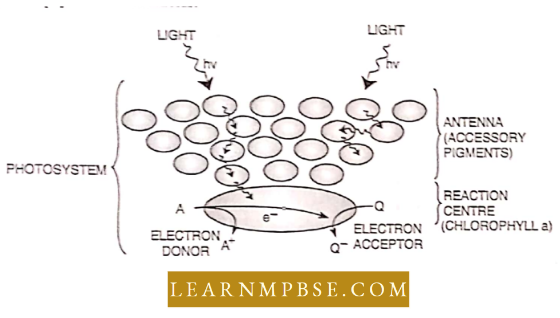
  • P680 and P700 constitute the reaction centre (or photocentres). Other accessory pigments and chlorophyll molecules are light-gatherers or antenna molecules (capture solar energy and transfer it onto the reaction centres by resonance transfer or inductive resonance).

NEET Biology Photosynthesis And Translocation Of Organic Solutes Absorption And Action Spectra

An action spectrum is a graph showing the rate of a process (e.g. photosynthesis) at different wavelengths of light. An absorption spectrum is a graph showing the amount of light of different wavelengths absorbed by a pigment.

The close similarity between the action spectrum of photosynthesis and the absorption spectrum of chlorophyll shows that chlorophylls are responsible for the absorption of light in photosynthesis.

NEET Biology Photosynthesis And Translocation Of Organic Solutes Photosystem 1 And Photosystem 2

  • Emerson’s enhancement effect. Emerson and Lewis (1943) observed a sudden drop in photosynthetic yield (evolution of O2) by Clilorella above 680 mn (far red) – redtdrop. But if red light of shorter wavelength was also supplied simultaneously, photosynthetic yield increased (enhancement effect).
  • Hence, Emerson (1957) proposed that two pigment systems or photochemical reaction systems are involved in the light phase (which act synergistically).
  • A photon absorbed anywhere in the trapping (or harvesting) zone of a P6g0 centre can pass its energy to the P680 molecule. The cluster of pigment molecules which transfer their energy to P680 absorb light at or below the wavelength of 680 runs.
  • Along with these molecules make tip the Photosystem II or PS II In the same way.P700 along with accessory pigments which absorb at or below 700 constitute the Photosystem I or PS I. PS I is located both in Stroma and Grana Lamellae. PS II is located in Grana. It possesses chlorophyll a. chlorophyll b and carotenoids.
Photosynthesis And Translocation Of Organic Solutes Conversion Of Light Into Electrical Energy

NEET Biology Photosynthesis And Translocation Of Organic Solutes Photophosphorylation Light phase

  • Arnon et al (1954) discovered that isolated chloroplasts could synthesise ATP in the presence of light. Such a light-driven formation of ATP was called photophosphorylation.
  • This is accompanied by photolysis of water, as a result of which O2 is released and H combines with N’.ADP to form NADPH. Photophosphorylation can be defined as the coupling of phosphate with ADP to produce ATP using light energy during photosynthesis.
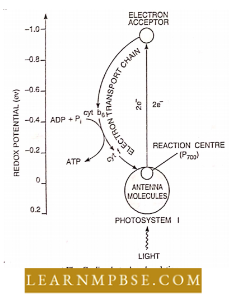
  • Cyclic photophosphorylation. When the photons activate Photosvstem I. a pair of electrons are raised to a higher energy level. They are captured by the primary acceptor which passes them on to ferredoxin (Fd), and plastoquinone (PQ). cytochrome complex, plasticity and (PC) and finally back to chlorophyll P7OQ.
 

Photosynthesis And Translocation Of Organic Solutes Cyclic Photophosphorylation

  • The process is cyclic. At each step of electron transfer, the electrons lose potential energy. Their trip downhill is used by the transport chain to pump H+ across the thylakoid membrane. The proton gradient triggers ATP synthesis.
  • Non-cyclic photophosphorylation. When both photosystems are illuminated, there is a continuous current of electrons flowing from water to NADP+. Electrons from P6g0 are replaced by electrons removed from water by splitting of water that evolves oxygen.

Photosynthesis And Translocation Of Organic Solutes Eletron Transport Flow And Photophosphorylation

The excited electron from P680 flows down an electron transport chain to P700 (Pc- plastoquinone, cytochrome complex, PC-plastocyanin) generating ATP. Illumination of PSI boosts electrons to a high energy state which are passed to NADP reducing it to NADPH (protons from H2O. The net products of non-cyclic electron flow are ATP and NADPH.

NEET Biology Photosynthesis And Translocation Of Organic Solutes Calvin Cycle

Melvin Calvin (1954), an American scientist, worked out the path of carbon by using the paper chromatography technique. In recognition of his work, Calvin was awarded with Nobel Prize in 1961. Analysis of plant extracts was made within seconds after the beginning of photosynthesis with the injection of 14CO2.

Photosynthesis And Translocation Of Organic Solutes The Calvin Cycle Proceeds In Three Stages

Translocation Of Organic Solutes NEET

Various steps of the dark phase can be studied as under:

  • Carboxylation. The first step is the carboxylation of Ribulose, 1,5 biphosphate (RuBP) by atmospheric CO2 in the presence of the enzyme RuBP carboxylase or rubisco.
  • Six molecules of RuBP (5-carbon compound) come in contact with six molecules of CO2 to form six molecules of six carbon unstable compounds which are converted into 12 molecules of PGA (3-carbon compound) with the help of an enzyme called carboxydisniutase.
  • Rubisco is a large protein molecule and constitutes 16 per cent of chloroplast protein and is one of the most abundant proteins on the earth.
  • Glycolytic reversal. The 6 molecules of PGA utilise 6 ATP molecules to form 6 molecules of 1,3- diphosphoglyceric acid. These, in turn, utilize 6 NADPH supplied by the light reactions and get converted to a 3-C glyceraldehyde phosphate- a triose phosphate (TP).
  • It seems to be a reversal of glycolysis, the only difference being that the reducing power is obtained from NADPH, and not NADP.
  • PGA + ATP + NADPH -» Glyceraldehyde.
    phosphate + NADP+ + ADP + IP
  • Regeneration of RuBP- F-6-P next undergoes a transketola.se relation that removes, the two top carbons as the thiamine pyrophosphate (TPP) derivative,, of glycoaldehyde, leaving the tetrose erythrose 4-phosphate (E-4-P).
  • The (E-4-P) condenses,s by aldolase reaction, with DHAP to form sedoheptulose diphosphate (SDP), and this is converted by a second^ energy-liberating step to sedoheptulose-7-phosphate (S-7-P) and Pi by a phosphatase reaction.
  • As far as can be determined, the same phosphatase works on FDP and SDP. The S-7-P undergoes a transketolase reaction in which. the two top carbons are removed as TPP- glycolaldehyde leaving the pentose ribose-5 phosphate (Ru-5-P).
  • This is converted to ribulose-5-phosphate (Ru-5-P) by phosphopento.se isomerase. The TPP-glycoaldehyde derived from F-6-P and F-7-P in the transketolase reaction is transferred to PGA forming xylulose-5-phosphate (Xu-5-P) which is converted to Ru-5-R hy n phosphopentose epimerase. The R-5-P is converted to Ru-5-P by an isomer.

Photosynthesis And Translocation Of Organic Solutes Calvin Cycle Or Dark Reaction

NEET Biology Photosynthesis And Translocation Of Organic Solutes Factors Affecting Photosynthesis

se and is phosphorylated by phosphoribulokinase. ATP being the donor produces ribulose biphosphate (RuDP) and ADP ( a second “priming” reaction that prepares the pentose for carboxylation).

  1. Light Intensity. The compensation point is 25-100 ft candles in shade plants and 100- 400 ft candles in sun plants. The optimum light intensity is 10% of full sunlight for shade plants and 50-70% of full summer sunlight for C3 sun plants.
  2. In C4 plants saturation point is not reached even in full sunlight. At higher light intensity, there is a decrease in photosynthesis called solarisation. It can be due to photoinhibition (reduction in hydration)and photoxidation.
  3. Light Quality. Red light favours carbohydrate synthesis while blue light stimulates protein synthesis. Maximum photosynthesis occurs in the blue and red parts while minimum photosynthesis takes place in the green part of the spectrum.
  4. Red light is more efficient in photosynthesis as compared to blue light. However, maximum photosynthesis occurs in full sunlight.
  5. Oxygen. In C3 plants, the optimum oxygen for photosynthesis is 2-5%. It is reduced at normal atmospheric concentration of oxygen. No such effect is found in C4 plants. Above 21% there is a reduction in photosynthesis (Warburg Effect).
  6. Chlorophyll. It is essential for photosynthesis. Photosynthesis does not occur in chlorotic regions. Willstatter and Stoll coined the term assimilation number or photosynthetic number as the number of CO2 molecules reduced per unit of chlorophyll. However, chlorophyll is always supra-optimal.
  7. Age. The rate of photosynthesis is maximum in just matured leaves but declines with age.
  8. If the rate of translocation becomes slower than the rate of synthesis, the latter also declines due to the accumulation of end products. Chemicals like cyanides, NH, OH, CO, H2S, iodoacetates, chloroform, ethers, DCMU, CMU etc. inhibit photosynthesis.
  9. Accumulation of End Products. Accumulation of food in the chloroplasts reduces the rate of photosynthesis.
  10. Duration. Photosynthesis can continue indefinitely in the presence of light though the rate begins to fall slightly after 3-4 days of continuous exposure.

NEET Biology Photosynthesis And Translocation Of Organic Solutes Photorespiration

Respiration that is initiated in chloroplast and occurs in light is called photorespiration.
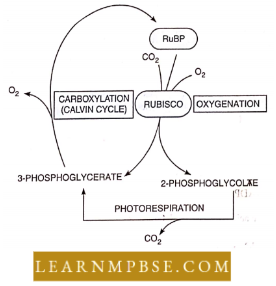
With an increase in temperature as on a hot summer day the affinity of RuBP carboxylase for CO2 decreases and O2 increases.
Photosynthesis And Translocation Of Organic Solutes Photorespiration Involves Oxygenation

  • As a result, RuBP is changed to 2 Phosphoglycolate and PGA. Thus photosynthetically fixed carbon is lost by photorespiration.
  • Photorespiration takes place through the Involvement of three cell organelles, the chloroplast, peroxisomes and mitochondria.
  • Photorespiration is the process of the uptake of O2 and the production of CO2 in light by photosynthesising tissues. It is quite common in C3 plants.
  • Photorespiration causes a high loss of fixed carbon without producing energy-rich compounds is produced during this process.
  • Photorespiration is also called a cycle because of 2-carbon intermediates.
  • Linking Of Photorespiration To Calvin Cycle
  1. The first oxidative slop is the conversion of Rnl)P into 3-carbo PGA and 2-Carlion phosphor glycolic acid which moves lo peroxisomes to form glyoxylic acid, and the glyoxylic acid is converted to serine. Serine passes out to the mitochondria is converted into IHIA and finally enters the Calvin cycle.

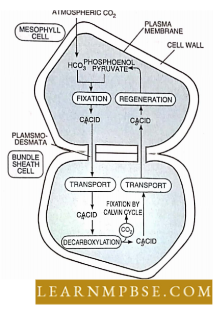
NEET Biology Photosynthesis And Translocation Of Organic Solutes C4 Pathway

In plants like maize, sorghum, sugarcane etc. the CO2 molecule combines with IMiP to form a four-carbon compound, oxaloacetic acid (OAA). It is known as the C2 cycle because the initial product of CO2 fixation is a 4-carbon compound.

Overall C4 equation is
6PEP+ 6RuBP + 6CO + 30ATP + 12NAPH-> 6PEP + 6RuBP + C6 HO6 + 30ADP +30 H3 PQ + 12NADP


Photosynthesis And Translocation Of Organic Solutes C4 Photosynthetic Carbon Cycle

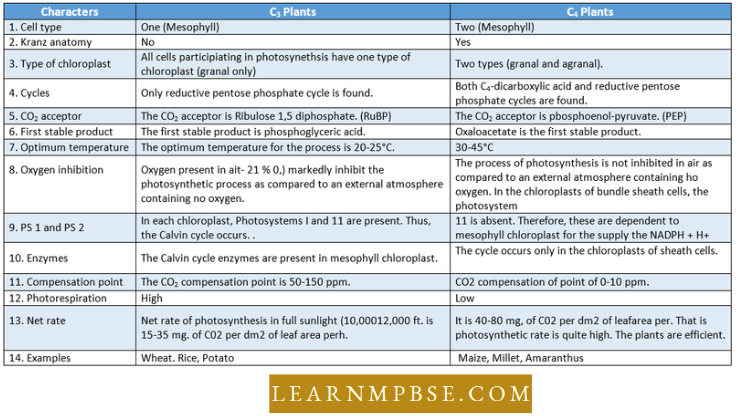
Difference Between C3 And C4 Plants

Photosynthesis And Translocation Of Organic Solutes Differences Between C3 And C4 Plants

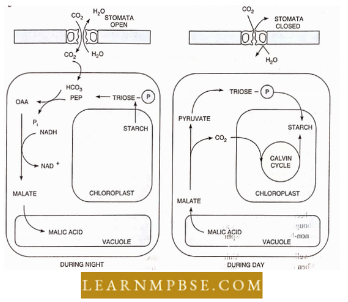
Photosynthesis And Translocation Of Organic Solutes Crassulacean Acid Metabolism

NEET Biology Photosynthesis And Translocation Of Organic Solutes Important Terms

  • Calvin Cycle. The reductive pentose pathway of photosynthesis is named after its discoverer. It is also called a pathway”.
  • Hill Reaction. It is the name of a part of the light reaction of photosynthesis, after R. Hill, who first observed it in 1937, Under Hill’s reaction, NADP is reduced to NADPH2
  • Blackman’s law of limiting factors. It suggested that when a process is conditioned to its rapidity by it number of factors, keeping other factors constant, the rate of process is determined by the slowest or limiting factor.
  • Reductive I’cntose Pathway. It is a set of reactions in the process of photosynthesis in which CO2 is fixed by ribulose-diphosphate ( a pentose sugar) to give PGA, which is used to produce a hexose sugar and more ribulose-diphosphate, which is used for further CO2 fixation.
  • Sedohcpliilo.se. A seven-carbon compound formed in the Calvin cycle.
  • C3 Pathway. It is another name for the Colvin cycle which is also called the reductive pentose pathway.
  • C4 Pathway. It is a kind of CO2 fixation, found in some tropical plants-both monocotyledons and dicotyledons. It is also called the Hatch and Slack cycle.
  • In this pathway, CO2 is fixed by a three-carbon compound (phosphoenol pyruvate) and ultimately a molecule with 4 carbon atoms (male) is produced.
  • Plants, in which the C4 pathway is found, are called C4 plants, For Example. Saccharum, Sorghum, Maize, Cyperus etc.
  • Photorespiration is absent in C4 plants. These plants use CO2 more efficiently than C3 plants.
  • Crassulacean Acid Metabolism (CAM). It is a kind of CO2 fixation found in many succulent plants, For Example. Crassulaceae.
  • Phosphoglyceric Acid (PGA). It is a compound with three atoms of carbon. It is the first product of the reaction between CO2 and ribulose diphosphate in the reductive pentose pathway of the process of photosynthesis.
  • Ribulose diphosphate. A compound made up of a molecule of the pentose sugar ribulose and two phosphate groups. It is also called ribulose 1,5-diphosphate or RuDP. It is the main compound involved in CO2 fixation.
  • Red drop. Sharp fall in the rate of photosynthesis as found by Emerson near the far end of the spectrum, This decline in photosynthesis is called the red drop.
  • Spectrophotometer. An instrument used to measure the rate of absorption of different wavelengths of light by different pigments. The absorption of different wavelengths of light by a particular pigment is plotted and called the absorption spectrum.

NEET Biology Photosynthesis And Translocation Of Organic Solutes

  1. The food is translocated from the supply end or source (leaves) to the consumption end or sink (storage regions).
  2. The translocation of organic solutes takes place in plants in all directions.
    • Downward translocation (from leaf to stem and roots)
    • Upward translocation (from leaves to developing buds)
    • Radial translocation (from the pith to the cortex).
  1. There is ample evidence to believe that food is translocated through phloem such as
    its component structure, the effect of blocking phloem and ringing experiments conducted by Malpighin Stephan Hales and Curtis.
  2. The experimental evidence collected by Rabadieu and Burr by using C14 and experiments-with aphids performed by Kennedy and Mittler also confirms phloem translocation of food. Some days may be translocated in an upward direction through the xylem.
  3. Radioactive isotopes such as P32, S35, Sr90, N15, C14, C11 and H3 have been used in recent years along with techniques like a reverse flap, autoradiography and freeze-drying.
  4. Food is translocated mainly as sucrose but also in the form of raffinose, stachyose, verbascose, mannitol, myoinositol and sorbitol.
  5. The rate of metabolite movement is calculated in terms of mass transfer rate. The translocation velocity may be 55 cm/hr (sucrose). It is 270 cm/hr in sugarcane and 290 cm/ hr in squash.
  6. Mechanism of Translocation. Several hypotheses have been proposed to explain the mechanism of translocation.
  • It was earlier believed that good is translocated from source to sink by simple diffusion. Since the rate of diffusion is extremely slow hence Mason and Phillips proposed an activated diflusion hypothesis which lacked experimental evidence.
  • De Vries proposed that food is translocated by streaming currents of protoplasm.
  • It explains the bidirectional movement of metabolites and the faster rate of translocation. observe the streaming of protoplasm in mature sieve elements.
  • Thaine and Canny observed streaming in vertically running transcellular strands in sieve elements. The presence of these strands has been confirmed by the use of C2 But the die rate of translocation as last as 290 cm/hr cannot be achieved by protoplasmic streaming.
  • The activated diffusion theory of Mason and Maskell (1936) takes into account the utilization of ATP.
  1. Electro-osmotic theory was proposed by Fensom (1957) and Spanner (1958). According to this, an electropotential across the sieve plate is responsible for a faster rate of liquid flow.
  2. Munch’s Mass Flow or Pressure Flow Hypothesis (1930) Munch’s hypothesis postulated the movement of protoplasm mass along a turgor pressure gradient induced by the maintained gradient of water potential.
  3. This is based on the principle that an increase in turgor pressure causes mass flow’ of solution from production chamber A (comparable to leaf) to consumption chamber (comparable to root).
  4. The movement of solute will continue till the solutions in both chambers attain the same concentration.
  5. In living plants, the carbohydrates are continuously synthesized in mesophyll cells and are translocated to roots or storage organs through phloem.

NEET Biology Photosynthesis And Translocation Of Organic Solutes Factors Affecting Translocation

The process of food translocation is influenced by several factors as follows :

  • Temperature: The effect of temperature may be direct or indirect. It has been experimentally confirmed that the optimum temperature for translocation ranges between 20 -30 C. It increases with the increase of temperature up to a maximum limit and then decreases.
  • By using C14 it has been observed that the translocation rate increases in sugarcane when temperature is raised from 20 to 33 C. It has been also observed that when the root temperature is higher than the shoot, translocation to the root increases but to the shoot tip, decreases.
  • If the condition is reversed i.e. when the shoot temperature is higher than the roots, translocation to the shoot tip increases and to the roots decreases.
  • Light: The rate of translocation is influenced by light intensity. With the increase in light intensity the translocation to root as compared to shoot increases. However, by using C*  it has been observed that in the dark, more food is translocated in the root of Glycine than in light.
  • Minerals: It has been demonstrated that boron enhances the translocation of labelled sucrose in tomatoes. It is thought that boron makes a complex with sucrose. This borate sugar moves more rapidly than non-borate sugar. Phosphorus deficiency also reduces the translocation rate.
  • Hormones: It is well known that cytokinins influence the translocation of soluble nitrogen
  • compounds. When they have sprayed the leaves externally, translocation of N, t compounds from lamina to petiole is retarded,’ hence it remains green for a longer period.
  • Inhibitors: The metabolic inhibitors like azides, CP, 2-4 dinitrophenol (DNP), fluorides, HCN, iodoacetates etc. retard metabolism and thus indirectly influence the translocation process.

Photosynthesis is the single most important biological process required for human existence.

  • Jan Baptism Van Uelmont (Belgian physician) with his simple experiments concluded that all the substance of plant was produced from water and none from soil Contribution of Jan Ingcnhonsz. He confirmed Priestley’s work and also discovered that the release of O, by plants was possible only in sunlight by green plants.
  • Contribution of C.B. Van Nicl. He gave a simplified equation of photosynthesis.
  • Contribution of Joseph Priestley (1703-1804). He showed that plants can take up CO2 from the atmosphere and release O2
  • Within the leaf, photosynthesis occurs in specialised cells called mesophyll cells.
  • PAR is photosynthetically active radiation of visible speed
  • ATP, NADPH + H+ are produced in light reaction and are used for the reduction of CO2 Isolated chloroplast cannot carry out CO2 reduction because enzymes necessary for CO2 reduction are leached out during the isolation of chloroplasts.
  • Chlorophyll acts as a reaction centre and accessory pigments called carotenoids act as antenna complexes and harvest light from different regions of the spectrum.

Photosynthesis And Translocation Of Organic Solutes Crassulacean Acid Metabolism

Photosynthesis And Translocation In Plants NEET

Crassulaccan Acid Metabolism (Cam Plants)

CAM plants fix CO2 at night, from malice which is stored in large vacuoles in mesophyll cells until the next day. CAM plants use the enzyme Pepco (PEP carboxylase). The malate formed at night releases CO2 during the day to the Calvin cycle within the same cell, which now has NADPH and ATP available from light-dependent reactions.

  • CAM represents Crassulacean acid metabolism. The Crassulaceae is a family of flowering succulents. In CAM plants stomata open during night only and is an adaptation of xerophytic succulents. Photosynthesis in such cases is usually not as efficient as in C3 or C4 plants, but it allows the CAM plants to live under stress-
  • Isolated chloroplasts can carry out CO2 reduction provided the leached substances are externally supplied to them.
  • This was proved by D.I. Arnon and his associates.
  • Dark reactions can occur in light as well as in the dark.
  • The temperature coefficient (Q10) is defined as the ratio of the velocity of a reaction, at a particular temperature to that at a temperature 10°C lower.
  • For a physical process, the value of Q10 is slightly greater than one.
  • For photochemical reactions, the value of Q10 is one.
  • For a chemical reaction, the value of Q10 is two or more i.e., with the rise of 10°C temperature, the rate of chemical reaction is doubled.
  • The difference between C4 plants and CAM plants is that in C4 plants two cycles are separated by different leaf cells (i.e. in mesophyll cells and bundle sheath cells) whereas in CAM plants both pathways are found in mesophyll cells both being separated by time.

NEET Biology Photosynthesis And Translocation Of Organic Solutes Quanta to Memory

Chi C—C35 H32 O5 N4 Mg (Mol. wt.) = 712. Phytol absent it is present in brown algae + diatoms.

Chl d—C54 H70 O6_ N4 Mg (Mol. wt. 895) red algae

Bacteriochlorophyll a—C55 H74 O6 N4 Mg (Mol. wt. 911)

  • Chi a : Chi b = 2.5-3.5 : 1
    For sun plant 5.5: 1 [For heliophyte)
    For shade plant 1:4:1 [For sciophyte]
  • Chlorophyll absorbs more of blue light than red light. 40% (Blue) 30% (Red) For Chi a 48% (Blue) 20% (Red) —For Chi b
  • Bacteriochlorophyll-b found in Rhodopseudomonas is not yet known.
  • Chlorobium Chlorophyll-old name of bacterioviridin
  • Carotenoid-lipochrome. Fat-soluble, light not necessary.
  • Calvin gave a molecular model of the chloroplast.
  • Discovered by Wakineroder as a provitamin of carrot types – a, b, g and carotene, phytotene, neurosphere.

Ratio of xanthophyll: Carotene in plant 2:1.

  • Xanthophyll Zeaxanthin gives a yellow colour to the leaf.
  • Size of chlorophyll 15 A ‘ 15 A Porphyrin head while Phytol tail is 20 A long
  • Chlorophyll absorbs light of wavelength 400-500 nm and 600-700 nm.
  • During peak hour, the rate of photosynthesis is 20 times of respiration.
  • C4 plants-Dimorphism grain mesophyll, e.g. sugarcane.
  • Temp, range for algae; 75 C.
  • C3 plant; 10-25°C, C4 plant-; 30°C-45°C.
  • Solute translocated contains mostly 10-26% carbohydrates sucrose and 10% nitrogen compound.
  • If CO2 increases by 15-20 times then photosynthesis increases if no other factor is limiting.
  • If the CO2 cone decreases by 10-15 times, the rate of Photosynthesis decreases.
  • The total amount of solar energy trapped by photoautotrophs is 0.024 % and the product, of photosynthesis, is 170 billion tonnes from 8 “108-metre tonne of carbon

NADP is called TPN (Triphosphopyridine nucleotide called Co II.

  • The excited state remains for 5×1 O’9 sec.
  • Coupling factors are present on the thylakoid.
  • Bacterial Photosynthesis-Green Sulphur (e.g. chlorobium), Purple sulphur (Eg. Chromatium, Purple non-Sulphur (Rhodo Sperellum)
  • In cyclic photophosphorylation, e“ released by the reaction centre is accepted by the reaction centre.
  • The process of photophosphorylation is the same as mitochondrial reaction is called Oxidative phosphorylation.
  • All types of plastid processes are the same as they can transform a frame from one form to another.
  • Ratusky effect Chi shows out burst of fluorescence during the first few moments of illumination.
  • C3 and C4 plants may occur in different species but the same genus For Example- Euphorbia corollata, E. macula
  • In grass allotropes, semialata in the C3 plant and C4 plant occur in another ecotype.
  • Photo-bioluminescence. The phenomenon of re-irradiation of absorbed energy. It consists of fluorescence which occurs almost instantaneously and phosphorencence occurs after a gap. Chlorophyll shows fluorescence. Their phosphorescence is doubtful.
  • Carotenoids absorb light strongly in the blue-violet range. These are called shield pigments as they protect chlorophyll from photooxidation, (bleaching)
  • Park and Biggins coined the term ‘Quantosomes’ for a group of pigment molecules required for carrying out a photochemical reaction. These occur in membranes of thylakoids. Each quantosome has 250-300 chlorophyll, carotenoids, quinone compounds, sulpholipids, phospholipids, protein and chlorophyll molecules-160 chi a, 70 chi b, 50 carotenoids.
  1. Chlorophyll transfers solar energy to reaction centres by resonance transfer or inductive resonance.
  2. Of the 90% of photosynthesis carried out by algae, 80% is carried out by marine and 10% by freshwater algae.
  3. Photosynthetic efficiency increases in intermittent light.
  4. The products of the light phase are not used immediately in the dark phase, so photosynthetic efficiency decreases in continuous saturating light.
  5. RuBP carboxylase or Rubisco is a large protein molecule and constitutes about 16% of chloroplast protein. It is the most abundant protein on the earth.
  6. O2 is a competitive inhibitor of CO2 fixation. Any increase in the O2 cone, would favour the uptake of O2 rather than CO2 and thus inhibit photosynthesis.
  7. Photorespiration is also called dark respiration and there is a loss of Carbon as CO, and a loss of energy in this process.
  8. Photorespiration reduces the potential yield of plants growing in the tropics by 30-40%.
  9. H.P. Kartschak and C.E. Hartt found that in sugarcane, a tropical plant, leaves removed CO, more efficiently from the atmosphere and the first products of photosynthesis were acids having 4-C atoms (Malic, OAA, aspartic acid) than 3 Carbon*acid PGA.
  10. The same has been found true for tropical plants including monocots (Maize, Sorghum and Eleusine) and dicots (Amaranthus and Euphorbia spp.)
  11. Chloroplasts in C4 plants are called dimorphic.
  12. Correlation between Kranz anatomy and C4 plants was established by Dewton and Treguna.
  • 2.5-30° C is the optimum temperature for photosynthesis In opuntia it can be 55 C.
  • In lichens -20° C to -24° C and in conifers -35° C.
  • Total sugar in phloem sap can be up to 90%. Sucrose constitutes 5-15% of total sugars. Other sugars are raffinose (triose), stachyose (tetrose) and verbascose (pentose)
  • Pure phloem saps may be collected by using sap-sucking aphids.
  • Photosynthesis is an anabolic, endergonic, oxidation-reduction process.
  • Solarisation-Destruction of chlorophyll due to high light intensity.
  • The most common limiting factor for photosynthesis is CO,
  • Compensation point- light intensity at which rate of photosynthesis = rate of respiration (In morning and evening)
  • In C3, more CO is released in light than in dark (due to photorespiration)
  • The yield of C3 plants is increased by increasing CO, in the atmosphere.
  • Tracer Technique-Rabideau and Buer supplied C14 O2 to a leaf during photosynthesis. The sugar synthesised in this leaf was labelled with 14C (tracer). The presence of labelled sugars in the phloem showed that solutes are translocated through the phloem.
  • Goodwin suggested that Chlorophyll and Carotenoids may be attached to the same protein forming a complex called photosynthin.
  • Phycobilins are also known as biliproteins
  • O2 of glucose comes from CO2

Out of total light, 1-2% light is used by green plants.

Enzyme PEP Carboxy dismutase in C4 plants is very sensitive to CO2, this is why C4 plants can absorb CO, from its low concentration while C3 plants fail to avail it from such a low concentration.

The first step of photosynthesis is the excitement of electrons of the chlorophyll molecule.

  • The first chemical step of photosynthesis is the photolysis of H2
  • The light reaction forms ATP or assimilatory power and NADPH2 which is used in the reduction of CO, in the dark phase.
  • Light reaction occurs in the granum and dark reaction in the stroma.
  • Phosphoglyceraldehyde-it is the connecting link between photosynthesis and respiration.
  • During solarization, photooxidation occurs in which some cell constituents are oxidized.
  • Light is never a limiting factor except on cloudy days.
  • Photosynthesis occurs between 390-750 m.u.
  • Assimilatory Number-It is the amount of CO2 absorbed in gms/hour by gm of chlorophyll.
  • 48 light quantum is necessary for 6 CO2
  • Bacteria photosynthesise at 900 mu wavelength
  • Plastidome-Plastid complex of cell.

Quantum yield- No. of O2 released per photon or quantum of light. Its value is 1/8 —1/10. In other words, the evolution of one molecule of O2 or consumption of one molecule of CO2 requires 8-10 quanta.

NEET Biology Photosynthesis And Translocation Of Organic Solutes Questions From Competitive Examinations

Question 1. Which of the following occurs in the dark reaction of photosynthesis?

  1. Formation of ATP
  2. Release of O2
  3. Release of H,
  4. Synthesis of PGAL.

Answer: 4. Synthesis of PGAL.

Question 2. The first reaction in photosynthesis is :

  1. Photolysis of water
  2. Excitation of chlorophyll molecules
  3. Formation of ATP
  4. Fixation of CO2.

Answer: 2. Excitation of chlorophyll molecules

Question 3. Fixing one molecule of C02 in the Calvin cycle is required :

  1. 3 ATP + 1 NADPH
  2. 3 ATP + 2 NADPH2
  3. 2 ATP + 3 NADPH2
  4. 3 ATP + 3 NADPH

Answer: 2. 3 ATP + 2 NADPH2

Question 4. The enzyme required in early C02 fixation in the C4 cycle is :

  1. RuBP carboxylase
  2. RuBP oxygenase
  3. PEP carboxylase
  4. PGA dehydrogenase.

Answer: 2. RuBP oxygenase

Mechanism Of Phloem Transport NEET

Question 5. A chemical which absorbs light energy and changes it to chemical energy is :

  1. Xanthophyll
  2. Chlorophyll a
  3. Chlorophyll b
  4. Chlorophyll c.

Answer: 2. Chlorophyll a

Question 6. One of the following is a C4 plant:

  1. Sugarcane
  2. Tomato
  3. Mango
  4. Apple.

Answer: 1. Sugarcane

Question 7. Which pair is wrong?

  1. C3 – maize
  2. C4 – kranz anatomy
  3. Calvin cycle – PGA
  4. Hatch and Slack cycle

Answer: 1. C3 – maize

Question 8. Which pigment system is inactivated in the red drop :

  1. PS-1 and P.S-II
  2. PS-I
  3. PS-II
  4. None.

Answer: 3. PS-II

Question 9. Which plant is LDP :

  1. Tobacco
  2. Glycine max
  3. Mirabilis Jalapa
  4. Spinach.

Answer: 4. Spinach. Spinach.

Question 10. The proteinaceous pigment which controls the activities concerned with light is :

  1. Phytochrome
  2. Chlorophyll
  3. Anthocyanin
  4. Carotenoids.

Answer: 1. Phytochrome

Question 11. The first stable product of photosynthesis in C4 plants is :

  1. Ribulose a 5 – biphosphate
  2. Phosphoglyceric acid
  3. Malic acid
  4. PGAL.

Answer: 3. Malic acid

Question 12. Which one of the following is the aim of Moll’s half¬leaf experiment?

  1. To show that carbon dioxide is produced during aerobic respiration
  2. To show that carbon dioxide is produced during anaerobic respiration
  3. To show Chlorophyll is necessary for photosynthesis
  4. To show the importance of carbon dioxide for photosynthesis.

Answer: 4. To show the importance of carbon dioxide for photosynthesis

Question 13. Photosynthesis is maximum in :

  1. Blue light
  2. Greenlight
  3. Red light
  4. U.V. light.

Answer: 3. Red light

Question 14. Cyclic photophosphorylation form :

  1. ATP
  2. ATP and NADPH
  3. NADPH
  4. ATP, NADPH and O.

Answer: 1. ATP

Factors Affecting Photosynthesis NEET

Question 15. Which of the following possess both PS -1 and PS – II?

  1. Purple sulphur bacteria
  2. Green sulphur bacteria
  3. Cyanobacteria
  4. Purple non-sulphur bacteria.

Answer: 3. Cyanobacteria

Question 16. Evidence for liberation of 0, from water during photosynthesis comes from :

  1. Release of O80 if the water contains the same
  2. Isolated chloroplast supplied with reducing agents like potassium ferrocyanide evolves O2 even in
    absence of CO2
  3. Photosynthetic bacteria do not liberate O2 and they use H, and S to obtain reduced power
  4. All the above.

Answer: 4. All the above.

Question 17. Which of the following provides energy to ETS by absorption of sunlight?

  1. Water
  2. Chlorophyll
  3. Mitochondria
  4. ATP.

Answer: 4. ATP.

Question 18. Photosystem II occurs in :

  1. The outer membrane of mitochondria
  2. Grana
  3. Stroma
  4. The inner membrane of mitochondria.

Answer: 2. Grana

Question 19. CO, acceptor in the C3 cycle is:

  1. PEG
  2. RuBP
  3. OAK
  4. Malic acid.

Answer: 2. RuBP

Question 20. ETS associated with photophosphorylation occurs in :

  1. Stroma
  2. Thylakoid
  3. The outer membrane of the chloroplast
  4. Mitochondria.

Answer: 4. Mitochondria.

Question 21. C4 plants are abundant in :

  1. Tropical regions with more dry conditions
  2. Tropical regions with more humid conditions
  3. Temperate region with more dry conditions
  4. Temperate regions with more humid conditions.

Answer: 2. Tropical region with more humid conditions

Question 22. Photorespiration in C, plants stall from :

  1. Phosphoglycerate
  2. Phosphoglycolate
  3. Glycerate
  4. Glycine.

Answer: 2. Phosphoglycolate

Question 23. Hill reaction occurs in :

  1. High altitude plant
  2. Total darkness
  3. Absence of water
  4. Presence of ferricyanide.

Answer: 4. Presence of ferricyanide

Question 24. In sugarcane plants 14CO2 is fixed in malic acid, in which the enzyme that fixes C02 is :

  1. Fructose phosphatase
  2. Ribulose biphosphate carboxylase
  3. Phosphoenol pyruvic acid carboxylase
  4. Ribulose phosphate kinase.

Answer: 3. phosphoenol pyruvic acid carboxylase

Question 25. Which of the following is not an electron carrier?

  1. CoQ
  2. Cytc
  3. Cyt a
  4. HO           
  5. Cyt a3

Answer: 4. H2O

Question 26. How many molecules of glycine are required to release one molecule of CO during photorespiration?

  1. Four
  2. Three
  3. Two
  4. One.

Answer: 3. Two

Light Reaction And Dark Reaction NEET Notes

Question 27. Who demonstrated photolysis of water by isolated chloroplasts?

  1. Liebig
  2. M. Calvin
  3. Von Neil
  4. Hill.

Answer: 4. Hill.

Question 28. As compared to sun plants, plants adapted to low light intensity possess :

  1. Spiny leaves
  2. Extensive root system
  3. High rate of CO fixation
  4. Larger photosynthetic unit.

Answer: 4. Larger photosynthetic unit.

Question 29. In comparison to a C3 -plant, how many additional molecules of ATP are needed for the net production of one molecule of hexose sugar by C4 -plants :

  1. Six
  2. Two
  3. Zero
  4. Twelve.

Answer: 4. Twelve.

Question 30. Photosynthesis in C4 plants is relatively less limited by atmospheric C02 levels because

  1. Effective pumping of CO into bundle sheath cells
  2. The primary fixation of CO is mediated via PEP carboxylase
  3. Four carbon acids are the primary initial CO fixation products
  4. Rubisco in C plants has a higher affinity for CO2.

Answer: 2. The primary fixation of CO is mediated via PEP carboxylase

Question 31. Photosynthetic active radiation (PAR) has the following range of wavelengths :

  1. 400-700 nm
  2. 450-950 nm
  3. 340-450 nm
  4. 500-600 nm.

Answer: 1. 400-700 nm

Question 32. The pathway of the Calvin cycle was discovered by using an isotope of:

  1. 180
  2. 32P
  3. UC
  4. I4C.

Answer: 4. I4C.

Question 33. Chloroplast lacks :

  1. Carotene
  2. Chlorophyll
  3. Xanthophyll
  4. Anthocyanin.

Answer: 4. Anthocyanin.

Question 34. Bacterial photosynthesis does not show :

  1. Photosystem I
  2. Utilization of energy
  3. Evolution of oxygen
  4. Formation of organic product.

Answer: 4. Formation of organic product

Question 35. A phenomenon which converts light energy into chemical energy is:

  1. Respiration
  2. Photosynthesis
  3. Transpiration
  4. None of these.

Answer: 2. Photosynthesis

Question 36. In photosystem-I, the first electron acceptor is :

  1. Plastocyanin
  2. An iron-sulphur protein
  3. Cytochrome
  4. Ferredoxin.

Answer: 2. An iron-sulphur protein

Light Reaction And Dark Reaction NEET Notes

Question 37. The translocation of organic solutes in sieve tube members is supported by:

  1. Mass flow involving a carrier and ATP
  2. Cytoplasmic streaming
  3. Root pressure and transpiration pull
  4. P-proteins.

Answer: 4. P-proteins

Question 38. During photorespiration, the oxygen-consuming reaction (s) occur in :

  1. grana of chloroplasts and peroxisomes
  2. stroma of chloroplasts
  3. stroma of chloroplasts and mitochondria
  4. stroma of chloroplasts and peroxisomes.

Answer: 3. stroma of chloroplasts and mitochondria

Question 39. The Calvin cycle proceeds in three stages.

Reduction, during which carbohydrate is formed at the expense of the photochemically made ATP and NADPH

Regeneration, during which the carbon dioxide acceptor ribulose-1, 5-biphosphate is formed

Carboxylation, during which carbon dioxide combines with ribulose-1, 5-biphosphate.

Identify the correct sequence.

  1. 3-1-2
  2. 3-2 – 1
  3. l-2-3
  4. 2 – 1 – 3
  5. 1-3-2.

Answer: 1. 3-1-2

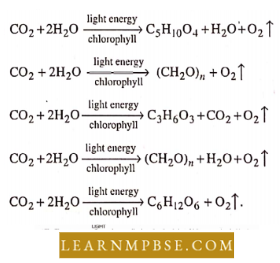
Question 40. Which of the following is a simplified equation of photosynthesis?
Photosynthesis And Translocation Of Organic Solutes Equation Of Photosynthesis Question .40

Answer: 4.

Question 41. Choose the correct combination of labelling the number of carbon compounds in the substrate molecules, involved in the citric acid cycle.
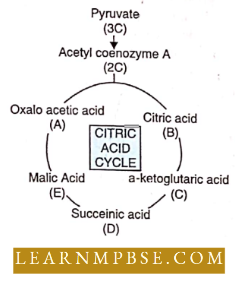
Photosynthesis And Translocation Of Organic Solutes Choose The Correct Combination Question .41

  1. A. 4C, B. 6C, C. 5C, D. 4C, E. 4C
  2. A. 6C, B. 5C, C. 4C, D. 3C, E. 2C
  3. A. 4C, B. 3C, C. 4C, D. 5C, E. 6C
  4. A. 4C, B. 5C, C. 6C, D. 4C, E. 4C
  5. A. 4C, B. 6C, C.4C, D. 4C, E. 4C.

Answer: 1. A. 4C, B. 6C, C. 5C, D. 4C, E. 4C

Question 42. In the given chart of photophosphorylation, what does “a” represent?
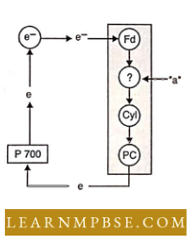
Photosynthesis And Translocation Of Organic Solutes Chart Of Photophosphosphorylation Question 42.

  1. PC
  2. FRS
  3. PQ
  4. Cyt. a3.

Answer: 3. PQ

Question 43. The reaction that is responsible for the primary fixation of CO is catalysed by:

  1. RuBP carboxylase
  2. PEP Carboxylase
  3. RuBP carboxylase and PEP
  4. PGA synthetase

Answer: 3. RuBP carboxylase and PEP

Question 44. The enzyme that is not found in the C plant is :

  1. RuBP carboxylase
  2. NAJDP reductase
  3. ATP synthase
  4. PEP carboxylase

Answer: 4. PEP carboxylase

Photosynthesis And ATP Production NEET

Question 45. Which of the following three organelles are involved in photorespiration?

  1. Chloroplast, mitochondrion, glyoxysome
  2. Chloroplast, peroxisome, mitochondrion
  3. Chloroplast, glyoxysome, mitochondrion.
  4. Chloroplast, lysosome, peroxisome

Answer: 2. Chloroplast, peroxisome, mitochondrion

Question 46. Consider the following statements :

A. The portion of the spectrum between 500 nm and 800 nm is also referred to as photosynthetically active radiation (PAR)

B. Magnesium, calcium and chloride ions play prominent roles in the photolysis of water

C. In cyclic photophosphorylation. oxygen is not released (as there is no photolysis of water)  and NADPH is also not produced.

D. Of these statements given above

  1. A is true, but B and C are false
  2. A and B are false, but C is true
  3. B is true, but A and C are false
  4. A and B are true, but C is false
  5. A and C are true, but B is false

Answer: 2. A and B are false; but C is true

Question 47. Which of the following statements about photosynthesis is/are correct?

A. In C plants, the primary CO acceptor is PEP

B. In the photosynthetic process PS II absorbs energy at or just below 680 nm

C. The pigment that is present in the pigment system 1 is P683 :

  1. B and C only
  2. An only
  3. C only
  4. A and B only
  5. A and C only.

Answer: 4. A and C only.

Question 48. Consider the following statements regarding photosynthesis :

A. ATP formation during photosynthesis is termed as photophosphorylation

B. Kranz’s anatomy pertains to leaf

C. Reduction of NADP+ to NADPH occurs during the Calvin cycle

D. In a chlorophyll molecule magnesium is present in phytol til. Of the above statements :

  1. A and B are correct
  2. C and D are correct
  3. A and C are correct
  4. A and D are correct
  5. B and C are correct.

Answer: 1. A and B are correct

Question. 49. Which of the following statements is/are not true?

A. In CAM plants stomata open during the dark and remain closed during the day

B. Role of Na+ in stomatal opening is now universally accepted

C. The water of root cells is higher than the water potential of soil

D. Capillarity theory is the most accepted theory of water movement through plants

E. The walls of xylem vessels made up of lignocellulose have a strong affinity for water molecules

  1. B, C and E only
  2. B, C and D only
  3. A, B and C only
  4. B, and only
  5. A and E only.

Answer: 2. B, C and D only

Question 50. Which of the following is photophosphorylation?

  1. production of ATP from ADP
  2. production of NADP
  3. synthesis of ADP from ATP
  4. production of PGA.

Answer: 1. production of ATP from ADP

Question 51. In leaves of C plants, malic acid synthesis during CO, fixation occurs in the:

  1. bundle sheath
  2. guard cells
  3. epidermal cells
  4. mesophyll calls.

Answer: 4. mesophyll calls.

Question 52. Electrons from exited chlorophyll molecule of photosystem II are accepted first by :

  1. quinone
  2. ferredoxin
  3. cytochrome -b
  4. cytochrome -i

Answer: 1. quinone

Question 53. The C plants are photosynthetically more efficient than C plants because:

  1. the CO, efflux is not prevented
  2. they have more chloroplasts
  3. the CO, compensation point is more
  4. CO, generated during photorespiration is trapped and recycled through PEP carboxylase.

Answer : 3. the CO, compensation point is more

Question 54. CAM helps the plants in :

  1. Conserving water
  2. Secondary growth
  3. Disease resistance
  4. Reproduction.

Answer: 1. Conserving water

Question 55. A process that makes an important difference between C3 and Cplants is :

  1. Glycolysis
  2. Photosynthesis
  3. Photorespiration
  4. Transpiration.

Answer : 3. Photorespiration

Photosynthesis And ATP Production NEET

Question 56. Which of the following concerning early experiments of photosynthesis is wrongly matched?

  1. (A) Joseph Priestley  – Showed that plants release
  2. Jan Ingenhousz    – Showed that sunlight is essential for photosynthesis
  3. Julius von Sachs  – Proved that plants produce glucose when they grow
  4. T.W. Engelmann    – Showed that the green substance is located within special bodies in plants
  5. Cornelius van Niel – Showed that hydrogen reduces CO, to carbohydrates.

Answer: 5. Cornelius van Niel – Showed that hydrogen reduces CO, to carbohydrates

Question 57. Which of the following statements regarding the C4 pathway is false?

  1. The primary CO, acceptor is phosphoenol pyruvate.
  2. The enzyme responsible for CO, fixation is PEPcase.
  3. The mesophyll cells lack RuBisCO enzyme.
  4. The C4 acid OAA is formed in the mesophyll cells.
  5. The bundle sheath cells contain the enzyme PEPcarboxylase.

Answer: 5. The bundle sheath cells contain the enzyme PEPcarboxylase

Question 58. Consider the following statements concerning photosynthesis.

A. The first carbon dioxide acceptor in the C cycle is PGA.

B. In C plants, the first stable product of photo-synthesis during dark reaction is RuBP.

C. Cyclic photophosphorylation results in the formation of ATP.

D. Oxygen which is liberated during photosynthesis comes from water. Of the above statements

  1. A and B alone are correct
  2. A and C alone are correct
  3. C and D alone are correct
  4. B and C alone are correct
  5. B and D alone are correct

Answer : 3. C and D alone are correct

Question 59.  The diagram represents the Hatch and Slack pathways. Choose the correct combination of labelling numbered 1 to 5.
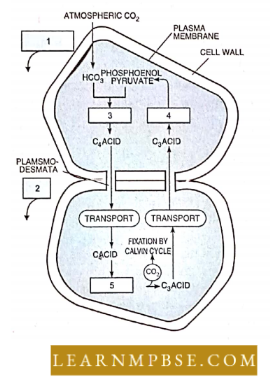
Photosynthesis And Translocation Of Organic Solutes The Hath And Slack Pathway Question 59

  1. 1-Mesophyll cell ; 2-Bundle sheath cell;
    3-Regeneration; 4-Fixation; 5-Decarboxylation.
  2. 1-Bundle sheath cell; 2-Mesophyll cell; 3-Fixation;
    4- Regeneration; 5-Decarboxylation.
  3. 1-Mesophyll cell; 2-Bundle sheath cell; 3-Decarboxylation; 4-Fixation; 5-Regeneration.
    B1 The enzyme responsible for CO, fixation is PEPcase.
  4. 1-Mesophyll cell; 2-Bundle sheath cell; 3- Fixation;
    4-Decarboxylation; 5-Regeneration.

Answer: 4. 1-Mesophyll cell; 2-Bundle sheath cell; 3- Fixation; 4-Decarboxylation; 5-Regeneration.
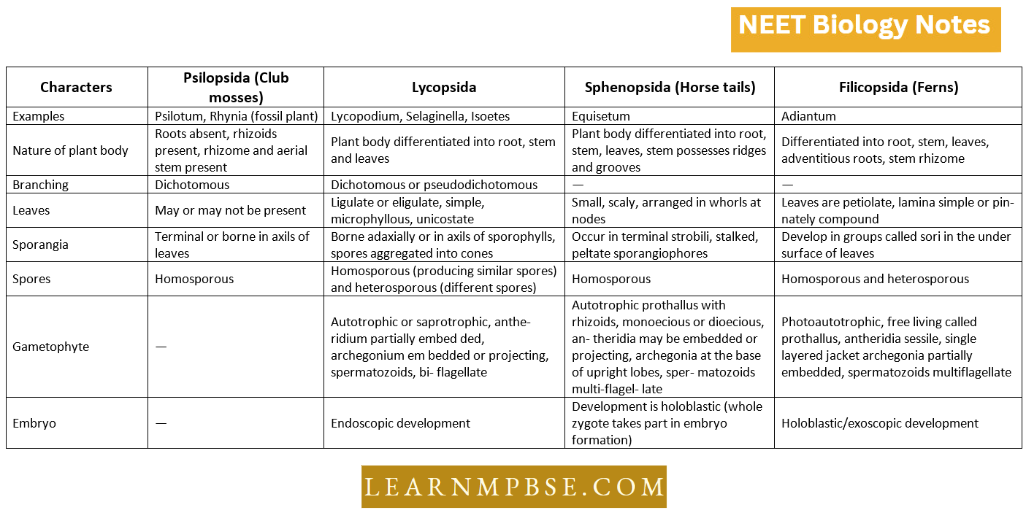
NEET Biology Notes – Pteridophyta

NEET Biology Pteridophyta

  • Pteridophytes. The term Pteridophyta was coined by Haeckel. Pteron (Gk) means a feather and the name Pteridophyta was given to this group because of their pinnate or feather-like fronds. Pteridophytes include about 10,000 species.
  • Ferns are a big group of pteridophyta with 9300 species and some ferns may be 18 metres in height (Giant tree fern).
  • The smallest pteridophyte is Azolla (aquatic fern)

Read and Learn More NEET Biology Notes

Pteridophyta Classification Of Pteridophytes

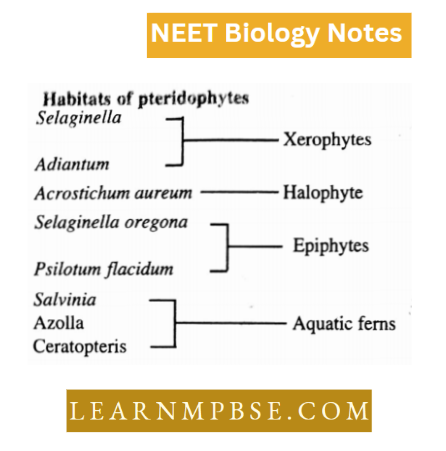
Habitats of pteridophytes

Pteridophyta Habitats Of Pteridophytes

Pteridophyta NEET Notes

Features of pteridophytes

  1. Pteridophytes are assemblages of seedless vascular plants that have successfully invaded the land and reproduce through spores.
  2. Main plant body is sporophyte (2N).
  3. initiated into root, rhizome, and leaves. The latter may be megaphyllous or microphyllous.
  4. Plants show evolution of stele from protostele siphonostelesolenostele dictyostele dictyostele.
  5. Spores are produced in sporangia after meiosis. A group of sporangia occurs in the form of sorus covered with indusium. They may be homosporous (For example ferns) or heterosporous (For example Selaginella).
  6. Gametophytic Generation. Spores on germination form prothallus which is monoecious, bear both antheridia and archegonia.
  7. Sperms and eggs on fertilization form oospores which again start sporophytic generation
  8. The life cycle of Pteridophytes is of Diplohaplontic type i.e. main plant body is sporophyte which alternates with gametophyte. Both generations are morphologically dissimilar. This is also called a heterologous type of alternation of generations.

NEET Biology Pteridophyta Selaginella

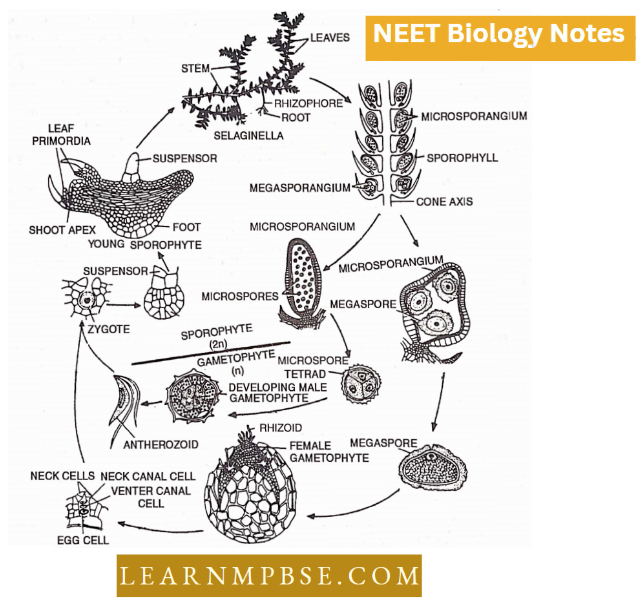
The sporophytic generation of this lycopod has a plant body differentiated into genuine roots, stems, and leaves. The branched stem is typically horizontal and prostrate.

  • Rhizophores extend vertically downward from the branches of the dichotomies. Adventitious roots form when the rhizosphere contacts the soil. The leaves may be uniform or potentially dimorphic.
  • They possess microphyllous and ligulate characteristics. The sporophyte generates spores. Selaginella exhibits heterospory.
  • Spores are generated in sporangia located in the axil of the sporophylls. The sporophylls are clustered at the terminal sections of the branches, forming the strobili.
  • Each strobilus possesses microsporophylls and megasporophylls that are analogous and ligulate.
  • The microsporophylls support the microsporangia, while the megasporophylls support the megasporangia.
  • Each microsporangium and megasporangium possesses a bilayered jacket surrounding a nutritive tissue, the tapetum, which encases the spore mother cells. The majority of microspore mother cells undergo meiosis to produce many microspores.
  • In the megasporangium, typically only one megaspore mother cell remains functional (sometimes 2-3), and after meiosis, it creates four megaspores, of which commonly one to three are nonfunctional. In S. motorsport, only a single megaspore is operational.

Plant Kingdom Pteridophyta NEET

  • The developing spores are provided with nourishment by the remaining megaspore mother cells that endure degeneration
  • The megasporangium assumes a lobed aspect as a consequence of the megaspores’ expansion. The spores are expelled through the dehiscence of the wall, which is divided into two halves by a vertical apical incision.
  • The gametophytes. The spores are the initial cells of the gametophytic generation. The gametophyte’s growth is precocious and begins in the sporangia.


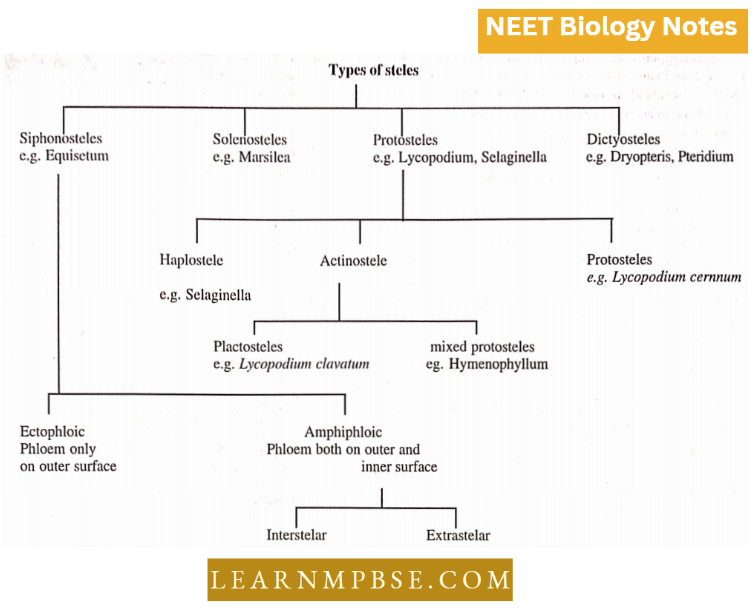
Pteridophyta Types of Steles

Modifications of siphonostctc

  1. Cladosiphonic siphonostele. A siphonostele not perforated by leaf gaps Example a few species of Selaginella.
  2. Phyllosiphonic siphonostele. A siphonostele perforated by leaf gaps- Example Nephrolepis.
  3. Solenostele. A siphonostele perforated by leaf gaps which are scattered but not overlapping Example Ferns.
  4. Dictyostele. A siphonostele perforated by several overlapping leaf gaps. Each separate strand is called a meri stele Example Dryopteris, Pteridium, Pteris, etc.
  5. Polycyclic dictyostele. A dictyostele consisting of two or more concentric rings of meristeles Example Pteridium aquilinum.
  6. Eustele. Much dissected siphonostele having vascular strands separated apart by parenchyma Example Equisetum.
  7. Polysetelic condition. Presence of more than one stele Example Selaginella kraussiana.

Pteridophyta Sporangium On Basis Of Development

The microspores are orange-red, tetrahedral, with a two-layered wall and tri-radiate.

Their nucleus divides by mitosis to form male gametophytes within their wall. Their liberation is generally withheld upto the 13-celled stage.

At this stage, they contain 1 urothelial cell, 8 jacket cells, and 4 androgenic cells. The four androgenic cells divide to form the antherozoid mother cells and astrocytes and ultimately 256 antherozoids are formed.

Each antherozoid is biciliate and liberated by the rupturing of the exine. They swim about freely in search of a female gametophyte or if developed within the sporangium they may be carried along with the raindrops.

The megaspores are large, white to pale green, tetrahedral, and tri-radiate.

They may be shed before any trace of a cellular organization or shortly after the first archegonia are formed or may be retained until after fertilization and a considerable development of the embryo.

Pteridophyta Selaginella Life Cycle

The germinating megaspore enlarges considerably followed by free-nuclear division eventually giving rise to a massive multicellular megagametophyte or female gametophyte tissue. A part of the tissue of the gametophyte gets exposed.

The exposed region may contain chlorophyll and even rhizoids. Several archegonia develop from the superficial cells of this tissue along with clusters of rhizoids.

The mature archegonia have a neck of two tiers of cells each, enclosing a neck canal cell and venter enclosing a ventral canal cell and an egg. At maturity, the neck and venter canal cells disintegrate exposing the egg to be fertilized.

Characteristics Of Pteridophyta NEET

Fertilization of the egg by the antherozoids results in the formation of the zygote or oospore.

Apogamy and parthenogenesis are known in several species.

The young Sporophyte. Following fertilization, the resulting zygote secretes a wall and divides and redivides to form the embryo. The embryo pushes its way into the tissues of the gametophyte by its suspensor.

It is differentiated into a stem apex, two leaf primordia with their ligules at one end, and the rhizosphere at the opposite end. Situated between them is the foot. This juvenile sporophyte ultimately matures into a sporophyte of Selaginella.

NEET Biology Pteridophyta Life Cycle Of Dryopteris

It belongs to the division Pteropsida, Class Filicineae, order Filicales, and family Polypodiaceae.

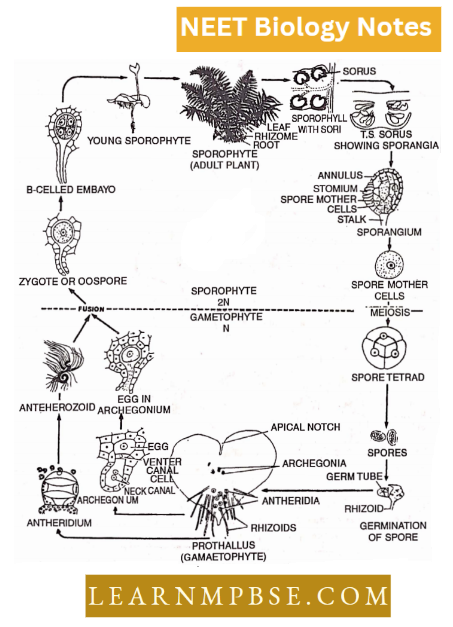
The plant body is sporophytic and the mature sporophyte contains roots, rhizomes, and leaves.

Roots are adventitious. The rhizome is well-branched and remains covered with several fine hairs called ramenta. Leaves are circinately coiled, when young. Mature leaves are very large and bipinnately compound.

Internally, the roots are ditch and exarch.

Pteridophyta Dryopteris Life cycle

  1. Internally, the rhizome contains a dictyostele. Each dictyostele is made up of meristeles. Companion cells are absent in the phloem and the xylem is devoid of vessels.
  2. The stele is horseshoe-shaped in the upper portion of the rachis, while in its lower portion, it is made up of several meristeles.
  3. Spores are present in the sporangium. Several sporangia are grouped in a sorus. Several sori remain attached on the lower surface ofthe leaves, and such leaves are called sporophylls. Sori kidney-shaped bodies. Each sorus remains covered by a layer of indusium.
  4. Each sporangium is a stalked body. The edge contains 16-30, small brown cells called annulus. They possess thickenings on the inner and radial walls. The outer walls remain thin.
  5. A strip of thin-walled cells on each sporangium represents the stomium. The diploid spore mother cells, present inside the sporangium, divide by meiosis, and each forms four haploid spores.
  6. The spore germinates to produce a heart-shaped prothallus or gametophyte. Both the sex organs (antheridia and archegonia) and the rhizoids are present on the ventral surface of the prothallus. Archegonia are present in apical cushion and antheridia are present in rhizoidal region.
  7. Antheridia are present on the lower part of the ventral surface of the prothallus, along with rhizoids. Antherozoids are uninucleate and multiflagellate.
  8. Archegonia are present near the apical notch.
  9. Fertilization takes place in the presence of water. Malic acid is the chemotactic substance present in the archegonium. The zygote develops into a sporophyte without reduction division. The young sporophyte remains attached to the gametophyte for some time.
  10. Plants show heteromorphic alternation of generations.

Economic Importance

  1. Food. Sporocarps of Marsilea are edible. The starchy pith of Angiopteris erecta and Alsophila australis is eaten by the natives of Australia.
  2. Medicines. Rhizomes and petioles of Dryopteris have vermifuge properties. Adiantum roots can cure throat infections.
  3. Its leaves are dried and used as a laxative. Lycopodium is used in the treatment of rheumatism and disorders of the lungs and kidneys. Equisetum arvense is a diuretic while its ash relieves acidity and dyspepsia.
  4. Scrubbing. Equisetum stems have rough and abrasive surfaces. They are used in scrubbing and polishing.
  5. Ornamental value. Some ferns and club mosses are grown indoors as well as in gardens for their graceful foliage.
  • A few characteristics that are responsible for the successful survival of vascular plants are: deep soil penetrating root system.
  • Water-saving methods developed by plants as cuticles on leaves.
  • support to woody plants is provided by collenchyma, sclerenchyma, and by the lignification of wood.
  • they bear a vertical main axis and a conspicuous radial symmetry around the axis. Such construction permits efficient nutrient absorption from all sides around the plant. The pteridophytes were the first plants to develop vascular tissue.
  • Pteridophytes are vascular plants without flowers and seeds.
  • In pteridophytes sporophyte is independent and in bryophytes the sporophyte is dependent.
  • The pteridophytes are the most primitive living (For example Selaginella, Lycopodium, Equisetum) and fossil (For example Rhynia) Vascular plants.
  • The absence of root hair and root cap is a stem-like character of Selaginella rhizophore.
  • They are regarded as organogenesis. Resembles with stem, exogenous origin, adventitious roots, and bear leaves when injured.
  • Calixylon is a fossil pteridophyte from the upper Devonian period with a trunk of 5ft. These heterosporous pteridophytes must have given rise to gymnosperms.
  • Simple sori (primitive) in which all sporangia develop simultaneously.
  • Gradate sori (more advanced): where sporangia develop in basipetal succession or mixed sori (most advanced): where sporangia develop in an irregular sequence.
  • Dryopteris and moss form monoecious gametophytes as all spores are uniform.
  • Suigenesis means neither a root nor a shoot complete but something new.
  • Circinate ptyxis is shown by young leaves that are under the influence of hyponasty and they take two years to open up under the influence of epinasty.

Examples Of Pteridophyta NEET

NEET Biology Pteridophyta Quanta To Memory

  • Haeckel coined the term pteridophyta (vascular cryptogam).
  • Zimmaman (1930) proposed the “Telome theory” for the evolution of vascular plants. He proposed that all vascular plants have evolved from simple dichotomously branched pteridophytes such as Rhynia.
  • Tree fern with upright aerial stem Example Cyathaea, Alsophila.
  • Cyathaea is the tallest fem
  • Rhynia is a fossil plant placed under Psilophytales.
  • Salvinia , Azolla and Marsilea are water ferns.
  • Spores are usually all alike ( i.e. Homosporous) Example Lycopodium, Pteris, Adiantum, Pteridium, etc. or they are of two different sizes (i.e., Heterosporous) Example Selaginella, isolates, Marsilea, Azolla, Salvinia etc.
  • Dryopteris is homosporous and Selaginella is heterosporous
  • Sporangia are usually borne on or in the axil of leaves
    called sporophylls. Examples are Lycopodium, Selaginella, and Pteris.
    Nephrolepis, Adiantum, etc. In some aquatic plants
    sporangia are produced within specialized structures called
    sporocarps, for Example, Marsilea, Salvinia, Azolla, Regnellidium,
    Pilularia etc.
  • In pteridophytes or Ferns, the archegonia secrete malic acid which attracts the antherozoids.
  • In pteridophytes ovules are absent. Selaginella and fem both are pteridophytes, so in both ovules are absent.
  • Azolla, a water fem is used as a biofertilizer.
  • Ferns are cultivated as ornamental plants.
  • The embryo is diploid and spores are haploid.
  • In the fem, the neck is small and is having a single neck canal cell with two nuclei.
  • In a fern Example, Pteris or Dryopteris sex organs are produced on the lower side of the prothallus and antheridia are towards the base among the rhizoids.
  • In some ferns, trophopod (a food storage organ formed by large and modified leaf base) has been found, for Example Asplenium, and Dryopterisfragrans.
  • In ferns, spores are produced in sporangia after meiosis in diploid spore mother cells.
  • Precocious Germination. In situ, spores germinate while in sporangium Spike. The collection of sessile sporophyll is called spike.
  • Tapetum is the innermost layer of sporangial jacket. It provides nutrition and degenerates at maturity.
  • Heterosporous pteridophytes like Selaginella and Marsilea always produce dioecious gametophytes because microspores will form male gametophytes and megaspores will form female gametophytes.
  • The bursting point of the fem sporangium is the stomium. It is made up o£ thin walled cells. Due to tension in the annulus, stomium breaks down.
  • In Selaginella, the stele is suspended by unicelled trabeculae.
  • The suigenesis hypothesis of rhizophore was given by Goebel.
  • Ramenta. In ferns, the multicelled, chaffy, and dry scales covering young rhizomes and leaves which prevent desiccation are called ramenta.
  • In ferns, endodermis has characteristic Casparian strip.
  • Stomium: The place from where the capsule opens is called the stomium.
  • Golden fem— Onychium
  • Walking fem = maiden hair fem — Adiantum
  • Male shield fem— Dryopteris
  • In Marsilea [fern] microspore forms 9 celled male gamete
  • There is no annulus in Marsilea.

Life Cycle Of Pteridophytes NEET

  • In ferns, the xylem is mesarch in stem, petiole, and leaves while in roots it is diarchy.
  • A corm-like rhizomorph occurs in isolates.
  • Apospory. Development of gametophyte directly from the vegetative cells of sporophyte without formation of spores. It was first demonstrated by Druery (1884).
  • Apogamy. Development of sporophyte from gametophytic tissue without involving fusion of gametes. It was first observed by Farlow in Pteris and the term apogamy was introduced by de Bary (1978)
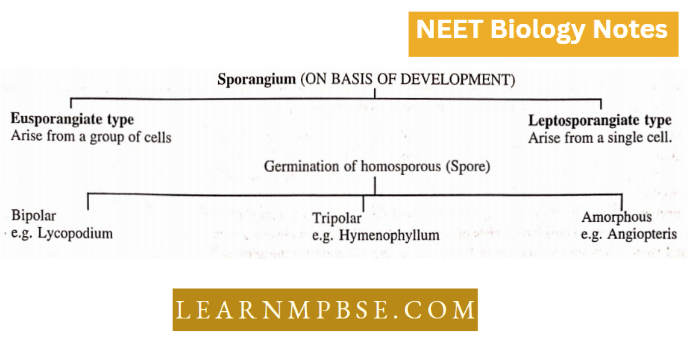
  • Eusporangium. Sporangia spore-producing structures develop from a group of initial cells Example in Psilatum Lycopodium, Equisetum.
  • Leptosporangium. Sporangia originate from a single superficial cell Example in Marsilea, Pteris In some forms eg Polypodium aureum and Drynaria regidula the leaves develop prothalli under dim light but sporophytic buds under strong light.
  • Rhynia was discovered from Rhyncihert Valley in
    Scotland by Mackie (1913).
  • Each leaf of Selaginella bears on its upper surface near its base a small membranous, tongue-like outgrowth ligule.
  • Large greatly vacuolated cells for water absorption are called glossopodium.


NEET Biology Multiple Choice Questions – Pteridophyta

NEET Biology Pteridophyta Multiple Choice Questions

Question 1. Which of the following plant’s arcs is known as vascular cryptogams?

  1. Angiosperms
  2. Bryophytes
  3. Ptcridophytcs
  4. Gymnosperms.

Answer: 3. Ptcridophytcs

Question 2. The gametophytic generation in pteridophytes is commonly called:

  1. Thallus
  2. Plant body
  3. Pro thallus
  4. Protoncma.

Answer: 3. Pro thallus

Question 3. The male sex organs produced by the gametophyte are:

  1. Sporangium
  2. Archegonia
  3. Sorus
  4. Anthcridia.

Answer: 4. Anthcridia.

Read and Learn More NEET Biology Multiple Choice Question and Answers

Question 4. Ferns arc mostly :

  1. Isogamous
  2. Heterosporous
  3. Homosporous
  4. Asexual.

Answer: 3. Homosporous

Question 5. Stele in fern’s rhizome is of mostly :

  1. Siphonostelc
  2. Solenostelc
  3. Dictyostele
  4. All of the above.

Answer: 3. Dictyostele

Pteridophyta MCQs For NEET

Question 6. Stele is defined as:

  1. At the xylem elements of the vascular bundle
  2. The cortex portion of the stem
  3. Phloem of the vascular elements
  4. Vascular tissue surrounded by pericycle and endodermis.

Answer: 4. Vascular tissue surrounded by pericycle and endodermis.

Question 7. The sac-like structure in which spores are enclosed in

  1. Strobilus
  2. Sorus
  3. Sporangium
  4. Sporangiophere

Answer: 3. Sporangium

Question 8. Some of the pteridophytes and gymnosperms the sporophyll aggregate at the apices of the main stem or its branches to form definite compact structures. The compact structures are called:

  1. Sporangiophore
  2. Sorus
  3. Sporangium
  4. Strobilus or cone.

Answer: 4. Strobilus or cone.

Question 9. The condition where a pteridophyte produces two kinds of spores and sporangia is termed as :

  1. Homospory
  2. Homothallism
  3. Heterospory
  4. Apospory.

Answer: 3. Heterospory

Question 10. Pteridophytes are characterized by :

  1. Presence of a vascular system
  2. Absence of flowers
  3. Absence of fruits
  4. All the above.

Answer: 4. All the above.

Pteridophyta MCQs For NEET

Question 11. The main plant body of pteridophyte is :

  1. Gametophyte
  2. Sporophyte
  3. Sporangium
  4. Prothallus.

Answer: 2. Sporophyte

Question 12. Fem differs from selaginella by one of the following:

  1. Absence of heterosporous form
  2. In rhizoids
  3. In the arrangement of leaves
  4. All the above.

Answer: 1. Absence of heterosporous form

Question 13. The prothallus represents :

  1. Gametophyte of fem
  2. Sporophyte of angiosperm
  3. Sporophyte of gymnosperm
  4. Sporophyte of fem.

Answer: 1. Gametophyte of fem

Question 14. Pteridophytes differ from bryophytes in :

  1. Having motile sperms
  2. Having vascular tissues
  3. Archegonia
  4. Alternation of generations.

Answer: 2. Having vascular tissues

Question 15. Adaxial outgrowth from the base of leaves in selaginella is called:

  1. Stipule
  2. Ligule
  3. Trabeculae
  4. Velum.

Answer: 2. Ligule

Question 16. The function of ligule is :

  1. Hygroscopic
  2. Permutation
  3. Reproduction
  4. All the above.

Answer: 1. Hygroscopic

Question 17. Rhizophore of selaginella is :

  1. Phototropic
  2. Phototactic
  3. Gcotropic
  4. Hygroscopic.

Answer: 3. Gcotropic

Question 18. Selaginella is characterized by the presence of:

  1. Homospory
  2. Ligule
  3. Flower
  4. None of the above.

Answer: 2. Ligule

Question 19. Rhizophore positive geotropic structure of selaginella is :

  1. Root
  2. Stem
  3. A new organ called subgenres
  4. None of the above.

Answer: 3. A new organ called subgenres

Question 20. The dominant generation in selaginella is :

  1. Haploid
  2. Gametophyte
  3. Triploid
  4. Diploid.

Answer: 4. Diploid.

Question 21. When a spore germinates within a sporangium, it is called :

  1. Precocious
  2. Epigeal
  3. Heteroecious
  4. Hypogeal.

Answer: 1. Precocious

Pteridophyta MCQs For NEET

Question 22. One character common for selaginella and fem is :

  1. Heterospory
  2. Protostele
  3. Development of sporangium
  4. Absence of ovule.

Answer: 4. Absence of ovule.

Question 23. Microsporangia and megasporangia are found in same strobilus in :

  1. Fem
  2. Selaginella
  3. Pinus
  4. Moss.

Answer: 2. Selaginella

Question 24. Heterospory is the production of :

  1. Sexual and asexual spores
  2. Mega and microspores
  3. Haploid and diploid spores
  4. Haploid and tetraploid spores.

Answer: 2. Mega and microspores

Question 25. Prothallus of dryopteris is :

  1. Haploid
  2. Diploid
  3. Triploid
  4. Tetraploid.

Answer: 1. Haploid

MCQs on Pteridophyta Question 26. Rhizophore in selaginella is :

  1. Exogenous in origin
  2. Endogenous in origin
  3. Internal in origin
  4. None of the above.

Answer: 1. Exogenous in origin

Question 27. The number of megaspores in Selaginella rupestris is:

  1. One
  2. Two
  3. Three
  4. Four.

Answer: 1. One

Question 28. Selaginella differs from moss in having:

  1. Well-developed vascular system
  2. Motile sperms
  3. An independent gametophyte
  4. Both a and c.

Answer: 1. Well-developed vascular system

Question 29. Development of embryo in selaginella is :

  1. Meroblastic
  2. Holoblastic
  3. Aposporous
  4. None of the above.

Answer: 1. Meroblastic

Question 30. In selaginella, male gametes are :

  1. Monoflagellated
  2. Biflagellated
  3. Multiflagellated
  4. Aflagellate.

Answer: 2. Biflagellated

Pteridophyta MCQs For NEET

Question 31. Gametangia of fern are produced on :

  1. Leaves
  2. Sorus
  3. Prothallius
  4. Ramcntn.

Answer: 3. Prothallius

Question 32. Mciistclos a found in:

  1. Stem of cycas
  2. Needle of pinus
  3. Leaf of patterns ferm
  4. Rhizome of fern

Answer: 4. Rhizome of fern

Question 33. According to available loss iris which of the following went to install hand vascular 

  1. Psilopliv tales
  2. Lycopods
  3. Horse-tail
  4. Cycas

Answer: 1. Psilopliv tales

MCQs on Pteridophyta Question 34. Sporangia and spore-bearing leaf in fem is called a

  1. Ramentum
  2. Sorus
  3. Lndusium
  4. Sporophyll.

Answer: 4. Sporophyll.

Question 35. Which of the following is not heterosporous?

  1. Dryopteris
  2. Selaginella
  3. Marsilea
  4. Pinus.

Answer: 1. Dryopteris

Question 36. The annulus of the sporangium of the ferns assists in the spore dispersal by:

  1. Losing water from its cells
  2. Taking up water from the air
  3. Collapsing in the face of strong wind
  4. Losing the air of its cells.

Answer: 1. Losing water from its cells

Question 37. In many ferns, spore dissemination is affected by

  1. Annulus
  2. Lndusium
  3. Tapetum
  4. Soms.

Answer: 1. Annulus

NEET Biology Plant Kingdom MCQs

Question 38. Actinostele is related to :

  1. Dictyostele
  2. Protostele
  3. Siphonostele
  4. Solenostele.

Answer: 2. Protostele

Question 39. The tallest pteridophyte is :

  1. Equisetum
  2. Cyathaea
  3. Dryopteris
  4. Lycopodium.

Answer: 2. Cyathaea

Question 40. Gametophyte of fem is known as :

  1. Protonema
  2. Germling
  3. Prothallus
  4. Capsule.

Answer: 3. Prothallus

Question 41. Two distinct generations in a single life history are common in :

  1. Bacillus
  2. Mango
  3. Pteris
  4. Spirogyra.

Answer: 3. Pteris

Question 42. A stele without a central pith is called :

  1. Solenostele
  2. Protostele
  3. Dictyostele
  4. Siphonostele.

Answer: 4. Siphonostele.

Question 43. Multiflagellate antherozoids are found in :

  1. Spirogyra
  2. Ulothrix
  3. Funaria
  4. Dryopteris.

Answer: 4. Dryopteris.

Question 44. Vessels are absent in :

  1. Spirogyra and ulothrix
  2. Rhizopus and funeral
  3. Dryopteris and cycas
  4. All the above.

Answer: 4. All the above.

Question 45. Eed habit originated in :

  1. Pteridophytes
  2. Gymnosperms
  3. Angiosperms
  4. None of the above.

Answer: 1. Pteridophytes

Question 46. The leaves in ferns show :

  1. Hypostomatic condition
  2. Presence of sori on the ventral surface
  3. Circinate ptyxis
  4. All the above.

Answer: 4. All the above.

Question 47. Pteris and cycas resemble each other in the presence of:

  1. Cambium
  2. Vessels
  3. Ciliated sperms
  4. Seeds.

Answer: 3. Ciliated sperms

Question 48. Which of the following is a fossil pteridophyte?

  1. Lycopodium
  2. Selaginella
  3. Psilotum
  4. Rhynia.

Answer: 2. Selaginella

NEET Biology Plant Kingdom MCQs

Question 49. In Dryopteris, antherozoids are :

  1. Coiled and multi-flagellate
  2. Coilet,l and hi flagellate
  3. Sickle-shaped and multi-flagellate
  4. Sickle-shaped and hi flagellate

Answer: 1. Coiled and multi flagellate

Question 50. In pteridophytes. The reduction division occurs, when:

  1. Spores are formed
  2. Gametes are formed
  3. Prothallus is formed
  4. Sex organs are formed.

Answer: 1. Spores are formed

Question 51. Ramenta are found in

  1. Fern
  2. Mosses
  3. Maize
  4. Dicots

Answer: 1. Fern

Question 52. Lycopodium is :

  1. Isogamous
  2. Homosporous
  3. Heterosporous
  4. Heterogamous

Answer: 2. Homosporous

Question 53. Which of the following pteridophytes shows die chloroplast having pyrenoids :

  1. Equisetum
  2. Selaginella
  3. Pteridium
  4. Marsilea.

Answer: 2. Selaginella

Question 54. Heterospory and seed habit are often discussed about a structure called :

  1. Spathe
  2. Bract
  3. Petiole
  4. Ligule.

Answer: 4. Ligule.

NEET Biology Plant Kingdom MCQs

Question 55. The opening mechanism of sporangium in dryopteris is effectively operated by :

  1. Annulus only
  2. Stomium only
  3. Annulus and stomium both
  4. Apical opening.

Answer: 3. Annulus and stomium both

Question 56. Which of the following has amphiphloic siphonostele?

  1. Rhizome of marsilea
  2. Stem of lycopodium
  3. Rhizome of pteris
  4. Stem of equisetum.

Answer: 1. Rhizome of Marsilea

Pteridophyta vs Bryophyta MCQs

Question 57. Which one of the following is common to pteridophytes and bryophytes?

  1. Dependent gametophyte on sporophyte
  2. Sporophyte dependent on gametophyte
  3. Multicelled sex organs with sterile jacket wall
  4. Absence of sporophyte.

Answer: 3. Multicelled sex organs with sterile jacket wall

Question 58. While entering the neck of an archegonium in fem, sperms show:

  1. Phototaxy
  2. Chemotaxis
  3. Themiotaxy
  4. Cyclosis.

Answer: 2. Chemotaxy

Question 59. 200-Million years ago, the dominant flora of die earth was of:

  1. Archaebacteria
  2. Mosses and ferns
  3. Gymnosperms
  4. Angiosperms.

Answer: 3. Gymnosperms

Question 60. “Maidenhair fem” is:

  1. Dryopteris
  2. Azolla
  3. Adiantum
  4. Pteris.

Answer: 3. Adiantum

Best MCQs For NEET Biology

Question 61. chlorophyll or chloroplast is present in spores of

  1. Lycopodium
  2. Selaginella
  3. Dryopteris
  4. Marsilea.

Answer: 1. Lycopodium

Question 62. The process by which an embryo develops without involving gametic fusion is called :

  1. Apospory
  2. Syngamy
  3. Apogamy
  4. Isogamy.

Answer: 3. Apogamy

NEET Biology Multiple Choice Questions – Plant Kingdom Bryophyta

NEET Biology Plant Kingdom Bryophyta Multiple Choice Questions

Question 1. The proponent of moss resembles the green alga. It differs from green alga in having:

  1. Buds
  2. Colourlcss rhizoids
  3. Oblique sepia and discoid chloroplast
  4. All of the above.

Answer: 4. All of the above.

Question 2. Sex organs in funerals develop :

  1. At The axils of leaves
  2. At the lip of the gametophore
  3. In the protonema
  4. Inside the capsule.

Answer: 2. At the lip of gametophore

Question 3. The green upright sterile hair-like structure among antheridia of funeral are known as :

  1. Apophysis
  2. Perigonial teeth
  3. Trabeculae
  4. Paraphyses.

Answer: 4. Paraphyses.

Question 4. A bryophyte of considerable economic importance is :

  1. Marchantia
  2. Riccia
  3. Funaria
  4. Sphagnum.

Answer: 4. Sphagnum.

Bryophyta MCQs For NEET

Question 5. In funaria meiosis occurs :

  1. At the time of spore formation
  2. When the nucleus of the zygote divides
  3. At the time of the formation of Sperms
  4. At the time of egg formation.

Answer: 1. At the time of spore formation

Read and Learn More NEET Biology Multiple Choice Question and Answers

Question 6. Anchorage organs of the funeral are :

  1. Unicellular rhizoids
  2. Adventitious roots
  3. Multicellular rhizoids
  4. True roots.

Answer: 3. Multicellular rhizoids

Question 7. Which one of the following is absent in the sporophyte of the funeral?

  1. Foot
  2. Seta
  3. Elaters
  4. Columella.

Answer: 3. Elaters

Question 8. Apophysis is :

  1. Part of peristome of funaria
  2. Sterile filaments among antheridia of moss
  3. Terminal part of sporophylls of Pteris
  4. The lower portion of the moss capsule.

Answer: 4. Lower portion of moss capsule.

Question 9. In the funeral, intermingled with the archegonia are present upright hairs called :

  1. Scales
  2. Rhizoids
  3. Paraphysis
  4. Periphyses.

Answer: 3. Paraphysis

Bryophyta MCQs For NEET

Question 10. Which of the following is a diploid?

  1. Capsule of moss
  2. Gametophyte, archegonia, and egg of moss
  3. Gamclophyte, antheridia, and sperm of moss
  4. Gametophyte and spore of moss.

Answer: 1. Capsule of moss

Question 11. Which of the following is not associated with moss capsules?

  1. Trabeculae
  2. Peristome
  3. Columella
  4. Stomium.

Answer: 4. Stomium.

Question 12. The function of the peristome in moss is

  1. Spore dispersal
  2. Nutritive
  3. Protective
  4. Absorption of water and mineral,

Answer: 1. Spore dispersal

Question 13. In which of the following sporophytes remains attached to gametophytes?

  1. Fungi
  2. Gymnosperms
  3. Algae
  4. Bryophytes

Answer: 4. Bryophytcs

Question 14. The function of craters is :

  1. Absorption of food
  2. Conduction of sap
  3. Spore dispersal
  4. To provide support.

Answer: 3. Spore dispersal

Bryophyta MCQs For NEET

Question 15. A bryophyte differs from pteridophyte in:

  1. Archegonia
  2. Lack of vascular tissue
  3. Antheridia
  4. Sperms

Answer: 2. Lack of vascular tissue

Question 16. Development of sporophyte from gametophyte cells without fertilization is called :

  1. Apospory
  2. Apogamy
  3. Parthenogenesis
  4. Syngamy.

Answer: 2. Apogamy

Question 17. In bryophytes, diploid chromosome number occurs in :

  1. Spore mother cell
  2. Gametes
  3. Sperms
  4. Meiospores.

Answer: 1. Spore mother cell

Question 18. Gemmae are vegetative reproductive structures found in:

  1. Angiosperms
  2. Bryophytes
  3. Algae
  4. Gymnosperms.

Answer: 2. Bryophytes

Question 19. Which bryophyte has simplest sporophyte :

  1. Riccia
  2. Marchantia
  3. Anthoceros
  4. Funaria.

Answer: 1. Riccia

Plant Kingdom MCQs NEET

Question 20. Female sex organ in riccia and funaria is called:

  1. Paraphysis
  2. Oospore
  3. Archegonium
  4. Artheridium.

Answer: 3. Archegonium

Question 21. When gametophyte develops from sporophyte without the production of spores it is called:

  1. Apogamy
  2. Parthenogenesis
  3. Apospory
  4. Sporogenesis.

Answer: 3. Apospory

Question 22. At the funeral leaves are arranged on the stem :

  1. Oppositely
  2. Spirally
  3. Opposite and decussate
  4. None of the above.

Answer: 2. Spirally

Question 23. The development of a sporophyte directly from the unfertilized egg is called :

  1. Apospory
  2. Parthenogenesis
  3. Apogamy
  4. Syngamy.

Answer: 2. Parthenogenesis

Plant Kingdom MCQs NEET

Question 24. In funaria, annulus separates:

  1. Apophysis and theca
  2. Theca and operculum
  3. Columella and apophysis
  4. Opercuium and apophysis

Answer: 2. Theca and operculum

Question 25. The gametophyte produced by apospory is

  1. Haploid
  2. Triploid
  3. Polypolid
  4. Diploid

Answer: 4. Diploid

Question 26. Funana is a bryophyte because it :

  1. Has no true roots and stems
  2. Has sporophyte attached to the gametophyte
  3. Is non-vascular
  4. All the above.

Answer: 4. All the above.

Question 27. In funeral :

  1. Outer peristome teeth are hygroscopic than the inner teeth
  2. Both types of teeth are hygroscopic
  3. Inner teeth are responsible for the dispersal
  4. Outer teeth are diploid and inner haploid.

Answer: 1. Outer peristome teeth are more hygroscopic than the inner teeth

Question 28. In bryophytes, anlherozoids are :

  1. Biflagellate
  2. Multi flagellate
  3. Sometimes biflagellate and sometimes multiplayer- late
  4. Biflagellate in a few species and multiflagellate in the rest.

Answer: 1. Biflagellate

NEET Important Questions On Bryophyta

Question 29. In mosses:

  1. Gametophyte is independent of sporophyte
  2. Sporophytes are partly dependent on gametophyte
  3. Both 1 and 2
  4. None of the above.

Answer: 3. Sporophyte is partly dependent on gametophyte

Question 30. Funaria may be differentiated from pinus by the character:

  1. No fruits are produced
  2. No seeds are produced
  3. Antheridia and archegonia are present
  4. Presence of sporophyte.

Answer: 2. No seeds are produced

Question 31. Spores of funaria give rise to :

  1. Prothallus
  2. Sporophyte
  3. Protonema
  4. Gametophyte.

Answer: 3. Protonema

NEET Important Questions On Bryophyta

Question 32. Protonema is a stage in the life history of:

  1. Cycas
  2. Funaria
  3. Riccia
  4. Angiosperm.

Answer: 2. Funaria

Question 33. Gametophytic generation is dominant in:

  1. Angiosperm
  2. Gymnosperm
  3. Pteridophyta
  4. Bryophyta.

Answer: 4. Bryophyta.

Question 34. In funaria stomata occur :

  1. In the epidermis of the stem
  2. In the capsule epidermis
  3. In the leaf epidermis
  4. All the above.

Answer: 2. All the above.

Question 35. Conducting tissue of moss is made of :

  1. Xylem and phloem
  2. Parenchyma
  3. Collenchyma
  4. Xylem.

Answer: 2. Parenchyma

Question 36. The apophysis region of the capsule is concerned with :

  1. Photosynthesis
  2. Formation of spores
  3. Dispersal of spores
  4. Retention of moisture.

Answer: 1. Photosynthesis

Question 37. Protonema of funaria is:

  1. Tlialloid
  2. Foliose
  3. Filamentous
  4. Cruslaccous.

Answer: 3. Filumentous

Bryophyta vs Pteridophyta MCQs

Question 38. The green photosynthetic region of the capsule is called :

  1. Paralysis
  2. Apophysis
  3. Pcrigonial leaves
  4. Trabeculae.

Answer: 2. Apophysis

Question 39. In funaria the leaves which surround the antheridia! Cluster arc called :

  1. Perichaetial leaves
  2. Foliage leaves
  3. Scale leaves
  4. Perigonial leaves.

Answer: 4. Perigonial leaves.

Question 40. At the funeral, the leaves surrounding the archegonial cluster are called:

  1. Perichaetial leaves
  2. Perigonial leaves
  3. Acicular leaves
  4. Foliage leaves.

Answer: 1. Perichaetial leaves

Question 41. One character common in Funeral and Dryopteris is:

  1. Stele is protostele
  2. Heterosporous sporophyte
  3. Monoecious gametophyte
  4. Dioecious gametophyte.

Answer: 3. Monoecious gametophyte

Question 42. In funeral, rhizoids arise from :

  1. Basal region
  2. Apical region
  3. Dorsal region
  4. Ventral region.

Answer: 1. Basal region

Bryophyta vs Pteridophyta MCQs

Question 43. The evidence for the aquatic origin of bryophytes is :

  1. Ciliated sperms
  2. Green colour
  3. Protonema thread
  4. Some are still aquatic.

Answer: 1. Ciliated sperms

Question 44. Spores in a funeral are:

  1. Three layered
  2. Two layered
  3. Four layered
  4. None of the above.

Answer: 2. Two layered

Question 45. Mosses show :

  1. Isomorphic alternation of generations
  2. Heteromorphic alternation of generations
  3. Haplobiontic life cycle
  4. None of the above.

Answer: 2. Heteromorphic alternation of generations

Question 46. Funaria is similar to cycas in the character :

  1. Fruits are produced
  2. No seeds are produced
  3. Antheridia and archegonia are present
  4. A pollen tube is present.

Answer: 3. Antheridia and archegonia are present

Question 47. The body of the funeral is :

  1. Simple rosette thallus
  2. Differentiated into root, central axis, and leaves
  3. Differentiated into rhizoids, stems, and leaves
  4. None of the above.

Answer: 3. Differentiated into rhizoids, stem and leaves

Best MCQs For NEET Biology

Question 48. Annulus in funaria capsule separates :

  1. Operculum from columella
  2. Theca from columella
  3. Operculum from theca
  4. Olumclla from apophysis.

Answer: 3. Operculum from theca

Question 40. Antherozoids of Marchantia are :

  1. Short, curved, and biflagellate
  2. Short, straight and multi-flagellate
  3. Long, straight, and biflagellate
  4. Long. Curved and biflagellate.

Answer: 1. Short, curved, and biflagellate

Question 50. Antheridium in a funeral is :

  1. Pear-shaped
  2. Club-shaped
  3. Flask-shaped
  4. Spherical.

Answer: 2. Club-shaped

Question 51. The sporophyte of a funeral is composed of:

  1. Capsule only
  2. Spore sacs and spores
  3. Foot and capsule
  4. Foot, seta, and capsule.

Answer: 4. Foot, seta, and capsule.

Question 52. Peristome in funaria constitute :

  1. 16 Teeth
  2. 16 + 16 Teeth
  3. 32+16 Teeth
  4. 16 + 32 Teeth.

Answer: 2. 16 + 16 Teeth

Best MCQs For NEET Biology

Question 53. The central middle part of the moss capsule is sterile and is called:

  1. Apophysis
  2. Operculum
  3. Columella
  4. Spore sacs.

Answer: 3. Columella

Question 54. The mode of nutrition of sporophyte of moss is :

  1. Parasitic
  2. Autotrophic
  3. Saprophytic
  4. Semi-parasitic.

Answer: 4. Semi-parasitic.

Question 55. The producing part in the capsule is :

  1. Columella
  2. Operculum
  3. Spore sac
  4. Apophysis.

Answer: 3. Spore sac

Question 56. Funaria gametophyte is :

  1. Dioecious
  2. Monoecious and autoecious
  3. Monoecious
  4. Heterothallic.

Answer: 2. Monoecious and autoecious

Question 57. Calyptra develops from :

  1. Neck of archegonium
  2. Venter wall of archegonium
  3. Paraphysis
  4. An outgrowth of the gametophyte.

Answer: 2. Venter wall of archegonium

Question 58. Anlheridia intermixed with paraphysis arc seen in:

  1. Marchantia
  2. Funaria
  3. Riccia
  4. Anthoceros.

Answer: 2. Funaria

Question 59. Primary protonema of moss is :

  1. Haploid
  2. Diploid
  3. Sporophyte
  4. Triploid.

Answer: 1. Haploid

Best MCQs For NEET Biology

Question 60. The center of the moss axis is occupied by :

  1. Xylem
  2. Phloem
  3. Pith
  4. Conducting tissue.

Answer: 4. Conducting tissue.

Question 61. In riccia, the archegonium is :

  1. Rounded
  2. Cup-shaped
  3. Star-shaped
  4. Flask-shaped.

Answer: 4. Flask-shaped.

Question 62. In most, antheridia and archegonia occur at the tips of two different branches of the same plant. The condition is called :

  1. Monoecious and autoecious
  2. Monoecious and paroecious
  3. Monoecious and synoecious
  4. Dioecious.

Answer: 1. Monoecious and autoecious

Question 63. The leafy gametophore is developed from protonema in :

  1. Riccia
  2. Marchantia
  3. Funaria
  4. Anthoceros.

Answer: 3. Funaria

Question 64. Spore mother cells in the funeral are :

  1. Haploid
  2. Tetraploid
  3. Diploid
  4. Triploid.

Answer: 3. Diploid

Question 65. In archegonium the cell above the egg cell is called :

  1. Neck canal cell
  2. Neck cell
  3. Venter canal cell
  4. Cover cell.

Answer: 3. Venter canal cell

Question 66. In the funeral, the spore germinates to produce :

  1. Prothallus
  2. Protonema
  3. Proembryo
  4. Embryo.

Answer: 2. Protonema

Question 67. The tallest moss in the world is :

  1. Funaria
  2. Pogonatum
  3. Polytrichuni
  4. Dawsonia.

Answer: 4. Dawsonia.

NEET Biology Notes – Plant Kingdom Bryophyta

NEET Biology Plant Kingdom Bryophyta Characters

Bryophyla Gk. Bryon = moss +pliyton = plants are also called “Amphibious plants or kingdom Plantae”.

Tlicse are liverworts, mosses, and hornworts which collectively constitute a group of vascular plants. About 25,000 species of liverworts and mosses are known.

  1. The plants represent two morphologically distinct generations i.e. gametophytic and sporophytic.
  2. The gametophytic phase is the dominant phase of the cycle and in general plant body term is used for this phase.
  3. The plant body in primitive forms like Riccia and Marchantia is thalloid but mosses like Funaria. it may be differentiated into rhizoids, stems, and leaves.
  4. The thalli of Riccia and Marchantia are attached to the substratum by unicellular, unbranched rhizoids, which may be smooth-walled or tuberculated but in mosses like Funaria, rhizoids are branched, multicellular, and obliquely septate.
  5. The plant body is made up of simple thin-walled parenchymatous cells. The xylem, phloem (vascular tissue), and mechanical tissue (sclerenchyma, etc.) are altogether lacking in bryophytes.
  6. Bryophytes are found in moist places due to the following reasons:
  7. In the absence of true roots, cells can absorb water directly from the ground or atmosphere.
  8. Biflagellate sperms of bryophytes need water for their movement to reach
    the archegonium (female sex organ) for fertilization.
  9. Mosses seldom reach heights. Funaria is 1-3 cm in height. They rarely grow more than 15 cm in height. The tallest species of Moss has been reported from New Zealand having a size of 60 cm.
  10. Vegetative propagation. They have a very good power of regeneration.
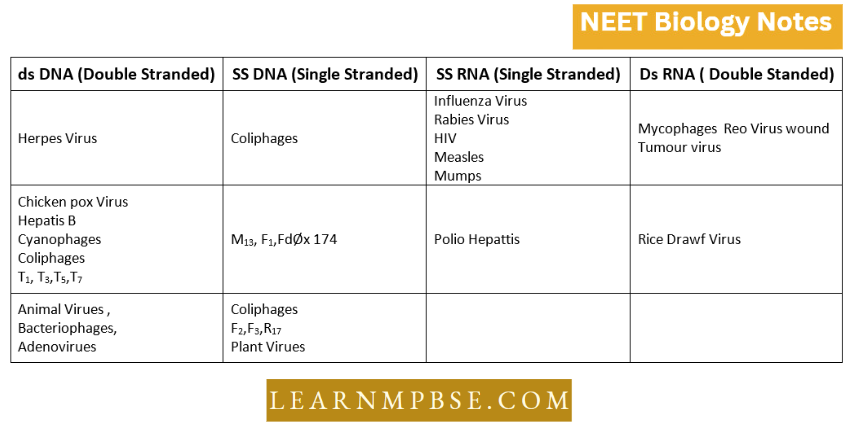
  11. Sexual reproduction. Bryophytes have evolved a life cycle that comprises two phases gametophyte (IN) and sporophyte (2N). The conspicuous stage in the life cycle is gametophyte which may be thallus, liver-like as in liverworts, or leafy as in mosses.

Read and Learn More NEET Biology Notes

Bryophyta NEET Notes

Vegetative reproduction occurs by:

  1. Progressive death and decay of thallus
  2. Adventitious buds
  3. Persistent apices
  4. Tubers
  5. Gemmae
  6. Bulbils
  7. Protonema

Gametophytes

  1. At maturity, the gametophytes are nutritionally independent, while sporophytes are dependent upon as well as being permanently attached to gametophytes.
  2. Bryophytes reproduce vegetatively by tubers, gemmae, fragmentation, etc.
  3. The male sex organ is called the antheridium.
  4. Antheridium is made up of a mass of astrocytes enclosed by the sterile jacket.
  5. Each astrocyte gives rise to biflagellate sperms (male gamete).
  6. Sexual reproduction is of the oogamous type
  7. The female sex organ is called archegonium.
  8. Each archegonium is a multicellular flask-shaped structure. Its lower dilated, swollen part is called the venter and its slender, elongated upper part is called the neck.
  9. Sex organs antheridium and archegonium are multicellular and jacketed.
  10. The venter encloses the egg (female gamete) and venter canal cell. The neck encloses a row of neck canal cells.
  11. The syngamy (fertilization) takes place in water. The sperms swim in the water to reach the archegonium. One of the sperm fuses with an egg to form a diploid zygote.
  12. The zygote undergoes continuous divisions without undergoing any resting period
  13. The developing embryo is retained inside the center, where it finally develops into sporogonium.
  14. The sporophytes (sporogonia) are partially or completely dependent upon gametophytes.
  15. The sporogonium is usually differentiated into foot, seta, and capsule.
  16. In Riccia foot and seta are absent. The capsule is embedded in the thallus. In Riccia even the sex organs are found inside the thallus.
  17. In capsule, meiosis occurs in spore mother cells to form haploid spores.
  18. The spores are homosporous i.e. only of one type- the young gametophyte.
  19. Haploid spores, after dispersal from the capsule, may germinate either directly into gametophytic thallus (Riccia, Marchantia, or may form filamentous protonema which bears adventitious buds to give rise to leafy paint (gametophore)

Bryophyta NEET Study Material

Alternation of generations.

Plant Kingdom-Bryophyta Alternation Of Generations

  1. Bryophytes exhibit a distinct and heteromorphic alternation of generations in which two phases gametophytic and sporophytic follow each other in regular sequences.
  2. The first phase is gametophyte which produces male and female gametes (i.e. antheridium and archegonium).
  3. The sporophyte phase starts immediately after fertilization of egg and sperm with the formation of a diploid zygote.
  4. The zygote forms a diploid multicellular sporogonium which is usually differentiated into foot, seta, and capsule (moss).
  5. Haploid spores are formed after meiosis. Thus spore is the first cell of the gametophytic generation.
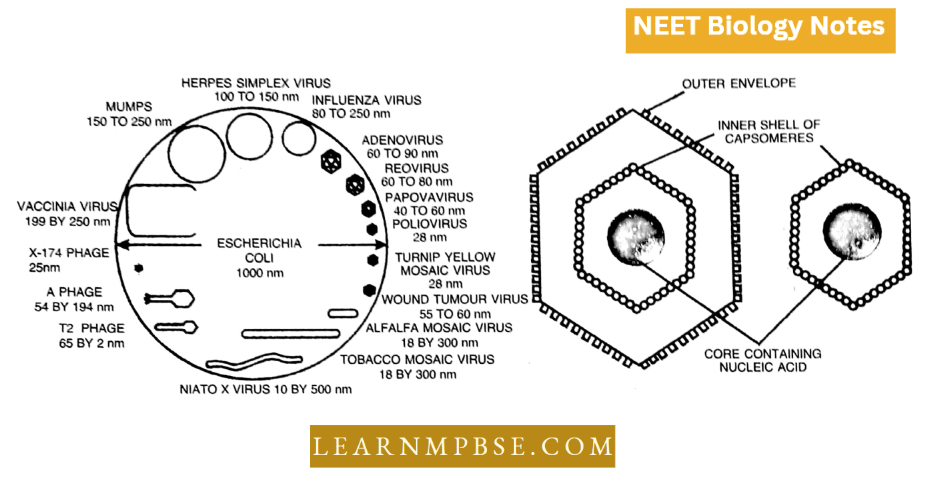
  6. The spore germinates to give rise to the plant body (haploid) directly or after protonema formation.
  7. Because a gametophytic stage alternates with a sporophytic stage, a clear alternation of generations is present which is of a heteromorphic type
  8. Bryophytes are considered more advanced than green algae as they represent a multicellular sporophytic generation.
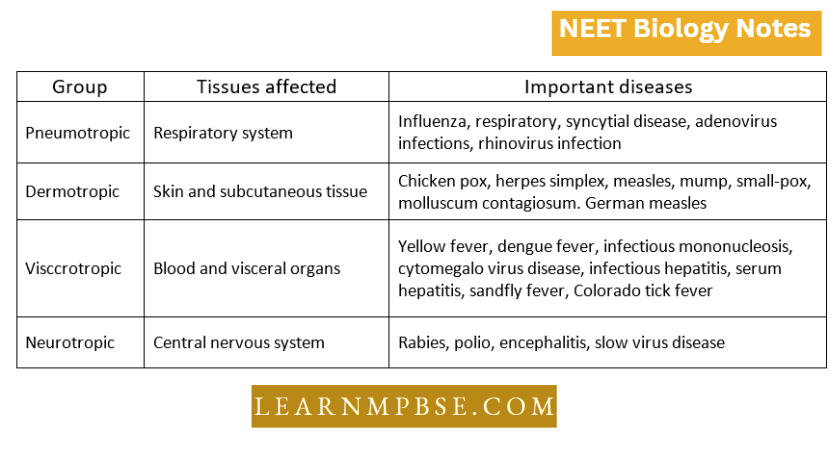
Plant Kingdom-Bryophyta Classification Of Bryophates

NEET Biology Plant Kingdom Bryophyta Funaria

It is a moss located in damp and shaded environments. The primary plant is part of the gametophytic generation, characterized by a leafy gametophore. It originates from the lateral bud of the protonema, which signifies the juvenile stage.

  • The plant possesses rhizoids, cauloid stem-like structures, and phylloid leaf-like structures. Leaves are green and produce food through photosynthesis. The stem has inadequate branching, with lateral branches present.
  • Vegetative reproduction occurs by the fragmentation of leafy gametophores, protonema, and secondary protonema, among other methods. The plant is monoecious, possessing male reproductive organs at the apex of the male branch and female reproductive organs at the apex of the female branch.
  • The male branch tip is enveloped by peritoneal leaves and exhibits a rosette-like morphology. The female branch of Perichaetia exhibits leaves with a bud-like appearance; this aspect is unsightly, as both sexes are located on separate branches.
  • Antheridia are club-shaped and interspersed with green, unbranched filamentous filaments known as paraphysis.
  • A single antheridium produces a substantial quantity of motile, biflagellate, curved-body antherozoids.
  • Archegonia are flask-shaped formations. They also alternate with paraphyses that possess the same structure and function.
  • A solitary archegonium possesses a contorted neck, comprising 6-10 neck canal cells, a distended venter containing a single oosphere, and a venter canal cell.
  • Antherozoids navigate through the water to reach the archegonium, guided chemotactically by sucrose, enter the neck, and fuse their nucleus with the oosphere to form an oospore (2N).

Plant Kingdom Bryophyta NEET

Oospore divides mitotically to produce sporogonium having foot, seta, and capsule. 1 Capsule has apophysis, theca, and operculum.

  • Sporogonium has green cells so it is partially Aa—1 dependent on the gametophyte.
  • The spore sac in theca part has spore mother cells (2N) which by meiosis produce haploid spores. The peristome (32 teeth in two whorls) helps in spore liberation.
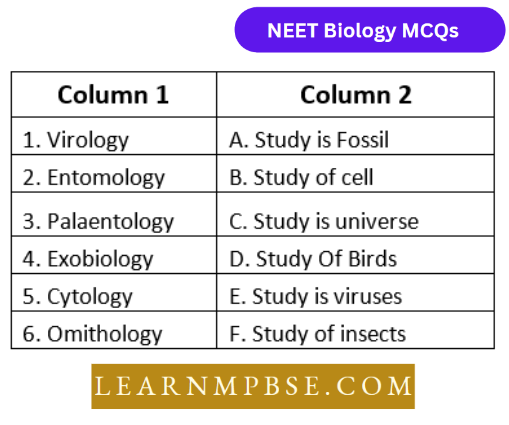
  • A single spore on a suitable substratum produces primary protonema.
  • Thus in the life cycle of Funaria, there are two distinct generations. One of these is a haploid independent leafy moss plant, the other is a diploid sporophyte.
  • The two alternate with each other, it is called heteromorphic Alternation of Generations and the life cycle is diplohaplontic.

Liver worts

  • The protonema stage is absent.
  • Vascular tissues as well as conducting tissues are absent.
  • Liverworts have unicellular rhizoids instead of roots.
  • The plant body of liverworts shows dichotomous branching.
  • The plant body possesses scales or amphigastria for retaining moisture and protection.
  • Capsule possesses elaters for dehiscence.
  • The capsule is devoid of any assimilatory tissue, columella, and peristome.
  • The capsule is the fertile part of sporogonium
  • Sporogonium may or may not show distinction into the foot, seta, and capsule

Mosses

  • They possess a juvenile filamentous stage called protonema.
  • Multicellular rhizoids are present instead of roots.
  • Sporogonium is differentiated into foot, seta, and capsule.
  • Capsule has abundant assimilatory tissue and columella.
  • Capsule produces haploid spores.
  • In mosses elaters are absent.
  • Moss plant develops on protonema as buds.
  • Moss leaves [phylloids] may have non-vascular midribs.

Economic importance

The peat deposits of Sphagnum, an aquatic moss, are harvested in blocks, desiccated, and utilized as fuel due to their exceptional absorptive capabilities and antiseptic attributes.

  • Sphagnum is utilized for wound dressing. Sphagnum, owing to its water-retention capacity, is utilized for packaging plants and cut flowers destined for distant locations.
  • Gardeners utilize this moss for vegetative proliferation during layering and similar techniques. Peat holds significant value for agriculturalists. Its incorporation into clayey soils enhances the soil’s texture.
  • Peattar, ammonia, and paraffin are some of the byproducts of peat. It is an excellent soil enhancer, it occupies ponds, pools, etc., and ultimately, due to its rampant proliferation, they get filled.
  • The debris is progressively transformed into solid earth. Sphagnum in the pools resembles soil and is therefore referred to as quaking bogs.
  • Bryophytes have a significant role in soil erosion prevention. The expansive carpets or mats they create stabilize the soil, so preventing erosion.
  • Function in ecological succession. The Moss stage is the second phase of biological succession on bare rock, gradually transforming the rock substrate into rich soil.
  • Wetlands. Sphagnum peat mosses proliferate swiftly in shallow waterways, creating dense mats on the water’s surface. They provide a deceptive semblance of solidity, resulting in the drowning of both animals and humans.
  • Cuisine. Mosses serve as sustenance for several small creatures. Certain avian species, such as GrouseChicken, consume the capsules of Bryum and Polytrichum.

Apophysis It is a sterile and photosynthetic lower part of the capsule. Paraphysis are sterile structures present in archegonia and antheridia Analogous structures are those which are functionally similar but genetically different.

  • The leaves and stem of Funaria are functionally similar to the leaves and stem of angiosperms but genetically different.
  • Perichaetial leaves whorl of leaves surrounding archegonia.
  • Perigonial leaves. A whorl of leaves surrounding antheridia.
  • Homosporous. Morphological meiospores in bryophytes are of one kind. This condition is called Homosporous.
  • Heteromorphic alternation of generations. When the gametophyte and the sporophyte of the same plant are completely different in size and shape, that is called heteromorphic alternation of generations or heterologous type of alternation of generations.
  • Columella is a sterile structure present in the capsule of Funaria surrounded by a spore sac in theca region.
  • Cauloid and PhyllokL The stem and leaf-life organs of bryophytes are generally called as cauloid and phylloid respectively as there is the complete absence of vascular tissue and these are gametophytic structures. ChJorenema or Caulanema. The colored branches of protonema are called chlorine or caulanema Cauloid. Stem-like structure of moss is called cauloid.

Characteristics Of Bryophyta NEET

NEET Biology Plant Kingdom Bryophyta Quanta To Memory

  • In the Bryophyte’s life cycle, the dominant phase is a gametophyte because the main plant body is gametophytic and dominant.
  • In Bryophytes meiosis occurs in diploid spore mother cells.
  • A goldmine of liverworts is in the western Himalayas.
  • True mosses Funaria (cord moss),Sphagnum (Peat or Bog or Turf mosses) Polytrichum (Hair cap moss) Pogonatum (Maiden hair moss) Tortula (Twisted moss).
  • Fossil bryophytes have been recorded from tertiary beds in the Cenozoic era Example Mucorales, and Jungermanniales.
  • Outer, larger peristome teeth are hygroscopic in nature and inner, smaller are non-hygroscopic.
  • Elaters are hygroscopic because of peculiar thickening and their movements loosen the spore masses which are discharged and dispersed by air.
  • Sphagnum is commonly called bog moss peat moss or turf moss as it can convert into bogs because of its creeping nature.
  • It is true moss. With this development the water of bogs becomes acidic (pH 3.7 or lower), followed by compression from plants on the top leading to the development of dark-colored peat which can be used as fuel on drying.
  • The sporophytic stage of bryophytes is generally made up of foot, seta, and capsule and Ricca (a liverwort) has only capsule.
  • Sphagonal used is for skin disorders extracted from Sphagnum.
  • Elaters exhibit xerochasy.
  • Funaria is also known as cord moss.
  • A capsule of Marchantia forms about 3,000,000 spores.
  • Pogonatum sporogonium is without apophysis.
  • The flat roof of the columella is called the epiphragm.
  • The central sterile column of the capsule is called the columella.
  • Bryophytes are non-vascular plants with multicellular sex organs.
  • An erect gametophyte of bryophyte is called a gametophore.
  • Sterile hairs mixed with sex organs are called paraphyses.
  • The most complete fossil among Bryophytes -Naiadita lanceolate
  • Leaves of funaria are one cell thick In moss capsule peristome teeth are 32 and arranged in two rows.
  • Synoicous—Bryophytes in which male and female sex organs are intermixed on the same plant.
  • More stomata are present in apophysis, less in theca, and are absent in operculum.
  • In bryophytes, rhizoids are mostly tuberculate and may be smooth, (eg. Riccia)
  • In Funaria after fertilization the female branch becomes erect and the male branch is hence pushed to a side.
  • In Hepaticeae the sex organs are embedded in thallus.
  • Antheridia and archegonia are enclosed by multicellular sterile jackets.
  • In T. S. the stem shows a continued strand in the center outside which lies the cortex.
  • Outer layers of the cortex have chloroplast.
  • Leaves of Funaria are sessile and are analogous to real leaves of higher plants.
  • Rhizoids of Funaria are non-green and help in vegetative reproduction.
  • Paraphysis are unbranched, green multicellular thread¬ structure intermixed with antheridia and archegonia.
  • The paraphysis of the male branch is knobbed and the female branch is not pointed.
  • Paraphysis prepares food and absorbs water for sex organs.
  • The Epidermis of the apophysis of the capsule is provided with stomata.
  • Capsule is a partial parasite on gametophytes. Hypodermis is 2 cells thick.
  • Just below the lid or operculum, a perforate disc of thin-walled cells extends from the epidermis to the columella called as diaphragm.

Classification Of Bryophytes NEET

NEET Biology Plant Kingdom Bryophyta Questions From Competitive Examinations

Question 1. Female sex organs of bryophytes are called:

  1. Oogonia
  2. Ascogonia
  3. Archegonia
  4. Antheridia.

Answer: 3. Archegonia

Question 2. The term bryophyta was coined by:

  1. Iyengar
  2. Linnaeus
  3. Braun
  4. Bentham.

Answer: 3. Braun

Question 3. Apopliysis occurs in:

  1. Marchantia
  2. Pteridium
  3. Apocyanaceae
  4. Mosses.

Answer: 4. Mosses.

Question 4. Moss sporophyte does not possess:

  1. Flaters
  2. Seta
  3. Foot
  4. Columella.

Answer: 1. Flaters

Question 5. Thallus of riccia is :

  1. Haploid
  2. Diploid
  3. Triploid
  4. Tetraploid.

Answer: 1. Haploid

Bryophyta NEET Exam Preparation

Question 6. Bryophytes have :

  1. Archegonia
  2. Dominant gametophytic and parasitic sporophytic phases
  3. Thalloid plant body
  4. A11 the above.

Answer: 4. A11 the above.

Question 7. In funeral, calyptra is formed from :

  1. Capsule
  2. Archegonium
  3. Columella
  4. Antheridium.

Answer: 2. Archegonium

Question 8. In bryophytes, the adult plant body is :

  1. Epiphyte
  2. Sporophyte
  3. Gametophyte
  4. Sporophyll.

Answer: 3. Gametophyte

Question 9. Which of the following pair of plants is not a seed producer?

  1. Funaria and ficus
  2. Funaria and fern
  3. Puccinia and pinus
  4. Ficus and chlamydomonas.

Choose the wrong pair :

  1. Heapiicopsida – Marchantia
  2. Lycopsida – selaginella
  3. Bryopsida – anthoceros
  4. Pteropsida – dryopteris
  5. Sphenopsida – equisetum.

Answer: 2. Lycopsida – selaginella

Question 10. Archegoniophore is present in :

  1. Marchantia
  2. Chara
  3. Adiantum
  4. Funaria.

Answer: 3. Adiantum

Life Cycle Of Bryophytes NEET

Question 11. Read the following statements and answer the question which follows them.

  1. In liverworts, mosses, and fems gametophytes are free-living
  2. Gymnosperms and some fems are hetero sperms and some fems are heterosporous
  3. Sexual reproduction is in focus, volvox and Albugo are oogamous
  4. The sporophyte in liverworts is more elaborate than that in mosses
  5. Both pinus and Marchantia are dioecious

Answer: 1. In liverworts, mosses, and fems gametophytes are free-living

Question 12. How many of the above statements are correct?

  1. Two
  2. Three
  3. Four
  4. One

Answer: 2. Three

NEET Biology Notes – Kingdom Fungi

NEET Biology Kingdom Fungi Features Of Fungi

This division comprises more than 100,000 species of fungi and has representation in almost every available habitat on earth and many fungi are of major economic or medical significance to man.

  1. They are composed of moulds, yeast, mushrooms, puffballs and toadstools.
  2. Fungi are found in almost all types of habitats. Many species of phycomycetes are found in water and are called aquatic fungi.
  3. Fungi are well adapted to the environment and nutrition. They grow in a wide range of temperatures and pH.
  4. Psychrophilic fungi grow at and below freezing point while thermophilic fungi remain viable even at 62°C.
  5. Most of the fungi grow well in acidic pH between 5 — 6-5 pH. Light is generally not essential for the growth of fungi.
  6. The fungi are achlorophyllous non-vascular thallophytes.
  7. Their mode of nutrition is either saprophytic, parasitic or symbiotic.
  8. 5 Fungi are dimorphic. Some pathogenic fungi of humans and other animals have a unicellular and yeast-like form in their hosts but when they grow saprobically in the soil they have filamentous bodies Example Blastomyces dermatitis.
  9. The thallus is very simple and may be unicellular (yeast ) or consists of a network of hyphae called mycelium. The mycelium may be aseptate and coenocytic (Rhizopus) or septate as in Penicillium, Agaricus etc.
  10. The reserve food material is in the form of glycogen and oil droplets.
  11. Their mode of reproduction is vegetative by fragmentation, and asexual by formation of conidia, oidia, zoospores and chlamydospores.
  12. Sexual reproduction is oogamous in lower forms (Phycomycetes, Ascomycetes), by somatogamy in higher forms (Basidiomycetes) and is absent in deuteromycetes. So fungi show a reduction in sexuality.

Read and Learn More NEET Biology Notes

Characteristics Of Fungi NEET

Sexual reproduction transpires through isogamy, anisogamy, heterogamy, gametangial contact, gametangial copulation, spermatization, and somatogamy. Somatogamy can be classified as pseudogamous, monogamous, or adelphogamous.

Three mycelial phases exist—dikaryotic, diploid, and haploid—due to distinct nuclear processes: plasmogamy, karyogamy, and meiosis.

NEET Biology Kingdom Fungi Classification Of Fungi

Kingdom Fungi Classification Of Fungi

NEET Biology Kingdom Fungi Oomycota

This group includes fungi with aseptate mycelium. These are lower fungi. This group is further divided into phycomycetes and zygomycetes. Phycomyceles. = Oomycetes = Algal fungi = Egg fungi.

They are popularly called algal fungi because they bear a striking resemblance to some algae ( Vaucheria) in the morphology of the thallus. The thallus ranges from unicellular to a profusely branched filamentous mycelium which is coenocytic.

Asexual reproduction takes place by sporangiospores equivalent to conidia often called conidiosporangia. Sexual reproduction is mainly by gametangia contact when present is isogamous or heterogamous.

Karyogamy generally follows plasmogamy so there is no dikaryophase in the life cycle. Common examples are black moulds, pink moulds, white rust, Phytophthora and downy mildews. Zygomycetes (conjugation fungi)

  1. These are saprophytic or parasitic fungi and can be grown on a culture medium.
  2. During life history a diploid resting spore called zygospore is produced by conjugation, hence the name of the group is zygomycetes.
  3. Mycelium is coenocytic.
  4. Hyphae are non-septate and haploid.
  5. Hyphae produce aerial branches called sporangiophores bearing sporangia at the tip of hyphae which produces non-motile spores.

1. Squinting Fungus.

Pilobolus crystallinus is a coprophilous or dung mould.

2. Rhizopus and Mucor.

Bread Mould (Rhizopus stolonifer) Rhizopus is a saprophytic fungus. Mycelium is made up of rhizoidal hyphae meant for attachment and absorption of food and water, stoloniferous hyphae which bear at nodes vertically a group of aerial hyphae called sporangiophores.

Hyphae are aseptate and coenocytic. It has many nuclei and reserves food in the form of oil and glycogen.

  • The life cycle is of Haplontic type.
  • Vegetative reproduction by fragmentation.
  • Asexual reproduction. Under favourable conditions, sporangia is borne on sporangiophores.

Each sporangium has a central dome-shaped columella and many multinucleate sporangiospores. Sporangiospore on dispersal to other substratum again produces new mycelium.

Characteristics Of Fungi NEET

Sexual reproduction. It occurs at the end of the growing season under unfavourable conditions. Sexual reproduction employs the conjugation of two gametangia resulting in the formation of azygospore.

Zygospore (2N) is the only diploid structure zygospore wall breaks so there is the formation of promycelium. Then a germ sporangium develops at the tip of the promycelium. This germ sporangium develops uninucleate haploid meiospores known as germ spores. So life cycle is haplontic.

Kingdom Fungi Oomycota

NEET Biology Kingdom Fungi Eumycota

Ascomycetes. They are also called Sac fungi characterised by the presence of ascus in which usually 8 ascospores are produced. Many asci are grouped to form a fructification called ascocarp which is of 4 types viz.

Cleistothecium (closed ) Example Penicillium

Apothecium ( open cup-shaped ) Example Peziza and

Perithecium (flask-shaped) with pore called ostiole Example Clavicepspurpurea.

Ascostroma – cushion-like and chambered, locules separated by stroma and having asci. Yeast ( Saccharomyces cerevisiae).

It is commonly employed in bread making and beer brewing and is also called brewer’s or baker’s yeast. It is unicellular ascomycetes.

It consists of a mass of protoplast surrounded by a cell wall. The protoplast has stored foods in the form of glycogen, fat and volutin granules.

The nucleus is situated on one side of the vacuole. Asexual reproduction is by budding and fission Example A small protuberance arises which gradually increases in size.

It is known as bud. Meanwhile, the nucleus of the mother cell divides mitotically and migrates into an enlarged bud.

In this way, a large number, of buds are formed in a chain. Sexual reproduction is by conjugation of two yeast cells.

Yeast may be homothallic or heterothallic. The diploid cell may multiply by budding or it may produce ascospores. There are two stages, haploid and diploid which regularly alternate with each other.

So in Saccharomyces cerevisiae, the life cycle is the haplodiplontic type and haplontic in Schizosaccharomyces homosporous and diplontic Example Saccharomycodes Ludwig. Yeasts are used in baking, as food and in the alcohol industry.

Kingdom Fungi Eumycota

Basidiomycetes. These are also called club fungi (due to Basidium) characterised by the presence of complicated fruiting bodies called basidiocarps. They bear reproductive structures called basidia.

Each basidium produces four basidiospores exogenously. The common examples are the smuts, rusts, the toadstools and puffballs. Mushroom.

Agaricus campestris is the most common form of mushroom which being edible is also cultivated. In Punjab, it is called Dhingari. Basidiospores are produced in a reproductive structure called basidiocarp which is differentiated into a stalk called a stipe and a cap-like structure called pileus.

Basidiospores germinate to form primary mycelium which is of short duration.
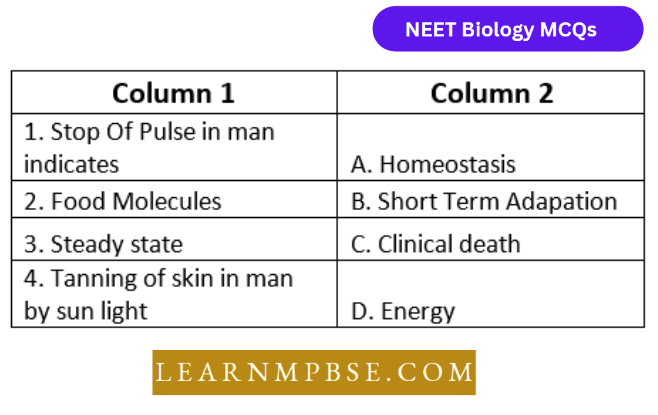
Then there is somatogamy in two different strains resulting in the formation of dikaryotic mycelium. On the mycelium are produced ring fruiting bodies (basidiocarps) also called fairy rings.

In each basidiocarp are produced club-shaped basidia in hymenium layers of gills which are present in pileus. Gills bear numerous basidia and paraphyses. Each basidium is club-shaped and produces four basidiospores exogenously, basidiospores are borne on stalk-like structures called sterigmata.

Kingdom Fungi NEET Question Bank

Basidiospores on dispersal again produce haploid or monokaryotic primary mycelium. Thus completing the life cycle in which there is a monokaryotic phase (primary mycelium) eukaryotic phase, and diplophase (only represented by basidium). Deuteromycetes.

These are also called “ Fungi Imperfecti” as the sexual stage is not found. The conidial stage is similar to the conidial stage of ascomycetes.

The fungi of this class cause many diseases of plants Example Colletotrichumfalcatum causes red rot of sugarcane. Deuteromycetes, Helminthosporium, Alternarici, Fusarium.

NEET Biology Kingdom Fungi Useful Terms

Clamp Connection. It is a small looped hypha which develops at the time of cell division and septa formation in the dikaryon of basidiomycetous fungus.

Cleistothecium. Closed ascocarp is termed cleistothecium. Eucarpic. When only a part of the thallus is used for the formation of reproductive bodies.

Kingdom Fungi Basic Features Of Fungal Anatomy

Holocarpic. Cells which is completely converted into reproductive structures. Dolipore septum. It is a complex pore in the septum of the hypha of a basidiomycetous fungus.

Diplanctism. The successive production of two different types of zoospores by a single fungal organism is termed as diplanetism Example Saprolegnia.

Mycobiont. Fungus partner of lichen. Parasexuality.

It was first reported by Pontecarvo and Roper in 1952 in Aspergillus nidulans and the imperfect stage of Einericella nidulans. Some fungi have genetic recombination of a type which is different from the normal sexual type. This other than sexual mode of reproduction is called parasexuality.

Predaceous fungi. These are animal trapping Examples Dactylella, and Arthrobotrys (belong to deuteromycetes). They capture small insects such as eelworms, rotifers, and protozoans and use them as food Rust. Fungal genera of Uredinales cause dark spots on the stems and leaves of hosts, for example, Puccinia.

Smut. Fungal genera of Ustilaginales produce a large number of black dusty spores (chlamydospores), ExampleUstilago.

Zygospores. These are thick-walled spores of zygomycetous fungi formed after the fusion of two gametangia.

Plectenchyma. When the mycelium gets organised into loosely or compacdy woven tissue-like structures.

Pseudoparenchyma. Mycelium in which the hyphae are very closely packed to lose their identity.

Perithecium A type of ascocarp which is flask-shaped and bears a pore through which ascospores are discharged, for Example, neurospora or cells. Somatogamy Fusion of two somatic hyphae.

Heterothallism. It was discovered by A.I. Blakeslee. He found two types of species in Mucorales and designated them as homothallic and heterothallic types.

In homothallic species, a zygospore is formed by conjugation of hyphae produced from a single mycelium Example R.sexualis. In the heterothallic species Example, R. stolonifer zygospore is not formed if two hyphae are produced from a single mycelium.

In these species, sexual union occurs only between two different mycelia considered as (+) and (-) strains. (+) and (-) strains are alike morphologically but differ physiologically. This is known as heterothallism.

The heterothallism may be morphological or physiological. Heterothallic fungi may be bipolar or tetrapolar. In bipolar species, there is only one pair of compatibility factors whereas in tetrapolar species there are two pairs of genetic factors.

Heterothalism is a device to prevent inbreeding and promote outbreeding. The haploid fungi reproduce asexually by producing a large number of mitospores. These spores germinate and give rise to new individuals.

All these individuals are genetically identical as they are formed from the same parent fungus by mitosis.

Kingdom Fungi Classification NEET

Sexual reproduction involves the fusion of gametes and meiosis. Homothallic species reproduce sexually by fusion of gametes produced from two gametangia having almost similar genetic constituents (i.e., inbreeding) and, therefore, have fewer chances of genetic variation among the offspring.

Heterothallic species, on the other hand, ensure a combination of two gametes belonging to genetically different individuals (i.e., outbreeding) which results in greater genetic variation among the offspring so that they can withstand abnormal environmental conditions and adapt themselves in different substrata. Therefore, heterothallism is a device to prevent inbreeding and promote outbreeding.

NEET Biology Kingdom Fungi Economic Importance Of Fung

  1. As Food, Yeast is used because it contains about 50% protein. Yeast protein is called single-cell protein.
  2. Agaricus bisporous, Volvaria and Lentinus elodus are some edible mushrooms.
  3. Research Tools. Neurospora and Physarum are used in several genetics and biochemistry experiments.
  4. Antibiotics. Penicillin ( from Penicillium nolatum and P. chrysogenum), and griseofulvin ( from Penicillium griseofulvum), are some antibiotics obtained from fungi).
  5. Acids. Several organic acids are produced from species of Rliizopus, Aspergillus, Mucor, etc.
  6. Hormones. Gibberellin is obtained from Giberellafujikuroi.
  7. Vitamins. Saccharomyces cerevisiae and other yeasts are good sources of vitamin B- ) complex and riboflavin.
  8. Spoilage of food grains. Rliizopus, Mucor, Aspergillus, Penicillium, etc. are spoiling agents of food grains, fruits etc.
    • Poisonous fungi. Amanita phalloides, A. verna and Boletus satavus are highly poisonous fungi. Coprinus, Psilocybe and Incocybe are also poisonous. Amanitaphalloides is called “Death cup”.
  9. Some fungi are extremely poisonous. For example- Amanita phalloides (death cup) produces poisonous toxins like a-amanitin, phalloidin, etc., which stop the synthesis of mRNA.
    • Sclerotia of the fungus Claviceps purpurea contains many poisonous alkaloids which cause poisoning in human beings. The acute condition of such poisoning is called ‘St. Anthony’s fire’, Helvetia (saddle fungus) is a poisonous cup fungus and can be fatal if consumed.
  10. Toxins and aflatoxins. Amanitaphalloides, A. vema, Clavicepspurpurea, Aspergillus flavus, etc. produce toxins and aflatoxins.
    • Some fungi contaminate our food and secrete toxins. These toxins are called mycotoxins. They are very harmful and cause illness when such contaminated food is consumed. Some of the important mycotoxins are.
    • Aflatoxins are produced by Aspergillusflavus and related strains. Some of these are carcinogenic.
    • Amatoxins and Phallotoxins are produced by the mushroom- Amanita phalloides (death cup).
    • Coprine is produced by the edible mushroom Coprinus atramentanius.
    • Ochratoxins are produced by Aspergillus ochraceus and Penicillium viridicatum.
    • Trichothecenes are produced by species of Fusarium, Cephalosporium, Trichoderma, etc.
    • Zearalenone is produced by species of Fusarium.
  11. Hallucinogenic drugs. Psilocybe mexicana, Amanita in sharia, Incocybe, etc. are some fungi which produce some hallucinogenic drugs, responsible for nausea, vomiting, diarrhoea, and even death. LSD is obtained from fungus, Claviceps purpurea.
  12. Lichens used in medicines. Jaundice, hydrophobia, lung diseases.
    • Lichens as a source of dyes
    • Other uses
    • Nitrogen fixation by yeasts like Saccharomyces and Rhodotorula
    • Production of latex by Mycena galopus.
    • Soil building by Rhizopus, Cladosporium, Aspergillus etc.
    • Along with bacteria, fungi work as decomposers.
    • Biological control of growth of hyperparasites like insects, nematodes, bacteria and even other fungi.
    • Neurospora is good research material for geneticists and Physarum for molecular biologists for the study of DNA.

Kingdom Fungi Some Antibiotics Dervied From Fungi

Kingdom Fungi Some Industrial Products Dervied From Fungi

Kingdom Fungi Some Vitamins Dervied From Fungi

Kingdom Fungi Some Disesases Caused By Fungi In Plants

Kingdom Fungi Some Diseases Caused By Fungi In Man And Animals

NEET Biology Kingdom Fungi Lichens

Lichens are a distinct assemblage of intriguing organisms that coexist with mosses on tree trunks and rocks. Lichen is a symbiotic relationship between a fungus and an alga.

  • The fungal element is referred to as mycobiont, whereas the algal element is termed phycobiont.
  • Lichen is a symbiotic relationship between algae and fungi, with the algae potentially being blue-green or green in color.
  • Algae synthesize food from carbon dioxide and water, whereas fungi assimilate water and minerals.
  • Lichens are fundamentally categorized into three types: Crustose lichens. The thallus is planar and creates a crust on rock, exemplified by Graphic scripta, Haemotoma puniceum, Lecanora, and Rhizocarpon.
  • Foliose lichens are broad and leaf-like, exhibiting lobed structures; examples include Parmelia, Xanthoria, and Physcia. Fruticose lichens.
  • They exhibit extensive branching akin to shrubs and are affixed to the substrate via a disc. The branches produce reproductive structures known as apothecia. Usnea, Cladonia exemplars.
  • Asexual reproduction occurs by the use of soredia. Lichens serve as markers of atmospheric pollution.
  • Certain lichens are used in pharmaceuticals and as sustenance. Lichens are crucial in soil formation, facilitating succession on a rock known as xerosere.

Old Classification of Lichens based on Habitat

  1. Terricolous —Growing on soil Example Lecidea, Cladonia.Floerkeana
  2. Saxiscolous —Growing on rocky substrata Examples Dermatocarpon, Porina, Xanthoria
  3. Corticolous—Growing on wood bark Example Usnea, Parmelia.
  4. Lignicolous — Developing on wood Example Cyphelium

NEET Biology Kingdom Fungi Economic Importance Of Lichens

  1. Beneficial Activities
    • Early colonizer. Lichens are the pioneers of plant growth on bare rocks and are called first colonizers.
  2. Soil builder.
    • The lichens are pioneers of vegetation in a lithosere ( succession on rocky surface). They bring about the biological weathering of rocks by forming acids such as carbonic acid, oxalic acid, etc., which leads to soil formation.
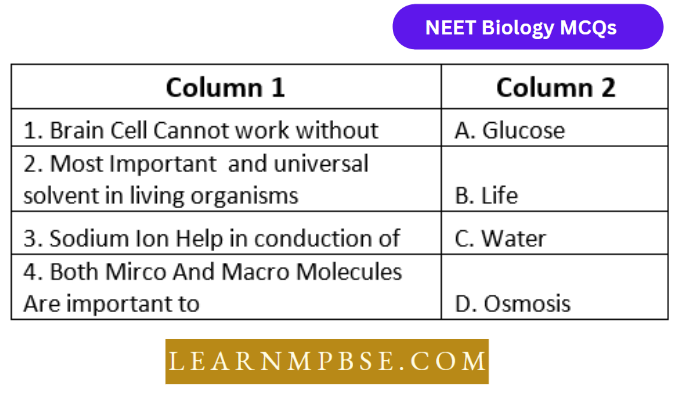
  3. Food.
    • Some lichens are a valuable source of food for wild animals and cattle.
    • Cladonia rangiferina growing to a height of about 30 cm, in the arctic regions, serves as food for Reindeer, hence called ‘reindeer-moss’.
    • Certaria islandica is used as a food article in Iceland (hence called ‘Iceland moss’), Sweden and Norway.
    • Lecanora esculenta is used as food in Israel.
    • Enocarpon miniatum is used as a vegetable in Japan.
    • Umblicaria esculenta is used as food in Japan.
    • Parmelia, generally called rathapu in Telugu is used as a spice in curry (curry powder ) in South India and it is also used as a food, as well as in making chocolates and pastries.
    • Species of Stereocaulon and Evemia are also used as fodder.
  4. Medicinal uses
    • Cladonia pyxidata is used in the treatment of whooping cough.
    • Pannelia permata is used in the treatment of snakebites.
    • Parmelia sexatilis is used in the treatment of epilepsy.
    • Lobaria purmelia is used in the treatment of lung diseases.
    • Evemia and Usnea are used in the treatment of haemorrhage
    • Usnea barbata is used in the treatment of urinary diseases.
    • Some species of Usnea and Cladonia are used to extract an antibiotic called usnic acid which has antibacterial activity and has proved very effective against tuberculosis when used in combination with streptomycin.
    • Peltigera and Black pepper are used in the treatment of rabies.
    • Peltigera canina is used in the treatment of hydrophobia and liver ailments.
    • Cetraria islandica is used in the treatment of diabetes and respiratory diseases.
    • Rocella montagnei is used in the treatment of angina.
    • Cladonia, Rocella and Evemia are used in controlling different types of fevers.
    • The protolichesterinic acid obtained from some lichens has anticarcinogenic properties.
  5. Industrial uses
    • The lichens contain carbohydrates in the form of lichenin. Hence, they are used in producing alcohol in countries like Sweden and Russia.
    • Species of Evemia, Pseudomia, and Ramalina contain essential oils and hence they are used in the manufacture of soaps and perfumes. Besides, they also contain chemicals like geraniol, naphthalene, etc.
    • A red dye is obtained from the Ochrolechia species.
    • A brown dye is obtained from Parmelia species.
    • A dye orchill is prepared from Rocella tinctoria.
    • Another brilliant colouring dye is, cud-bear obtained from lichen species.
    • Litmus used as an acid-base indicator is obtained from Rocella Montagne and Lasallia pustulate.
    • Indicator of air pollution. Lichens act as an indicator of air pollution because no lichen can be found in areas of heavy industrial pollution. After all, lichens are sensitive to S02.
    • Njfixation. Lichens having blue-green algae are important in fixing nitrogen.
    • Chemicals. Some lichen yields important chemicals. For example:
    • Ramalina siliquosa yield salzinic acid.
    • Parmelia subtrudecta yield lecanoric acid.
    • Cladonia crispate yields squamatic acid.
    • Religious importance. Sweet-scented thalli of lichens like Evemia and Ramalina are used in the preparation of ‘ dhup’ and ‘hawan samagris’.

Kingdom Fungi Classification NEET

Harmful Activities

  1. Damaging buildings. In humid areas, lichen can grow on window panes, marble and cement damaging the building by their etching activity.
  2. Poisonous. Some lichens are poisonous, such as Letharia vulpina due to vulpinic acid, Cetraria juniperina due to pinastrinic acid, Parmelia molluscum due to selenium, Xanthoria parietina due to beryllium and Evemiafutjuracea due to chlorine.
  3. In deuteromycetes or fungi imperfectii sexual reproduction is absent or yet to be discovered.
  4. A few important members of Deuteromycetes are :
    • Colletotrichumfalcatum causes red rot of sugarcane.
    • Helminthosporium oryzae causes brown leaf spot disease in rice.
    • Altemaria solani causes early blight disease of potato and tomato.
    • Cercospora personata causing tikka disease.
    • Fusarium oxysporium causing wilt disease.
    • Fusarium moniliforma causes balance disease of rice and releases gibberellins.
  1. Fungal tissue is called plectenchyma which is formed due to well-organised hyphae either forming parallel called prosenchyma or giving the appearance of parenchyma of higher plants called pseudoparenchyma.
  2. In liquid media, particularly in the presence of a high concentration of sugar the hyphae become segmented like in yeast called as torula stage.
  3. Aflatoxins, a type of mycotoxin was discovered in 1961 in Aspergillusflavin and later on in many other members.
  4. Morchella is morel or sponge mushroom and is highly-priced for their delicacies.
  5. In 1845-1860 a million people died in Ireland alone due to the destruction of potato crops by Phytophthora infestans. This famine led to the discovery of plant pathology.
  6. Most parasitic fungi are autoecious except rust. Puccinia is heteroecious as it requires two hosts after its life cycle, i.e. wheat (primary host) and barberry. (secondary host).
  7. Thiamine (Vit. B) produced by Saccharomyces cerevisiae Riboflavin by Saccharomyces cerevisiae Vit B12 Eremothecum ashbyic YitaminsPhodatarala gracilis Keratimophilic Fungio Grown on nails, feathers, hairs, hoofs.
  8. Fungi growing on
  9. Tree bark = Carticolous
  10. Dungwood = Cophoprhilous
  11. Burnt wood = ep xylic and xerophilous
  12. “Lomasomes” or “plasmoalemmasomes” are some membranous structures found in between the plasmalemma and cell wall of some fungi. Chlorophyll is absent in all fungi.
  13. Yeast is also called sugar fungus or Zuckerpilz. Neurospora crassa was regarded as Drosophila of the plant kingdom.
  14. Largest fungus. Giant puffball Parmelia lichen is called Rock flower. Cladonia is known as Reindeer moss. Pethigera is called dog lichen.
  15. Coprinus comatus (Basidiomycetes) fungus is used in making ink (from gills). So it is called an Inky Cap mushroom.
  16. In fungi vesicular structures that develop from cell membranes are called lomasomes. They are found in between the cell wall and cell membrane and help in the elaboration of the cell wall.
  17. Some fungi emit light and are called luminescent fungi. These fungi have luciferase enzyme which acts on luciferin in the presence of oxygen, for example, Xylaria hypoxylon, Panus sp, and Arrnillaria mallet. Fossil fungi are Mucarites combrensis, Agarites wardens, and Penicillites curtipes.
  18. The fungi which grow in trees are called lignicolous fungi Example Polyporus, and Trametes.
  19. Heterothallism was discovered by Blakeslee in the species of Mucor. It refers to the sexual union between hyphae of opposite strains. Homothallic mycelia are self-fertile.

NEET Biology Kingdom Fungi Quanta to Memory

  1. The fungi which grow on dung are called Coprophilous fungi eg. Mucor media, Pilaria, and Pilobolus.
  2. Famous Irish Famine caused by: Late blight of potato Fungus Phallus unpicks is a member of Basidiomycetes is a dead man’s finger.
  3. Hydnum is a member of articles called tooth fungus.
  4. In Deuteromycetes Parasexuality is an alternative method of sexual reproduction
  5. Phycomycetes are called algal fungi or lower fungi.
  6. The torula stage is the budding of oidia in a sugary solution.
  7. About 2300 antibiotics have been discovered so far from various fungi. Of these, some 123 have been extracted from Penicillium and 115 from Aspergillus.
  8. The best work on fungi produced so far is ‘Silloge Fungorum’ by Saccardo. The work on Puccinia, Penicillium and Neurospora aroused interest in this branch.
  9. Several mycotoxins (aflatoxins, zearalenone, ochratoxins, trichothecenes) are produced by fungi.
  10. Many forms (For example, Amanita phalloids) are poisonous.
  11. Cleviceps purpurea causes ergotism. It also yields a hallucinogenic drug called L. S. D. Rotting of wood (Polyporss, Fomes, Ganoderma), allergies (Mucor, Aspergillus etc.) deterioration of articles (Cladisporium, Altemaria, Chaetomium) is caused by many forms.
  12. Several forms are eaten as food Example, Agaricus and Morchella. Yeast cakes, incaparina, SCP etc. are edible products obtained from yeasts. Penicillium sp. is used for flavouring cheese. Yeasts are used in brewing and baking.
  13. Aspergillus causes Aspergillosis in human beings. A pheromone is a substance secreted to the outside by an individual and received by a second individual of the same species in which it induces a specific reaction Example a definite behaviour i.e. fusion of two yeast cells during sexual reproduction.

NEET Biology Kingdom Fungi Questions For Competitive Examinations

Question 1. Which one of the following is a harmful lichen?

  1. Umbilicaria
  2. Letharia
  3. Usnea
  4. Caledonia.

Answer: 2. Letharia

Question 2. Mycorrhizal association occurs in pinus, ficus and :

  1. Utricularia
  2. Legumes
  3. Eucalyptus
  4. Azadirachta.

Answer: 3. Eucalyptus

Question 3. The collateral host is:

  1. Additional host
  2. Host in which life cycle is completed
  3. Alternate host
  4. Infected host.

Answer: 1. Additional host

Question 4. Sexual reproduction is absent in :

  1. Deuteromycetes
  2. Phycomycetes
  3. Ascomycetes
  4. Basidiomycetes.

Answer: 1. Deuteromycetes

Fungi Examples NEET

Question 5. In an ascus of ascomycetes, the number and arrangement of ascospores are:

  1. 8 In linear order
  2. 4 In linear order
  3. Both a and b
  4. 8 Or 4, linear order or unordered.

Answer: 4. 8 Or 4, linear order or unordered.

Question 6. Mycelium of mucor/rhizopus is :

  1. Aseptate and unicellular
  2. Septate and unicellular
  3. Septate and multicellular
  4. Coenocytic.

Answer: 4. Coenocytic.

Question 7. Fungi are always:

  1. Heterotrophs
  2. Saprophytes
  3. Parasites
  4. Autotrophs.

Answer: 1. Heterotrophs

Question 8. Which of the following produces aflatoxin?

  1. Viruses
  2. Bacteria
  3. Fungi
  4. Nematodes.

Answer: 3. Fungi

Question 9. An example of an obligate anaerobe is :

  1. Clostridium
  2. Hiv
  3. Aspergillus sp
  4. Penicillium notatum

Answer: 1. Clostridium

Question 10. An adhesive pad of fungi penetrates the host with the help of:

  1. Mechanical pressure and enzymes
  2. Hooks and suckers
  3. Softening by enzymes
  4. Only by mechanical pressure.

Answer: 1. Mechanical pressure and enzymes

Question 11. One of the following attacks inflorescence and grains equally :

  1. Loose smut of wheat
  2. Covered smut of barley
  3. Com smut
  4. Late blight of potato.

Answer: 1. Loose smut of wheat

Question 12. Which of the following fungi releases mycotoxin in stored rice grains?

  1. Aspergillus
  2. Altemaria
  3. Fusariurn moniliforme
  4. Penicillium.

Answer: 1. Aspergillus

Question 13. Match the disease and causative agent

Kingdom Fungi Question 13 Match The coloumns

  1. A-1,B-2,3-3,4-4
  2. A-4,B-3,3-2,4-1
  3. A-2,B-3,3-4,4-1
  4. A-4,B-2,3-1,4-1

Answer: 2. A-4,B-3,3-2,4-1

Question 15. Lichen growing on wood is called :

  1. Saxicolous
  2. Terricolous
  3. Corticolous
  4. Lignocolous.

Answer: 4. Lignocolous.

Question 16. A fungal filament system is known as mycelium, but pseudo mycelium is formed in:

  1. Yeast
  2. Rhizopus
  3. Aspergillus
  4. Synchytrium.

Answer: 1. Yeast

Question 17. The causal agent of red rot of sugarcane is

  1. Helminthosporium
  2. Fusarium
  3. Pythium
  4. Colletotrichlim.

Answer: 4. Colletotrichlim.

Reproduction In Fungi NEET

Question 18. White rust of crucifers is :

  1. Puccinia graminis
  2. Ustilago tritici
  3. Albugo candida
  4. Aspergillus flavus

Answer: 3. Albugo candida

Question 19. Among rust, smut and mushrooms all three :

  1. Are pathogens
  2. Are saprobes
  3. Bear ascocarps
  4. Bear basidiocarps.

Answer: 1. Are pathogens

Question 20. Which of the following environmental conditions are essential for optimum growth of mucor on a piece of bread?

  1. Temperature of about 25°c
  2. Temperature of about 5°c
  3. Relative humidity of about 5%.
  4. Relative humidity of about 95%
  5. A shady place
  6. A brightly illuminated place

Choose the answer from the following options :

  1. 2, 2 and 5 only
  2. 2, 3 and 6 only
  3. 1, 3 and 5 only
  4. 1, 4 and 5 only.

Answer: 4. 1, 4 and 5 only.

Question 21. Yeast and algae are the main sources of

  1. Vitamin b complex
  2. Vitamin c
  3. Minerals
  4. Vitamin k.

Answer: 2. Vitamin c

Question 22. Red rot of sugarcane and white rust of radish are respectively caused by:

  1. Albugo candida and cercospora
  2. Colletotrichum and fusarium 28.
  3. Pythium and phytophthora
  4. Albugo candida and puccinia graminis
  5. Colletotrichum and albugo candida

Answer: 5. Colletotrichum and Albugo candida

Question 23. Azolla increases soil fertility of:

  1. Maize
  2. Barley
  3. Rice
  4. Wheat.

Answer: 3. Rice

Question 24. Identify from the following examples, a fungus which is of medicinal importance.

  1. Agaricus
  2. Saccharomyces
  3. Penicillium
  4. Cercospora.

Answer: 3. Pehicillium

Reproduction In Fungi NEET

Question 25. Which pair of the following belongs to basidiomy- cetes?

  1. Pufballs and claviceps
  2. Peziza and stinkhorns
  3. Morchella and mushrooms
  4. Birds’ nest fungi and puffballs.

Answer: 4. Birds’ nest fungi and puffballs.

Question 26. Ergot of rye is caused by a species of:

  1. Uncinula
  2. Ustilago
  3. Claviceps
  4. Phytophthora.

Answer: 3. Claviceps

Question 27. Deuteromycetes are called imperfect fungi due to :

  1. Lack of cell wall
  2. Lack of sexual reproduction
  3. Lack of asexual reproduction
  4. Lack of vacuoles.

Answer: 2. Lack of sexual reproduction

Question 28. Select the wrong statement:

  1. Anisogametes differ either in structure, function or behaviour
  2. In oomycetes female gamete is smaller and motile, while the male gamete is larger and non-motile
  3. Chlamydomonas exhibits both isogamy and anisogamy and the focus shows oogamy
  4. Isogametes are similar in structure, function and behaviour.

Answer: 2. In oomycetes female gamete is smaller and motile, while the male gamete is larger and non-motile

NEET Biology Multiple Choice Questions – Kingdom Fungi

NEET Biology Kingdom Fungi Multiple Choice Questions

Question 1. The branch of botany which is concerned with the study of fungi is called:

  1. Parasitology
  2. Mycology
  3. Bacteriology
  4. Embryology.

Answer: 3. Bacteriology

Question 2. The parasitic fungi take their food from the host with the help of:

  1. Talparaphysis
  2. Soredia
  3. Hausloria
  4. Conidia.

Answer: 2. Soredia

Question 3. Fungi that are used as food :

  1. Rusts
  2. Smuts
  3. Mushrooms
  4. Downy mildews.

Answer: 2. Smuts

Read and Learn More NEET Biology Multiple Choice Question and Answers

Question 4. Multinuclcatc and aseptate hyphae of rhizopus are called

  1. Oidia
  2. Hcterolhallic
  3. Chlamydospores
  4. Coenocytic.

Answer: 4.  Coenocytic.

Question 5. Sporangia in rhizopus are borne on :

  1. Rhizoidal hyphae
  2. Lateral branch of sporangiophore
  3. Tips of sporangiophores
  4. None of the above.

Answer: 3. Tips of sporangiophores

NEET Biology MCQs

Question 6. Commercial mushrooms are grown in soil enriched with horse manure. These mushrooms are :

  1. Autotrophic
  2. Parasitic
  3. Saprophytic
  4. Chemosynthetic

Answer: 3. Saprophytic

Question 7. Mushroom is :

  1. Puccinia
  2. Parasitic
  3. Agaricus
  4. Chemosynthetic.

Answer: 1. Puccinia

Question 8. Who found the phenomenon of heterothallism in Rhizopus

  1. Aiexopouios
  2. Blakeslee
  3. Lyenger
  4. R.n. Singh

Answer: 2. Blakeslee

Question 9. Sporangiospores are :

  1. Flagellated
  2. Biflagellated
  3. Multinucleated
  4. Ciliated

Answer: 3. Multinucleated

Question 10. Torula stage is found in medium

  1. Rich in sugars
  2. Pesticides
  3. Antibiotics
  4. Rich in fats.

Answer: 1. Rich in sugars

Question 11. Sexual reproduction in rhizopus is by

  1. Spores
  2. Oidia
  3. Conjugation of two gametangia
  4. Conidia.

Answer: 3. Conjugation of two gametangia

NEET Biology MCQs

Question 12. Yeast is an important source of:

  1. Proteins
  2. Sugars
  3. Riboflavin
  4. Vitamin c

Answer: 2. Sugars

Question 13. Ascocurp of penh llllnni is :

  1. Crithccitiiu
  2. Apntliccium
  3. Acroslromn
  4. Clcistotlicdum.

Answer: 4. Clcistotlicdum.

Question 14. Early blight and late blight arc caused respectively by :

  1. Aspergillus and penicillium
  2. 11Sthugo and puccinia
  3. Graphiola and agarlcus
  4. Aliemaria and phytophthora.

Answer: 4. Aliemaria and phytophthora.

Question 15. Citric acid is commercially manufactured from :

  1. Mucor
  2. Citromyccs pfefferiaur
  3. Aspergillus
  4. Saccharomyces.

Answer: 3. Aspergillus

Question 16. The protective sterile covering in the ascocarp is :

  1. Upidcrm
  2. Epicarp
  3. Peridium
  4. Periderm

Answer: 3. Peridium

Question 17. The hyphae of rhizopus are :

  1. Branched, tubular and coenocytic
  2. Branched and septate
  3. Unbranched and septate
  4. Unbranched, unicellular and tubular.

Answer: 1. Branched, tubular and coenocytic

Question 18. Torula stage is observed in :

  1. Puccinia
  2. Mucor
  3. Agaricus
  4. Penicillium.

Answer: 2. Mucor

NEET Biology MCQs

Question 19. Yeasts are used commercially in :

  1. Butter industry
  2. Wine and baking industry
  3. Tobacco industry
  4. Textile industry

Answer: 2. Wine and baking industry

Question 20. In Rhizopus, which of the stages does not contain ‘n’ number of chromosomes

  1. Hyphae
  2. Stolon
  3. Rhizoids
  4. Zygospore

Answer: 4. Zygospore

Question 21. The majority of the species of rhizopus are :

  1. Parasitic
  2. Saprophytic
  3. Epiphytic
  4. Lithophytic.

Answer: 2. Saprophytic

Question 22. When fungi feed on dead organic matter, they are called

  1. Parasite
  2. Saprophytes
  3. Lithophytes
  4. Dimorphic.

Answer: 2. Saprophytes

Question 23. Which of the following is used commonly in genetical experiments:

  1. Mucor
  2. Rhizopus
  3. Morchella
  4. Neurospora.

Answer: 4. Neurospora.

Question 24. Which of the following is unicellular and uninucleate?

  1. Rhizopus nigricans
  2. Saccharomyces cerevisiae
  3. Puccinia graminis
  4. Morchella esculenta.

Answer: 2. Saccharomyces cerevisiae

NEET Biology MCQs

Question 25. In a lichen, the fungal partner belongs to :

  1. Phycomycetes
  2. Ascomycetes
  3. Basidiomycetes
  4. Deuteromycetes

Answer: 2. Ascomycetes

Question 26. “Foolish seedling disease of rice” has been behind the discovery of which growth hormones?

  1. Auxins
  2. Ethylene
  3. Gibberellins
  4. Cytokinins.

Answer: 3. Gibberellins

Question 27. Plasmodium is a thallus found in:

  1. Myxomycetes
  2. Phycomycetes
  3. Ascomycetes
  4. Basidiomycetes.

Answer: 1. Myxomycetes

Question 28. Fungi reproduce by only asexual methods in :

  1. Myxomycetes
  2. Ascomycetes
  3. Basidiomycetes
  4. Deuteromycetes.

Answer: 4. Deuteromycetes.

NEET Biology MCQs

Question 29. Zygospore of mucor germinates to form :

  1. Mycelium
  2. Promycelium
  3. Hyphae
  4. Germ tube.

Answer: 2. Promycelium

Question 30. Penicillin is produced from :

  1. Penicillium chrysogenum
  2. Penicillium claviform
  3. Penicillium expansum
  4. Penicillium divarication.

Answer: 1. Penicillium chrysogenum

Question 31. Black rust of wheat is caused by :

  1. Rhizopus
  2. Yeast
  3. Penicillium
  4. Puccinia tritici.

Answer: 4. Puccinia tritici.

Question 32. A facultative parasite is one which :

  1. Always requires a living host
  2. Is normally saprophytic but can also become parasitic
  3. Is normally a parasite but can also become a saprophyte
  4. Always requires dead organic matter.

Answer: 2. Is normally saprophytic but can also become parasitic

Kingdom Fungi MCQs For NEET

Question 33. The severe famine of West Bengal of 1942-43 was due to the destruction of rice crop by a fungus :

  1. Helminthosporium
  2. Penicillium
  3. Puccinia
  4. Rhizopus.

Answer: 1. Helminthosporium

Question 34. Yeast (saccharomyces) belongs to :

  1. Phycomycetes
  2. Ascomycetes
  3. Basidiomycetes
  4. Deuteromycetes.

Answer: 2. Ascomycetes

Question 35. Rhizopus belongs to :

  1. Zygomycetes
  2. Ascomycetes
  3. Deuteromycetes
  4. None of the above.

Answer: 1. Zygomycetes

Kingdom Fungi MCQs For NEET

Question 36. Fleming discovered penicillin from :

  1. Penicillium camembert
  2. P. Notatum
  3. P. Chrysogenum
  4. P. Expansum.

Answer: 2. P. Notatum

Question 37. How many ascospores are formed in saccharomyces cerevisiae:

  1. 2
  2. 4
  3. 8
  4. 16.

Answer: 2. 4

Question 38. Yeast is found abundantly in :

  1. Horse dung
  2. Nose of fishes
  3. Moist bread
  4. Organic substances are rich in sugar.

Answer: 4. Organic substances rich in sugar.

Question 39. The yeast cell wall is made up of:

  1. Pectin
  2. Carbohydrate
  3. Glucose and mannose
  4. Fungal cellulose.

Answer: 4. Fungal cellulose.

Question 40. When a portion of fungal mycelium is used in the formation of reproductive structure :

  1. Eucarpic
  2. Acarpic
  3. Holocarpic
  4. None of the above.

Answer: 1. Eucarpic

Kingdom Fungi MCQs For NEET

Question 41. An alga and a fungus remain in lichens in :

  1. Parasitic relationship
  2. Symbiotic relationship
  3. Saprophytic relationship
  4. Epiphytic relationship.

Answer: 2. Symbiotic relationship

Question 42. Wheat rust is caused by :

  1. Albugo
  2. Ustilago
  3. Aspergillus
  4. Puccinia.

Answer: 4. Puccinia

Question 43. ‘Smuts’ belong to the genus :

  1. Puccinia
  2. Ustilago
  3. Altemaria
  4. Phytophthora.

Answer: 2. Ustilago

Question 44. Which of the following is a fungal disease?

  1. Tuberculosis
  2. Smallpox
  3. Rabies
  4. Ringworm.

Answer: 4. Ringworm.

Question 45. ‘Ergot of rye’ is caused by :

  1. Puccinia
  2. Ustilago
  3. Ciaviceps
  4. Alternaria.

Answer: 3. Ciaviceps

Fungi Important Questions For NEET

Question 46. In yeast, cell wall contains :

  1. Amylose and glucose
  2. Glucose and mannose
  3. Glucose and muramic acid
  4. Sucrose and mannose.

Answer: 2. Glucose and mannose

Question 47. The coprophilous fungi inhabit:

  1. Dung
  2. Deadwood
  3. Decaying leaves
  4. Food.

Answer: 1. Dung

Question 48. Bakane disease is connected with the discovery of :

  1. Ga
  2. Iaa
  3. Aba
  4. 2, 4 — D.

Answer: 1. Ga

Question 49. Mycorrhiza is a relationship between :

  1. Algae and fungi
  2. Fungi and the roots of higher plants
  3. Fungi and rhizoids of lower plants
  4. None of the above.

Answer: 2. Fungi and the roots of higher plants

Question 50. Which one of the following is edible?

  1. Agaricus
  2. Rhizopus
  3. Neurospora
  4. Peronospora.

Answer: 1. Agaricus

Question 51. Aflatoxins are produced by some :

  1. Bacteria
  2. Fungi
  3. Viruses
  4. Algae.

Answer: 2. Fungi

Fungi Important Questions For NEET

Question 52. Fungi in the division oomycete are known as :

  1. Egg fungi
  2. Sac fungi
  3. Club fungi
  4. Cup fungi.

Answer: 1. Egg fungi

Question 53. Heterothallism prevents :

  1. Breeding
  2. Inbreeding
  3. Crossbreeding
  4. Interbreeding.

Answer: 2. Inbreeding

Question 54. Dolipore septum is a characteristic feature of:

  1. Phycomycetes
  2. Zygomycetes
  3. Ascomycetes
  4. Basidiomycetes.

Answer: 4. Basidiomycetes.

Question 55. Apothecial cups are the characteristic of:

  1. Aspergillus
  2. Saccharomyces
  3. Peziza
  4. Agaricus.

Answer: 3. Peziza

Fungi Important Questions For NEET

Question 56. Dikaryotisation in basidiomycetes takes place :

  1. Plasmogamy
  2. Plasmogamy and karyogamy
  3. Clamp connection formation
  4. Karyogamy is followed by meiosis.

Answer: 3. Clamp connection formation

Question 57. Smut of maize is caused by :

  1. Ustilago avenae
  2. Ustilago maydis
  3. Ustilago hordei
  4. Ustilago nuda.

Answer: 2. Ustilago maydis

Question 58. Funga l hyphae penetrate the hard cell walls of their hosts with the help of:

  1. Enzymes
  2. Hormones
  3. Sharp tips
  4. Sugar exudates.

Answer: 1. Enzymes

Question 59. The hyphal system is called mycelium in:

  1. Algae
  2. Fungi
  3. Bryophytes
  4. Pteridophytes.

Answer: 2. Fungi

Question 60. Penicillin was first discovered by :

  1. Alexander fleming
  2. P. Ehrlich
  3. Robert Koch
  4. S. Waksman.

Answer: 1. Alexander Fleming

Fungi Important Questions For NEET

Question 61. Select the correctly matched pair.

  1. Cause of Irish potato famine – altemaria solani
  2. Cause of Bengal potato famine – helminths – emporium
  3. Black wart disease of potato – phytophthora infestans
  4. Late blight of potato – cytoplasm candida.

Answer: 3. Black wart disease of potato – phytophthora infestans

Question 62. To digest the food that lies in external, medium fungi secrete:

  1. Enzymes
  2. Hormones
  3. Sugar
  4. None of the above.

Answer: 1. Enzymes

Question 63. Which of the following is a fungicide?

  1. Enzymes
  2. Bordeaux mixture
  3. 2-4 D
  4. None of the above.

Answer: 2. Bordeaux mixture

Question 64. Late blight of potatoes is caused by :

  1. Altemaria solani
  2. Phytophthora infestans
  3. Albugo candida
  4. Fusarium moniliforme.

Answer: 2. Phytophthora infestans

Question 65. White rust of “crucifers” is caused by :

  1. Albugo candida
  2. Pythium
  3. Cercospora
  4. Phyllactinia.

Answer: 1. Albugo candida

NEET Biology Plant Kingdom MCQs

Question 66. Yeast cells are the best source of:

  1. Biotin
  2. Vitamin (b11, b12)
  3. Vitamin a
  4. Vitamin d.

Answer: 2. Vitamin D.

Kingdom Fungi NEET MCQ Question 67. Fungal extract of which fungus is used as poison?

  1. Lentinus
  2. Volveriella
  3. Amanita
  4. Armillaria.

Answer: 3. Amanita

Question 68. All fungi are always :

  1. Autotrophs
  2. Heterotrophs
  3. Saprophytes
  4. Parasites.

Answer: 2. Heterotrophs

Question 69. Rhizopus is :

  1. Parasite
  2. Obligate parasite
  3. Epiphyte
  4. Saprophyte

Answer: 4. Saprophyte

Question 70. Aecidial stages of puccinia develop on :

  1. Wheat leaves
  2. Wheat stem
  3. The upper surface of the barberry leaf
  4. The lower surface of barberry leaf.

Answer: 4. Lower surface of barberry leaf.

NEET Biology Plant Kingdom MCQs

Question 71. ‘Reindeer moss’ is a lichen used as food by men. This belongs to the genus:

  1. Cetraria
  2. Lobaria
  3. Usnea
  4. Cladonia.

Answer: 4. Cladonia.

Question 72. Which of the following groups contain typically coenocytic forms :

  1. Lichens
  2. Phycomycetes
  3. Liverworts
  4. Chlorophyceae.

Answer: 2. Phycomycetes

Question 73. Dikaryon formation occurs in :

  1. Phycomycetes and slime moulds
  2. Ascomycetes and slime moulds
  3. Basidiomycetes and Phycomycetes
  4. Both ascomycetes and basidiomycetes.

Answer: 4. Both ascomycetes and basidiomycetes.

Question 74. A basidiomycetous fungus producing uredospores on wheat plants is :

  1. Ustilago
  2. Puccinia
  3. Phytophthora
  4. Altemaria.

Answer: 2. Puccinia

Question 75. When an entire body of a fungus is used in the formation of reproductive structure, the organism is called as :

  1. Acarpic
  2. Holocarpic
  3. Eucarpic
  4. None of the above.

Answer: 2. Holocarpic

Question 76. Asci are formed in :

  1. Ascobolus
  2. Saccharomyces
  3. Penicilliurn
  4. All the above.

Answer: 4. All the above.

NEET Biology Plant Kingdom MCQs

Question 77. Which of the following stages in rhizopus is diploid?

  1. Zygospore
  2. Hypha
  3. Stolon
  4. Spore.

Answer: 1. Zygospore

Question 78. “Fungi imperfecti” reproduce by :

  1. Sexual method
  2. Asexual method
  3. Vegetative methods
  4. Sexual and asexual methods.

Answer: 2. Asexual method

Question 79. The yeasts and mushrooms differ from algae because they :

  1. Cannot carry out photosynthesis
  2. Lack of cellulosic cell wall
  3. Reproduce by sexual methods
  4. Are terrestrial as well as aquatic.

Answer: 1. Cannot carry out photosynthesis

Question 80. Which group is a pioneer of xerophytic succession?

  1. Algae
  2. Fungi
  3. Bryophytes
  4. Lichens.

Answer: 4. Lichens.

NEET Biology Plant Kingdom MCQs

Question 81. The absorptive nutrition of fungi is aided by :

  1. Dikaryon formation
  2. Spore formation
  3. The fact that they are all parasites
  4. Their large surface area-to-volume ratio.

Answer: 4. Their large surface area-to-volume ratio.

Question 82. Branched conidiophores are found in :

  1. Penicilliurn
  2. Rhizopus
  3. Ustilago
  4. Saccharomyces.

Answer: 1. Penicilliurn

Question 83. Mushroom is a :

  1. Saprophyte
  2. Photosynthesises the food material
  3. Facultative parasite
  4. Obligate parasite.

Answer: 1. Saprophyte

Question 84. Among the following which one is an example of heterothallism :

  1. Pteris
  2. Rhizopus
  3. Cycas
  4. Castor beans.

Answer: 2. Rhizopus

Question 85. In which of the following plants, columella is present in sporangium?

  1. Yeast
  2. Spirogyra
  3. Ulothrix
  4. Rhizopus.

Answer: 4. Rhizopus.

NEET Biology Plant Kingdom MCQs

Question 86. Powdery mildew of crops is caused by :

  1. Ascomycetes (Erysiphe)
  2. Basidiomycetes (mushroom)
  3. Phycomycetes (Albugo)
  4. Bacteria.

Answer: 1. Ascomycetes (Erysiphe)

Question 87. Which of the following is not a prokaryote?

  1. Bacteria
  2. Yeast
  3. Blue-green algae
  4. Viruses.

Answer: 2. Yeast

Question 88. Which statement about fungal nutrition is not true?

  1. Some fungi are active predators
  2. Some fungi form mutualistic associations with other organisms
  3. Fungi can make some of the compounds that are vitamins for animals
  4. Facultative parasites can grow only on their specific hosts.

Answer: 3. Fungi can make some of the compounds that are vitamins for animals

Question 89. The organism used for alcohol fermentation is :

  1. Saccharomyces
  2. Aspergillus
  3. Pseudomonas
  4. Penicillium.

Answer: 1. Aspergillus

Question 90. Which causes the disease of potatoes?

  1. Pythium debaryanum
  2. Phytophthora infestans
  3. Peronospora destructor
  4. Synchytrium endobioticum.

Answer: 2. Phytophthora infestans

Question 91. Gametangial copulation (conjugation) is common in :

  1. Ascomycetes
  2. Zygomycetes
  3. Chytridiales
  4. Deuteromycetes.

Answer: 2. Zygomycetes

Fungi vs Bacteria MCQs For NEET

Question 92. A fungus which requires only a single host for the completion of its life cycle is called :

  1. Heteroecious
  2. Autoecious
  3. Heterothallic
  4. Heterosporous.

Answer: 2. Autoecious

Question 93. A thick strand of underground hyphae resembling a root is called as :

  1. Rhizoid
  2. Rhizophore
  3. Rhizomorph
  4. Radicle

Answer: 3. Rhizomorph

Kingdom Fungi NEET MCQ Question 94. In yeast meiosis occurs in:

  1. Ascospores
  2. Ascus mother cell
  3. Bud
  4. Pseudomycelium.

Answer: 2. Ascus mother cell

Question 95. A group of algal cells imprisoned in fungal mycelium serving for vegetative multiplication of lichen called :

  1. Isidium
  2. Soredium
  3. Cephalodium
  4. Helotism.

Answer: 2. Soredium

Question 96. Which of the following is mainly caused by the preparation of alcohol?

  1. Lactobacillus
  2. Azotobacter
  3. Penicillium
  4. Saccharomyces.

Answer: 4. Saccharomyces.

Question 97. Motile sperms are absent in :

  1. Rhizopus
  2. Funaria
  3. Fern
  4. Cycas.

Answer: 1. Rhizopus

Fungi vs Bacteria MCQs For NEET

Question 98. The first antibiotic isolated was :

  1. Neomycin
  2. Terramycin
  3. Streptomycin
  4. Penicillin.

Answer: 4. Penicillin.

Question 99. Organisms which obtain their food from nonliving material in the environment are called :

  1. Sporophytes
  2. Epiphytes
  3. Parasites
  4. Saprophytes.

Answer: 4. Saprophytes.

Question 100. In rhizopus sexual fusion takes place between :

  1. Two gametangia
  2. Two gametes
  3. Two hyphae
  4. Two sporangia.

Answer: 1. Two gametangia

Question 101. The source of infection for wheat rust in wheat plants is :

  1. Uredospore
  2. Teleutospore
  3. Basidiospore
  4. Aeciospore.

Answer: 4. Aeciospore.

Question 102. Select the correctly matched pair :

  1. Bioindicator of pollution – lichen
  2. Litmus yielding lichen – paramecia saxatilis
  3. Claviceps purpurea — smut of barley
  4. Fungus usnea – source of streptomycin

Answer: 1. Bioindicator of pollution – lichen

Question 103. The taxonomy of true fungi is based on :

  1. Life history
  2. Mode of nutrition
  3. Sexual reproductive structures
  4. Complexity of vegetative structure.

Answer: 3. Sexual reproductive structures

Question 104. Which one of the following is achlorophyllous :

  1. Chlorobium
  2. Chlamydomonas
  3. Yeast
  4. Euglena.

Answer: 3. Yeast

Fungi vs Bacteria MCQs For NEET

Question 105. The common black mould is :

  1. Rhizopus
  2. Aspergillus
  3. Saccharomyces
  4. Penicillium.

Answer: 1. Rhizopus

Question 106. Open ascocarp is :

  1. Apothecium
  2. Perithecium
  3. Ascoonium
  4. Cleistothecium.

Answer: 1. Apothecium

Question 107. Hypertrophy of floral parts is caused by :

  1. Cystopus or albugo
  2. Aspergillus
  3. Cephaleuros
  4. All the above.

Answer: 1. Cystopus or albugo

Question 108. Mycorrhiza is a symbiotic relationship between higher plants and :

  1. Virus
  2. Fungi
  3. Algae
  4. Bacteria.

Answer: 2. Fungi

Fungi vs Bacteria MCQs For NEET

Question 109. Identify the wrongly matched pair :

  1. Smut disease of cultivated plants – ustilago
  2. Smut of wheat – Puccinia
  3. Loose smut of wheat – ustilago tritici
  4. Late blight of potatoes – phytophthora infestans.

Answer: 2. Smut of wheat – Puccinia

Question 110. Binucleate spores of Puccinia graminis released from barberry leaf and responsible for initial infection in a wheat plant are called:

  1. Pycniospores
  2. Aeciospores
  3. Uredospores
  4. Teleutospores.

Answer: 2. Aeciospores

Question 111. The sequence of structures in a conidial mycelium of penicillium spinulosum shall be :

  1. Foot cell → condiophore → phialides → conidia
  2. Conidiophore→ foot cell → sterigmata→ conidia
  3. Foot cell → phialides →conidia
  4. Conidiophore → phialides → conidia.

Answer: 4. Conidiophore →phialides→ conidia.

Question 112. The conidia of penicillium are :

  1. Thick-walled, uninucleate
  2. Thin-walled uni-or multinucleate
  3. Thick-walled multinucleate
  4. Thin or thick-walled, multinucleate.

Answer: 2. Thin-walled uni-or multinucleate

Question 113. In penicillium aspergillus the conidial chains borne at the tips of:

  1. Metulae
  2. Sterigmata
  3. Rami
  4. Conidiophores.

Answer: 2. Sterigmata

Fungi vs Bacteria MCQs For NEET

Question 114. Which is regarded as drosophila of the plant kingdom?

  1. Neurospora
  2. Aspergillus
  3. Penicillium
  4. Yeast.

Answer: 1. Neurospora

Question 115. Mehta is famous for his work on :

  1. Blast of rice
  2. Brown leaf spot of rice
  3. Wheat rust
  4. White smut.

Answer: 3. Wheat rust

Question 116. Phytophthora infestans is characterised by :

  1. Coenocytic mycelium
  2. Exposed sporangiophores with sympodial branching
  3. Cellulosic cell wall
  4. All the above.

Answer: 4. All the above.

Question 117. Ascocarp of penicillium is :

  1. Cleistothecium
  2. Perithecium
  3. Apothecium
  4. Ascostroma.

Answer: 1. Cleistothecium

Fungi vs Bacteria MCQs For NEET

Question 118. The term ‘lichen’ was first coined by :

  1. Linnaeus
  2. Theophrastus
  3. Fritsch
  4. John ray.

Answer: 2. Theophrastus

Question 119. Which food is used by a fungal partner made by an algal partner in a lichen?

  1. Starch
  2. Sugar
  3. Mannitol
  4. Glycogen.

Answer: 3. Mannitol

Question 120. After plasmogamy, the ascogonium of penicillium shows :

  1. Formation of autogenous hyphae
  2. Transverse septation into dikaryotic cells
  3. Crozier formation
  4. Coiling of antheridium around the ascogonium.

Answer: 2. Transverse septation into dikaryotic cells

Question 121. The two conidia of a chain in aspergillus are connected through a space called :

  1. Separating disc
  2. Connective
  3. Isthmus
  4. Disjunctor.

Answer: 2. Connective

Fungi vs Bacteria MCQs For NEET

Question 122. Which of the following refers to the perfect stage of Aspergillus?

  1. Eurotium
  2. Emericella
  3. Both of these
  4. None of these.

Answer: 3. Both of these

Question 123. Meiosis in aspergillus occurs inside the :

  1. Crozier
  2. Ascogenous hyphae
  3. Ascus
  4. Ascus mother cell.

Answer: 4. Ascus mother cell.

Question 124. Bunt of wheat/kamal bunt is caused by :

  1. Ustilago tritici
  2. Tillctia tritici
  3. Puccinia graminis tritici
  4. Puccinia recondida.

Answer: 2. Tillctia tritici

Question 125. Hyphal outgrowth arising from the lower cortex of the thallus of foliose lichens is called:

  1. Mycelium
  2. Rhizines
  3. Haustoria
  4. Rhizoids.

Answer: 2. Rhizines

Question 126. The edible fruiting bodies which are underground arc called :

  1. Truffles
  2. Puff balls
  3. Ascocarp
  4. Basidiocarp.

Answer: 1. Truffles

NEET Biology MCQs

Question 127. Lichenin/lichen starch is present in :

  1. Cells of phycobiont
  2. Cell walls of phycobiont
  3. Cells of mycobiont
  4. Cell walls of mycobiont.

Answer: 4. Cell walls of mycobiont.

Question 128. The yeast/s showing diplobiontic life history :

  1. Saccharomyces
  2. Saccharomyces
  3. Schizosaccharomyces
  4. None.

Answer: 2. Saccharomycodes

Question 129. An anticancer drug is obtained from a giant puffball which is :

  1. Amanita
  2. Lycoperdon
  3. Claviceps
  4. Clavatia.

Answer: 4. Clavatia.

Question 130. Wilt of banana and tomato is caused by :

  1. Sclerotia
  2. Puccinia
  3. Fusarium
  4. Altemaria.

Answer: 3. Fusarium

Question 131. The source of griseofulvin an anti-ringworm drug is :

  1. Torula
  2. Penicillium griseofulvum
  3. Penicillium chrysogenum
  4. Candida.

Answer: 2. Penicillium griseofulvin

NEET Biology MCQs

Question 132. Extract of sclerotia of a fungus is used to produce l.s.d. It is :

  1. Cannabis (bhang)
  2. Amanita
  3. Claviceps
  4. Poppy.

Answer: 3. Claviceps

Question 133. In this fungus, the zygote acts as an ascus and the diploid nucleus undergoes meiosis to form four ascospores:

  1. Penicillium
  2. Yeasts
  3. Phycomycetes
  4. All fungi.

Answer: 2. Yeasts

Question 134. What is unique in the cell wall of fungi?

  1. Cellulose
  2. Diaminopimelic acid
  3. Acetyl glucosamine
  4. Muramic acid.

Answer: 3. Acetyl glucosamine

Question 135. Point out the wrong pair:

  1. Ascocarp—ascomycetes
  2. Coenocytic mycelium—lower fungi
  3. Clamp connections—oomycetes
  4. Basidiocarp—clamp connections.

Answer: 1. Ascocarp—ascomycetes

Question 136. The passing of the life cycle by a fungus only on one host is known as:

  1. Endurance
  2. Autoecious
  3. Heteroecism
  4. Epiphytism.

Answer: 2. Autoecious

Question 137. A parasite which can act as a saprophyte as well is known as:

  1. Obligate saprophyte
  2. Facultative saprophyte
  3. Obligate parasite
  4. Facultative parasite.

Answer: 2. Facultative saprophyte

Question 138. The term heterogeneous means :

  1. Presence of heterokaryon
  2. Presence of heterothallism
  3. Passing of life cycle on two hosts
  4. None of the above.

Answer: 3. Passing of life cycle on two hosts

NEET Biology MCQs

Question 139. Which of the following pairs are correctly matched

  1. Angular leaf spot—
  2. Wilt of cotton—
  3. Leaf spot of cotton—
  4. Red rot of sugarcane—

Answer: 3. Leaf spot of cotton—

Question 140. Match the terms in column 1 with those in column 2.

Kingdom Fungi Question 140 Match The coloumns

  1. 1-E,2-A,3-B,4-C,5-D
  2. 1-E,2-A,3-C,4-B,5-D
  3. 1-E,2-A,3-B,4-D,5-C
  4. 1-E,2-A,3-C,4-F,5-D

Answer: 1. 1-E,2-A,3-B,4-C,5-D

Question 141. Match list 1 wish list 2 and select the correct

Kingdom Fungi Question 141 Match The coloumns

  1. A-4,B-2,3-3,4-1
  2. A-3,B-2,3-4,4-1
  3. A-4,B-3,3-2,4-1
  4. A-3,B-2,3-1,4-d

Answer: 3. A-4,B-3,3-2,4-1

Question 142. The phenomenon in which plasmogamy, karyogamy and haploidisation do not follow a sequence in terms of time and space is called :

  1. Heterozygosity
  2. Parasexuality
  3. Homozygosity
  4. Heterothallism.

Answer: 2. Parasexuality

Question 143. Phytoalexins are:

  1. Certain chemicals produced by pathogens to kill the host
  2. Certain phenolic substances are produced by the host to kill the pathogens
  3. Certain chemicals essential for better growth of plants
  4. Certain inorganic substances help the pathogens to invade the host cells.

Answer: 2. Certain phenolic substances produced by the host to kill the pathogens

Question 144. In yeast, during budding, which process occurs?

  1. Doubling of chromosomes
  2. Spindle formation
  3. Unequal division of cytoplasm
  4. Synopsis.

Answer: 3. Unequal division of cytoplasm

Question 145. Which one of the following is not the mode of reproduction in yeast?

  1. Budding
  2. Fission
  3. Plasmogamy
  4. Oogamy.

Answer: 4. Oogamy.

Kingdom Fungi MCQs For NEET

Question 146. The umbrella-shaped structure of the basidiocarp of Agaricus is known as :

  1. Gill
  2. Stipe
  3. Pileus
  4. Hymenium.

Answer: 3. Pileus

Question 147. Dolipore septa are found in :

  1. Deuteromycetes
  2. Basidiomycetes
  3. Zygomycetes
  4. Phycomycetes.

Answer: 2. Basidiomycetes

Question 148. Hymenium in Agaricus represents the :

  1. The rhizomorphs
  2. Fertile layer of basidia
  3. The presence of dolipore septal complex
  4. The haplomycelium.

Answer: 2. Fertile layer of basidia

Question 149. Fairy rings are formed by :

  1. Agaricus
  2. Wood fungi
  3. Moulds
  4. Penicillium.

Answer: 1. Agaricus

Question 150. Massive fortifications produced in Agaricus are known as :

  1. Basidiocarp
  2. Pyrenocarp
  3. Ascocarp
  4. Cystocarp.

Answer: 1. Basidiocarp

Question 151. The part of the mushroom visible above the ground is :

  1. Ascus
  2. Basidium
  3. Ascocarp
  4. Basidiocarp.

Answer: 4. Basidiocarp.

Kingdom Fungi MCQs For NEET

Question 152. gills are seen in :

  1. Bacteria
  2. Oscillatoria
  3. Ulothrix
  4. Agaricus.

Answer: 4. Agaricus.

Question 153. Which of the following is an edible fungus?

  1. Mucor
  2. Verticillium
  3. Agaricus
  4. Fusarium.

Answer: 3. Agaricus

Question 154. Substances which are formed by host tissue in response to injury, physiological stimuli, infectious agents or their products which inhibit the growth of micro-organisms are called :

  1. Inhibitions
  2. Phytotoxins
  3. Phytoalexins
  4. Prohibitions.

Answer: 3. Phytoalexins

Question 155. Consider the following processes heterokaryon formation diploidisation of nucleus  restoration of diploid nuclei to their haploid state (apodization) parasexual cycle in fungi involves :

  1. 1 and 2
  2. 1 and 3
  3. 2 and 3
  4. 1,2 and 3.

Answer: 4. 1,2 and 3.

Question 156. Which one of the following substances plays an important role in the biochemical defence of host plants?

  1. Mycotoxin
  2. Phytoalexin
  3. Vivotoxin
  4. Pathotoxin.

Answer: 2. Phytoalexin

Question 157. The well-known famine in Ireland in the 40s has been attributed mainly to the failure of the potato crop which was infected by :

  1. Alternaria solani
  2. Phytophthora infestans
  3. Phytophthora parasitic
  4. Pythium aphanidematum.

Answer: 2. Phytophthora infestans

Question 158. Large strain cells are found in the yeast :

  1. Saccharomyces
  2. Saccharomyces
  3. Both
  4. None.

Answer: 1. Saccharomyces

Question 159. The structure first to enter a bud in yeast :

  1. Mitochondrion
  2. Nucleus
  3. Endoplasmic reticulum
  4. Vacuole.

Answer: Nucleus

Question 160. Yeast is used for the production of :

  1. Ethyl alcohol
  2. Acetic acid
  3. Cheese
  4. Curd.

Answer: 1. Ethyl alcohol

NEET Biology Notes – Kingdom Protista

NEET Biology Kingdom Protista

Protists show remarkable variations in cell organization, patterns of cell division and life cycle. The occurrence of organisms with flexible lifestyles justifies the erection of the intermediate eukaryotic kingdom.

Characters of Protists

  1. This kingdom includes diverse kinds of mostly unicellular and primarily aquatic eukaryotes.
  2. They are eukaryotic organisms having typical eukaryotic cell organelles such as nuclei, mitochondria, ER, Golgi bodies, plastids etc.
  3. The mode of nutrition is absorptive, ingestive or photo-autotrophic.
  4. Mostly bear eukaryotic flagella composed of 9 + 2 internal microtubular structures.
  5. Protists may be motile or non-motile. Protists show mainly three types of mechanisms
    of locomotion.
  6. Sarcodine protists move with the help of pseudopodia. Flagellate protists move with the help of flagella and in other groups of ciliata locomotion is with the help of short-sized, hair-like cilia.
  7. They may be haploid or diploid.
  8. Reproduction is asexual as well as sexual.
  9. Asexual reproduction occurs by binary or multiple fission or spore formation. It
    involves mitosis only. Sexual reproduction in protists involves syngamy and meiosis.
  10. They may show zygotic meiosis or gametic meiosis.

Read and Learn More NEET Biology Notes

Major Groups of Protists Dinoflagellates (Pyrrophyta)

  • They have two distinct unequal flagella. The cell wall is divided into plates. They reproduce asexually.
  • Some are phosphorescent. Dinoflagellates are unicellular, photosynthetic protists which store starch or oils as their reserve food material.
  • These are brown-red (due to xanthophyll pigment) and are characterised by the presence of a transverse groove (girdle) which divides the cell into two semi-cells.
  • The cellulosic cell walls sometimes form structured plates called theca, conferring upon them an armoured appearance.
  • Out of the two flagella emerging from the groove, one lies in the longitudinal direction, while the other lies transversely in a furrow between the plates.
  • Several dinoflagellates exhibit bioluminescence (fire algae). The species of Gonyaulax and other dinoflagellates produce toxic blooms (red tides) in the ocean.
  • The toxins may get concentrated in the tissues of animals (shellfish, oysters etc.).
  • Dinoflagellates exhibit some prokaryotic characteristics (absence of histone protein, simpler mitosis, centromere and spindle absent) as well as eukaryotic characters (cell organelles bounded by a membrane, 9 + 2 arrangement of microtubules in flagella).
  • Whorling Whips. Dinoflagellates, due to spinning caused by the activity of transverse flagellum (in cingulum/annulus) and longitudinal flagellum (in sulcus).
  • Dinoflagellates, diatoms and euglena-like flagellates are protistan algae or photosynthetic protists. They account for over 80% of CO2 fixed in the biosphere.

Characteristics Of Protista NEET

Diatoms

The diatoms are the major producers in the seas. They lack flagella. They float in water due to the presence of lipids in them. They have overlapping cell walls with deposition of silica. Their fossils are known as diatomaceous earth.

They are diploids and reproduce sexually as well as asexually. The main features of diatoms are:

  1. Diatoms are unicellular, noh-flagellate golden-brown algae. Their cell wall (frustule) nude up of the overlapping halves (upper kitchen and lower hypothec) like a soap tvv |vtn divh. and impregnated with silica.
  2. Reserve food material in diatoms is in the form of lipid/volutin. Light storage lipids keep the cell afloat.
  3. Sperms of diatoms have a single whiplash flagellum.
  4. The oil in vv hale blubber, in fish and shark liver oils are believed to be the condensates from oil droplets originally present in the diatoms.
  5. The good walls of diatoms are resistant to natural degradation. Hence, huge deposits of diatom frustules (diatomaceous earth) occur in the world- which are powdered and used in toothpaste and metal polish.
  6. Diatomaceous earth is also used as an absorbent for nitroglycerine to make explosives and for filtration of liquids, especially in sugar refineries.
  7. The diatom cell walls have thicker and thinner areas producing a complex series of ‘markings’ on the cell surface.
  8. Diatoms reproduce asexually by cell division which occurs more frequently during midnight or early morning hours.
  9. In a population of diatoms, the average size goes down as the division progresses. The original size is restored by the auxospore formation.

Euglena-like flagellates (Euglenoids)

Euglena-like flagellates are found in freshwater. They are covered by a pellicle as the cell wall is absent. They bear one or two flagella. They have a myxotrophic mode of nutrition.

  1. Euglenoids are naked (cell walls absent); 1/2/3 flagella arise from an invagination at the anterior end of the cell.
  2. Pyrenosomes. In euglenoids, a chloroplast contains a proteinaceous body or pyrenoid.
  3. The latter has a central clear area or pyrenophore with a disc-shaped pyrenosome on either side.
  4. A paramylum shell is formed over it. Paramylum granules also occur freely in the cytoplasm.
  5. Euglenoids show both plant-like and animal-like characteristics.
  6. A photosensitive eye spot senses the intensity and direction of light and helps in phototactic.

Slime moulds

Slime moulds may be acellular or cellular. They glide as a mass of protoplasm on decaying vegetable matter, ingesting food particles. The moving strands of protoplasm are called plasmodium in acellular slime moulds and pseudoplasmodium in cellular slime moulds.

  1. Cellular slime moulds (Example; Dictyostelium) are uninucleate, haploid, naked amoeboid a large number of these aggregate to form slug (pseudoplasmodium) — the cells of the slug behaving as one unit without losing their individuality. Hence, these exhibit a primitive type of multicellularity. There occurs a division of labour among the aggregating amoebae. This aggregation of individual cells coupled with the division of labour confers upon them die name ‘communal slime moulds’.
  2. The acellular slime moulds are characterised by the presence of a multinucleate, free-living, naked amoeboid mass of protoplasm (plasmodium) which may be a minute, homogeneous protoplasmodium or divided into vein-like network (phaneroplasmodium Plmarum). Under dry conditions, the plasmodium gets transformed into sporangia. Thread-like sterile structures (papillitis the sporangia help in the dispersal of spores.
  3. Slime moulds show both fungus-like (spore production) and animal-like (ingestive nutrition) characteristics.
  4. The fructifications or fruiting bodies of slime moulds are of three types-
    1. Sporangia. One to several thousand sporangia develop on a single plasmodium.
    2. They may be stalked or sessile, globose, cylindrical or cup-shaped and variously sculptured.
    3. lasrnodiocarps. These are mostly sessile and develop around some of the main veins of plasmodium. They are variously shaped.
    4. Australia. They are large, sessile, globose or hemispherical structures that resemble a mass of fused sporangia.
    5. Capillitia Sterile threads in sporangia of acellular slime moulds for dispersal of spores.
    6. Communal Slime Moulds. Cellular slime moulds due to the formation of pseudoplasmodium by coming together of numerous myxamoebae.

Characteristics Of Protista NEET

Protozoan Protists

  1. Protozoan protists are classified into four
  2. Foraminifera (Example Globigerinare giant, multinucleate sarcodines protected by
    a many-chambered external shell made up of calcium carbonate.
  3. These produce thread-like extensions (branched through the pores in the shells to capture their The fossils of foraminifers (shells) are usually found in the regions of the earth containing petroleum.
  4. Radiolarians are giant multinucleated sarcodines (several cm. in diameter), having an internal skeleton of silica.
  5. Helicozoans are beautiful, freshwater sarcodines covered by a shell of silica. These give out filopodia for capturing prey.
  6. Sporozoans are parasitic protozoans which form spores e.g. Plasmodium (Malarial parasite.) They form spores as sporozoites at some stage of their life cycle.
  7. Ciliates have cilia all over their body. Cilia are used for locomotion and feeding.
  8. Ciliates have specialised organelles for performing a variety of their functions. The defence organelles flask-shaped, trichocysts are used to paralyse prey. Trichocysts also help in the anchorage of the ciliates during feeding.
  9. Ciliates exhibit nuclear dimorphism i.e. micronucleus for reproduction and macronucleus for controlling body functions.
  10. Binary fission is the main mode of reproduction. Some ciliates as Paramecium reproduce sexually by conjugation.
  11. The fossils of foraminifers (shells) are usually found in the regions of the earth containing petroleum.
  12. Radiolarians are giant multinucleated sarcodines (several cm. in diameter), having an internal skeleton of silica.
  13. Helicozoans are beautiful, freshwater sarcodines covered by a shell of silica. These give out filopodia for capturing prey.
  14. Sporozoans are parasitic protozoans which form spores e.g. Plasmodium (Malarial parasite.) They form spores as sporozoites at some stage of their life cycle.
  15. Ciliates have cilia all over their body. Cilia are used for locomotion and feeding.
  16. Ciliates have specialised organelles for performing a variety of their functions. The defence organelles flask-shaped, trichocysts are used to paralyse prey. Trichocysts also help in the anchorage of the ciliates during feeding.
  17. Ciliates exhibit nuclear dimorphism i.e. micronucleus for reproduction and macronucleus for controlling body functions. Binary fission is the main mode of reproduction. Some ciliates as Paramecium reproduce sexually by conjugation.

NEET Biology Kingdom Protista Amoeba Proteus

Important points

  1. Amoeba are living grey-coloured, asymmetrical protozoan with a size of about 0.25 to 0.60 mm long.
  2. The body of an Amoeba is bounded by a single-layered, thin, elastic living membrane called a plasma membrane or plasmalemma.
  3. The body consists of protoplasm differentiated into a centrally placed nucleus and cytoplasm. The cytoplasm consists of two distinct regions the outer ectoplasm and the inner endoplasm.
  4. The ectoplasm is thin, clear and transparent. It is said to be protective in function.
  5. Endoplasm is inner, granular translucent. The endoplasm can be differentiated into two regions by their physical nature i.e., an outer stiff viscid zone called plasma gel and inner more fluid called plasmasol.
  6. The endoplasm contains a contractile vacuole, many food vacuoles, globules and crystals.
  7. In amoeba process of digestion takes place first in an acidic medium and then in an alkaline medium.
  8. Pseudopodia of amoeba are tipped by hyaline caps.
  9. The contractile vacuole is a clear bubble-like spherical structure present in the outer part of the endoplasm meant for osmoregulation. Suspended in the endoplasm are endoplasmic reticulum, ribosomes, mitochondria, Golgi bodies and Iysosomes.
  10. The nucleus is dense and disc-shaped. It is situated more or less near the centre. It is bounded by a nuclear membrane. Inside the nucleus lies nucleoplasm.
  11. Scattered in the nucleoplasm are a large number of chromosomes. It also contains one or two nucleoli (Sing— Nucleolus). The nucleus controls the vital functions of life.
  12. Locomotion with the help of pscudopodia.
  13. The single-celled body performs all vital functions of life.
  14. It has a holozoic mode of nutrition. Ingestion takes place by import, invagination, circumfluence and circumvallation. Digestion of food takes place inside food vacuoles.
  15. Excretion and respiration take place on the general surface of the body.
  16. Reproduction by asexual means only maybe by binary, multiple fission or
    sporulation.
  17. Cyst formation during unfavourable periods also helps in dispersal.
  18. Amoeba was first observed by R.R. Holf inI755, and H.I. Hirschfield described the details in 1862.

NEET Biology Kingdom Protista Entamoeba Histolytica

  1. It is pathogenic, photo/oan and belongs to class Carolina (sarcosine)
  2. It is a human parasite and inhabits the large intestine and lower part of the small intestine.
  3. It feeds on erythrocytes and worn-out cells.
  4. It is irregular in shape with a single blunt pseudopodium.
  5. The contractile vacuole is absent.
  6. A single rounded nucleus with a fine peripheral layer of chromatin granules and many food vacuoles present.
  7. Reproduction is asexual.
  8. The cysts are quadrinucleate.
  9. Infection of human beings occurs by taking food and water contaminated with faecal matter containing cysts.
  10. Entamoeba histolytica causes amoebic dysentery’ (enteritis).
  11. It occurs in two forms, trophozoite form (magna form) and precystic form fminuta form).
  12. Trophozoite form (20-30 pm) pathogenic form lives in mucosa and submucosa of the large intestine and may reach the liver, brain, and gonad. It is active, motile, feeding form having a single nucleus and food vacuole; cyst absent.
  13. The precystic form (12-15 mm) non-pathogenic form lives in the lumen of the large intestine. It is inactive, non-motile, non-feeding stage have 4 nuclei and a cyst.
  14. It was discovered in Russia by Losch (1875).

Kingdom Protista Entamoeba Histolytica

NEET Biology Kingdom Protista Plasmodium

Important points

Kingdom Protista Life cycle of Malarial Parasite (Plasmodium vivax)

  • It is an important pathogenic parasite which causes malaria in man.
  • The lift cycle is completed in two hosts, mini is the primary host of Plii simulitmi and the mosquito is the intermediate (secondary) host.
  • When an infected female Anopheles mosquito sucks the blood of a man. it injects thousands of into humans along with its saliva.
  • The sporozoites reach the liver cells within half an hour after a mosquito bite.
  • The sporozoites multiply in the liver through asexual reproduction known as Schizogony.
  • The complete two cycles in the liver are known as pre-Erythrocytic schizogony and exo-Krythrocytic schizogony.
  • Piv-l-erythrocytic cycle produces a large number of cryptoincrozoitcs and the Exolirythrocytic cycle produces metacrypto merozoitcs. They are of two sizes and are called micro meta crypto merozoites and macro meta crypto merozoites.
  • Metacry ptomerozoitcs attack the R.B. Cs in man and start the erythrocytic schizogony.
  • The various stages in this cycle are the signet ring stage, the Amoeboid stage, the Trophozoite stage and the Schizont.
  • Some yellow-coloured excretory granules are formed on the surface of RBC known as SchufTner’s dots. During this cycle, the haemoglobin of the RBCs breaks into Hacmozoin, a toxic substance.
  • After die completion of the erythrocytic cycle the RBC ruptures and this causes shivering. The haemozoin is released out of the R.B.Cs and this causes malaria fever.
  • After completing several erythrocytic cycles in the human, the parasites become so plentiful, that they either kill the host or may die themselves due to the struggle for existence. To avoid the chances of total extinction, the parasites go to the other host i.e. female anopheles mosquito.

The parasites make two types of gametocytes, in the human R.B.C.s i.e.

Microgametocytes (Male) and megagametocytes (female). These gametocytes are sucked into the crop of mosquitoes when it bites an infected person.

The male gametocytes produce male gametes (each one about 6) and female gametocytes produce one female gamete each in the lumen of the crop of mosquito. The process by which the male gametes separate away from the male gametocyte is known as exflagellation.

Fertilization takes place in the cavity of the crop of mosquito and a large number of zygotes are formed. The zygotes become spindle-shaped as they pass through the wall stomach and are known as vermiform or ookinete. Some zygotes fail to penetrate and are passed out with faeces.

Kingdom Protista Classification

The zygotes gel encysted in the stomach wall and are known as oocysts (sporocysts). There may be up to 5000 oocysts present on the stomach wall of one infected mosquito.

A large number of sporozoites are produced in the sporocysts by repeated divisions. This asexual phase is termed sporogony.

As the wall of sporocyst ruptures the sporozoites are released into the haemolymph and carried to salivary glands. During the sucking of blood, the sporozoites are injected into the body of a healthy person along with saliva.

Kingdom Protista Some Important Features Of Four Species Of Plasmodium

NEET Biology Kingdom Protista Paramecium

Important points

Found in fresh water having decayed organic matter, bacteria, also known as slipper animalcule because its shape resembles like sole of a slipper and the size is about 0.3 mm.

The outer membrane is thick, inelastic and tough and is known as a pellicle.

  • The oral groove extends from the anterior end and runs obliquely backwards making the body asymmetrical.
  • There are rows of cilia present all over the body which arise from basal bodies (kinetoscope). The cilia are longer at the posterior end and known as caudal tuft.
  • In Paramecium about 2500 cilia are present. Cilia beat in metachronous fashion and a cilium beats 10-11 times per sec. Caudal tuft cilia of paramecium are tactile.
  • A row of cilia, kinetosomes and kinetodesmata constitute kinety. All the kineties form the infraciliary system or neuromotor system.
  • The cytoplasm is divided into ectoplasm and endoplasm.
  • A definite cell mouth is present known as the cytostome which opens into a funnel-shaped structure known as the cytopharynx, which leads to the endoplasm A temporary cytopyge or cell anus is present for the egestion of undigested food. Nutrition is holozoic.
  • There are two contractile vacuoles present, one at each end of the body, meant for osmoregulation. Each contractile vacuole has a central reservoir and few radiating canals.
  • Posterior contractile vacuole works more efficiently in paramecium.
  • There are two nuclei which show nuclear dimorphism and make nuclear apparatus.
  • They are situated in the endoplasm. Types of nuclei present are meganucleus and micronucleus. The meganucleus controls vegetative activities, divides by amitosis and contains trophochromatin (mostly RNA). The micronucleus controls reproductive activities, divides mitotically and contains dichromatic (mostly DNA).
  • The species of paramecium having only three nuclei is Paramecium aurelia.

The food particle is taken through the cytostome into the endoplasm, where it becomes a vacuole known as a food vacuole.

The food vacuoles revolve in cytoplasm along an ‘8’ or ‘0’ shaped path. The movement is due to cyclosis (Rotatory streaming movement of cytoplasm).

In the ectoplasm is present a large number of sacs, all over the inner side of the pellicle known as trichocysts. These are discharged when Paramecium is stimulated and gets enlarged and thus plays a defensive role. They also help in anchorage.

Paramecium swims actively in water along a spiral path with the beating of cilia (effective stroke and recovery stroke). The spiral path results due to forward push, axial rotation and turning of the anterior end.

  • Reproduction takes place asexually and sexually. Asexual reproduction takes place by transverse binary fission.
  • Asexual reproduction, generation after generation leads to senility and ageing in paramecium. It resorts to sexual reproduction for rejuvenation.
  • Sexual reproduction takes place by conjugation (amphimixis).
  • Paramecium also overcomes senility by a cystotomy, autogamy, tendonitis and he mixes.
  • In Paramecium bursaria, the green alga zoochlorella lives as a symbiont.
  • Paramecium respond to electric current (galvanotaxis). If the current is weak it moves towards the cathode and if the electric current is strong moves towards the anode and then swells and disintegrates.

Paramecium contains self-duplicating bodies in cytoplasm mainly; Kappa particles other mutant particles are pi, lambda and ft particles.

Protista vs Monera NEET

NEET Biology Kingdom Protista Trypanosoma

Important points

  1. It is a parasitic zooflagellate that mostly parasitizes the blood of vertebrates, first observed by Fonle (1901 ).
  2. Common species of Trypanosoma which live as parasites in the blood of man are: T. gambiense (causes African Sleeping sickness spread by tse fly, Glossina pelpalis), T. rhodesiense. (causes fast African sleeping sickness) and T. cruzi (causes South American trypanosomiasis or Chagas disease, transmitted by a large blood-sucking bug).
  3. The body is microscopic, elongated, leaf-like flattened, covered by pellicles and tapering at both ends. The anterior pointed end bears flagellum and the posterior end is blunt.
  4. Trypanosoma shows polymorphism. The four morphic forms me viz.
    1. Leishmania form
    2. Lcptomqnuil form
    3. Crilhidial form
    4. Trypanosoma form
  5. Tire trypanosomal form occurs both in the invertebrate and vertebrate host and crithidia is found in the invertebrate host only.
  6. The cytoplasm contains numerous greenish refractile granules called volutin granules supposed to store food material.
  7. Large oval vesicular nucleus present with nucleolus or endosome in the middle.
  8. It obtains its food by osinotrophy from the blood.
  9. Excretion and respiration through the general surface.
  10. Sexual reproduction is unknown and it reproduces asexually by longitudinal binary fission.
  11. The life cycle is completed in two hosts. The primary host is a man and the intermediate host or vector is a tsetse fly.
  12. Infection to man is caused by the introduction of meta cysts by the bite of the tsetse fly.
  13. Ablastin. It is the antibody produced during early infection of trypanosoma.
  14. Meninges-encephalitis is caused by Trypanosoma.

NEET Biology Kingdom Protista Leishmania

Leishmania is also a digenetic, parasitic flagellate. The vertebrate host is man and the invertebrate host is sand fly of the genus Phlebotomus. Reserve hosts are cats and dogs. Leishmania is an intracellular parasite of man.

It is dimorphic. Two forms are:

  1. Leishmania form
  2. Leptomonad form

Leishmania donovani causes kala-azar or Visceral Leishmaniasis or dum dum fever in Africa, South America; India, and China. In Kala Azar Antimony compounds, like tartar emetic, sodium antimony tartrate, gluconate etc are used as drugs.

Leishmania tropica is a causative agent of Oriental sore. This species is more common in Africa and Central Asia.

NEET Biology Kingdom Protista Giardia

Monogenetic parasite of the human large intestine classified under the class Flagellata.

Giardia lamblia also referred to as Giardia intestinalis, is colloquially termed the “grand old man of the intestine.” Giardia induces “giardiasis” or dysentery in humans. Other species are also present in rabbits, dogs, cats, rats, guinea pigs, etc.

Trichomonas

  • Trichomonas is a monogenetic, parasitic flagellate organism.
  • Trichomonas is the predominant protozoan present in all vertebrate taxa. Trichomonas buccalis is located in the oral cavity and exacerbates pyorrhea.
  • Trichomonas vaginalis is present in the vagina of a human female. It induces vaginitis and leucorrhea in females. Male individuals remain unaffected.
  • Trichomonas hominis resides in the human large intestine, resulting in recurrent diarrhea.
  • Helizoans (Solar Animalcules). The protists exhibit radiating axopodia reinforced by axial filaments. Illustration of Actinophrys. The latter exists in both freshwater and saltwater. It is heterotrophic.

NEET Biology Kingdom Protista Foraminiferans

Sarcodines possess one or more chambered calcareous shells, with extracapsular protoplasm that generates reticulopodia.

  • Foraminifera ooze frequently accumulates at the seabed and, with time, transforms into limestone formations. The Egyptian pyramids are constructed from it.
  • Petroleum-bearing formations frequently contain fossilized foraminifera.
  • The White Chalk of the Cretaceous period and the Nummulitic Limestones of the Eocene epoch are of foraminiferal origin. Illustrations. Haphidium (also known as Polystomella), Globigerina.

NEET Biology Kingdom Protista Radiolarians

The snowlines are of considerable size and multifaceted. The chromosomal count is elevated.

  • Aulocantha possesses the highest chromosomal count, totalling 1600. Radiolarians possess siliceous, structured capsules, with the intracapsular region containing nuclei and vacuoles.
  • The extracapsular region contains pseudopodia (niopodia, axopodia, or reticulopodia).
  • Radiolarian ooze resembles diatomaceous earth. Chalk was developed during the Ordovician-Carboniferous period, and siliceous powder was produced in Tertiary rocks. Illustrations. Acanthomctra, Ccillozoie.

Protista vs Monera NEET

NEET Biology Kingdom Protista Types Or Parasites

  1. Permanent parasite. Parasitic for whole life, Example Entamoeba,
  2. Obligate parasite. Unable to live outside the body of the host. Example viruses, Mycoplasma, (Hi) Facultative parasites, capable of living as a parasite (normally free-living), e.g. Clostridium tetani
  3. Temporary parasite. Comes in contact with the host for only a part of the lifecycle,
  4. Periodic parasite. Visiting host at a specific period of life history (W) Intermittent parasite. Temporary parasite visiting host at intervals. Example female Mosquito, Leech,
  5. Incidental parasite. An organism becoming parasitic over host perchance/incidentally
  6. Ectoparasite. On the surface of the host, Example Hydramoeba.
  7. Endoparasite. Parasites live inside the body of the host It is of the following types.
  8. Intracellular/Cytozoic parasite Endoparasite within host cells, Example Plasmodium.
  9. intercellular/Histozoic/Tissue parasite. Endoparasite in spaces amongst cells Example Trichinella.

Body Fluid Parasite. In blood and other fluids, for example, Trypanosoma, (x) Coelozoic/ Cavity/Gut/Parasite. In the lumen/cavity of the body and organs, for Example; Giardia noxious/ Monogenetic parasite.

Passing life in a single host,  Heteroxenous/Heteroecious/ Digenetic parasite. Passing life in two hosts Hyper parasite.

Parasite over Parasite. Protozoan. Noscma is parasitic over protozoan Spliaerospora which is itself- parasitic overToad Fish. Pathogenic parasite, disease-causing (x iv) Non-pathogenic parasite.

Types of Hosts Primary Host. Host in which the parasite becomes sexually mature. Definitive Host.

Host of the adult parasite, Intermediate/Secondary Host. The host in which the parasite passes its larval stage is the collateral Host. Alternate host in which the parasite can subsist but cannot complete its life cycle.

Kingdom Protista Classification of kingdom Protista Phylum

  • Coordinated ciliary beating may be metachronous (when cilia of transverse rows beat simultaneously) or synchronous (when cilia of longitudinal rows beat simultaneously). Among the protozoans, ciliates arc fastest in their locomotion and cover about 2 min per second.
  • Medium in the food vacuole of Paramecium is first acidic and then alkaline.
    Nuclear dimorphism. Presence of two morphologically and physiologically different nuclei e.g. in ciliates.
  • The Chromatin of the meganucleus is called trophochromatin,
    while that of the micronucleus is called idiochromatin.
  • Trichocysts: Reported by Ellis. Pellicle, an extracellular coat of Paramecium is compa
    able to the skin of higher animals. Hill (1752) Discovered Paramecium. T.H. Sonneborn (1917) Reported that Paramecium caudatum has 16 syngens (varieties showing conjugation), while P. aurelia has 14 syngens.He also reported the cytoplasmic inheritance of Kappa particles in Paramecium.
  • Ceratium is a member of dinoflagellates which are called fire algae as most of their members have luciferin compounds.
  • Nosema was discovered by Pasteur (1865) causing the chronic disease ‘pebrine’ in silkworms and mosena disease in honeybees.
  • Oriental sores also called cutaneous leishmaniasis because of the formation of 2-3 raised nodular lesions of about 2 5 cm in diameter on the skin of the exposed part of the body. Entamoeba gingivalis is not a causative agent of pyorrhoea but aggravates it, the causative agent is Trichomonas tenax. Chromatoid bodies stain easily with dyes which stain the chromatin therefore called so actually they are reserve food bodies formed in precystic forms which form cysts by secreting thin transparent cysts.
  • The damaged cells of the spleen release lysolecithin which further damages RBC causing excessive release of bile pigments even in urine, therefore, called black water fever by Plasmodium falciparum. Coclozoic parasites are those which live in the alimentary canal or cavities of the host body, example; Entamoeba histolytica, Giardia lamblia and Balantidium coli.
  • Schizogony is also called agamogony which is an asexual process not related to the sexual phenomenon. The product of schizogony generally grows into trophozoite.
  • In certain species, capillitia have granules of carbonate of lime in capillitial threads called limeknots. The spores germinate into protoplasm exhibiting amoeboid movements before karyogamy therefore called myxamoebae.

Important Contributors

  • Term Protista was given by Eamst Haeckel
  • Leeuwenhoek (1674. 1675, 1681). First to see and sketch protozoan protists including Vorticella and Gia- cs> Golgi (1885). Studied erythrocytic cycle of Plasmonlia (from his stool). Goldfuss (1822). Separated protozoa from other animals. Von-Sicbold (1845). Found protozoans to be unicellular.
  • The term unicellular was replaced with acellular by Dobel. Haeckel. In 1873, he differentiated protozoa from metazoa. Haeckel (1886) carved the kingdom protista for single-celled organisms. Lnvernn (1880). Discovered Plasmodium in erythrocytes.

Quanta to memory

  • The earliest Protist was probably a flagellate. Flagella helped in moving the large eukaryotic cell through the water to where it could survive i.e. towards the light in the case of photoautotrophs and towards food in the case of heterotrophs. Flagellated cells are absent in red algae, higher seed plants and higher fungi. Several aquatic larval stages of animals are ciliated.
  • The presence or absence, number, appearance, shape and place of insertion of flagella are important characteristics of protists. Proterospongia.
  • A colonial protozoan protist having choanocyte-like flagellated and collared cells. It is a connecting link between Protista and Porifera. Auxospores.
  • Rejuvescent spores formed in diatoms to correct the size which decreases with each binary fission. Schuffner’s granules are absent in the blood of a person infected with P. malariae. A few members of dinoflagellates, Gonyaulax and Gymnodinium produce the so-called ‘red tide’.
  • A sudden increase in their number at the sea surface over a vast expanse makes the sea appear red. A toxin released by such large numbers may kill other marine animals like fish.
  • Zooxanthellae. Dinoflagellates symbionts in other protists and invertebrates. Some dinoflagellates such as Noctiluca are phosphorescent (bioluminescent).
  • They make the sea surface glow in the dark. Volvox colony is called coenobium as the zooids (individuals of the colony) are interconnected by protoplasmic strands. Noctiluca has photogenic granules with a light-emitting pigment called luciferin.
  • It shows bioluminescence so is commonly called night light. The process of sexual reproduction allows greater variation in the progeny than asexual reproduction by mitosis.
  • The rapid evolutionary advancements made during the one billion years of eukaryotic existence were believed to be made possible by sexual reproduction. Entamoeba gingivalis is found in 70% population and spreads through kissing. E. histolytica was discovered by Lamble however details regarding its pathogenicity were given by Losch.
  • E. coli is found as an endocommensal in the colon of about 50% population. Egyptian pyramids are formed of Foaminiferan ooze. Aulocantha (a radiolarian protozoa) has the largest number of chromosomes (1600).
  • Opalina is found as an endo commensal in the rectum of the frog. Vorticella is an epizoic protozoan and is commonly called bell-animalcule.

Reproduction In Protista NEET

NEET Biology Kingdom Protista Questions From Competitive Examination

Question 1. In amoeba, contractile vacuole is present :

  1. Near trailing end
  2. Near advancing end
  3. In the middle of the body
  4. Near the nucleus.

Answer: 1. Near trailing end

Question 2. Which of the following is incorrectly matched?

  1. Culex pipiens—filariasis
  2. Aedes aegyptii—yellow fever
  3. Anopheles culinarians—leishmaniasis
  4. Glossina palpalis—sleeping sickness

Answer: 3. Anopheles culinarians—leishmaniasis

Question 3. A contractile vacuole meant for osmoregulation is not found in:

  1. Sarcodina
  2. Sporozoa
  3. Zooflagellata
  4. Slime moulds.

Answer: 2. Sporozoa

Question 4. Malaria is caused by :

  1. Virus
  2. Bacterium
  3. Sporozoan
  4. Helminth.

Answer: 3. Sporozoan

Question 5. Which of the following is not connected with the reproduction of protozoans?

  1. Cryptogamy
  2. Schizogamy
  3. Autogamy
  4. Conjugation.

Answer: 2. Schizogamy

Question 6. Which of the following features is common in all protozoans?

  1. Holozoic nutrition
  2. Contractile vacuole
  3. Pseudopodia
  4. Eukaryotic organisation.

Answer: 4. Eukaryotic organisation.

Question 7. What of the following is not true of Euglena?

  1. Presence of chlorophyll
  2. Presence of proteinaceous pellicle
  3. Presence of cellulose cell wall
  4. Presence of flagellum.

Answer: 3. Presence of cellulose cell wall

Question 8. Which of the following is incorrect:

  1. Omnivory
  2. Holozoic nutrition
  3. Photoautotrophy
  4. Pseudopodia feeder.

Answer: 3. Photoautotrophy

Question 9. Which of the following features is common amongst euglena, amoeba, entamoeba and trypanosoma?

  1. Binary fission
  2. Holozoic nutrition
  3. Contractile vacuole
  4. Multiple fission.

Answer: 1. Binary fission

Kingdom Protista NEET Notes

Question 10. Which of the following unicellular organisms has a macronucleus for trophic function and one or more micronuclei for reproduction?

  1. Euglena
  2. Amoeba
  3. Paramecium
  4. Trypanosoma.

Answer: 3. Paramecium

Question 11. man in the life cycle of plasmodium is

  1. Primary host
  2. Secondary host
  3. Intermediate host
  4. None of these

Answer: 2. Secondary host

Question 12. Entamoeba histolytica differs from amoeba in the absence of

  1. Pseacopodia
  2. Contractile vacuole
  3. Nucleus
  4. Aectoplasm

Answer: 2. Contractile vacuole

Question 13. Myxomycetes are :

  1. Saprobes or parasites, having mycelia, asexual reproduction by fragmentation, sexual reproduction by fusion of gametes
  2. Slimy mass of multinucleate protoplasm, having pseudopodia-like structures for engulfing food, reproduction through fragmentation or zoospores
  3. Prokaryotic organisms, cellular or acellular, saprobes or autotrophic, reproduce by binary fission
  4. Eukaryotic, single-celled or filamentous, saprobes or autotrophic, asexual reproduction by fusion of two cells of their nuclei

Answer: 2. Slimy mass of multinucleate protoplasm, having pseudopodia-like structures for engulfing food, reproduction through fragmentation or zoospores

Reproduction In Protista NEET

Question 14. The thalloid body of a slime mould (myxomycetes) is known as:

  1. Fruiting body
  2. Mycelium
  3. Protonema
  4. Plasmodium

Answer: 4. Plasmodium

Question 15. What is common about trypanosoma, noctiluca, monocystis and giardia?

  1. They produce spores
  2. These are all parasites
  3. These are all unicellular protists
  4. They have flagella.

Answer: 3. These are all unicellular protists

Question 16. Which one of the following is a slime mould?

  1. Physarum
  2. Thiobacillus
  3. Anabaena
  4. Rhizopus

Answer: 1. Physarum

Question 17. Which one of the following pairs is wrongly matched

  1. Yeast – ethanol
  2. Streptomycetes – antibiotic
  3. Coliforms- vinegar
  4. Methanogens- gobar gas

Answer: 3. Coliforms- vinegar

Question 19. Single-celled eukaryotes are included in :

  1. Fungi
  2. Archaea
  3. Monera
  4. Protista.

Answer: 4. Protista.

Kingdom Protista NEET MCQs

Question 20. Which one of the following life cycle stages of the malarial parasite is responsible for the relapse of malarial symptoms?

  1. Merozoite
  2. Hypnozoite
  3. Sporozoite
  4. Gametocyte

Answer: 1. Merozoite

NEET Biology Multiple Choice Questions – Kingdom Protista

NEET Biology Kingdom Protista Multiple Choice Questions

Question 1. Protists which arc diploid reproduce sexually by the process of:

  1. Zygotic meiosis
  2. Cyst formation
  3. Binary fission
  4. Gametic meiosis.

Answer: 4. Gametic meiosis.

Question 2. Photosynthetic protists are :

  1. Diatoms, euglenoids and slime moulds
  2. Sareodincs Dinoflagellates and diatoms
  3. Euglcnoids, diatoms and dinoflagellates
  4. Ciiatcs. Zooflagellates and dinoflagellates.

Answer: 3. Sareodincs. Dinoflagellates and diatoms

Question 3. Unicellular organisms having mouth, gullet, anus, sensory structures and pellicle belong to the group:

  1. Zoomastigina
  2. Ciliophora
  3. Sporozoa
  4. Sarcodina.

Answer: 2. Ciliophora

Question 4. Red tide is caused by :

  1. Gonyaulax
  2. Noctiluca
  3. Triceratops
  4. Pyrocyst.

Answer: 1. Gonyaulax

Kingdom Protista MCQs For NEET

Read and Learn More NEET Biology Multiple Choice Question and Answers

Question 5. Sea water glows during the night due to the occurrence of:

  1. Gonyaulax
  2. Noctiluca
  3. Euglena
  4. Cyclotella.

Answer: 2. Euglena

Question 6. Diatomaceous earth is formed due to the remains of the following parts of diatoms:

  1. Cell wall
  2. Chloroplast
  3. Cytoplasm
  4. All of these.

Answer: 1. Cell wall

Question 7. Pyorrhoea is caused by :

  1. Entamoeba gingivalis
  2. Trichomonas buccalis
  3. Lieshmania donovani
  4. Trypanosoma gambiense.

Answer: 2. Trichomonas buccalis

Question 8. The vegetative phase of slime moulds is called:

  1. Cyst
  2. Hypha
  3. Plasmodium
  4. Sporangium.

Answer: 3. Plasmodium

Question 9. Diatoms are also known as :

  1. Cyanobacteria
  2. Blue-green algae
  3. Green algae
  4. Golden brown algae.

Answer: 2. Blue-green algae

Kingdom Protista MCQs For NEET

Question 10. Microfossils are often associated with petroleum-bearing formations belonging to :

  1. Euglenoids
  2. Dinoflagellates
  3. Rotifers
  4. Foraminiferans.

Answer: 2. Dinoflagellates

Question 11. Photosynthetic protists contribute a percentage of global photosynthesis:

  1. 80
  2. 70
  3. 50
  4. 50

Answer: 1. 80

Question 12. Which of the following is an insect vector for leishmania?

  1. Male anopheles mosquito
  2. Female anopheles mosquito
  3. Sand flies
  4. Tse-tse fly.

Answer: 3. Sand flies

Question 13. Light sensitive structure of euglenoids is :

  1. Cilium
  2. Eye spot
  3. Flagellum
  4. Chloroplast.

Answer: 2. Eye spot

Question 14. The class of phylum protozoa to which amoeba belongs is:

  1. Ciliata
  2. Rhizopoda
  3. Mastigophora
  4. Sporozoa.

Answer: 3. Mastigophora

Kingdom Protista MCQs For NEET

Question 18. Amoeba is:

  1. Saprozoic
  2. Autotrophic
  3. Heterotrophic
  4. Parasitic.

Answer: 3. Hetcrotrophic

Question 19. The type of pseudopodium found in amoeba is:

  1. Filopodium
  2. Reticulopodium
  3. Lobopodium
  4. Axopodium.

Answer: 3. Lobopodium

Question 20. Pseudopodia in amoeba are formed by :

  1. Pressure flow of cytoplasm
  2. Cell membrane contraction
  3. Movement of vacuoles
  4. All the above.

Answer: 1. Pressure flow of cytoplasm

Question 21. Food particles are procured by amoeba by :

  1. Invagination and import
  2. Circrumvallation
  3. Circumfluence
  4. All the above.

Answer: 4. All the above.

Question 22. In amoeba, food is stored and digested in food vacuoles which is analogous to:

  1. Stomach of rabbit
  2. Liver of rabbit
  3. Alimentary canal of rabbit
  4. The intestine of a rabbit.

Answer: 1. Stomach of rabbit

Kingdom Protista MCQs For NEET

Question 23. The contractile vacuole’s function in amoeba is :

  1. Reproduction
  2. Digestion of food
  3. Storage of food
  4. Osmoregulation.

Answer: 4. Osmoregulation.

Question 24. Locomotion in amoeba takes place by :

  1. Pseudopodia
  2. Flagella
  3. Cillia
  4. Seta

Answer: 1. Pseudopodia

Question 25. The freshwater amoeba and intestinal amoeba are alike in the possession of single contractile vacuole

  1. The absence of cilia
  2. The structure of the cyst
  3. Their mechanism of dispersal.

Answer: 2. The structure of the cyst

Question 26. Which mom widely accepted means of promotion m amoeba?

  1. Walking movement theory
  2. Willing movement theory
  3. Sol-gel theory
  4. Surface tension theory.

Answer: 3. Sol-gel theory

Question 27. Food capturing is the function of:

  1. Food vacuole
  2. Rctieulopodium
  3. Nucleolus
  4. Eye spot.

Answer: 2. Rctieulopodium

Question 28. Surface tension theory explains the theory of:

  1. Amoeboid movement
  2. Caterpillar movement of hydra
  3. Jerking movement of Euglena
  4. Tension develops on the surface during the movement of paramecium in water.

Answer: 1. Amoeboid movement

NEET MCQs On Kingdom Protista

Question 29. Excretion in amoeba takes place mainly by :

  1. Food vacuole
  2. General surface
  3. Contractile vacuole
  4. Pseudopodia.

Answer: 2. General surface

Question 30. If the water of the pond becomes dry, the amoeba will:

  1. Stick to the gills of the fish
  2. Undergo encystment
  3. Enter down into the soil
  4. Enter in the body of vertebrates.

Answer: 2. Undergo encystment

Question 31. Chromatin in the nucleus of amoeba is present in the form of:

  1. Reticulum
  2. Fine granular material
  3. Rod-like structure
  4. Spherical structure.

Answer: 2. Fine granular material

Question 32. Due to the formation of many pseudopodia simultaneously, the amoeba is often called:

  1. Polymorphic
  2. Polypodial
  3. Lobose protozoan
  4. Rhizopod protozoan.

Answer: 2. Polypodial

Question 33. Under favourable conditions, amoeba reproduces by:

  1. Binary fission
  2. Multiple fission
  3. Encystment
  4. Fragmentation.

Answer: 1. Binary fission

Protista Important Questions For NEET

Question 34. The contractile vacuole of amoeba is analogous to:

  1. Sweat glands of man
  2. The uriniferous tubule of a frog
  3. The pulsating heart of a rabbit
  4. Typhlosole of earthworm.

Answer: 2. Uriniferous tubule of frog

Question 35. Amoebulae are the by-products of:

  1. Syngamy
  2. Fragmentation
  3. Multiple fission
  4. Binary fission.

Answer: 3. Multiple fission

Question 36. Kala-azar is a protozoan disease spread by:

  1. Glossina palpalis
  2. Culex vislmin
  3. Plileobotamus argentipis
  4. Aedes Egypt.

Answer: 3. Plileobotamus argentipis

Protista Important Questions For NEET

Question 37. Bioluminescence is exhibited by :

  1. Uislimania
  2. Ceratium
  3. Toxoplasma
  4. Entamoeba.

Answer: 4. Entamoeba.

Question 38. Entamoeba histolytica lives as an endoparasite in:

  1. Stomach of man
  2. The large intestine of a man
  3. Liver of man
  4. Lungs of man.

Answer: 2. Large intestine of man

Question 39. How many nuclei are found in the meta cyst of Entamoeba histolytica?

  1. One
  2. Two
  3. Three
  4. Four

Answer: 4. Four

Protista Important Questions For NEET

Question 40. Besides the bead-like chromatin granules, what is present inside the nucleus of Entamoeba histolytica

  1. Parabasal body
  2. Micronucleus
  3. Karyosomc
  4. Contractile vacuoles.

Answer: 3. Karyosomc

Question 41. Infective cyst of entamoeba has :

  1. One nucleus with four chromosomes
  2. One nucleus with two chromatids
  3. Only one nucleus
  4. Four nuclei.

Answer: 4. One nucleus with two chromatids

Question 42. Amoebic dysentery is caused by:

  1. Amoeba proteus
  2. Plasmodium vivax
  3. Trypanosoma
  4. Entamoeba histolytica.

Answer: 4. Entamoeba histolytica.

Question 43. From a single cyst of entamoeba, the number of young ones which hatch out are :

  1. 8
  2. 4
  3. 6
  4. 2.

Answer: 3. 6

Question 44. Reproduction in trophozoite of entamoeba histolytica takes place by:

  1. Conjugation
  2. Multiple fission
  3. Autogas
  4. Binary fission.

Answer: 2. Multiple fission

Protista Important Questions For NEET

Question 45. Which of the following is a human parasitic protozoan found in the mouth attacking gums and teeth?

  1. Giardia intestinalis
  2. Entamoeba coli
  3. Entamoeba histolytica
  4. Entamoeba gingivalis.

Answer: 4. Entamoeba gingivalis.

Question 46. Entamoeba histolytica differs from amoeba proteus in not having:

  1. Pseudopodia
  2. Contractile vacuole
  3. Ectoplasm and endoplasm
  4. Nucleus.

Answer: 2. Contractile vacuole

Question 47. The infective stage of entamoeba histolytica is:

  1. Mature cyst
  2. Young trophozoite
  3. Mature trophozoite
  4. Sporozoite.

Answer: 1. Mature cyst

Question 48. Trophozoite and minuta. The trophozoite is the active, motile, feeding form and is pathogenic whereas minute is the cystic small, spherical, non-motile, non-feeding form which is non-pathogenic to man and serves for transmission of the parasite from one to another host:

  1. Statement is wrong
  2. Statement is true
  3. The statement is partially correct
  4. None of these.

Answer: 2. Statement is true

Question 49. The cell of paramecium is bounded by a firm membrane called :

  1. Cuticle
  2. Pellicle
  3. Epidemlis
  4. Plusmaleirtifia

Answer: 3. Epidemlis

Question 50. Cilia in paramecium arise from :

  1. Kinetochore
  2. Kinetosome
  3. Kinetodesma
  4. None of these above.

Answer: 2. Kinetosome

Question 51. Cilia of paramecium are :

  1. Of uniform length
  2. Much longer on the posterior end
  3. Much longer on the anterior end
  4. None of the above.

Answer: 2. Much longer on the posterior end

NEET Biology Plant Kingdom MCQs

Question 52. Cilia in paramecium are :

  1. Ulotrichous
  2. Atrichous
  3. Heterotrichous
  4. Spirotrichous.

Answer: 1. Holotrichous

MCQs on Protista Question 53. The position of the oral groove in paramecium is:

  1. Dorsovcntral
  2. Ventral
  3. Anterolateral
  4. Posterolateral.

Answer: 2. Ventral

Question 54. In paramecium trichocysts alternate with the bases of the cilia the function of trichocysts is:

  1. Anchorage, offence and defence
  2. Protection
  3. Anchorage to cilia
  4. Secretion.

Answer: 1. Anchorage, offence and defence

Question 55. Paramecium has:

  1. Single nucleus
  2. Two nuclei of the same size
  3. Two nuclei; a macronucleus and a micronucleus
  4. Four nuclei.

Answer: 3. Two nuclei; a macronucleus and a micronucleus

Question 56. What response is shown by paramecium when it faces a foreign body or chemical?

  1. Avoiding reaction
  2. Remains undisturbed
  3. Fights its way through
  4. Round up remains at one spot.

Answer: 1. Avoiding reaction

Question 57. The mode of ingestion in paramecium is:

  1. Holophytic
  2. Saprozoic
  3. Holozoic
  4. Saprophytic.

Answer: 3. Holozoic

Question 58. Movement of food vacuole in paramecium along a definite path due to rotatory streaming movement of protoplasm is known as:

  1. Cytokinesis
  2. Cyclosis
  3. Endomixis
  4. Metagenesis.

Answer: 2. Cyclosis

NEET Biology Plant Kingdom MCQs

Question 59. The cyclosis is to ensure that :

  1. Food material is digested completely
  2. Digested food material is distributed uniformly
  3. Excretory products are removed
  4. Mixing of food with enzymes takes place properly.

Answer: 2. Digested food material is distributed uniformly

Question 60. Undigested food material is removed from paramecium by:

  1. Bursting of contractile vacuole
  2. Bursting of food vacuole
  3. Temporarily formed anus
  4. None of the above.

Answer: 3. Temporarily formed anus

Question 61. Macronucleus is responsible for :

  1. Genetic functions of the organism
  2. Initiating conjugation
  3. Initiating binary fission
  4. Vegetative functions of the organism

Answer: 4. Vegetatiye functions of the organism

Question 62. Cytoproct serves for:

  1. Intake of h,O
  2. Controlling of activities of cilia
  3. Exit of undigested wastes
  4. Entry of food vacuoles.

Answer: 3. Exit of undigested wastes

Question 63. The function of two contractile vacuoles is :

  1. Removal of excretory products after digestion
  2. Removal of nitrogenous wastes
  3. Removal of excess water content from the cytoplasm
  4. Respiration.

Answer: 3. Removal of excess of water content from cytoplasm

Question 64. During favourable conditions, binary fission occurs. Its advantages are:

  1. Faster multiplication
  2. Slower increase in the number
  3. Consumes less time
  4. None of the above.

Answer: 1. Faster multiplication

Question 65. Usually, one binary fission takes :

  1. One hour
  2. Half an hour
  3. Three hours.

Answer: 3. Three hours.

NEET Biology Plant Kingdom MCQs

Question 66. Two mating types of paramecium stand for the two individuals of:

  1. Two species
  2. One species
  3. One variety of one species
  4. Two varieties of the same species.

Answer: 4. Two varieties of the same species.

Biology MCQ Protista Question 67. Synkaryon divides:

  1. Twice to form four nuclei
  2. Thrice to form eight nuclei
  3. Four to form sixteen nuclei
  4. Once two nuclei

Answer: 2. Thrice to form eight nuclei

Question 68. Each ex-conjugant gives rise to how many daughter paramecia

  1. Four
  2. Three
  3. Eight
  4. Two

Answer: 1. Four

Question 69. In paramecium aurelia and p. Caudatum, the position of cytoproct is:

  1. Posterolateral
  2. Anterolateral
  3. Posteroventral
  4. Anterodorsal.

Answer: 1. Posterolateral

Question 70. The function of the neuromotor system in paramecium is to:

  1. Co-ordinate the various stimuli
  2. Co-ordinate the ciliary beat
  3. Control osmoregulation
  4. Control digestion.

Answer: 2. Co-ordinate the ciliary beat

Question 71. Plasmodium was discovered by :

  1. Golgi and celli
  2. Ronald ross
  3. Charles laver
  4. Patric mansu.

Answer: 3. Charles Laveran

NEET Biology Plant Kingdom MCQs

Question 72. The average incubation period of Plasmodium vivax is:

  1. 10 Days
  2. 12 Days
  3. 14 Days
  4. 20 Days.

Answer: 3. 14 Days

Question 73. The duration of erythrocytic schizogony in Plasmodium malaria is about:

  1. 24 Hours
  2. 48 Hours
  3. 72 Hours
  4. 30 Hours.

Answer: 2. 48 Hours

Question 74. Exflagcllalion of the male gametocyte of plasmodium occurs in :

  1. Erythrocyte of man
  2. Salivary glands of female anopheles
  3. Stomach of the female anopheles
  4. Liver cells of man.

Answer: 3. Salivary glands of female anopheles

Question 75. The merozoites arc produced during schizogony or :

  1. Binary fission
  2. Multiple fission
  3. Repeated mitotic division
  4. Fragmentation.

Answer: 2. Multiple fission

Question 76. The infective stage in the life cycle of plasmodium is:

  1. Schizont
  2. Sporozoite
  3. Ookinete
  4. Mcrozoilc.

Answer: 2. Sporozoite

Protista vs Monera MCQs For NEET

Question 77. Fusion of male and female gametes of plasmodium takes place in:

  1. Liver cells of man
  2. The gut of a female Anopheles mosquito
  3. Blood cells of man
  4. Salivary glands of the mosquito.

Answer: 2. The gut of female anopheles mosquito

Kingdom Protista NEET Biology Question 78. Oocyst of plasmodium is formed in :

  1. Erythrocyte of man
  2. Plasma of man
  3. Liver cells of man
  4. Gut wall of mosquito.

Answer: 4. Gut wall of mosquito.

Question 79. The life cycle of plasmodium is:

  1. Polymorphic
  2. Polygenetic
  3. Digenetic
  4. Monogenetic.

Answer: 3. Digenetic

Question 80. The agony phase of the sexual phase of plasmodium is completed in:

  1. The blood of man
  2. The liver cells of man
  3. Stomach of female Anopheles mosquito
  4. Salivary glands of the female anopheles mosquito.

Answer: 3. Stomach of the female anopheles mosquito

Question 81. Mild tertian malaria is caused by :

  1. Plasmodium vivax
  2. Plasmodium falciparum
  3. Plasmodium ovale
  4. Plasmodium malariae.

Answer: 3. Plasmodium ovale

Question 82. The toxic malarial pigment causes chills and fever is known as:

  1. Haemoglobin
  2. Haematin
  3. Haemozoin
  4. Schuffner’s granules.

Answer: 3. Haemozoin

Question 83. The schizont stage in the life cycle of plasmodium occurs in :

  1. Erythrocytes of man
  2. Leucocyte cells of man
  3. Salivary glands of female anopheles
  4. Stomach of female anopheles.

Answer: 1. Erythrocytes of man

Protista vs Monera MCQs For NEET

Question 84. Cerebral malaria is caused by :

  1. Plasmodium falciparum
  2. Plasmodium malariae
  3. Plasmodium ovale
  4. Plasmodium vivax.

Answer: 1. Plasmodium falciparum

Question 85. Which of the following do not have locomotory organelles

  1. Rhizopoda
  2. Rhizopod
  3. Ciliata
  4. Sporozoa.

Answer: 4. Sporozoa.

Question 86. Trypanosoma gnmbirnsr causes the disease :

  1. Hcri beri
  2. Sleeping sickness
  3. Malaria.

Answer: 3. Malaria.

Question 87. Trypanosoma gamblers live in the human body in :

  1. Lymph
  2. Blood
  3. Cerebrospinal fluid
  4. Cerebrospinal fluid and blood.

Answer: 4. Cerebrospinal fluid and blood.

Question 88. Trypanosoma is transmitted by :

  1. Contamination
  2. Inoculation
  3. Contagious
  4. None of the above.

Answer: 2. Inoculation

Question 89. Schaffner’s dots are present in :

  1. Entamoeba
  2. Schizont stage ofplasmodium
  3. Ookinete stage of plasmodium
  4. Trophozoite stage of plasmodium.

Answer: 4. Trophozoite stage of plasmodium.

Protista vs Monera MCQs For NEET

Question 90. The most potent drug against malaria fever is :

  1. Septran
  2. Daraprim
  3. Cinchona
  4. Tetracycline

Answer: 2. Daraprim

Question 91. Which one of the following is a non-pathogenic protozoan?

  1. Entamoeba coli
  2. Entamoeba gingivalis
  3. Entamoeba histolytica
  4. Leishmania.

Answer: 1. Entamoeba coli

Question 92. What is the number of metacryptozoite formed per schizoint in Plasmodium vivax?

  1. 10,000
  2. 15,000
  3. 40,000
  4. 30,000

Answer: 1. 10,000

Question 93. Dinoflagellates resemble dinosaurs in:

  1. Armoured body
  2. Time of origin
  3. Having flagellate cells
  4. Being heterotrophs.

Answer: 1. Armoured body

Question 94. The micronucleated cyst stage is found in:

  1. Entamoeba histolytica
  2. Leishmania
  3. Trypanosoma
  4. Entamoeba coli.

Answer: 4. Entamoeba coli.

Protista vs Monera MCQs For NEET

Question 95. The life history of the human malarial parasite in Anopheles was first described by :

  1. Celli
  2. Ronald ross
  3. Grassi
  4. Laveran.

Answer: 3. Grassi

Question 96. Paroxysm in tertian malaria occurs after every :

  1. 72 Hours
  2. 48 Hours
  3. 24 Hour
  4. 12 Hours

Answer: 2. 48 Hours

Question 97. When a freshwater pond is about to dry, the likely response of amoeba will be:

  1. Binary fission
  2. Encystment
  3. Quick feeding
  4. No change

Answer: 2. Encystment

Question 98. The marine, pelagic, bioluminescent and tentacled protozoan is

  1. Noctiluca
  2. Giardia
  3. Balantidium
  4. Mastigoamoeba.

Answer: 1. Noctiluca

Question 99. Which stage of plasmodium is likely to be found in the stomach of a female anopheles, which has just taken a blood meal from a patient with malaria?

  1. Merozoites, trophozoites and gametocytes
  2. Sporozoites, trophozoites and gametes
  3. Merozoites, gametocytes and zygotes
  4. Gametocytes, ookinetes and gametes.

Answer: 1. Merozoites, trophozoites and gametocytes

Kingdom Protista MCQs For NEET

Question 100. Which of the following organelles is not seen in the protozoa?

  1. Setae
  2. Flagella
  3. Undulating membrane
  4. Lobopodium.

Answer: 1. Setae

Question 101. Removal of micronucleus in paramecium will impair the function of :

  1. Reproduction
  2. Excretion
  3. Locomotion
  4. Osmoregulation.

Answer: 1. Reproduction

Question 102. Bouts of recurrent fever in malaria are due to :

  1. Entry of sporozoites in the liver
  2. Merozoites attacking fresh rbc
  3. Anticoagulants and irritants are introduced during mosquito bites.
  4. Release of merozoites and their metabolic wastes.

Answer: 4. Release of merozoites and their metabolic wastes.

Question 103. Trypanosoma is :

  1. Non-pathogenic
  2. Polymorphic
  3. Non-genetic
  4. Facultative.

Answer: 2. Polymorphic

Kingdom Protista MCQs For NEET

Question 104. Schizogony in plasmodium occurs in :

  1. Rbc of man
  2. Alimentary canal of mosquito
  3. Liver of man
  4. Rbc and liver of man.

Answer: 4. Rbc and liver of man.

Question 105. Plasmodium vivax belongs to the class :

  1. Telosporea
  2. Sarcodina
  3. Mastigophora
  4. Ciliata.

Answer: 1. Telosporea

Question 106. Black water fever is another name for :

  1. Yellow fever
  2. Scarlet fever
  3. Encephalitis
  4. Etivo-automonal malaria.

Answer: 4. Etivo-automonal malaria.

Question 107. Protozoans living in the seminal vesicle of earthworms are:

  1. Monocytes
  2. Balantidium
  3. Trichonympha
  4. Opalina.

Answer: 1. Monocystis

Question 108. Which of the following adjectives cannot be correctly applied to describe entamoeba histolytica?

  1. Digenetic
  2. Dimorphic
  3. Pathogenic
  4. Endoparasite.

Answer: 1. Digenetic

Question 109. For a malarial parasite, humans are :

  1. Intermediate hosts
  2. Reservoir hosts
  3. Final host
  4. Carrier.

Answer: 1. Intermediate hosts

Kingdom Protista MCQs For NEET

Question 110. The transmission of entamoeba histolytica takes place by:

  1. Female anopheles mosquito
  2. Air
  3. Kissing
  4. Contaminated food and water.

Answer: 4. Contaminated food and water.

MCQs on Protista Question 111. Cavity of man. It causes :

  1. Pyorrhoea
  2. Amoebic dysentery
  3. Bronchitis
  4. No disease.

Answer: 4. No disease.

Question 112. African sleeping sickness or gambiense fever is caused by :

  1. Entamoeba
  2. Trypanosoma
  3. Leishmania
  4. Trichomonas.

Answer: 2. Trypanosoma

Question 113. Slime moulds belong to :

  1. Fungi
  2. Protista
  3. Monera
  4. Plantae

Answer: 2. Protista

Question 114. Shell or frustules occur in :

  1. Diatoms
  2. Heliozoans
  3. Radiolarians
  4. Foraminifera.

Answer: 1. Diatoms

NEET MCQs On Kingdom Protista

Question 115. A common phycobiont in lichens is :

  1. Microcystis
  2. Euglena
  3. Citraria
  4. Trebauxia.

Answer: 4. Trebauxia.

Question 116. Physarella and physarum are the examples of :

  1. Cellular slime moulds
  2. Acellular slime moulds
  3. Protozoan
  4. Blue-green algae.

Answer: 2. Acellular slime moulds

NEET MCQs On Kingdom Protista

Question 117. A genus with a single species is termed as :

  1. Monotypic
  2. Typical
  3. Atypical
  4. Polytypic.

Answer: 1. Monotypic

Question 118. The first act in taxonomy is :

  1. Description
  2. Identification
  3. Naming
  4. Classification.

Answer: 2. Identification

Question 119. Which of the following possesses characteristics of a plant and animal :

  1. Euglena
  2. Bacteria
  3. Mycoplasma
  4. Paramecium.

Answer: 1. Euglena

Question 120. The wall is two-layered in :

  1. Mycoplasma
  2. Archaebacteria
  3. Gram +ve bacteria
  4. Gram -ve bacteria.

Answer: 4. Gram -ve bacteria.

Question 121. Cellular slime moulds are :

  1. Haploid
  2. Diploid
  3. Triploid
  4. Polyploid.

Answer: 1. Haploid

Question 122. Protistan cells contain:

  1. 70 S ribosomes
  2. 80 S ribosomes
  3. Polyribosomes
  4. Genophore.

Answer: 3. Polyribosomes

NEET MCQs On Kingdom Protista

Question 123. Flagellated structures are absent in :

  1. Red algae
  2. Mushroom
  3. Higher seed plants
  4. All of the above.

Answer: 4. All of the above.

Question 124. In protist flagella if present are :

  1. 9+0
  2. 0 +2
  3. 2+7
  4. 9 + 2 Fibrillar.

Answer: 4. 9 + 2 Fibrillar.

Question 125. Distinct cell walls are absent in :

  1. All protists
  2. Some protists
  3. Photosynthetic protists
  4. Heterotrophic protists.

Answer: 4. Heterotrophic protists.

Question 126. Which day is celebrated as is malaria day?

  1. 20Th aug.
  2. 15Th aug.
  3. 26Th Jan
  4. 5Th june.

Answer: 1. 20Th aug.

Protista Important Questions For NEET

Question 127. Malarial parasites could best be obtained from a patient

  1. An hour before the rise in temperature
  2. When the temperature rises with vigour
  3. When the temperature comes to normal
  4. An hour after the temperature rise.

Answer: 2. When the temperature rises with vigour

Question 128. Locomotory organelles in the protista are :

  1. Flagella
  2. Cilia
  3. Pseudopodia
  4. All the above.

Answer: 4. All the above.

Question 129. Which species of protists are known as the whirling whips because of the spin produced by two flagella beating in opposing grooves along their hard-surfaced bodies?

  1. Diatoms
  2. Chrysophytes
  3. Dinoflagellates
  4. Golden brown algae.

Answer: 3. Dinoflagellates

Question 130. Shellfish taken from water during a red tide would be:

  1. Poisoned with neurotoxin
  2. Rich in proteins
  3. Dead
  4. Rich in minerals.

Answer: 1. Rich in proteins

Question 131. The protists in which cell also decrease with each division is:

  1. Dinoflagellates
  2. Diatoms
  3. Slime moulds
  4. Radiolarians.

Answer: 2. Diatoms

Question 132. Bivalved siliceous shell occurs in :

  1. Foraminiferans
  2. Radiolarians
  3. Heliozoans
  4. Diatoms.

Answer: 4. Diatoms.

Protista Important Questions For NEET

Question 133. Auxospores or re-juvenescent cells occur in :

  1. Dinoflagellates
  2. Diatoms
  3. Zooflagellates
  4. Sporozoans.

Answer: 2. Diatoms

Question 134. Eye spot or stigma of euglena occur attached to :

  1. The membrane of the contractile vacuole
  2. The membrane of the cytopharynx
  3. The membrane of the reservoir
  4. Both 2 and 3.

Answer: 2. The membrane of the cytopharynx

Question 135. The cell wall is absent in :

  1. Dinoflagellates
  2. Diatoms
  3. Euglenoids
  4. None of the above.

Answer: 3. Euglenoids

Protista Important Questions For NEET

Question 136. Mesokaryon is :

  1. A nucleoid with distinct chromosomes
  2. A nucleus with condensed chromosomes
  3. Nucleoid with histone protein
  4. A nucleus-like structure.

Answer: 2. A nucleus with condensed chromosome

Question 137. The transverse groove present in dinoflagellates is :

  1. Sulcus
  2. Cingulum or girdle
  3. Annulus
  4. Both 2 and 3

Answer: 4. Both 2 and 3

Question 138. A non-contractile vacuole called pustule is present near the flagellar base in :

  1. Diatoms
  2. Dinoflagellates
  3. Euglenoids
  4. None of these.

Answer: 2. Dinoflagellates

Question 139. The toxin of gonyaulax catenella is called :

  1. Hypnotoxin
  2. Saxitoxin
  3. Mycotoxin
  4. Both 1 and 3.

Answer: 2. Saxitoxin

Question 140. The mass of streaming protoplasm (wall-less mass of multinucleate protoplasm) in plasmodial (acellular) slime moulds is called the :

  1. Sporocytes
  2. Sporangia
  3. Plasmodium
  4. Pseudoplasmodium.

Answer: 3. Plasmodium

Question 141. Multinucleate decomposer organisms are:

  1. Pelomyxa
  2. Physarum
  3. Dictyostellum
  4. Arcella.

Answer: 2. Physarum

NEET Biology Plant Kingdom MCQs

Question 142. Reninococcus is a :

  1. Halophile
  2. Methanogen
  3. Chemolithotroph
  4. Myxobacterium

Answer: 2. Methanogen

Question 143. Cellulose digestion of termites is carried out by :

  1. Monocytes
  2. Trichonympha
  3. Trichomonas
  4. Lophomonas.

Answer: 2. Trichonympha

Question 144. Motile zygote of plasmodium occurs in :

  1. Salivary glands of anopheles
  2. Human RBCs
  3. The gut of female anopheles
  4. Human liver.

Answer: 3. Gut of female anopheles

Question 145. Egyptian pyramids are made of rocks formed from :

  1. Radiolarian ooze
  2. Armoured dinoflagellates
  3. Foraminiferan shells
  4. Diatomaceous earth.

Answer: 3. Foraminiferan shells

Question 146. Heliozoans actinophrys are :

  1. Zooflagellates
  2. Sporozoans
  3. Slipper animalcules
  4. Sun animalcules.

Answer: 4. Sun animalcules.

NEET Biology Plant Kingdom MCQs

Question 147. In a weak electric field, the paramecium moves :

  1. Towards the negative pole
  2. Towards the positive pole
  3. Around to avoid the effect of the current
  4. Forms cyst and does not move.

Answer: 1. Towards the negative pole

Question 148. The crithidial stage in the life history of Trypanosoma gambiense is found in :

  1. Salivary glands of tsetse fly
  2. Liver of man
  3. Cerebrospinal fluid of man
  4. Blood vascular system of the pig.

Answer: 1. Salivary glands of tsetse fly

Question 149. Protists obtain food as :

  1. Photosynthesisers
  2. Chemosynthesisers
  3. Holotrophs
  4. Photosynthesisers, symbionts and heterotrophs.

Answer: 4. Photosynthesisers, symbionts and heterotrophs.

Question 150. Protistan genome has :

  1. Membrane-bound nucleoprotein embedded in the cytoplasm
  2. Free nucleic acid aggregates
  3. The gene containing nucleoproteins condensed together in a loose mass
  4. Nucleoprotein in direct contact with cell substance.

Answer: 3. Gene containing nucleoproteins condensed together in a loose mass

Question 151. Myxamoebae belong to :

  1. Acellular slime moulds
  2. Cellular slime moulds
  3. Sarcodina
  4. Both 2 and 3

Answer: 2. Cellular slime moulds

NEET Biology Notes – The Living World

NEET Biology The Living World Understanding Life

  • Both life and non-living entities consist of identical elements and are regulated by the same physical laws.
  • The estimated number of known living organisms is 1.7 million, comprising 1.2 million animals and 500,000 plants.
  • All living organisms exhibit varying degrees of organization.
  • Despite the fact that non-living components comprise live organisms, life cannot be generated merely by assembling all necessary ingredients in appropriate quantities.
  • Aggregation, interaction, equilibrium, and transformation govern all forms of organizations.
  • A living creature is both an autonomous entity and a component of the natural environment.
  • Micro and macromolecules constitute life, and these molecules are perpetually engaged in interactions with one another.
  • Approximately 5,000 compounds exist in the biosphere, encompassing 3,000 distinct reaction types.
  • A cell may harbor 2000 enzymes to facilitate diverse metabolic pathways.
  • Following water, proteins are the most prevalent compounds in the body.
  • Cellulose is the predominant molecule in plants, whereas chitin is the most prevalent in animals.
  • Energy transfers and transformations occur continuously within a living cell.
  • Adenosine triphosphate (ATP) serves as the cellular energy currency.
  • Biological processes harness free energy from their surroundings.
  • Biological systems are governed by entropy.

The Living World NEET Notes

  • Energy-releasing reactions that are capable of proceeding spontaneously are exergonic as aerobic respiration, lactic acid fermentation, and alcoholic fermentation
    1. Aerobic respiration: C6H12O6+6O2→6CO2+6H2O
    2. Lactic acid fermentation: C6H12O6→2C3H6O3
    3. Alcoholic fermentation: C6H12O6→2C2H5OH+2CO2
  • Endergonic reactions are energy-consuming and cannot proceed at all unless energy is supplied continuously from an external source. fit Living organisms maintain their internal organization stable irrespective of changes in the environment.
  • Reproduction is a characteristic feature of all living organisms and ensures the perpetuation of the species.
  • DNA is the genetic material (RNA in plant viruses) and it is the only material capable of replication.
  • Living organisms can adapt themselves according to need. LJ Living organisms have a definite life span. Death is the terminal stage of the life cycle.
  • Death plays several positive roles such as reducing the population and recycling of materials.
  • Life can be defined as a unique complex organization of molecules expressing itself through chemical reactions that lead to growth, development, responsiveness, adaptation, and reproduction.
  • Atoms are nature’s building material All plants and animals and non-living substances are formed of matter.
  • Any material in the universe that has mass and occupies a space is defined as matter. The building blocks of matter are atoms. These atoms aggregate and constitute elements.
  • There are more tlum l(X) elements occurring in nature, out of these only 25 are essential to life. C. H, O. N, and P. S constitute about 98% of the mass of every living organism. performs the activities of life such as nutrition, growth, respiration, irritability, reproduction, etc.

Characteristics Of Living Organisms NEET

  • It is the reversible crystallo-colloidal solution. Huxley called protoplasm the ‘physical basis of life’. Life without protoplasm cannot exist.
  • Chemical bonds act as the glue of life Chemical bond. It is an attractive force that links two atoms to form a molecule. Covalent bond. When two atoms share a pair of valence electrons, the bond is called a covalent bond. Single bond.
  • A bond in which a single pair of electrons is shared. Double bond. When four electrons are shared, the bond is called a double bond (O = O).
  • The hydrogen bond is a weak chemical bond formed as a result of dipole-dipole interaction in which a partially electronegative atom of one molecule gets bonded to a partially electropositive but covalently held hydrogen atom.
  • Water is a polar molecule. Molecules that exhibit charge separation are called polar molecules because of their magnetic poles. Therefore, water is a polar molecule. In the water molecule, the oxygen atoms bear a partial negative charge (d) and each hydrogen atom has a partial positive charge (d+).
  • In liquid water, the negatively charged oxygen atom of one molecule of water is attracted to the positively charged hydrogen atom of another molecule of water. The bond resulting from this attraction is called a hydrogen bond.
  • Biomolecules. The molecules present in living systems are called biomolecules. Micromolecules. They are simple molecules with low molecular weight.
  • Micromolecules may be inorganic or organic. Inorganic micromolecules include water and inorganic salts. The organic macromolecules include sugar, amino acids, nitrogen bases, and nucleotides.
  • The micromolecules are as important as macro molecules for living organisms. Whereas most of the organic micromolecules constitute the basic unit for the formation of macromolecules, water, and salts have their role to play.
  • Macromolecules. They have a large size and their molecular weight runs into several thousands or even millions. All of them are organic compounds.
  • A macromolecule is formed by the linking together of several smaller molecular units or monomers. This phenomenon is called Polymerisation.
  • ACTH is a hormone that is the smallest protein with 39 amino acids and has mol. wt. 4500.
  • Haemocyanin (a Cu++ containing respiratory pigment of mollusks) is the largest protein. It has mol. wt. 9,10,000 and 8200 amino acids.
  • Term homeostasis was given by Cannon and refers to a favorable internal environment.

Life Span of Some Organism

  1. Mayfly- 1 day
  2. Monkey- 26 days
  3. Cat- 35 to 40days
  4. Elephant- 65 days
  5. Man- 100 days
  6. Tortoise- 200 year
  7. Sequoia tree – 3000 years to 4000 years
  8. Wheat- 5 months
  9. Dog- 20 to 30 years (recordes 29 years 5 months)
  10. Horse- 60 years
  11. Eagle- 90 years
  12. Parrot- 140 years
  13. Banyan Tree- 200 years to 4000 years
  14. Ficus religious- 2000 years to 3000 years

Understanding Life Biologically Important Macromolecules

Understanding Life Biologically Important Macromolecules.

NEET Biology The Living World Growth And Development

Growth

  • An increase in the mass or overall size of a tissue or organism or its parts is called growth.
  • Growth occurs due to the synthesis of protoplasmic and apoplasmic substances.
    1. Protoplasmic substances include cytoplasm and nucleus.
    2. Apoplasmic substances produced by the cells constitute the matrix of the tissues.
    3. Growth as a result of metabolism involves the transfer of energy and it occurs when anabolism exceeds catabolism. There will be degrowth in reverse situations.
  • Growth involves three processes in general:
  1. Cell proliferation
  2. Cell enlargement
  3. Secretion of extracellular matrix.

Development

  1. Development is characterized by three features Growth, Morphogenesis, and Differentiation.
  2. During morphogenesis cells begin to move or migrate, to shape the new individual For Example; A zygote develops into a blaslula, a blaslula into a gastrula, and so on.
  3. Differentiation is the process of tissue formation, cells change their shape and form and turn into particular types of cells, depending on their position in the body. Differentiation results in increasing diversity of cells.

Taxonomy And Systematics NEET

NEET Biology The Living World Energy Flow And Change In Living Systems

  • Energy is the ability to do work, life requires a constant flow of energy to perform life functions.
  • Energy exists in two states.
    1. Potential energy. The energy of position; and
    2. Kinetic energy. The energy of action. Much of the work performed by organisms involves changing potential energy (of food) to kinetic energy as exergonic reactions.
  • All the energy changes that take place in the universe, from nuclear explosions to the buzzing of bees, are governed by two laws of thermodynamics.
  • The first law is “ Energy is neither created nor destroyed, it only undergoes transfer or transformation.” Hence total amount of energy in the universe remains constant.
  • The second law is “ All objects in the universe tend to come to disorder or randomness which is continually increasing in the universe.”
  • In the process of transfer and transformation, a system (also an organism) loses some energy in the form of heat leading toward a state of randomness.
  • The energy lost to disorder is referred to as entropy. Organisms minimize entropy by intake of food (input of energy).
  • Although energy cannot come into or go out of the universe, Earth is constantly receiving energy from the Sun which heats the oceans and continents.
  • Part of it is trapped by photosynthetic organisms to change it into chemical energy as endergonic reactions.
  • The stored energy (ATP) can be shifted to other molecules by forming different chemical bonds or can be changed into kinetic energy; motion, light, electricity, and heat.

Enzymes direct Metabolic Pathways

  • Enzyme. Any of a group of catalytic proteins that are produced by living cells, and that mediate and promote the chemical processes of life without themselves being altered or destroyed.
  • Chemical reactions require activation energy to get started. Living systems contain enzymes that lower the activation energy. Life is therefore a process run by enzymes.
  • Most enzymes are globular proteins with one or a few grooves on their surface called active sites which only particular substrates can fit into. Therefore enzyme-substrate interactions are specific and because of this, a cell can run a thousand reactions at a time.
  • Each cell in our body contains 1000 to 5000 different types of enzymes.
  • Enzyme activity is sensitive to the presence of modulators that bind to the enzymes.
  • A substance that decreases the enzyme activity is called an inhibitor and if it increases the activity, it is an activator. Binding sites for these are called allosteric sites.
  • Sometimes end product of the reaction acts as an allosteric inhibitor for the enzyme. This is also known as feedback or end-product inhibition.

Taxonomy And Systematics NEET

NEET Biology The Living World Homeostasis

  • Hemostasis is the maintenance of the internal environment of the body. For this, all molecules cells tissues, organs, and systems must work together.
  • A feedback system also operates which provides information about the physiological state and content of the system and appropriate adjustments are made accordingly.
  • Most regulatory mechanisms of our body run through negative feedback loops.

Understanding life Negative Feedback Loops

The Living World Class 11 Notes For NEET

NEET Biology The Living World Thermoregulation

  • Thermal energy is generated during the exergonic events of metabolism.
  • Ectothermic organisms predominantly dissipate their thermal energy to the surrounding environment. Examples include fish, amphibians, reptiles, and flora. Their body temperature fluctuates with the environment and is referred to as poikilotherms.
  • Endothermic organisms conserve their heat energy for utilization. For instance, mammals, birds, and some fish such as tuna and swordfish. They possess insulating materials such as adipose tissue, fur, and plumage to minimize thermal dissipation to the surroundings.
  • These species maintain a reasonably consistent body temperature and are referred to as homeotherms.

NEET Biology The Living World Important Points

NEET Biology The Living World Reproduction And Survival

Reproduction:

The process through which an organism produces offspring of the same species is termed reproduction.

  • The fundamental characteristic of life is reproduction, and millions of years ago, DNA developed this capability. The continuation of organisms occurs via reproduction. “No entity endures eternally; nevertheless, existence persists.”
  • DNA is the hereditary molecule that encompasses all information pertaining to growth, differentiation, and functioning, thus referred to as a “blueprint.
  • ” The information encoded in DNA is utilized by cellular machinery to synthesize proteins, which may include enzymes or other types of molecules.
  • Viruses possess genetic material but lack the cellular machinery to utilize it; instead, they exploit the machinery of host cells.
  • Outside the live cell, they are inanimate; hence, their crystals can be preserved in a container for several years. A virus cannot be cultivated in an artificial media.

NEET Biology The Living World Important Points

NEET Biology The Living World Adaptation

  • Adjustment to new or altered environmental conditions by changes in genotype or phenotype is called adaptation.
  • Adapted organism means that its appearance, behavior, structure, and mode of life make it suitable to survive in a particular habitat.
  • Every organism must be adapted if it is to survive.
  • Adaptations arc of two types:

1. Short term adaptations

Useful variations that develop in specific conditions to overcome short unfavorable periods. Example:

  1. Hibernating animals become inactive in unfavorable conditions, metabolism becomes low; and the source of energy is stored fat.
  2. Dormancy of seeds, and their germination with the onset of favorable conditions.
  3. Tanning (darkening) of skin due to exposure to sunlight, more melanin is formed in the top layer of skin to protect the underlying tissue from solar radiation.
  4. Phototropism and geotropism are shown by growing plants.

2. Long-term adaptations

Useful variations that develop gradually over a long period as a permanent change, For Example:

  1. Different types of beaks and claws in birds for feeding and perching.
  2. The thick tail of the Kangaroo serves as the 5th limb.
  3. Backward protrusion of our ankle bone helps us stand erect.
  4. An opposable thumb in our hand makes it skillful.
  5. Female mosqutoes have to pierce and suck type mouth parts to suck human blood since the protein of mammalian blood is necessary for the production of their eggs.
  6. Desert plants are either leafless or have fleshy succulent stems covered by thick epidermis and wax layers.
  7. Night-blooming plants have either white or scented flowers to attract pollinators.
  8. The hummingbird (flower pecker) only hovers around the flower and does not sit on it as it can’t bear the bird’s load.
  9. The polymorphism in bees and termites is an adaptation for the division of labor in the colony.
  10. Aquatic plants have thin narrow ribbon-shaped orhighly dissected leaves to provide the least resistance to water currents and adsorb maximum light.
  11. The submerged parts are covered over by mucilage. Mechanical tissues are absent.
  12. Plants with both submerged and emerged leaves usually show heterophylism. The emerged leaves are broad and entire while the submerged ones are dissected or ribbon-like Example, Limnophila.

Biological Classification NEET

NEET Biology The Living World Death And Its Significance

  • Life and death represent the dual aspects of existence. The term death pertains exclusively to larger organisms characterized by higher levels of biological complexity.
  • At the cellular level, creatures do not perish as a cell splits into new cells; such organisms are termed “immortal,” exemplified by Amoeba, Paramecium, and Hydra.
  • Each organism perpetuates its existence by its progeny, namely via gametes.
  • Thus, “Death is the cost incurred for attaining a superior level of organization.”
  • It is a self-regulating homeostatic mechanism that monitors population density to avert overcrowding.
  • Death facilitates the recycling of matter, which is essential for maintaining equilibrium in nature.
  • Dead cells and tissues, such as heartwood (sclerenchyma) and cork, play crucial roles in providing support and protection to living tissues. Vessels in sapwood function as conduits for transporting water and minerals to significant elevations.
  • Histolysis of larval structures is necessary for the formation of adult structures during metamorphosis.
  • Aging is a prerequisite for death, except accidental death. Therefore, it is an integral component of the life cycle.
  • In humans, “clinical death” refers to the absence of a pulse and fixed pupils. Biological death transpires several hours later, as other tissues and organs continue to function for an extended period following clinical death. For transplantation, the organ or tissues are excised within minutes post-mortem.
  • Occasionally, an organism may seem lifeless yet rejuvenates when favorable conditions return; for instance, the leaves of club moss (Selaginella lepidophylla), which appears as desiccated straw, regain its verdancy within hours of being submerged in water.
  • The ease of Mvrothamnus and Cratemstigma in Africa is comparable. This arc is titled ‘The Resurrection Plant.

The Living World NEET Exam Preparation Notes

NEET Biology The Living World Virus

Virus: (Latin: Virus = venom or poisonous fluid) A large group of infectious agents ranging from 10-250 nanometres in diameter, composed of a protein sheath surrounding a nucleic acid core, characterized by total dependence on living cells for reproduction.

  • Beijcrinck in 1898 in Holland found that the filtrable, invisible, and noncultivable infectious entity would diffuse through an agar gel, like a fluid. He thought the fluid itself alive and called it contagium vivum fluiduni i.c. a living infectious fluid.
  • Viral diseases of vertebrates were well known by 1 892, Louis Pasteur had been studying canine rabies for some time. He indicated the cause of this disease as a virus. The term virus was then commonly used for a variety of infectious agents, including bacteria.
  • LoefTler and Frosch in 1898. showed that the agent of foot-and-mouth disease of cattle, like TMV, passed through bacteria-retaining filters, and was neither visible with a microscope nor cultivable on inanimate media.
  • Walter Reed (1900) and his associates discovered the virus of yellow fever, the first viral disease of man.
  • Features of Virus
    1. They are not free-living and occur only as obligate intracellular parasites.
    2. They have only a single kind of nucleic either DNA or RNA, but never both.
    3. Nucleic acid is a single molecule, i.e., one replicon, which may be single or double-stranded.
    4. The outer shell-capsid is mostly of protein, except for a few animal viruses where additional polysaccharides are also present.
    5. They can be propagated in living culture media only.
    6. They contain no metabolic enzymes or protein synthetic machinery of their own.
    7. They use host machinery for the synthesis of their proteins.
    8. They replicate. They do not grow, but their nucleic acid directs the host cell to make various parts of the virus and then to assemble these parts into complete, infectious particles, virions.
    9. The virus is noil-cellular.
    10. Viruses behave as non-living outside and when inside living cells behave as living.
    11. In inert conditions it is non-living but whenever it comes in contact with an organism it multiplies and show’s living phase.
    12. It is a connecting link between non-living and living.
  • Infection of a host cell by Virus. The steps involved in infection of host cell adsorption, separation of nucleic acid from the coat, penetration of nucleic acid, maturation, and release.
  • Genetic recombination. Genetic recombination in the T-even phage was discovered in 1946 by Delbriick.
  • Hershey, who. performed genetic crosses between infecting bacteria with a host range (h) and rapid-lysis (r) mutants of phages. It occurs by lysogeny, transduction, etc.
  • Structure of Virus

The Living World NEET Exam Preparation Notes

Chemical Structure and Composition

Viruses have a very simple structure. A virus is made of a nucleic acid core and protein coat called a capsid which surrounds the core.

A fully assembled particle, i.e., a virion, is capable of infecting the host.

  1. The nucleic acid. A virion always contains only a single kind of nucleic acid, i.e., either DNA or RNA. The nucleic acid may occur as single or double strands. Plant viruses contain only single or double-stranded DNA or single or double-stranded RNA Bacterial viruses (bacteriophages) contain single or double-stranded DNA  or single-stranded RNA.
  2. The infectious property of a virion is due to its nucleic acid. A host cell can synthesize complete virion if only free viral nucleic acid is injected within the cytoplasm of a living host cell.

Understanding Life Adatatipon of DNA And RNA

Understanding Life Adatatipon

Capsid or the protein coat:

The protein shell is referred to as a capsid. It consists of several similar protein subunits known as capsomeres.

  • Capsomeres consist of one or more types of proteins. The host specificity of viruses is attributed to the proteins of the capsid.
  • In a viral particle, the capsomeres are organized symmetrically, imparting a distinct form to the virus.
  • Certain larger virus particles, known as virions, possess an extra layer of lipids or lipoproteins surrounding the capsid.
  • Virions with an extra coating are termed enveloped
    • Example: Influenza virus, mumps virus), while those lacking this covering are designated as naked
    • Example: TMV

Biological Classification NEET

NEET Biology The Living World Kinds Of Viruses based on Host

  • Bacteriophages Viruses infecting bacterial cell
  • Mycophage – Virus infecting fungi
  • Cyanophage viruses infecting cyanobacteria (Safferman and Morris isolated from Plectonema)
  • Coliphages Any bacteriophage infecting Escherichia coli
  • Zoophages (Animal virus) Viruses infecting animal cells
  • Phytophages (Plant viruses) Viruses infecting plant cells
  • Protozoa Virus Infecting protozoa (Diamond and Mattem demonstrated virus infecting amoeba and entamoeba.
  • Mycoplasmal viruses infecting mycoplasma (Gourlay 1970)
  • Satellite viruses (Incomplete viruses). Sometimes one virus may depend upon the assistance of another virus in the same cell to help it perform a necessary function of its existence.
  • The first satellite virus to be recorded was found in association with a virus disease of tobacco, tobacco necrosis (Kassanis, 1963).
  • Slow viruses (Prions). Prions are described as proteinaceous particles thought to cause many diseases including the slow virus diseases.
  • Prions were named by Stanley B. Prusiner. Prions can survive heat, radiation, and chemical treatments that normally ate, They appear to be composed of only proteins.
  • He viruses cause a range of infections viz. acute, chronic, persistent, latent, slowly progressive, and infections.

NEET Biology The Living World Study Material

NEET Biology The Living World Some Important Viruses

  1. Influenza – Paramyxovirus
  2. Smallpox – Variolla virus
  3. Measles – Paramyxovirus
  4. Polio – Enterovirus
  5. German measles (Rubella) Tago viru
  6. Cold – Orthoinyxo virus
  7. Chickenpox – Varicella virus
  8. Mumps – Paramyxovirus
  9. Rabies – Rhadbo virus
  10. HIV – Human Immuno Deficiency Virus

Some Common diseases of plains are caused by Viruses

  1. Rosette disease
  2. Little leaf of Brinjal
  3. Yellow vein mosaic
  4. Potato leafroll
  5. Leaf curl of papaya
  6. Bunchy top
  7. Grassy shoot
  8. Tobacco mosaic

Biological Classification NEET

Classification and Nomenclature of Viruses

  1. Numerous classification methods have been offered repeatedly. Their classification mostly relied on host range, clinical epidemiology, and pathological signs.
  2. The categorization put forth by Lwoaff Horne and Tournler (1962) was utilized more frequently than alternative classifications.
  3. The classification was determined by the type of nucleic acid found in viruses. The International Committee on Virus Nomenclature has established a standard for virus nomenclature. The designation comprises two components.
  4. The initial segment represents the virus’s common name, whereas the subsequent segment encompasses the encoded information pertaining to the virus.

The second part is known as the cryptogram. It contains the following four pairs:

  1. The first pair – represents the type of nucleic acid/number of strands in nucleic acid.
  2. The second pair – represents the molecular weight of nucleic acid/amount of nucleic acid expressed as a percentage.
  3. The third pair – denotes the shape of the virus shape of nucleoprotein.
  4. The fourth pair- denotes the type of host carrier used in the transmission of the virus.

Example. The cryptogram of Tobacco Mosaic Virus (TMV)

R/l : 2/5 : E/E S/A

It can be explained as under:

  1. First pair – Nucleic acid – RNA (R) single-stranded – (1).
  2. Second pair – Molecular weight of nucleic acid – (2) hundred thousand/ Amount of nucleic acid (5%).
  3. Third pair – Shape of virus – elongated (E)/shape of nucleoprotein- elongated (E).
  4. Fourth pair – Host – seed plants or spermatophytes (S)/carrier of transmission – air.

NEET Biology The Living World Study Material

Example. The Cryptogram of Influenza Virus

  1. R/I : (2-3)/10 : S/E: V/A
  2. It can be explained as under:
  3. First pair: Nucleic acid – RNA (R)/single-stranded – (1)
  4. Second pair- Molecular weight of nucleic acid – (2 or 3) hundred thousand/ Amount of nucleic acid (10%).
  5. Third pair – Shape of virus – spherical (S)/shape of nucleoprotein – elongated (E).
  6. Fourth pair – Host – vertebrate (V)Transmission by – air
  7. Classification of human viral diseases based on the tissue affected

Understanding Life Classification Of Human Viral Diseases Based On The Tissue Affected

  • NaCl is an important constituent of our blood. It plays a role in the maintenance of erythrocytes in blood.
  • Carbon is the main sinistral element of living cells and
  • CO2 is the main source.
  • Molecular oxygen is necessary for life.
  • Energy transfers and energy transformations continuously take place in a living cell.
  • Carbohydrates are the main energy sources.
  • Glucose of the simplest carbohydrate.
  • Lipids are a major group of insoluble hydrocarbons. They are the main constituents of the membranes of the cell.
  • Steroids form hormones.
  • Proteins are the building materials of the body.
  • Amino acids are the building blocks of proteins.
  • Nucleic acids are information storage devices of cells.
  • DNA and RNA are the two main nucleic acids formed by nucleotides.
  • Adenosine triphosphate (ATP) is the ‘energy currency’ of the cell.
  • The living system utilizes free energy from the environment.
  • Living systems also billow both laws of ilicrmodynamies
  • Living systems are subject to entropy.
  • Living organisms maintain their internal organization
  • stable irrespective of changes in the environment. It is termed homeostasis.
  • Living systems are open systems.
  • Metabolism is the total of all chemical reactions taking place in the body.
  • Metabolism reactions are of two types i.e. building up reactions termed anabolism and breaking down reactions as catabolism.
  • All metabolic reactions are regulated and directed by enzymes.
  • Enzymes are proteinic substances and act as catalysts, thus termed biocatalysts.
  • Biochemical pathways are regulated and often depend upon the allosteric site of the enzyme.
  • Organisms may be poikilothermal or homeothermal about the regulation of temperature.

Hierarchy Of Classification NEET

NEET Biology The Living World Quanta To Memory

  1. In vitro. Studies in artificial medium.
  2. In vivo. Studies in natural medium.
  3. The oldest living tree is the bristle cone pine named Methuselah at 10,000 ft. on the calif side of the white mountains, with a confined age of 4600 years.
  4. Amoeba, bacteria, and Paramecium are thought to be immortal as these do not suffer from natural death.
  5. It has not been possible to create life because the nature of the molecular organization is complex and has not been completely understood.
  6. The art of keeping tissues and organs alive outside the body of an animal was demonstrated by Sidney Ringer.
  7. Homeostasis is maintained at the level of the organism as a whole with the cellular level as the basis.
  8. Resurrection plants like Selaginella lepidophylla dry up in humid conditions but become green and alive with rain. Other examples are Craterostigma and Myrothamnus.
  9. The concentration of salt in the body is .9% (0.9 gm in 100 ml) and it is isotonic with the cytosol. The life span of Macrozainia is about 10,000 to 12,000 years.
  10. Kangaroo rat lives in arid areas. It does not drink water and depends upon only metabolic water. It feeds on dry seeds.
  11. Neoteny: a phenomenon in which. the larva develops the gonads and starts reproduction without undergoing metamorphosis example, the Axolotl larva of Ambystoma (Tiger salamander).
  12. Mammalian RBCs are biconcave and enucleated except for Camel and Llama.
  13. The tusks of elephants are upper incisors while the tusks of walruses are upper canines.
  14. Peplomeres. The envelope is composed of both viral and host components. Peplomeres represent the subunits. Capsomeres. Capsid is made of identical protein subunits capsomeres.
  15. Flowers of Oplirys nucifera resemble the females of Calpa-aurea and are pollinated by male wasps.
  16. Bushmen of the Kalahari desert employ signals of fingers and thumbs to indicate animals during hunting. A.T.P. is called the energy currency of cells (Lipman 1941).

The Living World NEET Chapter Summary

NEET Biology The Living World Questions From Competitive Examinations

Question 1. Saline DNP is given to patients suffering from cholera as

  1. Na+ ions help in the retention of water in body tissues
  2. Ncal is involved in the supply of energy
  3. Naci furnishes most of the cell fuel
  4. Nacl impairs nerve impulses involved in the transmission of pain sensation.

Answer: 1. Na+ ions help in the retention of water in body tissues

Question 2. Vims that have an arthropod as an intermediate host before attacking a vertebrate is :

  1. Rcovirus
  2. Adenovirus
  3. Papovavirus
  4. Parvovirus.

Answer: 2. Adenovirus

Question 3. Caulimo (cauliflower mosaic) viruses have :

  1. Dsdna
  2. Ssdna
  3. Ssrna
  4. Dsrna.

Answer: 1. dsDNA

Question 4. Which of the following is not an adaptive feature?

  1. Phototropism
  2. Cell division
  3. Hibernation
  4. Accommodation.

Answer: 2. Cell division

The Living World NEET Chapter Summary

Question 5. Tire process which cannot take place in the absence of viruses:

  1. Transformation
  2. Conjugation
  3. Translocation
  4. Transduction.

Answer: 4. Transduction.

Question 6. Mimicry is for:

  1. Offense and defense
  2. Concealment
  3. Offense
  4. Transition

Answer: 1. Offence and defence

Question 7. Volant adaptation is for :

  1. Swimming
  2. Flying
  3. Climbing
  4. Running.

Answer: 2. Flying

Question 8. The smallest unit of life is :

  1. Dna
  2. Rna
  3. Cell
  4. Protein.

Answer: 3. Cell

Question 9. When a spontaneous process occurs then :

  1. Free energy decreases
  2. Free energy increases
  3. Free energy remains constant.
  4. Sometimes increases and sometimes decreases.

Answer: 2. Free energy increases

Question 10. Each molecule of NADH-, releases how many ATP molecules?

  1. 3
  2. 2
  3. 4
  4. 8.

Answer: 1. 2

Question 11. The maximum life span of a dog is :

  1. 5 Years
  2. 10 Years
  3. 15 Years
  4. 20 Years.

Answer: 4. 20 Years.

Hierarchy Of Classification NEET

Question 12. The most abundant element present in plants is :

  1. Manganese
  2. Eon
  3. Carbon
  4. Nitrogen

Answer: 3. Carbon

Question 13. Living steady state has a self-regulatory mechanism called:

  1. Feedback mechanism
  2. Homeothermy
  3. Homozygosity
  4. Homeostasis.

Answer: 4. Homeostasis.

Question 14. Energy flow and energy transformations of a living system follow-:

  1. Law of limiting factor
  2. Law of thermodynamics
  3. Liebig’s law of minimum
  4. Biogenetic law.

Answer: 2. Law of thermodynamics

Question 15. The statement correct about enzymes is :

  1. They are amino acids
  2. They are most active at a temperature of 0°c
  3. They are all proteins
  4. They are most active at pH 6.9.

Answer: 3. They are all proteins

Question 16. During strenuous exercise glucose is converted into :

  1. Glycogen
  2. Pyruvic acid
  3. Starch
  4. Lactic acid.

Answer: 4. Lactic acid.

Question 17. In which form is the food transported in plants 7

  1. Sucrose
  2. Fructose
  3. Glucose
  4. Lactose.

Answer: 1. Sucrose

Hierarchy Of Classification NEET

Question 18. Which one of the following statements regarding enzyme inhibition is correct :

  1. Competitive inhibition is seen when a substrate competes with an enzyme for binding to an inhibitor protein
  2. Competitive inhibition is seen when the substrate and the inhibitor compete for the active site on the enzyme
  3. Non-competitive inhibition of an enzyme can be overcome by adding a large amount of substrate
  4. Non-competitive inhibitors often bind to the enzyme irreversibly.

Answer: 2. Competitive inhibition is seen when the substrate and the inhibitor compete for the active site on the enzyme

Question 19. An organic substance bound to an enzyme and essential for its activity is called :

  1. Co-enzyme
  2. Holoenzyme
  3. Apoenzyme
  4. Isoenzyme.

Answer: 1. Co-enzyme

Question 20. An enzyme that can stimulate the germination of barley seeds is:

  1. A-amylase
  2. Lipase
  3. Protease
  4. Invertase.

Answer: 1. A-amylase

Question 21. Which of the following processes needs bacteriophage?

  1. Translation
  2. Conjugation
  3. Transformation
  4. Transduction.

Answer: 4. Transduction.

Question 22. Transfer of genetic information through virus is :

  1. Conjugation
  2. Conduction
  3. Transduction
  4. Transformation.

Answer: 3. Transduction

Question 23. The virus that infects bacteria is made up of :

  1. Protein only
  2. Dna and lipid
  3. Dna and protein
  4. Rna and protein.

Answer: 3. Dna and protein

The Living World NEET Notes

Question 24. Identify the hepatitis vims, that cannot survive independently and it require another hepatitis vims for its multiplication :

  1. Hepatitis-a vims
  2. Hepatitis-b vims
  3. Hepatitis-c vims
  4. Hepatitis-d vims.

Answer: 4. Hepatitis-d vims.

Question 25. Which has ssrna?

  1. Hav
  2. Hbv
  3. Ascaris
  4. Entamoeba

Answer: 1. Hav

Question 26. Blumberg (1963) discovered :

  1. Hiv
  2. Hbv
  3. Hav
  4. Cold vims.

Answer: 2. Hbv

Question 27. Small proteins produced by vertebrate cells naturally in response to viral infections and which inhibit the multiplication of viruses are called :

  1. Antitoxins
  2. Interferons
  3. Lipoproteins
  4. Immunoglobulins.

Answer: 2. Interferons

Question 28. The genetic material of retrovirus is :

  1. DNA
  2. RNA
  3. Both DNA and RNA
  4. None of these.

Answer: 2. RNA

Question 29. Provirus is :

  1. A free vims
  2. A free DNA
  3. Primitive vims
  4. Integrated viral genome

Answer: 4. Integrated viral genome

Question 30. Viroids cause :

  1. Tobacco mosaic
  2. Tulip yellow mosaic
  3. Cauliflower mosaic
  4. Potato spindle mosaic.

Answer: 4. Potato spindle mosaic.

The Living World NEET Notes

Question 31. The host of TMV is:

  1. Datura
  2. Triticum
  3. Nicotiana
  4. Withania.

Answer: 3. Nicotiana

Question 32. Prions are infectious agents associated with mad cow disease. These agents are :

  1. DNA
  2. RNA
  3. Proteins
  4. All of the above.

Answer: 3. Proteins

Question 33. A virus envelope is known as :

  1. Virion
  2. Nucleoprotein
  3. Core
  4. Capsid.

Answer: 4. Capsid.

Neet Special Self Assessment Test Unit The Living World

Question 1. Match the terms in column a with suitable terms in column b. Column b.

Understanding Life Question 1 Match The Coloumns

  1. 1-C,2-F,3-B,4-A,5-D,6-E,7-G
  2. 1-D,2-B,3-A,4-E,5-F,6-G,7-C
  3. 1-C,2-F,3-B,4-G,5-A,6-D,7-E
  4. 1-C,2-F,3-B,4-E,5-D,6-A,7-G

Answer: 1. 1-C,2-F,3-B,4-A,5-D,6-E,7-G

Question 2. Match the words of column 1 with that of column 2.

Understanding Life Question 2 Match The Coloumns

  1. 1-F,2-E,3-D,4-C,5-B,6-A,
  2. 1-E,2-F,3-A,4-C,5-B,6-D
  3. 1-E,2-F,3-A,4-B,5-C,6-D
  4. 1-E,2-F,3-A,4-C,5-D,6-B

Answer: 2. 1-E,2-F,3-A,4-C,5-B,6-D

Characteristics Of Living Organisms NEET

Question 3. Which of the following is the correct sequence of scientific methods of gathering information?

  1. Observation, formulation of hypothesis, testing of hypothesis, developing theory
  2. Formulation of hypothesis, testing of hypothesis, developing theory
  3. Observation, testing of hypothesis, formulation of hypothesis, developing theory
  4. Developing theory, observation, formulation of hypothesis, and testing of hypothesis.

Answer: 2. Formulation of hypothesis, testing of hypothesis, developing theory.

Question 4. Which of the billowing is a card statement?

  1. A hypothesis is a tentative theory
  2. The hypothesis is an intelligent guess
  3. The control experiment establishes the validity of the working experiment.
  4. All of the above.

Answer: 4. All of the above.

Question 5. Match the items in column 1 with those in column 2 Which of the following is correct?

Understanding Life Question 5 Match The Coloumns

  1. 1-C,2-D,3-D,4-A
  2. 1-C,2-B,3-A,4-D
  3. 1-C,2-B,3-A,4-D
  4. 1-C,2-D,3-A,4-B

Answer: 4. 1-C,2-D,3-A,4-B

Question 6. Match die statements of the two columns column 1 column 2

Understanding Life Question 6 Match The Coloumns

  1. 1-A,2-D,3-D,4-E
  2. 1-A,2-B,3-D,4-C
  3. 1-A,2-C,3-D,4-B
  4. 1-A,2-B,3-B,4-D

Answer: 3. 1-A,2-C,3-D,4-B

Question 7. As a result of decomposition after death :

  1. C, H, O. N. P. S. K. Ca is returned to the ecosystem
  2. Get the above elements recycled
  3. These elements are freed from their covalent bonds
  4. All of the above.

Answer: 4. All of the above.

Question 8. A living organism is considered to be open system because it has access to:

  1. Matter
  2. Energy
  3. Matte and energy
  4. Sunlight and matter.

Answer: 3. Matte and energy

Question 9. Carbon is a principal structural element of living cells. The carbon is obtained by living systems from :

  1. Glucose
  2. C02 of atmosphere
  3. Inorganic c02 dissolved in water
  4. Any organic molecule.

Answer: 3. Inorganic c02 dissolved in water

The Living World NEET Chapter Summary

Question 10. Which of the following is the main energy storage molecule in all living systems?

  1. Lipids
  2. Proteins
  3. Carbohydrates
  4. Both 1 and 3

Answer: 3. Carbohydrates

Question 11. Membranes often contain steroids. It is a type of:

  1. Lipids that contain four carbon ring
  2. Lipid with a long chain
  3. Formed of 15-carbon fatty acid
  4. All of the above.

Answer: 1. Lipids that contain four carbon ring

Question 12. For water to become a vapor, there must be sufficient heat energy to :

  1. Break its hydrogen bonds
  2. Break its covalent bonds
  3. Lower its specific heat
  4. Raise its specific heat.

Answer: 1. Break its hydrogen bonds

Question 13. A molecule that adds hydrogen ions to a solution is known as

  1. Buffer
  2. Base
  3. An acid
  4. A hydrophobic substance.

Answer: 3. An acid

Question 14. Which of the following is not an example of an open system?

  1. Cell
  2. Living system
  3. Thermos flask
  4. Blue-green alga.

Answer: 3. Thermos flask

Question 15. Growth occurs due to :

  1. Synthesis of apoplastic substances
  2. Synthesis of protoplasmic substances
  3. Metabolism which involves the transfer of energy
  4. All of the above.

Answer: 4. All of the above.